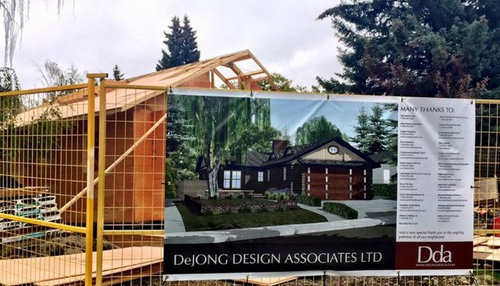
Our house appears to be under constant renovation, so I thought I'd provide a few comments about the process. Over the last 20 years my firm has been involved in many renovation projects, and now we are undergoing our own: our Five Year Plan. My wife is very patient, as are our neighbours, which helps since we have pretty much been in a state of renovation since we started living in our house. Once the new garage and mudroom addition is complete (it seems no one had jackets in the 50’s), all we will have left is the main floor bathroom to renovate. Originally, we staged our reno and started with the windows—they can give any house a new personality—and then moved on to main-floor flooring and trim, kitchen, basement, and rear exterior. This way, we had somewhere to hang out to recoup sanity, before starting on the addition that began late this summer.
Often, when I sit down with clients to establish the scope of work, I find that we are not really preserving anything. This means a new build has to be considered, or the scale of renos dialled back. This is where the owners have to put all their wishes onto the table so they can all be discussed, to avoid “scope creep” (the Achilles’ heel of every renovation). Most older homes have a certain lived-in patina, and when a new element gets installed, the existing parts of the house will tend to look even more worn out… then we start looking at those, and the proverbial ball starts to roll.
Second floor additions can be classic runaways: we often save very little as the entire main floor also gets redesigned. Even a simple face-lift, in which we update the house but do not add square footage, can burn through a substantial budget. Every house has potential, but it should be noted that all the fun stuff—kitchens, bathrooms, flooring, exterior and interior finishes, and windows—actually costs more to renovate than to build new, because we often have to first remove and throw out the old stuff. Removal and dump fees add up fast. Our house had four layers of roofing shingles (our installer said his record is five), so the removal and dumping cost almost as much as the new roof!
Keep in mind that if asbestos, Vermiculite, or lead is found, all of which are very common in pre-1970’s houses, removal can get VERY expensive. If the tents and white suits come out, it will be costly. Also note that the city may require that the owners re-service their house if the reno is extensive (meaning, water and sewer), which is also very expensive (add to the budget +/- $20,000.00). All of these costs have to be considered before owners actually get to build anything new.
Given that budgets always seem to be exceeded, a master plan is essential so that all elements of the project can be reconsidered, or staged. Everything does not need to be done at once but it should all be planned. It is best not to have to undo anything, and a good, comprehensive plan also means the house will not end up looking like it has multiple personalities. The sign of any good renovation is that the old and new integrate seamlessly. Questions also have to be asked about whether we are inheriting bad workmanship, or code-related issues, which can affect the reno: additions built on piles (decks that became part of the house), old wiring that has to be removed, or basements not built to standard, are just a few challenges that come to mind.
A very important part of the process is hiring a reputable contractor. A good contractor will budget and implement your project well, easing your stress. I am always asked about good contractors, and there are many: the key here is a page of references, not just having two or three. Unsolicited references are also good, but always consider the source. Being forthright about expectations and scope is vital—nothing should be left to chance. If it is not discussed and documented, there will be little recourse if the outcome is not as the owners desired.
Keep in mind that most additions not only require a Building Permit but also a Development Permit (basically a blessing of the design); these can average anywhere from two to five months for approval, even before construction can begin. The Development Permit process can be costly, as surveys are required, and the additional fees and time do add up.
Another consultant worth considering is an Envelope Consultant. They, in essence, deal with how a building reacts with water and water vapour; dealing with rain, snow, and ground water sounds easy, but there is a lot to consider. It is pretty difficult to conceptualise how walls and roofs breathe, and, if this is not properly dealt with, it can quickly manifest itself in mould and rot. Calgary’s harsh climate goes through well over 100 freeze/thaw cycles each season, which means a lot of wear and tear on materials. This leads to many instances of envelope failures, which emphasizes that good material selections, construction practices, and drainage considerations are critical.
There is a great deal more to on this subject; however I just wanted to touch on a few points based on my own experience.
Marvin DeJong - DeJong Design Associates Ltd.









Diane Land
Cancork Floor Inc.
Tori Black Homes