Software
Houzz Logo Print
phils_garden

Indoor vegetable garden lighting?

10 years ago

Being just south of Canada I built a small shop that I'd like to double as a hothouse. The south wall is 24' and has three 6' picture windows. What I'd like to do is bring 'square foot gardening' indoors. My thoughts were a number of 2'x4-5' planters to grow lettuce, tomatoes, green peppers, onions, and the more common spices. Also strawberries would be nice. Since it has water and a sink and is heated I would think building the planters and filling them with 'Mel's mix', (SF Gardening), I'd be good to go except light sourcing.

Since they would be in front of the picture windows, what supplemental lighting would be useful? The planters would be in a row 2' wide and since the planters would be 3' up and the ceiling is 8' that leaves 5' from ceiling to soil. The windows are partially shaded so they do not get full sun throughout the day.

Just a question, I was looking on Amazon and saw some LED's that were 600W, 800W, etc. Is that equivalent watts or actual watts? Do vegetables require that much light or is that just for pot growers? :D

Comments (15)

  • 10 years ago

    Thanks for the reply! So if I were to do the 24 feet sounds like 1200 watts total. Not factoring in natural light. At 10 hours that's about a buck a day in electricity. Schematic? Parts list? How do you convert the AC to DC? I have an electrical background but am unfamiliar with LED driver tech.

  • 10 years ago
    last modified: 10 years ago

    "Schematic? Parts list? How do you convert the AC to DC? I have an electrical background but am unfamiliar with LED driver tech."

    The most difficult and expensive part of building your own LED light is getting a suitable heat sink, cooling fan and, maybe, collimator reflector and lens with mounting hardware. The LED chips and drivers are relatively cheap and there are very large selections in Chinese Ebay stores. Sometimes, they offer kits. You can spend days and days shopping for the best deals.

    First, select the LED chip and note the current requirement and forward voltage range. Then select a constant current 120 VAC to DC driver that matches the LED's specification. There are also 12 VDC to DC drivers which are sometimes more convenient because cooling fans are also 12 VDC. Note, that you can often drive multiple LEDs connected in series with a single driver, in which case, the sum of the forward voltage ratings of the LEDs should match the driver's output ratings. Unless they are thermally connected, LEDs should not be operated in parallel because, if one gets hotter than the rest, it will draw more power, get even hotter and burn out.

    To get started, look here:

    http://www.ebay.com/sch/i.html?_from=R40&_trksid=p2053587.m570.l1313.TR0.TRC0.H0.X100W+led+chip+plant.TRS0&_nkw=100W+led+chip+plant&_sacat=0

  • 10 years ago

    Thanks! Sounds like I have so homework to do.

  • 10 years ago

    While you are doing your homework take a look at this thread:

    https://www.thcfarmer.com/community/threads/diy-led-with-cobs-small-medium-and-large-grows.64252/

    While I am using the cool white star LED's so far, I also have a set of blue and red that I will be trying to fruit tomatoes and peppers with indoors... but the site above seems to be the latest thinking on the subject, using the white COB LED's for the whole thing since they seem to cover the PAR spectrum very well and are very efficient. The site above provides full parts lists as well.

  • 10 years ago

    Oooh! Looks like I do have some homework to do! The CREE CRXA looks interesting.

  • 10 years ago
    last modified: 10 years ago

    Well, before you order those Cree CXA's, remember that post was from waaaaay back in 2014 haha! The next generation CXB's are out now and available from mouser, digikey etc. and about 20% more efficient than the CXA's. If you find yourself up late reading LED datasheets like I seem to be, make sure to pay close attention to the BIN's available for any particular LED, it can make a very big improvement in efficiency or color accuracy while costing a bit more. The nice things about the big COB's seems to be minimal or no soldering or need for schematics , just a power supply and heatsink for each.

  • 10 years ago

    I did notice the B's. I'm like you, spending hours over datasheets. Though long retired, the engineer in me refuses to die! :D It does look rather straight forward, almost 'plug-n-play. One thing I noticed on the pot site, he recommended the 100W CREE but recommended the 50W driver. Was that to run them half power to improve efficiency? Longevity? Cooling? Just curious if you know.

  • 10 years ago

    Yes he is all about the efficiency there! Seems most of the serious growers - which all seem to grow pot!- run them at half or some even third power to keep the electrical bills down. Of course you have to pay more in LED's since you need more for given output. My white LED enclosed/insulated shelf system is using 40 Cree XTE 5W leds running at the full 5W. I have them adhered with thermal glue to a sheet of 1/8" aluminum 2'x4' and they don't run much over 100f in my cool basement. I do have a fan wired up that triggers from a cheap thermal switch if they go over 110f and just a light breeze from the fan brings down the temp quickly. It went on all the time when my basement was about 70, but now that it has cooled off it really doesn't go on much if at all. This lets me heat the growing area with the heatsink instead of the little personal heater that goes on when the lights are off. I designed it to work in my basement over the winter at 40f temps. I am probably significantly reducing the lifespan running these so hard, and am not that worried about efficiency for my little grow area, but I sure get a kick out of watching how fast things grow under them and how close I can get them to the top of the plants! I harvested my first spinach, romaine and arugula leaves yesterday that were all planted as seeds three weeks ago!

  • 10 years ago

    That's what I figured. I'm not that much concerned with efficiency since I'd have to heat the building anyway. Right now the radiant heat kicks in at about 4 AM and runs for a couple of hours. If I turned on the lamps and ran the 1.2KW worth of LED's starting at 3 it would act like a small room heater.

    That growth is amazing! And inspiring as well. I'll have to start carving out time between 'honey do' projects. ;<)

    Do you have light baffles that keep the light concentrated on your 2x4 plot or do you keep them close enough that they are self limiting?

    Also, since the CXB's are 33% more efficient wouldn't that 200W for a 2x4 be more like 133W? I'll have to check the data sheets :D

  • 10 years ago

    Hadn't occurred to me to adjust for efficiency so I ran the numbers based on the datasheets and it was startling!

    My
    2'x4' panel of cree XTE led's which I bought on ebay from someone in
    china premounted on stars- i have to assume are about the lowest bin
    number. If that is the case then I am getting 13,800 lumens for my
    200watts of power. Now if by chance they happened to give me the top
    bins (haha!) then that would stretch to 19,800 lumens for my 200 watts.

    I just went ahead and ordered some top bin Cobs for the next section of my station- Cree CXB2530's 3000k (exact bin is
    CXB2530-0000-000N0HU230G) and ordered 900ma power supplies for each so
    running them well below their max of 1600ma. Factoring in temperature
    and current in the datasheets again, I come up with 26,450 lumens for
    the same 200 watts of power! So yeah, that is pretty significant. I lot
    of that difference is of course running the XTE's hard, their low bin
    efficiency, and the CXB's running soft but I am basically getting almost
    twice the light for the same watts in my two different setups!So,
    I am starting to get why our friends the pot growers are doing what
    they are doing and why people are seeking out the top BINS and paying
    more for them than the cheapies on ebay. Really impacts the electric
    bill on larger scales.

  • 10 years ago

    I got out the old excel program and reverse engineered the pot guy's design. Driving the CXA3070 at 50W gives 4000 lumens if he uses the highest output chips. That would say the 200W number equates to 16000 lumens for 2x4. So it sounds like you are in the ballpark.

    If I took the CXB3070 and drove it with their LND600 1.7A driver it turns that I get 8000 lumens. As best I can figure it would be 61W on a 107W array. So one lamp per 2x2 looks right it I'm not mistaken. I think that would get me down to less than 750W for the entire room. My 133 watt guess wasn't far off, (2x61W), for 2x4!

  • 10 years ago

    Thats great! Yes, 3070 is a lot of light in a little space. That was why I went with the CXB2530's, so I could put 4 in each 2x2 area and hopefully get better penetration through the leaves vs. one light. Not as cost effective though I imagine having to buy 4 of these. Still dazzled by my 20 XT-E's in the same 2x2' space and how well each of the leaves are lit up- even sitting just 2-3" under the lights. I have 30 plants in 4" pots under them. Looks like even with the 4 2530's I will need to drop the canopy about 8" below the lights to get a full spread.

    So for my third section I am building using just red and blue XP-E's. Try calculating the Lumens output on that one haha! I have been reading up and trying to do the math to convert the Radiant Flux that colored LED's are rated for vs. the Lumunous Flux that white LED's are rated for but realizing it is not really relevant. Looks like the proper way to evaluate all of these lights is with Radiant Flux since Lumunous Flux does a conversion based on human perception- not light energy produced much less wavelengths that are beneficial to plants. Guess I will go back to just shooting for 25w consumed per sq foot after all!

  • 10 years ago

    So you keep your lamps quite close to your plants? With different plant heights you just go off the tallest? Which colors are you going to buy, far red? royal blue? Will that setup be for flowering only?

    It looks like running the 2530's at 900 mA yields the following: Power looks like 130W for four, about half power for the COB's, and about 17,800 lumens if I figured it all right.

    I did find this, LMH20-8000-40G9-00000TW

    Already mounted and flat lensed, good low and high end, 8000 Lumens. You can buy heat sinks and hoods for them as well. I need to get my behind in gear and build or buy a planter so I can start playing!


  • 10 years ago

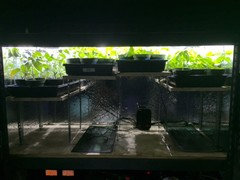
    Not sure how easy this is to see but this is my setup, the first unit with 40 XT-e's. 2x4' and a little over 2' tall inside. The led's are all on the "ceiling" which is a sheet of 1/8" aluminum. So I decided I would make a "flat" light and then bring the plants up and down into it as they grow if that makes sense. So 4 shelves of 1x2' that are pegged into steel strips with holes attached to floor and ceiling of box. Can move down in 3/4" increments as they grow. I move the pots around so that each tray has similar height plants. I have been keeping them only about 2" below lights. Only damage I see to leaves is once in a while something will grow fast and touch a LED and get burned.

    So yes, the second unit I am building now will be intended for flowering/fruit and experimenting in general. Same 2x4' box size. Same sheet of 1/8" aluminum heat sink. 2x2 will be the Red/Blue leds, 2x2 will be the COB's. Will grow the same plants (tomatoes and peppers) already started under white in each side and see how they differ. Yes, the reds are 660nm and blues 460nm. 6 modules of 8 red and 2 blue led's. All XP-E's running at 650ma. I also have 10 XP-E2's in white that I am putting in on a separate circuit so I can flip the switch and see the plants in normal colors. Thinking I may play around with leaving the whites on with the reds and blues as I have read the broader spectrum can help.

    Yeah, that premounted COB with lens etc. looks like that would be best for your setup. Check out HeatsinkUSA if you need heatsinks. I didn't end up ordering from them but they seem to be recommended a lot and have great prices.

Sponsored