

Our garden will need another generation
Which it may not get. So far we've put about thirteen years into our property; the bulk of the big garden dates from 2007 and later, and we're still doing basic planting. A few days ago a man came with a small excavator and dug us 112 holes. The soil that came up with mostly stony clay, with some purer clay as well (no loam: that's why the holes). The clay that got dug up sat in the warm sun for a few days and is now adobe, and is quite a job to amend and put back. We're trying to insure against future landslides with our planting: oaks, hazelnuts and flowering ash are all deeprooted, but most shrubs help, even the handsomely taprooted alfalfa. Even weeds. I continue my researches into basic hedging shrubs. Privet is still fine, but I'm beginning to notice how much of it I've planted, and am looking about for other possibilities: photinia (a recent favorite), hazelnut, mock orange, kerria, cotoneaster, shrub honeysuckle, lilac, spirea, forsythia, laburnum (on order for this fall, and we dug up some wild suckers) and the recent discoveries weigela and oakleaf hydrangea. All common as grass, but they must be procured, the holes dug and amended, the plantlets planted, and then watered for a year. And with, and following on, the shrubs, come the trees. Oaks specially, but also flowering ash, which is native and fast growing, looks good, roots deeply, and doesn't get huge and threaten to shade out great swathes of the garden. Fruit trees, about which I need to get more organized. And of course the roses. It's terribly late to put out an order this year, but we can still collect suckers and cuttings to plant in the propagation beds and grow on for next fall.
What we've been engaged on all these is years is the heavy job of transforming a piece of hardscrabble ground into a garden. Not necessarily the best designed garden with the most desirable plants, but a place that has soil that plants other than weeds and brush can grow in, with sun and shade, air and protection from wind, a healthy amount of organic detritus feeding back into the soil, and large plants whose roots will prevent landslides. Also a place that's beautiful and has a very fair variety of plants, but in a way that has been secondary. This garden will need another generation, which of course I can't guarantee it will get.
In another decade, if we can finish basic planting and continue maintenance and if no major disasters strike, we will have a healthy population of young, long-lived oaks and other trees, mature shrubs, a firm architecture of hedges and walks, and, perhaps, a growing population of herbaceous perennials, bulbs, and self-seeding annuals. At this point the refinements (supplied by someone else) could begin. I could see a hypothetical future gardener, say, twenty years from now, cursing all the ratty overgrown privet, lilac, and mock orange, and working on a plan to cut down some of the young forest of oaks, because--I suspect--the moment at which I decide I have enough oaks will be the moment at which there will prove to be too many of them. This future gardener will have enormous tasks of shrub removal, replacing banal ordinary plants with a selection of more unusual and diverse varieties; s/he'll have a mountain of renewal pruning; s/he'll find enormous room for improvement in every way. But this gardener will be working on a GARDEN, an already existing garden, with the enormous advantage of not starting from zero.
Comments (31)
 10 years ago
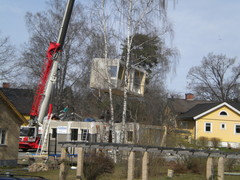
There will be no future gardener in our garden. My husband is sure our house will be demolished when we leave and I think it probable. It is very small and sits on one of the larger lots on the block, a half acre, worth far more than the house. Not large for American conditions but in this village it is. We share borders with five neighbors and lots around us are divided and new houses spring up, almost overnight. Last year a house was plonked down in pieces by a crane on a small division across the street. On that spot the old lady who used to live in the house to the left had a very large and colorful island bed backed by a boulder. We watched the boulder being blown up.
I don't feel sorry that our garden will disappear. It's so personal that I don't think it will be left intact even if someone should buy the property to live on it. There are too many trees, both fruit trees and native trees and far too many roses for a suburban garden. This old village is now a commuter suburb and very fast growing. I am more sorry about that change and the loss of charm than I am about my own garden. At the same time I know that more housing is needed.
22 April 2015 from my kitchen window:
 10 years ago
Mariannese, I feel the same thing will happen to my garden, for the same reasons. My daughter is married and permanently based overseas, and my son and daughter-in-law, while gardeners themselves, do not have the same love of roses that I have, or the time to maintain the garden as it is. When my husband and I have gone, I hope that my son will offer access to the garden for any garden clubs or individuals to take cuttings or plants, before the developers move in, but fewer people are interested in ornamental gardening here these days so our garden will be history in photos only.
Melissa, 40 years ago, I would have paid a fortune (if I'd had one) to have a chance of continuing to maintain and develop your garden or one like it :)
Related Professionals
Clarksburg Landscape Architects & Landscape Designers · Springfield Landscape Architects & Landscape Designers · Hilo Landscape Architects & Landscape Designers · Pine Bluff Landscape Contractors · Effingham Landscape Contractors · Madison Landscape Contractors · Everett Landscape Contractors · Hot Springs Home Builders · Jonesboro Home Builders · Middletown Home Builders · Louisville Home Builders · Anderson Home Builders · Bangor Home Builders · Fresno Home Builders · Helena Home Builders 10 years ago
We plan to be buried on our land. And I have finagled some continuity because all the offspring have invested much of themselves in the land - building ziplines and cargo-net platforms ( treehouses and walkways next), keeping beehives, cabin building, willow growing for basketry, building a field kitchen and cob oven and, of course, playing/gardening. And your daughter, Melissa, just from the osmosis of lived experience, will have that piece of land rooted in her being too - your garden is more than just the physical embodiment of soil and plantings, it exists as mind, spirit, imagination and will always exist, even if only in memory. But, for now, you are living in tree time (I am too) - a hugely different time scale than the usual sleep, creep, leap cycle. We (laughingly) made 5year, 10 year and 50year plans, on the advice of Forestry Commission and Woodland Trust advice...and have the priceless knowledge that our garden, unlike the obviously temporary urban garden and allotment, has the promise of maturity. I hesitate to assume that you might do also, Melissa, but I certainly feel some weight of responsibility to the landscape, hence less of my usual slapdash and easily bored garden experimenting and an attempt to be a serious student of the ecology and environment... those tiny samaras and berries grow into huge habitats, printed on the landscape for hundreds of years.
- 10 years ago
Melissa, it is interesting to hear about that issue (the future of your garden) from the "first generation" perspective. We, as I am sure everyone is tired of hearing, are the fourth generation of gardeners to garden on our 1/3rd acre lot near the downtown of a 50,000 person town.
I would like to think that the three generations who came before us are happy. I know my FIL was - when I married my DH and we moved in to this house, he had been the gardener for about 20 years (it was a rental during that period, but kept in the family because Germans, or I should say at least my DH's German ancestors, did not like to divest real estate). My DH had no interest whatever, and I had never gardened. My FIL walked me all over the garden and identified almost every plant for me (I was taking notes), and told me who planted it (himself, his parents, or his grandparents). He was a true gardener, and lived with my MIL about 5 blocks away (where he had personally built a 1/2 acre garden of mostly raised beds on a rocky hillside). So, he had been able to stay hands on re our garden, as he was the landlord. He talked about the plants as if they were his friends, and pointed out the ones which had been particularly beloved by his mother (both his mother AND his father were avid gardeners).
Anyway, when I got interested and started learning about the roses (of which we had about 35+ which had survived - my FIL was not a believer in babying plants), he was so happy, if a bit shocked at my extravagance in watering them and feeding them as much as I did. Between his German ancestry and having grown up during the Depression, he was very "careful" with his money, although he actually had plenty of it at that time. He had been collecting water in large barrels all over his and now our property to water the gardens - ahead of his time.
We are so lucky. Our 1905 house is on the City's list of historic architecturally important buildings, and so is protected a bit from future destruction. However, we have no children, and I am sure someone will purchase it at sometime in the future and change everything. I am just happy to have been able to protect & enjoy & I hope enhance it during our watch.
Jackie
 10 years agolast modified: 10 years ago
You never know.
My Dad planted a very personal garden on two acres in western Pennsylvania. He worked on it for over 50 years until the very end of his life. Some of his early plant selection proved to be mistakes and he removed them in his 70's and 80's -- weedy Siberian elms intended as a windbreak, a long hedgerow of Rosa multiflora, and a double row of pines planted too closely together. Still he reveled in the work.
After his death my youngest sister sold the property. We all fully expected the rundown house to be bulldozed and replaced, and the overgrown property to be split into two lots. However, the purchaser was the grandson of the farm family from whom we bought the property back in the early 1960's. He and his wife repaired and fixed up the house. When he gets home from his day job he raises animals at the family farm next door. And their young daughter finds my Dad's labyrinth of planting to be an enchanted kingdom. Yes, they took a few plants out, but the bones of my father's garden continue much as they did in his lifetime.
Rosefolly
 10 years ago
We have about 10 more years in this house. We will then be retired and possibly moving to a different state, but certainly to a different home. This house/yard will be too much for me to care for at that age. I'm sure my house will survive, it's in a fairly new neighborhood. But I am sure the new owners will not want to care for 150+ roses.
- 10 years ago
I thought we'd leave this house 10 years ago once the kids were all grown. The house is larger than we now need, and the property is much larger than I want to maintain. But my DH loves this place with all his heart, so we are here as permanently as one can predict.
There certainly are worse situations. There is a lot about the place I love, too. One might change and have regrets.
Melissa Northern Italy zone 8
Original Author10 years agolast modified: 10 years agoThe notion of moving from one home to another is rather foreign to me. People are diverse: for some that's normal, but I grew up in one house, the one my father built when I was born and lived in until his death; and this is my permanent home, at least as far as my heart is concerned. I may well have to live somewhere else in my old age, but I doubt I could call any other place home in the way I do this one. This is in spite of my discomfort with many aspects of Italian society and various inconveniences of my life here. I think I would be bored to death if I didn't have some kind of a garden and considerable contact with nature.
I don't know how the garden will be even ten years from now. DH is eighty, and I, though reasonably fit for my age, am not a muscly person. DD is extremely busy with her own projects and will be going off to university in a couple of years. I think it's unlikely she'll come back to live here full time: her interests and talents are likely to lead her to life in a town environment, and this is emphatically the country. I don't even want her to live and work in Italy. Corruption and illegality, favoratism and incompetence are so rife here, and the economy is so weak, that I doubt she could get a job appropriate to her merits. This is not a country for honest people. I think DD is going to be good at whatever she decides to do; I want her to have the pleasure of unfolding her talents and being rewarded for doing so. Naturally if she did decide against all the probabilities that this is where she wanted to live, I'd be overjoyed.
The garden covers perhaps one hectare, but there's another twelve hectares to our property, which is an old farm. The rest we leave as grass and woods. The previous owners cut most of the woods before selling, and leaving them to grow seems an environmentally reasonable decision. We have the grass cut and mulched once a year, so it goes back to feed the soil. We get a government subsidy for maintaining the grass and not letting it go to brush. The garden is my entertainment. I figure that, while on the one hand I'm growing exotic plants (ecological no-no), on the other hand I'm growing a generally environmentally responsible garden, and figuring out--if anyone were interested--how to do so. 99% organic (1% poisoning the elms and recently I've started sprinkling a bit of urea over amended holes), soil amendments from local sources, most of it waste material if we didn't use it (we're the only people around who have a need for spoiled hay). No watering after the first year. There is the considerable plus, as I see it, of improving the soil so that it can support bigger plants. With trees and shrubs replacing thin grass and weeds, the ground is better anchored (believe me, this is a serious consideration), more water is retained in the soil, reducing flooding, the air is cooler in summer, more carbon gets sequestered, more oxygen produced. Our township has some of the most polluted air in Europe; I figure it needs all the pure air it can get.
(And our *!ç#*! neighbors have PLOWED the field below the newest part of the garden. Their field half of which slid last year, pouring hundreds of tons of earth across the communal road below, and part of the remainder of which has slumped, the slump extending onto our own property. DH halted it last spring by building a barrier of large-diameter rebar and planks, then bought all the hazelnuts the local nursery had, planted them, and watered them all summer. I sure hope his efforts, along with the line of young lilacs we planted on the property line and the young self-seeded oaks are enough to hold the earth. I sure hope the entire hillside doesn't go, taking much of our garden with it. Our neighbors' entire lack of interest in preventing landslides, of which they've had several, baffles me. The ground is their livelihood after all.)
I have a friendly, not sure how well-informed, interest in the environment. I encourage a diverse population of native plants in the garden: all the little herbs in the grass; the handful of garden-worthy native shrubs and trees. The pleasure woods are the focus of my active attempts in this area. We've been working in this strip of woods for about three years now, clearing brush and ivy and cutting down fallen trees and, when the ground is ready, planting mostly native bulbs and woodland herbaceous plants and shrubs. Our plan here is to stick with mostly native plants and keep the wood as a wood, but a pleasant one: our own little Forest of Arden. I do love plant diversity; I love a good tree. Also cleaning up our predecessors' dump was constructive.
I was thinking of Jackie's multi-generational garden as I wrote my initial post. Such gardens are rare; fortunate is the passionate gardener who comes into possession of an established garden with room for development. This one won't get turned into a housing development. We're in an agricultural area with building restrictions, and anyway rural properties are a glut on the market here; with the difficulties of transportation and school no one wants to live in the country. I think it would be quite possible to find a buyer, probably English or American, for the property one day, but then, where would I go? It's a problem I don't have a solution for. And I have a deep-rooted, illogical belief in the importance of owning land.
DD has grown up in the country, liking it; currently she knows nothing else and so she takes her life here for granted. Her interests and activities don't require land or her being in the country. She might appreciate the cultural stimulation of a city. But if she spends a prolonged period surrounded by concrete she may discover that nature is important to her. Still, she doesn't have deep ties to this area, and I think she's likely to have a better life in most senses somewhere else. I have a grudge against Italy that I feel compelled to send my daughter away from it and from her parents for her own good.
P.S. Paula, I like your happy ending very much, and the reminder that these possibilities do exist. Land needs to be loved, and too often it isn't. I think Suzy is saying that as well.
- 10 years ago
I have this conversation with a number of my gardening friends--and also with friends who have a nice things like china, crystal, furniture that their kids don't want/already have enough of their own. I have no kids and this is an advantage in the future of my garden. I have no obligation to anyone and can pass my property on to some young person who I know will care for it. S/he will put their own stamp on the garden and the house, as I have done, but the spirit will continue, the wildlife will still find this to be a safe zone, the grand old oaks will stand and cats and roses can go on living here.
- 10 years ago
Melissa, thank you for the eloquent discussion of your property. I hope your husband's efforts are successful in minimizing the effects of your neighbors' poor land ethic. I think gardens are works of art and time, and can disappear easily, but willingly allowing topsoil or whole slopes to erode away is unethical.
I'm the third owner of my current half acre property in Eagar since the house was built about 1984. When I arrived here seven years ago there were four grown apples and two big cherry trees, with a very sad straggly bluegrass lawn underneath, a veggie plot with a modern rose, a rose of sharon, and a butterfly bush along one end, a lava rock front terrace supporting a small strip of struggling bluegrass, a nice bluegrass back lawn with three aspens along the south side, and a big alba or alba hybrid on a slope just outside the back lawn. The property edges and "front yard" were still in the native pinyon-juniper-blue grama vegetation, with occasional tulips, iris, hardy salvias and an ornamental almond bush scattered around.
So, I show up with some big dogs and interests in fragrant plants and range ecology. I pulled the almond out of the grama grass into a pot, and killed it in the process. I stopped mowing the native grass until winters, to increase the vigor of the grasses and wildflowers. I put a dry border in the grama grass, with apache plume shrubs, penstemons and such. The lava rock sloped terrace is turning into a rock garden dominated by hardy ice plants. The dogs destroyed the nice grass in back, plus any fencing and most planting I tried there. I switched to gravel in back and the front terrace yard. The aspens died for lack of lawn water. After two years of no cherries I had a neighbor cut out the cherry trees and one sickly apple, and restored the side lawn. I did plant two semi-dwarf apples to replace the sick apple. After the Wallow fire made us evacuate, I had two or three big junipers cut out of the front. One of my neighbors misses the cherry trees, but I prefer having enough sun for a small lawn, and I'm working on surrounding it with roses and perennial beds. I finally found that the dogs couldn't defeat five foot welded wire on t-posts, so now I'm working on roses and perennials along the back yard perimeter, with leaky hose irrigation. I'm putting three maples of two species in the gravelled back yard, each fenced off from the dogs.
The two owners before me might not recognize the plantings, and might not agree. Owners after me will probably alter what I am doing. Actually, all you have to do to get rid of virtually all non-native plants here, except Siberian elms, full grown apples and lilacs, is not water for a year or three. Grafted roses die out without special care, and you don't even see many "Dr. Huey" bushes. Most old roses in town are own-root hedges bordering lawns. My alba rosebush almost certainly does not pre-date the house, and was being watered along with the back yard grass. There is an old abandoned house in town with two old roses slowly dying for lack of water. I don't understand why roses die here so easily, when in California's Sierra foothills there were hundreds of old roses surviving six months of drought each year. I have learned I have to water roses occasionally in winter, even as cold as it gets here.
 10 years ago
We've decided that we want to live here in the country on this particular plot of land until we die, although often one can't control these things. Our only offspring, my husband's daughter and her family, live in the city and have no interest in country life or gardening. The house and garden will go to strangers and I wouldn't be surprised if they rip out every last rose, thinking that it's all too much trouble. I hope by that time having a lawn here will be forbidden because of the water shortage. I don't want to think of what will happen to this place after we're gone because most likely it's going to be something that we would not have chosen. Still, that's all speculation. I imagine as we age taking good care of the garden will be less possible but hopefully we'll have at least some semblance of what once was, if by that time global warming and water restrictions have not changed everything beyond what we can now imagine. Nowadays I try to live for and enjoy every day because thinking too far into the future has become too frightening. The garden keeps me diverted from season to season, and my thoughts are about what's happening now and what my hopes for next spring are. Like Melissa, I need land and nature around me. I have lived in cities but had to escape to mountain wildnernesses on a regular basis to keep me going. I'm not able to hike any more or camp at 10,000 feet, but for my needs this place has enough of nature to keep me happy for the rest of my life.
 10 years agolast modified: 10 years ago
I bought a book about fruit which can be grown in Florida, for my eventual move down there. One of the profiled fruits was jaboticaba (Plinia cauliflora), which is known for being very slow to bear when grown from seed -- needing a good 20-30 years. Included was a little Brazilian folk tale about it, going something like this:
A young man came across an elderly man who was clearly not long for this
world, and the ancient Brazilian Johnny Appleseed was planting
jaboticaba seeds. "Are you crazy?" The young man exclaimed. "Don't you
realize that you won't be around to eat the fruit?" The old man paused
and calmly explained, "If everyone thought like you, there would be no
jaboticaba fruit."Remember that when working on something that won't "bear fruit" for quite some time, and kudos to you for making the effort.
:-)
~Christopher
Melissa Northern Italy zone 8
Original Author10 years agoGenevre, does it have to do with annual rainfall levels? We have a regular summer drought, too, but our average annual precipitation is about forty inches. Good luck with your garden!
About passing things on, at least china and crystal aren't alive, and if their current owners love them, they have the comfort of knowing that their valuables will be appreciated in the future. There seems so much waste in gardening, but, there it is. I would like this property to fall into the hands of owners who wouldn't abuse it, anyway. And if they appreciated the treasure trove of the garden plant population, so much the better. You sound like you know what you'll be doing with your property.
You said it, Christopher: that old man knew what he was talking about. I actually lived that same anecdote. Perhaps as a culture we need to cultivate a greater long-sightedness. "Garden as if you were going to live another eighty years" has my fullest support.
I wouldn't be surprised to find that gardening magazines have real estate sections with houses with special gardens.
Good luck, Ingrid. By the way, compliments on your photos in the show-your-roses thread. I went back and noticed how good they were.
- 10 years ago
Speaking of passing along beloved possessions, my kids won't want my books, my small collection of (working) vintage sewing machines, or my garden plants. That is okay. I don't want their stuff either! When the time comes I will slowly divest myself of things I don't want. I already weed my books on a regular basis so that my personal library does not become unmanageable, and I have downsized my garden due to the drought. I've have set a limit of a dozen on the sewing machine collection size, quite modest for collectors. I care most about finding homes for the dogs should they outlive me. But honestly, I'm planning on outliving them.
Rosefolly
 10 years ago
We bought a rental house 3 doors from us which we dubbed "Rose Cottage" as it was built by a family with the surname Rose in 1945, we were the second owners. At Christmas, Birthdays and Mother's Day the 4 kids would pool their money and buy their mother a rosebush, so the yard was full of roses, mainly hybrid teas. We took good care of the roses the 12 years we owned the house, even with tenants. We sold when the CA market peaked in 2005, with offers over asking price. We finally chose a young couple who wrote a letter saying how taken they were with the roses and how they loved them so. They moved in and must've taken every living thing out of the yard with the exception of a very well pruned mulberry tree (pruned with good shape and large top knobs). I would not let tenants prune that and would cut each year's growth off with loppers. Anyway, the years of roses were not appreciated. Must be karma as they were foreclosed upon when the market crashed.
- 10 years agolast modified: 10 years ago
We have 2 acres of water front lake property that we plan to pass down to children and future grandchildren with a no sale clause lol. The property had established plants and trees when we bought it over 15 yrs ago but we have also added dog wood trees and so far over 30 roses. I am keeping a journal of what we plant and why we planted that particular rose or whatever it is so that future generations will have some kind of connection that grandma or great grandma, etc planted this Mrs. B R Cant (or whatever else rose or plant, you get the idea), and it hopefully will have some kind of sentimental meaning to them. I know I might not be realistic but that's my hope anyway that future generations will be able to enjoy what I planted and the beauty it adds to the lake.
- 10 years ago
Melissa, you are very likely correct about the different precip levels' effect on rose survival in Eagar versus the Mother Lode. Eagar's 22 inches is just over half the rain and snow average for Sonora, CA, though spread through nine months as opposed to six months for Sonora (thank you, weatherdb.com!). Another factor may be wind. Sonora was the least windy place I've ever lived, while Eagar sometimes sets the American daily record for wind velocity. I do wonder if tea roses are more drought tolerant than ones with more old European species DNA. I remember a huge old bush of "Gold of Ophir" along Highway 49 outside of Angels Camp, and other varieties in the Columbia Cemetary, all doing well despite no added water and some drought years.
- 10 years ago
Huh, a no-sale clause. I hadn't thought of that :) I'm gardening on 3 acres of mountain property with 2 houses, the one we use and a vacation rental. Maybe I could do something like that, though the kids may curse me forever, it is far fem everyone, but 2 aren't settled for sure yet and the other will be about 10 hrs drive.
Melissa Northern Italy zone 8
Original Author10 years agoFor my part I wouldn't limit what my daughter could do with this property, should she inherit it (I might have to sell some day). It would be better off in the hands of an interested stranger than in those of a child who didn't need or want it and for whom it would only represent a burden. I see this is a topic that a good many forum members have on their minds.
I think that our economy's demands for worker mobility are bad for gardens, among other things; also communities, in the sense that people invest less readily in place where they don't think they'll be permanent. How much is a person willing to put into a town, a home, a social circle, when s/he knows that in ten or twenty years s/he'll be moving on? How much of a local culture can develop when people come and go? It's not good for families, either. This is to be balanced against the dangers of stagnation and resistence to change in a too-fixed local population.
Genevre, Rosa gallica and R. canina grow locally and are obviously adapted to our conditions. The European once-blooming old roses, descendents of our wild species, do perfectly well with a summer dry period that generally runs from two to four months.
I love the sound of your garden, Valerie.
Well, off to plant some roses.
- 10 years agolast modified: 10 years ago
I was mostly joking about the no-sale clause, you never know what life holds so who knows what eventually will happen to my beloved lake place. Although my daughter has said she hope it stays in our family forever and while that is a nice thought, I know that life happens and things change. It is just my hope that the lake place is somewhere that future grandchildren, great grandchildren etc, will enjoy spending summers at the lake and maybe notice my roses :)
- 10 years ago
Re "no sale" clauses. At least in Tennessee they work. The farm we bought had such a clause dating back three generations that forbade the sale of the farm as long as family had children to inherit it.
They were able to sell when the only two children were no longer of child producing age.They had used it as a summer house, and had family in the area (the selling off / splitting up of parts of the farm were the probably reason for the clause).
Their marginally benign neglect is one of the reasons why "top soil" is only a memory on parts of this property. And we did ask of the surviving family if they wanted the land before we made an offer.
- 10 years agolast modified: 10 years ago
Valerie, I really enjoyed your post. It's not how big our gardens are, it is how we garden the plot that we have. A smaller garden can sometimes bring more pleasure than a larger one that exhausts the gardener. And by having that little garden, you are probably more likely to make it to 100 than if you had no garden to work. Long may you dig!
- 10 years ago
Thank you rosefolly. I think I just loaded a pic of my little place. It is from two years ago.
- 10 years ago
Sorry, for some reason it won't load. I will try again some other time next spring.
- 10 years ago
Hi Melissa,
when I was still gardening on my 100 square metre rooftop terrace in Rome, containing among other plants about 70 mostly OGRs and some Austins, I used to follow your always interesting posts on the forum of compagniadelgiardinaggio. What you said in this post has so many parallels to my own experience that I just decided to add my little comment. Losing or giving up a garden, even a pot ghetto, is never easy for an appassionate gardener as we all here are supposed to be, but I finally did it, out of concern for the professional perspectives of my two sons who didn't want to leave at first but were convinced by the impossibility to find a decent job as IT engineer and economist. Since 2012 they are building promising careers and are happy, one in my native Germany, the other one on the French Riviera. In the same area and similar climate as Rome, at about 50 km away, I was able to buy a small house with a big garden. Before selling my Rome appartment, I saved at least 30 of my most beloved roses, but some beautiful lemon and olive trees as well as a magnificient Chorysia sadly had to be left behind. The roses are now happily growing and many still blooming in the soil of Provence and 30 new ones have just been planted. My sons took both some plants from their old home too. Maybe this means good hope and continuity for my new garden as well.
- 10 years ago
Eve79540, I liked your story. It is a happy blend of practical reality with the continuing of a garden.
Melissa Northern Italy zone 8
Original Author10 years agolast modified: 10 years agoeve79540, that's very interesting! I certainly do wish you continuity and success in your new garden, and for many years to come. When you speak of parallels, do you mean perceiving a need for your children to leave Italy in order to have decent careers? I'm glad the move worked out for your sons, and that you're living close to one of them. A success story for gardening and families.
P.S. Your garden sounds like it is, or is on the way to being, fabulous.
- 10 years ago
Yes, Melissa, that's what I meant. The garden belonged to an elderly couple who had planted along the borders of the propriety a beautiful Viburnum hedge on one side, Pittosforum on the north border contiguous to a vineyard, and alas, 30 really big Leylandii along the border that gets all the morning sun until 1 p.m. I plan on making space for mostly climbing roses interspaced with Laurus nobilis and Eleagnus there. The garden itself was half English lawn (~ 700 m2) and half a gravel parking lot for the husbands collection of 3 or 4 cars, and a mobil-home, in front of the house. From April to July I was busy taking away the gravel and digging a hole for a water feature, no swimming pool, 6mx1,65m 90 cm deep, to remain under the tax-paying limit of 10 m surface. A neighbor did the masonry, a perfect job. I've started planting Mediterranean plants, mostly Lavander, Cistus, ecc. and roses, together with an Apricot and a Nectarine tree for my boys. Thanks so much for your good wishes which I reciprocate. Will keep following the forum, always enormously enriching to me.



onewheeler