Software
Houzz Logo Print
kevmo911

How do you grow tomatoes down here?

10 years ago

Here in central NC, zone 7b, my tomatoes went out toward the end of April, all in 5 gallon buckets. Maybe 30 plants in all. I had started them inside in mid-February. That was too early, as they got too big, too fast. Lesson learned, next year I start closer to April.

I acclimated them for a couple weeks, then put them out full time. They grew quickly, and I staked them with 6' bamboo. City (yard waste) compost, worm castings, rock dust, peat moss, and occasional compost tea, with wood chip mulch.

They started fruiting, and it looked like I might have a really nice crop. I battled some blight with baking soda, no big deal.

But I erred in placement, I think: full sun. And then it got really hot, really fast. In my area, the month of June had 12 days of 90+ heat. And July through August was pretty barren. Minimal tomatoes, though cherry varieties did a bit better.

I got frustrated, and while I kept watering, I stopped treating with baking soda, so blight did a bit more damage. And then, once it started cooling down, !voila!, new tomatoes. Not a lot, but more than in the summer. Heck, it's November 20th, and there are a few plants with flowers (global warming is creepy).

So, here I am, planning for next year. More raised beds will be going up, specifically for tomatoes. But where? The back yard is less than ideal, so I'm doing front yard gardening (no HOA, fortunately). There are a few trees that I could use for partial sun. Or I could rig up a sunshade of maybe 50%, which would hopefully bring the temperature down enough to keep the plants fruiting.

My diagnosis is too much sun, bringing too much heat (although the space-limiting buckets likely didn't help matters). Am I right? Wrong? Sort of both? Anyway, any and all thoughts, advice, and criticisms would be appreciated.

Cucumbers, by the way, shared the fate of the tomatoes. Most peppers stopped fruiting for a while at the absolute peak of heat, but were definitely more heat-tolerant than the tomatoes, and I got a really great crop of hots and sweets. But most stopped completely when the weather started getting cooler, though some sweet peppers continued.

Comments (22)

  • 10 years ago

    I set plants out in open soil after April 10th. My garden gets mid morning thru mid afternoon sun and they seem to do OK when I manage to make some effort to add some decent cow manure. I had never considered that an early pick might help the plant, but it certainly prevents the fruit from going soft from the excessive heat if left on the vine like I would in California.

    In spite of my manure comment, like John, I suspect that you are over fertilizing. I did very poorly this year that I attribute to poor manure (for tilth + fertilizer) addition. My neighbor did well in his raised, well tended bed.

  • 10 years ago

    Hmm. I'd never considered that I may be providing them with soil that's too rich. Regardless, though, I don't get the growth that John suggests would be the result of rich soil, so that's an issue I think I'll deal with further down the road. And I don't have much wiggle room as far as reducing soil content goes, as all the soil I'll be using is compost based. I suppose I could not add compost tea, but that's about all I could do.

    Chas, you say you get decent results with partial sun, although in your situation, that's the hottest part of the day. And I have neighbors that are in a similar situation as yours, yet they're able to grow. Perhaps it's something as simple as not enough water, or that buckets are too confining. I'll have to do some more thinking about what I'm doing wrong.

    Either way, I'll pick up a couple heat-tolerant varieties for experimenting. Sioux tomatoes is one variety I remember looking into.

    Next year I'll be using primarily seeds from tomatoes that I grew, so, theoretically, they'll be better adapted to the climate. I don't really believe it will make much, if any, difference. But a guy can hope :)

  • 10 years ago

    Are you saying that you don't have any land with dirt? Actually, first off, many people have complained that tomatoes grew poorly over the last couple of years. Mine certainly did poorly, but I attribute my difficulties to lazy attitude with poor attention. I imagine my successful neighbor probably used a mix of compost and soil in his bed. One aspect of excessive fertilizer is extra leaf growth that may not stimulate fruit/seed set (we're growing great, no one's gonna die; lets party). I hear that extra heat also decreases or stops fruit setting. I would also guess that humidity may be an issue. Most tomatoes in the US are from CA where we have never even heard the term dew point.

  • 10 years ago

    Well, most of my dirt is about 2 or 3 inches of black gold on top of solid orange/red clay. And I have a *lot* of buckets with the compost/peat/stuff mix that will be going into raised beds when I build them.

    As far as I can remember, the plants stopped producing fruit and stopped growing altogether at about the same time. They were 5' tall, give or take. I clipped or tied suckers to the center stake, so the plants were far more vertical than bushy.

  • 10 years ago

    OK, I would guess that it isn't a Nitrogen fertilizer issue anyway. Otherwise, I am not an expert on growth. However, I would still suggest growing in amended clay. When I first got to NC, I wondered how anything could grow in clay and wondered why Carolinians weren't two feet tall with distended bellies. When clay is amended with compost and other carbon based stuff, it gains air pockets etc and roots can grow into it. It turns out that the clay holds both water and micrnutrients better than other materials allowing less need for continual fertilizer and water additions.

  • 10 years ago

    An old time pro here who has grown tomatoes in various climes, north and south, over the years. Since retiring to the NC Piedmont area I also encountered container tomato growing difficulties, which I solved. Some suggestions that might help...

    I now only grow three bulletproof delicious "heat' tomatoes that set fruit in 100 degree temperatures.

    1. A Yankee introduction exclusive to Harris Seeds named Moreton Hybrid. Check Harris catalog. It was always my favorite when we lived north and I was very surprised at its productivity and heat resistance in the deep south, GA and SC.

    1. Another indeterminate from Russia seldom mentioned and held close by Texas growers named Yasenichki Yabuchar. Terrific taste! Hopefully you can find seed as mine is already committed.

    3. It is with caution that I also suggest the Florida Everglades tomato which will grow anywhere with vigor. Seed spreads over the neighborhood thanks to birds. It is basically a tasty weed, tiny small grape size fruit. Perfect for salads. Only grow one plant as it will 'own' you forever sending up new spring seedlings in strange places.

    More thoughts later re soil, fertilizing, etc.


  • 10 years ago

    I save my seeds, so I keep to heirloom and OP varieties. And I've got a couple cherry varieties that I might be able to coax into being more productive. But I'm looking into the Yasenichki Yabuchar, as well as Sioux (or Super Sioux?) and Homestead 24. The only place I can find that is selling the Yasenichki seeds is a small seller in Canada. Any suggestions on who might have Yasenichki seeds and be willing to part with a few?

  • 10 years ago

    kevmo911, I've waited to answer until you came to the conclusion that the issue might be the constriction from growing in 5 gallon containers. In open soil, tomatoes set off three or four wide spreading roots as they search for the soil nutrients they prefer. The roots are also like anchor roots of trees since indeterminates take a much longer growing season and can grow enormous if they have something to lean on. If not supported in some way, they run the ground and set opportunistic rootlets along their stalks.

    In my case, I run the far stalks (far from the orig. planting) through a trough of water with some very mild fertilizer in it. That kept the distant fruits growing and setting more flowers. The original spring/early summer growth gets attacked by a mix of blight and atmospheric pollution but by then, the newer fruits were setting more than 6-8' (yeah, feet) away and feeding off the trough water.

    I just fill a long planter, sometimes just a dishpan with rainwater and some slow release granular food and run the stalk through it. The soil where the tomato was planted may be hot and dry but the moisture is taken up by the rootlets along the stalk running through this mid-point water/food source. 2012 was the year we had the stretch of +100 degree weather and almost painful sunshine but the tomatoes survived and actually thrived.

    My Dad taught me never to scrimp on soil, in other words, to give at least three feet between tomato plants and between the rows. Let the good soil provide what the plant needs and use those 5 gallon buckets to catch thunderstorm water (put netting on top to keep the mosquitoes out).

  • 10 years ago

    In my defense, I did suggest that using planters wasn't ideal, and said I planned to use raised beds next year.

    I think I'm going to forego running stems through troughs, and try a bit closer together than 3 feet. We'll see how things go next season.

    Since the buckets all have drainage holes, using them as rain catchers would be problematic, but I do use other containers for rain catchers, so some rainwater does get used.

    As it stands, my current plan is to grow tomatoes in raised beds 12-16" deep, substituting heat-tolerant varieties for some of the poorest-performing ones. I'll be installing drip irrigation, rather than watering by hand (garden hose) in the evenings. I'm going to keep to my rich soil and woodchip mulch for now, as I'd rather change up just a few things at once. Thanks for all the ideas!

  • 10 years ago

    Well, that's good you'll be using a covered soil watering system. A good moisture meter might be useful.

  • 9 years ago

    I just searched and found this thread to see how you'll grow tomatoes in Carolina and what are the challenges. The thread was not active in 2016.

    I will come back to do more reading and familiarize myself . And I may have some comments and suggestions for 2017 season.

    Say

    I

  • 9 years ago

    Well I'm glad you revived it, because I hadn't noticed it before. I found nandinas post to be informative and I may give those tomato varieties a try next year.

  • 9 years ago

    My neighbors' or maybe composted grape tomatoes reseeded and appear every year. I mulch and water once in a great while. They are now flowering after the drought for the past couple months. I cage and stake but don't prune or fertilize much. They are freebies. I don't get a lot but they are much easier than the large heirlooms I used to slave over. Black cherry did well for me a few years ago.

  • 9 years ago

    I think since the heat wave arrives early summer, it is better to plant out as soon as possible, even before LFD and be prepared to cover them in case of late frost. This way you will have ample fruits set before the heat arrives.

    Mulching is very very important to keep the top of the soil/roots relatively cooler and to conserve moisture. A .thick cover of pine straw should work well, as it is locally available at reasonable cost.

    One of the benefits of garden soil high in clay, is that it has good moisture retention. But then If you get too much rain it can get soggy and roots might die. So there has to be a balance.

    Also, in high 90s, you don't need sun all day. 6 to 7 hours should be enough. So choose a spot that can give you needed shade. I have been growing tomatoes with 4 to 5 hours of direct sun, for the past 4 years in cool PNW. Not ideal but worked ok. So 6 to 7 hours in Carolina should be fine. So when I move to Carolina, I will choose a spot that provides some shade.

    When it is like 98F ( per weather forecast ) and direct sun is beating on the plant, the plant will feel much warmer than 98F.

    Sey

  • 9 years ago

    Update :

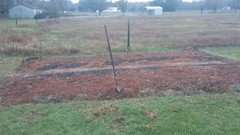
    I am making progress , making my garden for 2017 season. Here is a picture:

    It is roughly 500 sq-ft. I plan on planting close to 40 tomato plants , 20 peppers, some eggplants, okra, cukes, zukes and few other veggies.

    My garden will be mostly shaded before noon and should get full sun the rest of day. That will be like 8 hours . That is plenty of direct sun. Actually I might need to do some artificial shading. What I;ll do is plant the peppers, eggplants and okra where there will be more sun.

    Still long way away from plant out in 2017. But I am just planning and doing some homework.


    sey

  • 9 years ago

    Looks good. Never too early to plan. Wish you much success.

  • 9 years ago

    Thank much, Dave

    It has been a while since my last post. But really there isn't much to talk about right now . We have had quite few real cold freezing nights, temperatures in December, so far. The lowest being 24F. I think it is seasonably cold for this part of NC ( Southwest Columbus cty, near Whiteville ) . My garden is put to bed and tucked in. hehe

    The action will start around mid January when I start germinating peppers followed by tomatoes. I will grow about 20 peppers ( from mild to wild ) and about 30 tomato varieties of all colors, shapes and sizes. If you are looking for some seeds (OP) let me know.. Chances are that I might be able to share some.

    And of course, I will grow okra , eggplants, zukes, cukes, melons as well.

    sey

  • 9 years ago

    Just to mention a couple of things. I knew one man who dug a hole about half the depth of five gal bucket, put bucket in hole, and planted his tomatoes in it. It was easier for him to take care and he had tomatoes most of the summer. Now I always dig a trench about 12 inches deep, pull off all the leaves except the top ones or to the first blooms, lay the plant down in the trench, and cover them except the top with the leaves. Tomatoes will grow closer to the ground. I also cut off all the suckers as they take energy from the fruiting stems. In the winter when you clean up, there will be long roots all along the planted trunk! Amazingly my best year for tomatoes was when I fertilized with miracle grow! Especially the cherry tomatoes! I think I had one or two plants, but they grew to the top of 6 ft rebar, back to the ground, and started back up again. They were always covered. We would stop every time we went in or out of the house and grab a couple handfuls to snack on and I even brought some to coworkers! Oh, that was a good summer!

  • 9 years ago

    That was a nice tip country girl


    i was watching a local Carolina grow show on tv last month and the eccentric old lady said tomatoes drop blossoms when night time temps reach 76 degrees. It was absurdly hot this year, perhaps we had many nights of 76 degrees


  • 9 years ago

    The new posts reminded me that I hadn't updated since last year. I put in another two raised beds, 14" or so, and planted all tomatoes in them, none in buckets. Old dirt, city compost, a handful of organic (NPK and micros) additives, woodchip mulch. Much, much better results. Very little watering was necessary - I watered fewer than a dozen times all summer long. Blight hit very hard on the tomatoes I planted in May, though they produced very well through maybe halfway into the summer before slowing down. I got very little from them in the fall, as blight had done too much damage. As always, I was lax in spraying with a baking soda/soap mixture which, while effective, needs to be applied regularly.

    I did get more tomatoes during the summer months than I did last year, though production was still weak. I tried several heat-tolerant varieties, but noticed little difference between standard varieties and the heat-tolerant ones. Next year I won't be using that as a criteria for picking varieties. As before, cherry tomatoes tended to do better.

    I also planted 6 or 8 tomatoes during July. They'd been growing in Solo cups for several months, and were extremely rootbound and not in great shape in general, but most took off after a few weeks, and especially so when temperatures began to drop a bit. I was eating a ton of tomatoes from those plants through October. Interestingly, I planted seeds from a hybrid, wondering what I'd get and hoping they'd be a really nice cherry that I'd grown the previous year (pink princess from Fedco). I didn't get any of the pink princess, but got several plants that produced - I assume - one of its parent varieties, which turned out to be an excellent monster cherry tomato (2" diameter). I was pleased, and I'll try planting seeds from them again, but I have no idea what to expect. It's fun not knowing! In any case, I'll try planting a second batch in mid-summer again, as it worked out very well this year.

    As for peppers, I discovered that despite high temperatures, if they don't get near-full sun they aren't very productive, but had great results from hot peppers in the same bed - and planted at the same time - as the mid-summer tomatoes. It wouldn't work in cooler climates, but there was just enough warm temperature left in the year to get a single good crop out of them. I'll definitely not try the late planting for them again this coming season. However, I might do so with sweet peppers, which require considerably less time than hot peppers to fruit and ripen.

    And cukes, by the way, did amazingly well. Lemon cucumbers are a new favorite. They're not amazingly tasty - though they're quite good - but their tennis-ball size is perfect for grabbing one for a snack as I take the dog out for a walk, eating it like an apple. Armenian and striped Armenians are really fun to grow, but what the heck are you supposed to do with a two-foot long and 3" thick cucumber? Also, with both lemon and Armenian varieties, I discovered you've got to pick and eat them while they're young, as the bigger the get, the tougher the skin and seeds get (I'd heard that before, but now I know from experience).

    So, finally, for this summer, I'll be using a lot more of my own compost (leaves, grass, kitchen scraps), most of which wasn't ready this year but definitely is for this coming year, and I might try some peppers in buckets, but all tomatoes will again go in raised beds. I'm still loving the woodchip mulch. I'll try to be better about spraying for blight and hopefully keep plants hanging on through the summer to get a good fall crop out of them. Greens are the only plants that do well in the shadiest bed (mostly kale and spinach), and I've had very little success with lettuce - it croaks when temperatures get too warm. I'm going to move strawberries out of the main bed and put them in a smaller one - they're just too space-intensive for what amounts to a fairly small, short-lived crop. But oh, they're good! Also, raspberries are a year old (actually two, but only one in their current bed), so I'll hopefully get a good crop out of them. They did reasonably well this past year in a bed that's mostly clay, so they're pretty hardy. I might try carrots and potatoes. I've had very little success with carrots in buckets, so we'll try a deep raised bed.

  • 9 years ago

    I am active in tomato growing forum. Come by and share your views and comments.

    I am in southwest Columbus County, not far from Whiteville. This is my first season down here. I have already germinated some tomato and peppers, to test early start around mid -late March. I will start some more around Feb 15th for early-mid April plant out.

    Past Jan 5th, the weather has been real nice. I hope it gets even better after mid Feb.

    Have a nice 2017 tomato and pepper season.

    sey

Sponsored
High Point Cabinets
Average rating: 5 out of 5 stars21 Reviews
Columbus' Experienced Custom Cabinet Builder | 4x Best of Houzz Winner