Software
Houzz Logo Print
hzdeleted_24200779

pot ghettos

10 years ago

I'm not good at nuturing roses in pots.I can't seem to keep up with the fertilizing schedule suggested by Kim ; "weekly weakly". I try, but then the plot of my life thickens and stuff comes up and it always winds up that forget when I did the last dose,etc, etc, etc.So, I'd like some help in establishing criteria. My pot ghetto consists for the most part of 1)plants (grafted) that I put out without adequate soil preparation,that have sort of "hung on" to life but never being able to thrive 2) own-roots that resulted from in most cases a grafted being planted too deeply that subsequently grew roots, but not all in an organized, orderly fashion from around one point,so i wind up with two or more weak little babies. Now, whow long must I wait before putting one from category A out again into the garden? how much root mass must a rose have to be able to make it in a rough garden? a good example is a Super Dorothy that's been in a pot for ...boh? I don't remember how long! but I pulled it out of it's pot for a look today. It's been sitting there so long, and not seeming to grow at all The potting soil was a disgusting muck, clearly exhausted.There's a nice root system,but top growth is so scarse...shoyuld I just try putting it out? Fact is, it is very expensive in the long run to nurse roses along in pots. I could re-pot, in new soil, let it get bigger, but ...where to draw the line??? Comments, from all are welcome, but most especially from those of you who garden in challenging circumstances...poor soil, drought,etc

Comments (20)

  • 10 years ago
    last modified: 10 years ago

    If the root system looks good and the pot soil exhausted then this is an excellent opportunity to plant in the ground.. Any real soil will be better than a pot bound plant in old unfertilized exhausted potting soil. Try to loosen up the root mass a bit before planting (I could have suggested root washing and a bit of root pruning but I don't want to be the one who makes your life more complicated than it needs to be..).

    User thanked nikthegreek
  • 10 years ago

    Garden centers here routinely cut roots of bare-rooted roses way back when potting them and the plants still grow fine - I would definitely do what you have to to be sure the roots aren't kinked, knotted or circling at time of final planting.

    User thanked Embothrium
  • 10 years ago

    What can be done "ideally" has to be balanced with the "real world" with "real life". I don't fertilize regularly on a schedule. Quite honestly, most roses (and other plants) simply do not require it. Yes, you might enjoy more flowers, larger flowers, of possibly greater "quality" if you fertilized regularly, but to just keep them alive and enjoy what they can do on their own, very often it isn't required. My pot ghetto is HUGE. Every plant I have currently is potted and many are in exhausted soil. They grow and most are remarkably healthy, producing enough flowers for me to have accomplished FAR too many crosses this year for me to ever be able to fully explore. I'm forced to maintain them in cans until the required alterations to the new place can be properly accomplished. It isn't "ideal" but it works. Of course your mileage may vary depending upon climate, varieties, demands, etc., but I only feed those which either demand feeding to enable me to maintain them, or those which I wish to push faster to develop larger plants for propagation, or to see what they are capable of being. Not feeding the majority reduces salt build up in dry conditions; reduces cost; reduces the time required to maintain them and just makes it easier. I save the water required when hot water is desired from inside faucets, holding it in a clean plastic trashcan with a tight fitting lid, so there is water available when needed without having to resort to the hose. If I want to give some plants a "treat", I'll use a small bucket, mix the solution I want in the amount I want and use it. Otherwise, few things are fed. I just water when needed and spend the rest of my fun time outside enjoying, studying, pollinating, harvesting hips, etc. I honestly doubt you're going to lose anything by not feeding. But that's a decision each of us has to make. I wouldn't feel guilty about not feeding. I'm honestly looking at it as "testing by stress". If a seedling isn't good without chemical intervention, it is REALLY needed? And, I don't worry about breaking roots when repotting, other than the associated stress and how it might affect keeping the plant alive with wind, extreme UV, heat, etc. I'm careful, but not "obsessive" about it. And, I've not lost anything yet. I've culled, dumped, MANY since the move, but nothing has died on me.

  • 10 years ago

    bart, I'm terrible with pots and frankly can't be bothered. Most of my plants are own-root and I let them spend some time in their little pots, about ten days, moving them from full shade to sun, and then they go in the ground. Some sulk and don't grow much for a while and some take off right away. I'm extremely hit or miss with fertilizer. Right now I have an odiferous mixture of bunny poop and water sitting in a bucket that I need to apply and about a month ago I watered in bagged soil amendment to most of the roses, but I've also gone long periods of time without fertilizing. I do mulch the roses but again not in any sort of systematic way. I've discovered that in my location and with the drought what makes them perk up the most is water. I know for you getting water to your roses is an arduous task, but I hope you at least have more rain.

  • 10 years ago
    last modified: 10 years ago

    Soils either have enough soil minerals for the particular plants being grown or they don't and this varies on a case by case basis. Unless a soil is sandy, subject to leaching or otherwise has chronic deficiencies (large areas of the country do have naturally deficient soils) plants are much more likely to get enough minerals in the ground than sitting in frequently watered container media with minimal or no soil content. An easy way to tell if plants may need something is if they aren't the greenest green you've ever seen - plants can look quite green and still actually be quite deficient.

    Also if the remaining, outer- or uppermost leaves on a tree or shrub with evergreen or otherwise persisting leaves (such as many roses have) become noticeably greener after the older leaves color and drop in autumn that means the plant needs to be fertilized - when the bottom leaves were dying the plant moved nutrients these contained into the leaves it was keeping. The resulting improvement in their color shows they were deficient before the nutrient transfer occurred.

  • 10 years ago
    last modified: 10 years ago

    I can keep many roses looking much greener in pots than in the ground but, of course, this requires an effort. Reason is no particular deficiency in nutrients but the pH of my native soil... Never say never..

  • 10 years ago

    Then you would be talking about pH induced deficiency.

  • 10 years ago
    last modified: 10 years ago

    Yes, the point was that conditions differ so no generalizations can be made. The soil is not deficient, it is just of high pH due the presence of lots of calcium carbonate. The plants are deficient as a result. This is a more important distinction than it seems to be at first sight, since talking about deficient soil automatically leads the layman to think that the deficiency can be rectified by adding to the soil whatever nutrients are missing. Which is not the case of course when one deals with pH problems; it is to the plant that the nutrients need to somehow be made available not to the soil. Since this is a difficult and iffy undertaking, keeping them green in pots is easier...

  • 10 years ago

    Mal comune, mezzo gaudio. I just wanted to say that I'm terrible with pots. Inadequate potting soil, and I never fertilize, and of course my plants grow slowly if at all. But I have my propagation beds, which I don't think are an option for you. My practice varies, but what I find myself doing this fall is starting most of my tinier cuttings in pots while planting more robust cuttings and herbaceous perennials that need to grow for a year in the propagating beds. When (if) the cuttings start to put out new growth they'll be transplanted into individual pots or into the propagating beds. If there's a point to all this it's that, highly imperfect though my propagation is, and my pot ghetto maintenance, I do end up with a lot of plants for the garden.

    Interesting comments, Embothrium and Nik.

  • 10 years ago

    One thing I have observed is that commercial potting soils vary considerably in quality and that finding a good potting soil, if one is buying it and not constructing one's own (too labor-intensive for me at this time!), is critical. I did a side-by-side test once, growing seedlings of tomato, eggplant, and nicotiana (hmm - I probably should have included subjects from outside family Solanaceae, too...) in three different, widely available potting soils. One much-touted (and expensive) "organic" potting soil actually seemed toxic to the seedlings, quickly inducing what looked like nitrogen deficiency and worse -- I "rescued" those seedlings by transplanting them into another potting soil, further demonstrating that it was the soil, not the seedlings themselves, causing the problem. Of the remaining two soils tested, one (and it was the cheaper one!) obviously grew better seedlings than the other in otherwise identical conditions. So, it may not be that one is "terrible with pots" so much as using an inferior potting soil.

  • 10 years ago
    last modified: 10 years ago

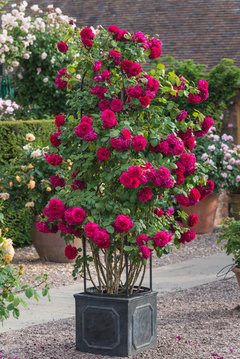
    ...perhaps the appliance of science can tell me how David Austin Roses have managed to coax 'Tess of the d'Urbervilles' into producing this kind of flush from such a small container.... if it's down to hard work and persistence, I might be less interested... but knowing me I might give it a bash...

    ..from the D Austin Rose Gallery...

  • 10 years ago

    That was likely grown in a green house and pushed like a florist rose. Results like that ARE possible, but not in the average back yard with the occasional hose watering. NEVER believe nursery "glamor shots"! They are even less "honest" than the over photo shopped, air brushed people versions!

  • 10 years ago
    last modified: 10 years ago

    Catspa, quite correct about the potting soils. What's more, different plants have different requirements not only in terms of nutrients but in terms of pH, aeration, water holding capacity and drainage. It is a matter of trial and error. In my local erratic market conditions, whenever I find a potting soil which I like for an application, it disappears from the market... Anyhow, my twopence worth regarding rose potting soil. It needs to have above average water holding capacity without, of course, sacrificing drainage. Coarse potting mediums good for my citrus are no good for my roses. My best advice is to mix some garden soil or clay into a standard potting mix. Maybe 5-10% clay or 20-30% garden soil and the rest some good fine grained peat based medium. Adequate water holding capacity can make the difference between needing to water twice a day during heat spells or every other day. That's a big deal.

    If one is to mix soil straight out of the garden into potting soil then one could do worse than taking some steps at partially sterilizing it. I just spread the soil on a concrete surface in the summer and cover with a tough clear nylon sheet. The Med sun does the rest in a few days. If one has a steam household cleaner one can attempt to use that also (I have never done this).

    My rule of thumb is that after 3 years or so, depending of course on plant and size of pot, some radical operation (e.g. re-potting, up-potting, root pruning) will be required.

    I fertilize depending on how often I water but not less than once a month during the growing season (which is most of the year over here..). A 3-1-2 ratio fertiliser with Mg and micronutrients is suitable for roses in pots. I use a granular rather than soluble or liquid fertiliser for cost reasons (plus applications don't need to be as frequent and the application is much easier; just spread and water), although if one really wants to be pedantic about it, a granulal fertiliser might pose more of a problem in terms of salt concentration in the long term. I buy the fertiliser in 40lb bags which makes it MUCH cheaper than any soluble or liquid fertilizer (not to mention those 'special' rosy ones).

    It is very important to water to runoff. IMO pots and a clean and tidy hardscape do not go well together unless you have someone constantly cleaning after you. Potting soil and salts from water and fertiliser WILL eventually stain hardscape permanently or not. No matter what one sees in glossy magazines... I also flush the pots about twice a year to help reduce salt concentration.

    IMHO relying solely on 'organic' fertilisation for pots is iffy at best as the pot environment is not very friendly to the required biochemical processes for breaking down these.

  • 10 years ago

    Catspa, the "organic" soil sounds like the new "organic" MG soil available at Costco this year that touts how it uses "landfill organics". I tried it and was immediately put off by the stench. The initial growth was very strange and off color, but it leveled out and the roses have grow quite well in it, developing some very impressive roots. I'm not inclined to go out of my way finding it again, but it did eventually work well for potted roses in my conditions and the price was good. I prefer not to spend more than $5/cu.ft. for potting soils.

  • 10 years ago

    I have noticed that anything to do with potting and repotting, including roses, is among the most tiresome and unrewarding chores of gardening. Alas, for me.

  • 10 years ago

    In my conditions, the potting mix I make contains enough nutrients for one growing season without adding anything further. Additionally, earthworms seem to always find their way into my pots -- I notice this when I put any Spring-potted bands in the ground by late Summer. Anything not planted in the ground will get some dry organic fertilizer scratched in at the surface, and a fresh inch of used coffee grounds on top. By the third year, I anticipate root pruning to keep the rose in the same container, or repotting into a larger container. With either process, fresh potting mix and organic dry fertilizer will be mixed in, as well as a top layer of used coffee grounds.

    If you haven't seen me mention it elsewhere, my potting mix is three parts peat moss, one part Bovung dehydrated manure, one part perlite, and one part vermiculite. For each gallon of mix, 1/2 cup dry organic fertilizer is added. This year, that fertilizer was Espoma Organic Garden Tone. Last year it was Jobe's Organic Knock-Out Rose Food. I switched only because it was cheaper to get the Espoma in larger bags. I use this for potting up bands and pushing growth before planting them in the ground.

    My conditions, however, will be the caveat. Here, it's not the growing season that's challenging for pots -- it's Winter.

    :-)

    ~Christopher

  • 10 years ago

    If you want to see some great pot growing of roses, look at what most of the folks in India do. I have several folks from India on my "friends list" on my Face Book page. What they do and how they do it is totally amazing. That being said, I grow all of my own root minis/minifloras in 7 1/2 and 10 gal. nursery pots. using my own mix for my pots, I usually get 4 years out of my soil before I start to see any drop off in flower production and general health of the bush's. When I see a rose that needs a a little help, I put a red stake in that pot in the fall so I know to change the soil out in the spring. After not getting my hands in the soil all winter, this is a little work I don't mind in the spring. Plus the rose that gets new soil responds in a BIG way.

  • 10 years ago

    What a great idea, Ken.

  • 10 years ago

    Ken, what is it that they do in India for potted roses?