Software
Houzz Logo Print
emerogork2

Hardy Cyclamen Confusion,....

10 years ago

I hope this area includes tubers,....

Last year I planted 5 tubers under the edge of a large pine tree and the only sign of survival for one of them was a bloom about a month ago. I purchased 5 more to try again.

When I went out to plant them, there were four clumps of leaves showing that they survived but I did not see any bloom other than the one. I have no idea which one bloomed. I dug around the location of the missing one and found nothing.

Now the question comes up again as in how to plant them. Which end is up? I cannot believe all the web sites that explain everything except this. I have read that the smooth side goes up, that the smooth end goes down, but neither side looks smooth!

One side is flat, while the other side is a dome. Why can't they describe that? I want to guess that the dome side is up.

One site says to plant them just under the surface. Another says to plant them 3"-4" deep.

Some how I did it right last year.
Thoughts appreciated.


Comments (24)

  • 10 years ago

    The best tubers will have a growing point in evidence - that should be planted up. If nothing is showing at all, there is a convex and a concave (slightly domed) side to the tubers. Plant with the concave side up and the convex side down. And they can be quite shallowly planted - just below the soil surface - although in colder climates I might plant them a touch deeper.

  • 10 years ago
    last modified: 10 years ago

    In short the smooth, round side goes down.

  • 10 years ago
    last modified: 10 years ago

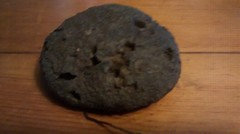
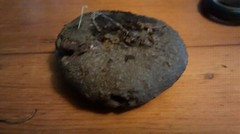
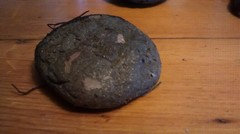
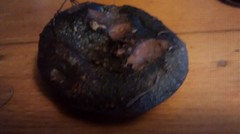
    Does it go into the ground looking like a bowl ready to catch water? Here are some pics. The first two are the same tuber. The second two are another. What is peculiar is that the indented side look as if there are residual roots there.

    "there is a convex and a concave (slightly domed) side to the tubers."
    Concave and convex are both domed.

    Please, I really don't want to know if these are good or bad tubers.


  • 10 years ago

    In order of the photos your tubers are: bottom side up, top side up, bottom s.u., top s.u.

    Convex is domed, concave is dished. As GG stated above, "Plant with the concave side up and the convex side down." What you see on the dented side are not roots but shoots.

    The top tuber doesn't look great but even with quite a bit of nibbling these things can grow. But you need to get them in the ground asap. They are beginning to look dry. At this time of year they should be full of roots and evergreen leaves (if they are C hederifolium) so they must be replanted straight away to stand a chance. It really would have been better to have just left them alone rather than disturb them. These are not a tuber which needs lifting and replanting. They need to be undisturbed and they will grow and spread for years.

  • 10 years ago

    Ok, now how about depth. I read barely covered to 3" - 4" deep.


  • 10 years ago

    Gardengal48 covered that point as well. "And they can be quite shallowly planted - just below the soil surface - although in colder climates I might plant them a touch deeper." In established groups the tops of the tubers are often visible.

  • 10 years ago

    How do these things propagate? Division? Off shoots? Just get larger? Other?


  • 10 years ago

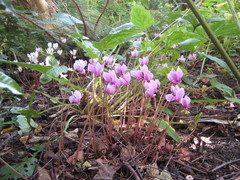
    The tuber gets larger but does not divide. They self sow. There is a seed pod in this picture. Brown marble sized thing bottom right of the clump

  • 10 years ago

    An established clump in my old garden produced a tuber the size of a frisbee - it was at least 8" across! The seeds develop on the old flower stems that curl like a corkscrew. When disturbed, these 'springs' toss the seeds over some distance. Ants are also responsible for seed transport - they are attracted to a sticky, sweet substance the seeds are coated with and will haul them considerable distances. I always had a few seedlings pop up in the lawn here and there.

  • 10 years ago

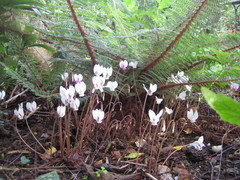
    Emerogork2 - you can see a couple of the corkscrews GG is talking about in my photo above. Left of the seed pod. Below is a white version but at the back you can see a couple of pale pink flowers. Presumably self seeders of mixed pink/white parentage. BTW have always had better luck planting a plant from a pot than those dry tubers in the bags at the garden centre.

  • 10 years ago

    " BTW have always had better luck planting a plant from a pot than those dry tubers in the bags at the garden centre."

    Ditto :-)

  • 10 years ago

    I just read that these tubers, similar to potatoes, can be cut vertically to grow more plants. It is cautioned that extra care has to be taken to avoid rot by using a disinfectant.


  • 10 years ago

    Unless it's an exceptional form don't risk cutting it. Let them do their thing and if they like the location they will reseed. Like gardengal said, they may show up at a distance and in spots you wouldn't have suspected.

  • 10 years ago

    Being the experimenter that I am, and having a surplus of these things, I am going to go ahead and chop one and place it in a special location to see what happens. It may be a bit late to do this but,....

    Having read that a disinfectant is worthwhile, I wonder if this is a generic precaution or if there is a specific reason. Also, what might be a good disinfectant to use? Would rooting hormone benefit this?

    P.S. "Unless it's an exceptional form" What might this Exceptional Form be?


  • 10 years ago

    Of course it is entirely up to you, but since ten is not exactly a huge number and yours are in a pretty ropey condition, I personally would not risk cutting them up. If you had dozens and they were big and robust it might be worth a try. My opinion is that you should replant them without further ado and cross your fingers. The longer they are out of the ground the less likely they are to survive.

  • 10 years ago

    There is no way I will even be interested in having dozens of these especially if someone says that one can be as large as a Frisbee. In a set of gardens totaling about 5500 sq ft and containing over 450 documented plants, 10 of these tubers are plenty for me. Being the explorer with plants, I see no reason to not to sacrifice one just for the experience.

    Ropy or not, the original five came from an end-of-the-year sale last fall so they were not in all that great of condition back then either yet 4 survived. I figure that I can add four more from this year's purchase and I will be three ahead of my original design. I see no reason not to try something new with one of them.

    As I see it, if I am successful and post the results next year, then others may try the same thing. Besides, if they self-propagate as easily as claimed then I will not really have much loss now, will I?


  • 10 years ago

    I usually give away the larger plants, but then they always fit so easily under shrubs and such that they don't really compete much with most other plants. They do most of their growing during the 'off' season and then politely disappear when everything else starts to grow.

    To me an 'exceptional' form would be one with larger blooms, a new flower form or a unique color. I'm guessing yours are cyclamen hederifolium and for me the foliage on these is even nicer than the blooms. Last year I killed one which developed a nice pink tint on the leaves once it got cooler out, I wouldn't have minded a division on that one.... although I know I wouldn't have braved it.

    Let us know how your experiment works. If it were me I would dust with rooting powder (usually contains a fungicide) and be done with it. I've also heard cinnamon works as a fungicide or a 10% bleach wash as a disinfectant.... or you could purchase something specific to your experiment, but then it starts costing money.

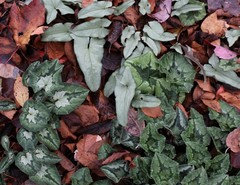
    Right now the various leaf patterns and shapes are really looking nice.


  • 10 years ago

    emerogurk - As kato says, they really don't compete for space in the garden since they are very low growing and fit underneath other plants. They are also invaluable in that they can grow in dry shade beneath trees. Through most of the summer they are invisible, only reappearing to flower in late August/September and then providing evergreen foliage in the Winter. My garden is about a twentieth the size of yours and I know I would never feel that I had too many of these charmers.

    But do let us know next year whether your tubers survive and how the division experiment gets on.

  • 10 years ago

    I've never seen the tubers that way (outside a pot and inside a bag). There would be a danger of their drying out and shriveling up.

    I often used to hear - regarding potted cyclamen - that the pot could be tilted in its dormant phase so that the corm didn't rot. (I think it's a corm, not a tuber.) This is totally inadvisable because then the corm will totally dry out and be cactus. Not a cactus. Just cactus.

    Do the seeds spring out? I thought cyclamen weaved their seed-studded stems towards the ground, trying to plant them themselves.

  • 10 years ago
    last modified: 10 years ago

    I doubt it is a corm. Is not a corm like an onion with internal layers and the sprouts come from the center? I sliced the tuber and it looks exactly like a potato.

    The halves were brushed with rooting hormone and pl;anted in a special location.

    I have not had them long enough to see the seed springie thingies....


    Time will tell.

  • last year
    last modified: last year

    Ok, I have a graduate degree in horticulture, but know very little about cyclamen growing specifically. I’m here to find out how to plant them, too. But I can tell you that bulbs have layers, like onions, and corms are solid and flattish, like crocus corms, with a top and a bottom. (they are actually stems, squashed down flat). But it seems cyclamen are tubers, or root tissue. My tubers are very dome shaped, with the underside depressed inward: concave (like a cave, hence the term), while the dome would be termed convex. I didn’t expect them to be so large!

    As for disinfecting the cut surface of one, I suggest letting the surface air dry for a few hours, as you would for an iris rhizome, then dusting with a fungicide before replanting. You might try planting each piece in a separate pot to see if any survive, before moving them to the intended spot. A chlorine solution is sometimes used in tissue culture, but it’s just as likely to kill the plant along with any fungus spores. Good luck with it!

  • last year

    Pretty late to the party for this 9 year old thread!! And cyclamen are technically considered tubers, not corms.

  • last year

    HU numbers. The domed side is the bottom, not the top. The flower and leaf shoots grow from the concave surface.

Sponsored