Software
Houzz Logo Print
rredbbeard

Is this papilio virused?

10 years ago
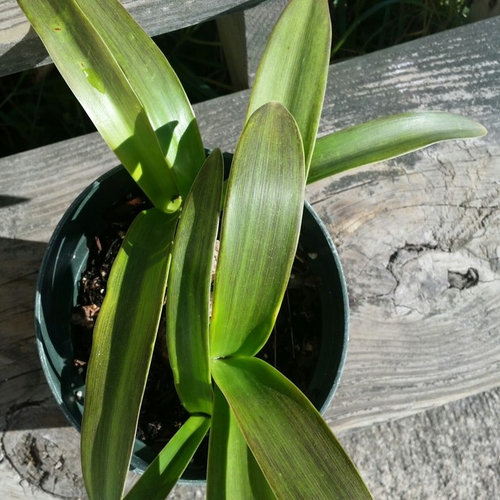
This papilio is showing a fine striation, and I'm hoping that this is a normal pattern and not virus. I thought that papilio almost never showed symptoms of virus?

Let me know what you think. It's one step from the trash can.

Pitch it, or keep it?

Thanks,

Rick in CT

Comments (21)

  • 10 years ago

    I'm not a total expert like some of the others here, but I'd keep it. I notice those striations on some of my bulbs on occasion. I'd maybe keep it quarantined for a couple of weeks, just to make sure noting develops. But I've never had an issue with those red streaks.

  • 10 years ago
    last modified: 10 years ago

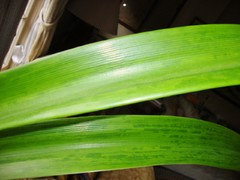
    Oooooo....I'm suspicious like you. Will take more than weeks to sort this out. I hear that H. Papilio is HMV resistant, but not virus proof. That fourth leaf from the left (darker green and pointing up) is the worst looking in the bunch and shows some mosaic pattern. Do you have others Papilios nearby getting the same light and care regimen? The red streaks aren't the issue. Move it far far away. I put mine under screen to stop any possible bugs moving between plants. If I had others like this one, it would go.

  • 10 years ago
    last modified: 10 years ago

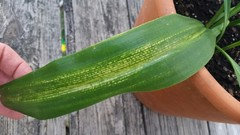
    I've been studying your leaves and I've decided that I don't think this is virus. Never can be sure of course but look at my picture and you an clearly see the mosaic pattern on the leaves. I don't think the stripes themselves are indicative of virus but if you see any of these mottled patterns then I would keep totally quarantined or toss. The thought that your papilio might be virused strikes fear in my heart as I too have read and was under the assumption that papilio was immune from this scourge.

    Donna☺☺☺

    And then.. I keep looking at your bottom leaf and I don't like the looks of it. What is the history of this plant; how long have you had it and where did you get it. I would be more suspicious if this was a brand new bulb but if you've had this bulb for years and none of your other bulbs have shown signs of virus then.....???

  • 10 years ago

    Had you already had bloom from it? These leaves look like belonging to a TET hybrid. Well, in my honest opinion :)

  • 10 years ago

    My first virused plant was about 2 years ago, and came directly from Royal Colors, which never made good on it. It was a collection of sonantini that I potted together, and one of the 5 or 6 bulbs grew leaves that were clearly virused, and I tossed the whole thing, pot and all. My second incident was this summer when phaedranassa viridiflora showed viral due to the stressful summer weather:

    Out it went. P.viridiflora is reputed to be a viral trojan horse, so I always treated it as such. P.carmiolii experienced the same heat stress, and the leaves didn't show a break, and I kept it. There are several species that are reputed to be reservoirs of mosaic virus, including h.teyucuarensis. (My related question is: why doesn't someone do a meristem of h.teyucuarensis to produce a line of virus-free plants? This is why the process was developed in the first place.)


    This plant in question is barely blooming size, and came from ebay, and (at least to me) papilio bulbs have a particular appearance, and seem denser/heavier than most amaryllid bulbs. Also their 'dormant' growth pattern is different. Haweha, what is a TET hybrid? Tetraploid?

    I'm thinking that I'll give this plant to a friend or relative who doesn't grow any plants, and ask them to take care of it for a while. That way it's not a risk to any other plants. I would of course tell them why it could have problems.

    --Rick in CT

  • 10 years ago
    last modified: 10 years ago

    Hi Rick,

    If you research the topic of somaclonal variation, you will find possible answers to your question about meristem culture of H. teyucuarense (i.e., why doesn't someone do a meristem of h.teyucuarensis to produce a line of virus-free plants?).

    Below are a few quick points that may be useful.

    • Tissue culture-induced variability is common in plants.

    • Plants arising from tissue culture from meristems are not always exact clones of the parent.

    • Somaclonal variation exists for almost all the phenotypic characters.

    • Variability is not limited to observable physical characteristics; DNA alterations also occur.

    In summary, although meristem culture may yield virus-free plants, they may not be true-to-type clones.

    Best,

    Blanca

  • 10 years ago

    Rick, I don't think the leaves look like H. papilio, but I think it could be virused

  • 10 years ago

    The leaf appearance is more like a hybrid,than papilio. The leaf does not look virused to me. It could be several things,but I have never seen mosaic manifest itsself like that.I have hundreds of Papilio. They all have been exposed to mosaic virused plants.In Florida there are endless vectors.I have never seen papilio exhibit symptoms of mosaic.I have five different strains of papilio. Most hybrids of papilio are susceptable.I have not had mosaic on an exotic star,yet,nor on some of my hybrids of papilio.

  • 10 years ago

    As an afterthought,Ebay sellers are sometimes calling anything which looks like it could be crossed with papilio,the species papilio.

  • 10 years ago

    This forum format is very confusing to me.I was commenting on the picture of a hand holding the single leaf.

  • 10 years ago
    last modified: 10 years ago

    I think the picture you are referring to was of my phaedranassa viridiflora, now departed. Picture #2 was Donna's plant.

    Rick in CT

  • 10 years ago

    The dark green skip pattern Donna posted is most certainly mosaic virus.I can't tell for sure if the plant posted by Rick is infected or not ,but i would err on the side of protecting my other plants. The leaf at 11 oclock is very suspicious.The leaf structureis unlike any papilio I have observed.

  • 10 years ago
    last modified: 10 years ago

    I concur with Donna, Hans-Werner, Josh, and
    Del. The leaves produced by this “eBay papilio”
    don’t look like any H. papilio that I’ve ever grown, and I have many different
    clones. I’ll refrain from commenting on
    the virus issue except to say that it’s not worth taking the risk. However, I will take the opportunity to say a
    warm hello to Del. It’s so good to see
    you posting here!

  • 10 years ago

    In reference to Blanca's comments, the words 'would' and 'could' stand out for me--there could also be a clone that is virtually identical to the original, sans virus? Even with an imperceptible genotype variation, it would seem preferable to have that cloned line available, and not place one's other plants at risk.

    If I recall correctly, meristemming was developed for the specific purpose of eliminating virus in a breed of potatoes. I'm wondering if there's some other factor that prevents this approach with h.teyucuarensis--is this plant impossible to meristem for some reason? Is there a knowledgeable scientist out there who can clarify this?

    Thanks,

    --Rick in CT

  • 10 years ago
    last modified: 10 years ago

    Pitch it.

  • 10 years ago

    I agree! I have nearly eliminated all affected bulbs from my collection. It's not worth the risk.

  • 10 years ago

    I agree.

    It's gone!

    --Rr

  • 10 years ago

    :-( sorry

  • 10 years ago

    lack of nutrition

  • 10 years ago

    Would you describe your experience with this please?

    Thanks,

    --Rr

0
Sponsored