Software
Houzz Logo Print
paulwsem

A. titanum brown spots.

10 years ago

I've had an Amorphophallus titanum for just a little bit over a week, where it was doing well. It came with two leaves, shed the first one, and now the second one is getting a couple brown spots on it. I'm willing to be that it's because of overwatering, because I spray the soil daily to make up for the fact that there isn't much humidity, but it could be something else. I heard that some of you grow them in low humidity zones, so can you give me advice for watering schedules? I doubt it's going dormant because it's too young for that. The pot it's in is about 4 x 4 x 6 inches.
Leaf pictures: http://i.imgur.com/mnZqiaB.jpg
http://i.imgur.com/hJzvRPB.jpg

Comments (11)

  • 10 years ago

    How warm is the soil? This is a tropical plant so it prefers soil temperatures on the warmer side such as 74-86f. It is also important that it has at least some exposure to daylight or the artificial lighting equivalent to a south facing window.


    you may want to get some seedling heating pads, and a larger pot with very good draining soil mixed in. There is no need to water unless you observe the top layer of soil drying out especially when your plant is indoors.

  • 10 years ago

    Ok, thanks for the watering advice. The room temperature is ~68-75, with the soil on a heat mat at about 78. A second heat mat is nearby to evaporate water to keep humidity at 50%, but I'm making a tent to give it. For lighting, it's under an 8x2000 lumen grow setup, with half on from 6am-6pm. I think the water was the biggest issue

  • 10 years ago

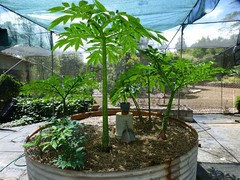
    I used to have dozens of a titanums since I made a huge seed order 1 year ago, but ended up selling all, but one of them on eBay or to friends. I've found that in a year, it is possible for them to put up 4-5 petioles getting progressively larger. They can also hold onto several petioles at once.

    Here's a blog I made to show the entire progression of a titanums over the course of an entire season.


    Rob, that's a nice healthy looking plant. You could potentially air-layer some of the other petioles to make more corms form at this size. The one I'm keeping now is small, but I'm currently confident in my gardening skills.


    A titanum picture blog

  • 10 years ago

    I've had good luck with striking leaf cuttings, but one of these potential "monsters" is plenty for me!

  • 10 years ago

    The two year old one is a lot bigger than I thought it would be. Where did you get the parts of the soil for it, and do you guys add any fertilizer aside from what's in the soil? Right now I just water with distilled and no fertilizer.

  • 10 years ago

    I've added miracle gro, azomite, and epsom salts to supplement my a titanums.

  • 10 years ago

    The volcanic rock is local (I live next to one). The sand is cleaned local river sand, the peat is imported in bales from, I think, the Ukraine. The chicken poo and blood bone are locally obtained.

    I fertilize once a fortnight with a 14.8.24 soluble fertilizer that is specifically used for feeding African Violets. I also mix slow release with the potting material along with a bit of dolomite, blood and bone and aged chicken poo. All my amorphs seem to be "gross" feeders during the leaf stage. I tend to get doubling and even tripling in size and weight of all my amorph corms each year.


    Here's a photo (taken just now) of my Amorphophallus collection (only one small seedling titanum in this group and it's in the small pot at centre. The dust pan is added to give a better idea of the scale.


  • 10 years ago
    last modified: 10 years ago

    Any exact ratios? I think I have peat, dolomite, perlite, and vermiculite and can get bark locally. Also, how often do they make a new leaf in the young stage? Mine had just put out a new one a month ago, so should I see one in the beginning of February or something?

    Edit: I have a dewy pine mix that's 1-1-1-1-1 of peat, perlite, pumice, lava, and sand. It's very coarse and well drained, but if I add more peat and a tiny bit of lime to it should it work?

  • 10 years ago

    I tend to mix by looks and feel rather then any exact ratios. The dolomite quantity is usually just a surface dusting (maybe 1/2 cup in a large 12" pot). The dolomite I believe will act as a bit of a buffer for the acid peatmoss and regular fertilizer applications. I've also read that A. titanum is found naturally in areas with limestone outcrops so I mix in a bit of crush local marble, 10mm screened volcanic rock, fine pine bark, and perlite to assist with drainage. Good drainage seems to definitely be a key to a healthy titanum. I've also successfully used coconut coire when good peat isn't available. If you do use coire, watch out for excess salt content.


    Here's a formula that the local Cairns Botanical Gardens uses successfully with their Amorphs :

    "The potting mix at the gardens is approximately 70% Searle's premium
    potting mix and 30% 5mm grade Diatomite rock.

    The Diatomite is a bit hard to find, I think the last lot we got was
    'Cleansorb' brand. Its used for blotting up spills.

    Its high Silica, and the Amorph seem to enjoy that and the improved
    drainage and air-spaces in the mix."

  • 10 years ago

    Ok, so I'll try half dewy pine mix and half peat, with about two tablespoons of lime for 6" pot. Sorry if I was asking too many questions, it's just that I've never grown any arum before and I only have one of these.

Sponsored