Software
Houzz Logo Print
titian1

Is this a virus?

10 years ago
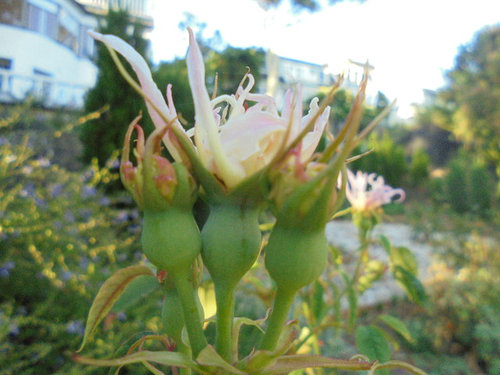
A number of my roses are putting out buds that have hip-like formations at the bottom, and tiny malformed flowers above.

Trish

Comments (68)

  • 10 years ago
    last modified: 10 years ago

    From the full paper: "

    Recently, a severe virus-like disease, characterized by a leaf

    rosette or witches’ broom symptom formed by dense small leaves

    on branches, was observed in China.The accompanying symptoms

    included remarkable decline, dieback and, eventually, plant death

    several years later. Here, we designate this disease as ‘wild rose

    leaf rosette disease’ (WRLRD). It is similar to the previously

    reported rose rosette disease (RRD), which is regarded as a serious

    problem by the nursery industry and many home gardeners,

    because it is lethal to the wild rose and potentially lethal to many

    ornamental rose species and cultivars. RRD is caused by Rose

    rosette virus (RRV) (Laney et al., 2011). WRLRD differs from RRD in

    the following ways: first, the witches’ broom symptom consists of

    the proliferation of only small leaves along the canes, instead of

    both leaves and twigs at the ends of canes; second, the leaves are

    not distorted and twisted; third, the thorns are not red-tinged or

    produced in excess."

    See the abstract at the link below::

    " Deep sequencing reveals a novel closterovirus associated with wild rose leaf rosette disease"

    http://www.ncbi.nlm.nih.gov/pubmed/25187347

    titian1 10b Sydney thanked henry_kuska
  • 10 years ago

    Hi Virginia, I have just rung one of the members on that list, thanks. He thinks it highly unlikely to be RRD, but I am sending him photos in the morning.

    I didn't think it worth trying any of the OGR people here, as I doubt that anyone believes it to be in Australia. And really, I want someone to test for it. One of the old rose nursery growers told me that there only is the Dept of Agriculture now, and they are not interested in anything other than industrial crops.

    I've now noticed it on several more roses, but not 2 large Marie van Houtte's that I didn't spread horse manure round at the time I did the others some weeks ago. I have spread round them a couple of weeks ago though. And strangely I don't see any on Mrs Dudley Cross anymore, who I painted with glysophate in September (as she had die-back into the graft), but who refused to die.

  • 10 years ago

    Strawberries and roses are closely related. Strawberries can get a Closterovirus that is spread by aphids.

    http://www.ncbi.nlm.nih.gov/pubmed/17109984

  • 10 years ago
    last modified: 10 years ago

    I would look into herbicide or mite damage before suspecting a viral infection mainly because this suddenly appeared on roses all over the garden and because of where you live this is statistically more probable.

    Henry is correct in that glyphosate can act as a growth accelerator but other broad leaf herbicides like 2,4D or triclopyr (Garlon) are real growth regulators and can more readily produce effects like these. They are also more readily absorbed through roots. If I had to guess between glyphosate and 2,4D / triclopyr I would choose the latter but I have no idea how that might have entered your garden although contaminated manure is known to cause such problems. Again, it is more probable for such a hormonal herbicide (rather than glyphosate) to contaminate a field to toxic concentrations through contaminated amendments.

    I would try to remove as much of the manure as possible and would repeatedly water heavily afterwards. If you can send samples of the manure for analysis for traces of hormonal herbicides do it.

    titian1 10b Sydney thanked nikthegreek
  • 10 years ago
    last modified: 10 years ago

    If I'm correct and this is the effect of auxin related herbicide these unfortunately tend to persist long in the plant tissue. You will need to repeatedly remove and dispose plant parts in order not to have re-contamination through decomposing tissue left on the ground. If the actual agent can be identified then a specialist might be able to tell you what to expect and what you could do to help.

    PS I just noticed you used sugarcane mulch also. I would be surprised if some herbicide like 2,4D is not used in sugar cane fields in Aus although I do not know what herbicides are commonly used there and whether such herbicides would be translocated into sugar cane stems and be persistent in the produced mulch. But that's another possibility.

    titian1 10b Sydney thanked nikthegreek
  • 10 years ago

    I'm not even close too possessing the intelligence of many here. However I wonder how a hormonal herbicide taken up through the root system would affect only one cane of a rose. Would not the entire roses new growth be affected? So much not known about the effects of herbicides.

    titian1 10b Sydney thanked Patty W. zone 5a Illinois
  • 10 years ago

    Like Nik, I'm suspicious of the most recent bout of manure you picked up. I wonder if you could call, explain what's going on, and ask if any contamination could be possible. Hopefully, you can talk with someone who a) knows what's going on and b) isn't too defensive to tell you.

    I don't know if the contamination would necessarily have to from a herbicide, just something that provoked trauma in your roses. Witches' brooms seem to be produced in response to various types of extreme stress in plants; herbicides and RRD are the most famous culprits in roses, but it seems that their close relatives, blackberries, can get Witches' Broom from a fungus.

    If you can find a plant pathologist (and the RBG might be able to point you in that direction?), it's a good idea if you can rule out RRD and any other mite-transmitted disease, if only for peace of mind. It does seem unlikely, though, that your garden in the middle of Sydney with no recent history of imported roses would be the first place in the country for a viral outbreak.

    Virginia

    titian1 10b Sydney thanked User
  • 10 years ago

    Regarding why herbicide absorbed from the roots may/would not affect all of the canes equally. I have tried Google Scholar searches. Apparently, it is possible that the herbicide would be translocated mainly to the most active growing point/cane. Sorry, I do not have time now to document this "possibility".

    titian1 10b Sydney thanked henry_kuska
  • 10 years ago

    I had a look at 3 'neglected' roses down the bottom this morning. All are exhibiting symptoms - none had horse manure. 18 of around 30 roses are now affected.

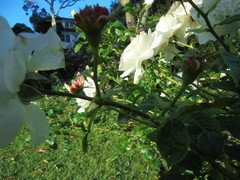
    Here is a photo showing malformed red 'buds' on a white rose.

  • 10 years ago

    Did you have any extreme swings in weather lately? Do your neighbours grow roses and are theirs affected too?

    titian1 10b Sydney thanked nikthegreek
  • 10 years ago

    Nik, no extreme swings, and no neighbours growing roses. Not many people do around here.

  • 10 years ago
    last modified: 10 years ago

    titian1, are there other roses growing in your neighborhood? Any similar signs or symptoms in vegetation near your garden? If there is a viral cause to your rose symtoms, the virus must have had a way of getting to your plants.

    Since you do use glyphosate on occasion, is it possible that a hose, nozzle, bucket or what-have-you could have been used for spraying herbicide, then possibly re-used to water plants; or any other sort of accidental contamination?

    In a way it's good that you have a bit more time to sort through chronologies of when you first saw problems, which roses were the first to have symptoms and which roses got manure/ organic mulch, or something else that you might have done...

    Do I understand that you saw symptoms on Mrs Dudley, then you tried to kill her with glyphosate in September, and now she has regrown without the symptoms she'd had before? That seems significant, but I can't really wrap my head around what it really means. Could it be that something traumatic happened around then that impacted MDC more quickly than your other roses, but is gradually impacting them also? And is MDC's recovery a sign that the other roses will also 'get over it' (whatever it is)?

    Good luck untangling it all,

    Virginia

    Edited to add that I cross-posted with Nik, asking about neighbors and roses...

    titian1 10b Sydney thanked User
  • 10 years ago

    Virginia, Mrs DC had die-back into the graft, which was why I tried to kill her - her roots were too much for me to remove, and she is not near other roses. When she grew back she had a little evidence of glyphosate poisoning, but soon outgrew it.

    I do use the sprayer for things other than glyphosate, but always flush it out well after. And it seems odd that, if it was that, it's happened all at once now, as I've been doing it for years.

    I have a friend a couple of suburbs away who grows roses. She's recently come out of hospital, and I don't like to worry her......But I'll ask someone else.

    Thanks all for your help and concern.

    Trish

  • 10 years ago
    last modified: 10 years ago

    I would also try, or have someone do it for me, to look into one of those buds under magnification to see if there's evidence of mites there. Some mite infiestations can cause malformations to growth in various plants. I'm not refering to transmission of some viral agent, just dmage that the mites themselves can do.

    titian1 10b Sydney thanked nikthegreek
  • 10 years ago

    Unless this were something new. Bud mites do bud damage that does not affect plant growth. An example, the eriophyid mite that affects coneflowers and its family members. This for us is a way to tell the difference between bud mites and asters yellow. With the later you will see a sick plant and buds. Having seen so much rrd here, I will say that your photos do not look like rrd. I have seen photos this year that resemble Trish's photos and it had been attributed to rrd. Most likely because we have rrd here. Wonder what Ann and others think. Have we seen the same symptoms here? Do we just not know all the affects herbicide damage?

    titian1 10b Sydney thanked Patty W. zone 5a Illinois
  • 10 years ago

    Trish, in your second photo there is an odd set of leaves. It could be sunlight reflection. Do you have any leaves that resemble those in this link. Weedkiller damage/RHS Gardening - Royal Horticultural Society

    titian1 10b Sydney thanked Patty W. zone 5a Illinois
  • 10 years ago
    last modified: 10 years ago

    Aceria sheldoni mite infestation in citrus can not only result in malformed flowers but malformed fruit also.

    titian1 10b Sydney thanked nikthegreek
  • 10 years ago

    Patty, the leaves are spindly and twisted. My camera is a cheap one, and can't cope with the bright light here. I've taken photos in the early morning, but they're still not much good. In the second photo - of the growth - it's just bright light.

    The leaves don't look like the RHS photo.

    I've spoken to a few experts here, and they all say RRD is not in Australia. The advice is to water well, and wait, and when (if!) healthy new growth appears, to feed with a seaweed solution. The general opinion is that it must be glyphosate damage. I really hope that's the case.

    Nik, I took apart a malformed bud this morning, and looked at it with magnifying glasses on, and couldn't see any mites - but that may not mean they're not there.

  • 10 years ago

    titian1, ring Swanes as you are in Sydney and ask for help, Drive upto Dural with some of the effected leaves, cut a branch off to show them what it is.

    titian1 10b Sydney thanked David_ in NSW Australia z8b/9a
  • 10 years ago

    Trish, you've had plenty of wonderful advice, to which I can't possibly add anything, but I just want to tell you how terribly sorry I am that you're having this problem. I know I'd be very upset and depressed, and this would be a shock to anyone growing roses. I can only hope that time will take care of this, since it most probably is not RRD. It's still a major disappointment, and I hope that just removing the affected parts and watering heavily will save the bushes. Best wishes.

    titian1 10b Sydney thanked ingrid_vc so. CA zone 9
  • 10 years ago

    Wondering about aminopyralid maybe? Or clopyralid? It looks a bit like the damage that some of the local allotment growers had a few years back from aminopyralid contaminated mulch.

    titian1 10b Sydney thanked fduk_gw UK zone 3 (US zone 8)
  • 10 years ago
    last modified: 10 years ago

    Aminopyralid is related to triclopyr discussed above and is highly persistent (along with picloram and clopyralid). It is a nasty herbicide. All of those can persist in mulch, compost AND manure and can cause long term problems.

    Glyphosate and its symptoms are quite well known to gardeners and any herbicide damage is usually attributed to this but some broadleaf herbicides used in crop farming are much nastier.

    titian1 10b Sydney thanked nikthegreek
  • 10 years ago

    fduk and Nik, I'm going to go to the place where I got the horse manure (mixed with wood shavings and straw) today, and hopefully speak to someone there.

    David, that's a good idea about going to Swanes, but I think I'll wait till after Xmas, because of traffic. It's a good hour and a half from me at the best of times.

    Ingrid, thankyou for your sympathy. I have to say I have been feeling pretty sick about it. I saw symptoms on a few more roses this morning. But all the advice I've been given this end includes 'don't panic'! Which makes me think of 'The Hitchhiker's Guide to the Galaxy!


  • 10 years ago

    fduk and Nik, I temporarily forgot about my 3 'neglected' roses at the bottom, which received no horse manure, and are all showing symptoms, so I don't think it can be the manure, and I don't use any broadleaf weedkillers.

  • 10 years ago

    titian1, when you say the 'neglected' roses are at the bottom of the garden, do you mean that they're at a lower elevation, and could have received some run-off (from the manure, for example) during a rain shower?

    I do think it's worth calling about the manure (maybe the mulch, too) even if all of the sick roses didn't get manured/mulched. If there was anything strange that happened at the source that could have led to some contamination, it's best to call soon, before people forget the details of what might've happened.

    I can well understand that until you have some sort of idea of what's going on, that must be a real stress, and I hope you get some answers soon. I'd be worried that if I didn't figure out what went wrong, then it might happen again.

    My own feeling is that somehow your roses were exposed to some chemical that didn't agree with them, probably of the herbicidal sort, but maybe not. My hope is that you'll be able to cut back the plants, give them some liquid seaweed and some pep talks, and they'll recover. I very much hope you don't have any fatalities there.

    Fingers crossed,

    Virginia

    titian1 10b Sydney thanked User
  • 10 years ago

    Is it possible that the herbicide residue in your sprayer has built up to such a level that it cannot be rinsed away? I think that if it is a plastic sprayer this might be your problem. I have seen damage done by roundup and that is what your roses look like. Also because so many are effected in different locations. The only logical explanation I could come up with is herbicide residue as you probably were spraying all of your roses with that same sprayer? I hope that makes sense. I am not very scientific. LOL Good luck. I imagine with lots of water and a bit of trimming your roses will rebound with no lasting effects.

    Valerie

    titian1 10b Sydney thanked onewheeler
  • 10 years ago

    Virginia, it is just possible that they received a bit of runoff, so I will go.

    Valerie, I really doubt that it's the sprayer, as I rinse and flush several times. The other use I put it to, is to spray with milk, and I've been spraying freely with that, and no surrounding plants are showing any ill effects. And a penstemon I've been using the milk spray on is very healthy.

  • 10 years ago

    Are you near Caringbah or Sylvania, they own both those nurseries


    titian1 10b Sydney thanked David_ in NSW Australia z8b/9a
  • 10 years ago

    Thanks, David, but I'm in the northern beaches. What doesn't make sense to me, is if it's due to a herbicide, why is nothing else affected?

  • 10 years ago

    Hi, are the photos that we have seen of present years foliage, after you pruned in(July) did you have foliage, lets say in September, did the foliage come out as the same as the photos you have posted. Can you send me a MSG from this forum somehow, I will reply with my details so we can contact via phone.


    titian1 10b Sydney thanked David_ in NSW Australia z8b/9a
  • 10 years ago

    Good question Trish. If you have a mixed border then other plants should be affected too if it is herbicide damage. Glyphosate may affect any kind of plant, though some are more sensitive, the others we have been mentioning would affect just broadleaf plants not the grasses and maybe not the conifers.

    titian1 10b Sydney thanked nikthegreek
  • 10 years ago
    last modified: 10 years ago

    David, the foliage was normal until a week or so ago.

  • 10 years ago

    I just received this email from someone I contacted in Sydney (thanks to Virginia).

    Severe damage was caused to property in Sydney a
    short time ago,
    railway contractors spraying herbicide 300mtrs away with a downwind was the
    problem. Needle like growth on foliage looks like herbicide damage.

  • 10 years ago

    Oh, wow. I'll bet that is the problem. Idiots (sorry). I hope you have a government agency that will go after those guys. Some nice hefty fines might be in order. Diane

    titian1 10b Sydney thanked nanadollZ7 SWIdaho
  • 10 years ago

    Oh, so sorry you have had this happen. I'm against them doing this for plant's sake and people's health.

    titian1 10b Sydney thanked Sheila z8a Rogue Valley OR
  • 10 years ago

    I'm so sorry for the damage, but glad that you got an answer that makes sense. Now you can stop worrying about manures, mulches and mites, and focus on caring for your poor roses.

    Good luck,

    Virginia

    titian1 10b Sydney thanked User
  • 10 years ago

    It's now raining steadily, and is forecast to do so for the next few days, which, if it is herbicide damage, is what I'm told my roses need.

    Again, many, many thanks to you all for your help and concern

  • 10 years ago

    I have sent an email

    titian1 10b Sydney thanked David_ in NSW Australia z8b/9a
  • 10 years ago

    Finding which herbicide may be the culprit will help to know what to expect. If a railroad track maintenance company is to blame that very probably was indeed glyphosate which may be fairly good news. How far from your property is that track? The further the better. Maybe you can pop out there to see if herbicide has been used. The signs should be obvious with browned out weeds etc.

    titian1 10b Sydney thanked nikthegreek
  • 10 years ago

    Nik, sorry, I should have been clearer. The above happened to another garden in Sydney. I don't actually live near a railway line, but it was interesting to know that damage could occur from that far away. I'm just hopeful that it is herbicide damage - strange thing to hope for!

  • 10 years ago

    Patty, I hope they're paying you!

    I hadn't heard of vinegar spray before. I'm going to try it.


  • 10 years ago

    Nope I'm paying, anything beats having Spring Green Lawn care service spraying herbicides on my roses.

  • 10 years ago

    It was only about 5 years ago that we had a service around here called Truegreen Chemlawn. Hahaha. Chemlawn?? Yikes. And they robocalled at all hours. Now, they call themselves True Green. The Chem part has disappeared magically. Why are these services always green? Anyway, Patty thank you for what you are doing. I don't trust those guys, either.

    And titian, I'm sorry you still haven't solved the mystery, but I think you are very close to doing it. So sorry. Diane

    titian1 10b Sydney thanked nanadollZ7 SWIdaho
  • 10 years ago

    I'm more and more convinced that the problem was in one batch of the horse manure and stall sweepings. 3 roses got no manure at all, and they are all fine - so far! 3 others got a later batch, and they're not showing any symptoms, though that could still happen, given the timing. The 3 'neglected' roses that may have got a little runoff, are not badly affected. I have used manure from there previously with no ill effects, so hopefully the latest batch is ok.

    A few of the roses are now putting out normal growth. I've been very lucky, in that we had 24 hours of good, soaking rain.

    I haven't yet been back to the place where I got the manure. Partly because it's left outside the gate, and I'm not sure that I can get access, but mainly because I feel rather mean, especially just before Xmas. Irrational I know, and I really ought to do it, as other people will suffer too. Perhaps, I'll go today..........

    Anyway, it's been lovely to not feel alone in my worry. Thank you all so much.

    Wishing everyone a very Happy Xmas,

    Trish

  • 10 years ago

    Trish, I think either explanation (drift or a contaminated batch of manure) could cover your situation, and you're already working on a cure with the rain you've had. Nice timing* on your part, I must say...

    I'm optimistic that your roses will pull through fine, but I'm sorry you had all this stress at a time of year that many people already find stressful. At least you have some resolution now, and won't have this hanging over you through your holidays.

    Enjoy!

    Virginia

    *Speaking of timing, I do think the tainted batch of manure is a better explanation, given the sequence of events, but also because I think if the problem were drift, other plants besides roses would have been affected, no? Which also makes me wonder if the manure contamination may have been something other than an herbicide.

    titian1 10b Sydney thanked User
  • 10 years ago
    last modified: 10 years ago

    I gotta tell you thanks to this post I've now learned more about herbicides then I thought possible. The good news again is your roses should grow out of it. Yay!

    The bad news is that what is best for our plants is being compromised. Anyway folks over here have also had problems. It's three different hormonal herbicides that do not break down as quickly as others. Sometimes taking as long as 2 years too deactivate. They are picloram, clopyalid and aminopyralid (hope I spelled them correctly) weed killers that roses are sensitive too. If compost contains a product that was sprayed with them it will cause problems. Compost containing as little as 3 parts per million will damage roses and other sensitive plants. Fairly sure thats what it looks like. Thou I'm no expert for sure. Frustrating and irritating isn't it.

    titian1 10b Sydney thanked Patty W. zone 5a Illinois
  • 10 years ago

    Forgot another fact about compost or manure containing persistent herbicides. They do not wash out with rain or water. They have too break down or be removed I am sorry too say. Here they are not available for home use. But can be sprayed by licensed companies or what ever you call them.

    I just read about a composting business in Vermont that voluntarily recalled its compost and manure products after receiving more than 500 complaints of damaged garden plants. A clopyralid tainted product had made its way into the mix.

    titian1 10b Sydney thanked Patty W. zone 5a Illinois
  • 10 years ago
    last modified: 10 years ago

    I found this link for you Trish hope it works It contains ways too help persistent herbicides break down faster. The best news will be if you are about to have hot weather. Hope this is helpful and thatI'm not being annoyingsuggested guidelines


    titian1 10b Sydney thanked Patty W. zone 5a Illinois
  • 10 years ago

    Patty, thank you, very helpful information. Temperatures are in the 70's this week, not absolutely ideal for those little microbes, but good enough. I'll make sure to keep the soil moist. And I can till around most of the roses without too much difficulty.