Software
Houzz Logo Print
rosinagutierrez

Hippeastrum Ambiguum / Elegans.

10 years ago

Any info i could get about this plant? I have been googling and I found very little.

Comments (27)

  • PRO
    10 years ago

    Hippeastrum elegans is also known as H. solandriflorum and you might find more information under that name. It has elongated funnel shaped florets, 6 to 10 inches long, that are white or greenish to yellow-white. Supposedly the florets have some fragrance. The scape can get fairly tall, about 18 to 24 inches. It can produce foliage that is 12 to 18 inches long and about 1 inch wide. I have not grown this one so do not have pictures. However, the Pacific Bulb Society has one on their web site:

    http://www.pacificbulbsociety.org/pbswiki/index.php/HippeastrumSpeciesTwo

  • PRO
    10 years ago
    last modified: 10 years ago

    Found some more information on your question. According to J.G. Baker(Handbook of the Amaryllideae,1888), Hippeastrum solandriflorum crossed with H. vittatum gave the hybrid ambiguum (Bot. Mag. t. 3542). Hamilton Traub in his Amaryllis Manual, 1958, lists H. elegans as being white flowered and there being a variety, H. elegans ambigua that had florets that were white, striped with Tyrian rose. Attached is a drawing of that variety from Traub.

  • 10 years ago
    last modified: 10 years ago

    So it is an hybrid! The image the seller gave me looks very much like a cross between those two species. Thank you very much for the info.

  • 10 years ago
    last modified: 10 years ago

    Hola Rosina,

    Presently, I don't have the time to write much about H. ambiguum Herb. ex Hook.

    It is a recognized species, which (in my opinion) is distinct from H. solandriflorum (aka H. elegans). However, the nomenclatural situation is confusing because H. ambiguum may also be a synonym for other names that are still in use. The genus Hippeastrum
    is long overdue for revision. Drs. Alan Meerow
    and Julie Dutilh have reportedly undertaken this arduous task.

    Meanwhile, please note that the copyright to the photo you posted is held, with all rights reserved, by Mariano Saviello.

  • 10 years ago

    Gracias mil Blanca....en cuanto a la foto, la tomé de la página donde compré la planta y sólo para describir a que me refería.. Qué hacer? La retiro? Feliz Navidad!

  • 10 years ago

    sorry, i said Thank you Blanca, and about the picture, took it from the seller's web page and i was just trying to show the plant I am talking about....should I remove it? Marry Christmas ......

  • 10 years ago
    last modified: 10 years ago

    Gracias Rosina! You did the right thing.

  • PRO
    10 years ago

    Have some more information that you might find interesting. In Herbertia, Volume 47, 1991, J.A. Castillo wrote an article: Hippeastrum in the Wild in Argentina. On Page 109: "Hippeastrum ambiguum is a species or wild hybrid found over a number of countries of South America. It has been suggested that wild plants have been found in the north of Cordoba Province in Central Argentina. Such reports could not be sustained, although Dr. O'Farrell and this writer had the luck of finding a white form of Hippeastrum ambiguum. This and the striped form were always found under cultivation or near human habitation. H. ambiguum has long, fragrant trumpets, white with dark red longitudinal stripes and in the white form very pale flesh colour stripes on a white background. This is a robust plant offsetting rapidly and this is the reason why it is widespread under cultivation, not being fussy in its requirements and adapting itself to a number of conditions. The foliage is very broad, shiny and long. It is dormant in winter, flowering with the first spring rains. It is also one of the hardiest Hippeastrum species, frosts of -10 degrees C not harming it nor impeding flowering. "

    In Herbertia, Volume 15, 1948 pg 148, Edith B. Stout in her article, Growing Amaryllids in Pots, states: "The Amaryllis ambiguum, an A. elegans hybrid I believe, seem to want to be planted well below ground--at least I've been unable to get it to bloom in a pot."

    The exact taxonomy of the plant may be in question as to whether it is a man-made or natural hybrid or species, but whatever it is, if it has fragrance as listed, it would be a welcomed addition to the Amaryllis collection.

  • PRO
    10 years ago

    I have seen Dr. Meerow's breeding and releases. But, the crosses listed with H. ambiguum does not establish whether the species name used is for a hybrid or true species. I agree with you that the taxonomy is messed up. Years ago Dr. Meerow did a genetic study of the Amaryllidaceae. Do not remember if H. ambiguum was in that study. Do you have that publication handy?

  • 10 years ago

    Sorry to butt in as you were asking Blanca for the article, but I am at work and have a free moment. Here is a link to the article you might be referring to in the American Journal of Botany. Luckily, most of his articles are free.

  • PRO
    10 years ago

    You are so welcome! You are not butting in as this is an open forum and any input is welcomed.

  • PRO
    10 years ago

    There are many instances of natural hybrids in nature. And many are fertile which totally cancels the old concept of what a species and what a hybrid actually are. Castillo even thought H. ambiguum might be a hybrid, especially since it was only found in or near human cultivation. So there is always the possibility that it is a hybrid. Your opinion is that it is not, but that is not proof. In fact, the specific epithet of ambiguum is no longer considered acceptable. According to The Plant List(www.theplantlist.org), H. ambiguum and its varieties as well as H. solandriflorum are all synonyms for H. fragrans. And you do not think H. ambiguum is related to H. fragrans. Again, a difference in opinion. Taxonomy is a big shell game and opinions and guesses are always involved. I really found this out when the taxonomists took the cultivated Chrysanthemum and put it in the genus Dendranthema. After all the uproar from the Chrysanthemum enthusiasts, the taxonomists found a way to change the type species so the mum could stay in the genus Chrysanthemum. All a big game. I used to tell my students to pick a source for the scientific name they were using and stick with it. Heck, look at what happened to the Coleus. It went from the genus Coleus to Solenostemun to Plectranthus. I taught my students all three but told them that for exams, it would be Coleus.

    Thank you for the botanical nomenclature lesson, but I am well aware that the use of single quotes and capitalized name indicates a cultivated variety or cultivar.

  • 10 years ago

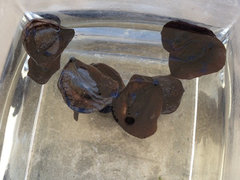
    I guess these interesting discussions occurr when a hobby/profession and a passion come together..... Regardless, my species, hybrids or whatever they sold me...are sinking


    .

  • PRO
    10 years ago

    So you were sold seed instead of bulbs? How long have you had the seeds floating? Usually my seeds send out a root within 2 weeks of floating.

  • 10 years ago

    2 weeks

  • PRO
    10 years ago

    I'd give them at least another week and then start worrying if you do not see roots emerging.

  • 10 years ago

    Rosina, it looks like there is a dead root emerged on at least 1 seed. When you first prepare the water, do you add any hydrogen peroxide? A brown.black root doesn't hold much promise; the roots should be white.

  • 10 years ago

    K: I put on my glasses and checked....there is nothing...not even a dead root. I didn't use H2O2......well, what can I do? Just wait and see what happens....

  • 10 years ago

    Yes just wait. What is that pointing down into the water from the seed near the middle of the photo? Maybe a piece of the papery seed covering.

  • 10 years ago

    it is a confused seed....it thinks it is an angelfish....

  • 10 years ago

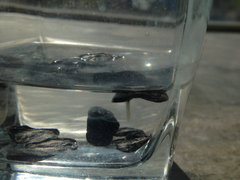
    Sprouting! Now, we are cooking with gas....hoping 'angelfish' and the rest get the idea.

  • PRO
    10 years ago

    Great news! Right on schedule; 2-3 weeks. I keep mine under fluorescent light until transplanting. Are yours in or under light?

  • 10 years ago

    Rosina, yes....looks from the side. That looks like a nice healthy root. The FAQ has lots of info on rooting seeds.

  • 10 years ago

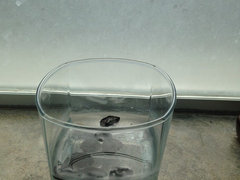
    Glazed glass window during the day and they sleep in a heated bathroom, I have more seeds....

  • 10 years ago

    what seeds is yours?

  • 10 years ago

    Don't know for sure....

0
Sponsored