Software
Houzz Logo Print
sam_md

Brood of Vipers

10 years ago
last modified: 10 years ago
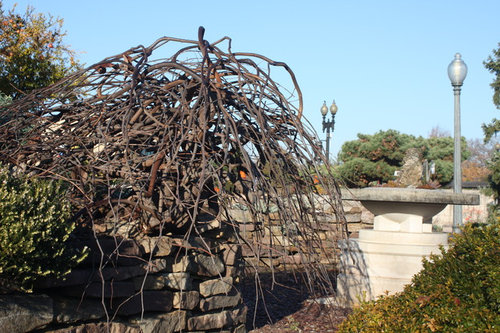

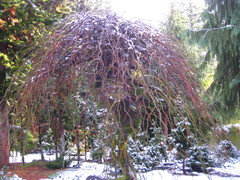
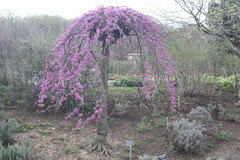
At least that's what it looks like. Don't see any sign of berries or cones. looks like its on its own roots. Growing in a raised bed in Wash DC next to blooming heather (unusual). No, its not Blacksnake Bush (I already checked) Can you name it?

Comments (25)

  • 10 years ago

    Weeping redbud???

  • 10 years ago

    Too gnarly to be an Acer palmatum var. dissectum.......maybe weeping mulberry?

  • 10 years ago

    I second weeping red-bud.

  • PRO
    10 years ago

    Agree with weeping Cercis, maybe 'Covey'?


  • 10 years ago

    My first thought was Camperdown Elm. I've never seen a weeping redbud. They're not common here.

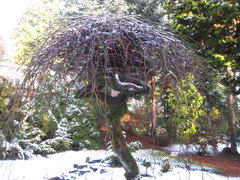
    Here's my Camperdown Elm this morning. The smaller branches have a bit of a zig zag look.


  • 10 years ago

    I call it Scamperdown elm because gray squirrels get on them and gnaw the bark.

  • PRO
    10 years ago

    Camperdowns have very distinctive buds. A closeup would tell.

  • 10 years ago

    The one asked about looks quite like the red-bud. I didn't mention the elm as a possible candidate.

  • 10 years ago

    On closer inspection I don't think it's a Camperdown Elm.

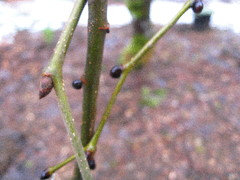
    Here's what the buds look like now on mine.

    Mike

  • 10 years ago
    last modified: 10 years ago

    The shape and colour of the remaining leaves suggested a weeping katsura - cercidiphyllum japonicum f.pendulum to my myopic eyes...although older specimens do achieve a rather more graceful outline than the OP pic.

  • 10 years ago


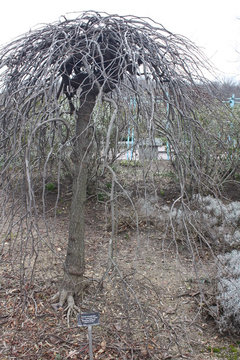
    Another weeping redbud. This one is staked up to about 5 or 6' and allowed to weep.

  • 10 years ago

    "Another weeping redbud"

    So are you saying the first one was also a weeping redbud? Lots of us had a go at the id but you didn't confirm. Can you enlighten us?

  • 10 years ago

    The plant in my OP looks like a weeping redbud. There are a couple of last year's leaves caught up in the top. The bark is smooth & dark like redbud.

    The pic in my OP no longer shows, why is that? Is that just me?

  • 10 years ago

    Just you, Sam. I see it fine. Try again.

    The first picture looks like a Weeping Redbud to me rather than a Camperdown Elm. The Redbud has smooth, curvier branches and not the zig zag of the Elm.

    My neighbor has a large weeping Katsura and the Redbud and Elm doesn't look like it.

    Mike

  • 10 years ago

    Yes, it has looked like the red-bud from the start.

  • 10 years ago
    last modified: 10 years ago

    Minor detail but I'm compelled to point out that's a heath, not a heather. (although generically, people sometimes say heather to refer to either one and more - i.e., the entire world of needly-leaved Ericaceae - it's important the distinction is made if anybody wants to go buy one)

    That looks a bit like the somewhat mysterious clone floating around the east coast wholesale nursery scene called "Mediterranean White". There also "Mediterranean Pink". These seem like either inferior clones of E. X darleyensis or brobdingnagian forms of Erica carnea. In any case if one wants a winter blooming heath (or a winter blooming plant, period!) I highly recommend a better form of Erica X darleyensis like 'Kramer's Rote' or 'Ghost Hills'.

    (gardengal, bboy, et al., the 'Med Pink' and 'Med Whites' out there might be the real thing. Here what nurseries sell as that never fully blooms in winter. Some say 'Med Pink' is the original E. X darleyensis: 'Darley Dale': but in my former garden a Heaths & Heather Nursery purchased 'Darley Dale' was blooming its head off in winter while a locally purchased 'Med Pink' was not; furthermore the flowers of 'Med Pink' which came later, were not as well colored) And btw 'Darley Dale' and 'Kramer's Rote', both in my old garden and this one, have had their open flowers withstand 3F. Yep, THREE degrees F. No typo. Surely the world's hardiest flowers? Not even the meso-arctic or antarctic flora has to withstand that? Because they bloom in the respective summers and though can tolerate frost, only a few degrees of it?)

  • 10 years ago

    ??? I've searched and searched but can't see any mention of heaths or heather in this thread. Are you in the right thread?

  • 10 years ago

    ....that's a heath, not a heather.

    Thanks davidrt28 for pointing that out. Both are so rare in these parts it is easy to get them confused. Interesting how heath & heather are so common in other parts of the world but a rarity in the midAtlantic.

  • 10 years ago

    Aha - at last I see the Heather mention right in the top post.

    ....that's a heath, not a heather. My personal take on this is that it is not worth worrying about trying to distinguish between the two names 'Heath' and 'Heather' since both are common names. I can't see that they serve much purpose in trying to identify plants accurately. If the botanical nomenclature is used the issue doesn't arise and good growers should be doing so.

    Nor does the distinction appear to be used by Heather experts around the world. The Heather Society of the UK doesn't bother with the name 'Heath' at all, except when giving vernacular names, and just sticks with 'Heather' for all the genera including Calluna, Erica and Daboecia. As does the North American Heather Society and all the other heather societies I've found. Heather Society of the UK

  • 10 years ago
    last modified: 10 years ago

    Interesting that the distinction is now being downplayed...but I'm quite sure all of the older, classic primary sources make it clear that the common name for Calluna is Heather and for Erica it is Heath. It might be a more important distinction here where Heathers are much harder to grow in a hot, humid summer climate...that was part of my impetus for making the correction. (not that most Heaths are particularly easy other than the very tough Erica carnea.)

  • 10 years ago
    last modified: 10 years ago

    mmm, never use 'heath' myself but I do refer to calluna as 'ling' and erica as 'heather'...just to distinguish them in my own head. Alternatively, I stick with winter flowering or summer flowering...although living in calcifuge land, I never grow any of them.

    As for weeping redbuds, I am seeing (awful) Lavender Twist in all the trendier gardens in my location lately.

  • 10 years ago
    last modified: 10 years ago

    No problem at all Campanula, I appreciated your perspective on the issue. Maybe the distinction is more common here than elsewhere. For example, look at the retail sales list for this nursery, which I think of as one of the ones carrying the most characteristic mix of "high end but not extremely rare" landscape material on the US east coast.

    http://www.colesvillenursery.com/inventory

    You will see they offer Erica as Heath...and not surprisingly do not offer Calluna at all. (though I have probably seen them on their list at times, they will always stock those two purported winter blooming heaths, which have become very common in the past decade and are even spotted at places like gas stations and strip malls!) So again that was my point for the correction, just to make sure people knew what that plant was commonly called in the nursery trade around here.

  • 10 years ago


    And here is our 'Lavender Twist' redbud in bloom.

Sponsored
AIS Renovations
Average rating: 4.5 out of 5 stars15 Reviews
Custom Craftsmanship & Construction Solutions in Franklin County, Ohio