

Observations from someone new to vermicomposting
Whenever doing something new, I first research (internet, youtube, etc) for weeks, perhaps months... then I carefully plan things out and purchase and so begin to learn first-hand how it all really works. This is the same pattern I've followed learning about vermicomposting.
I read up a lot on the internet and as expected, I found a lot of conflicting information. One source of confusion was how much a pound of worms are expected to consume per day, this is suppose to help me determine how many worms I need to get started with and thus how much bin area I will require. All sources seem to use the same measurement units, ratio of pounds of food per pound of worms. Many sources say half a pound of food per pound of worms daily... though I've found other sources stating it as high as 4-6 pounds! of food per pound of worms "under ideal conditions". So I set-up my bins (9 sq-ft area total) with bedding and buried juiced vegetable pulp back in early-October and allowed the decomposition to begin, then 2 weeks later I stocked the bins with 8 pounds of worms, which mathematically should then process 4 pound of food per day or 35 pounds per week! (once it really gets going in a month or two). Here it is mid-December, I would estimate those worms are up to handling maybe 2-3 quarts of pulp per WEEK! (that's only about 12-15 pounds tops!) That doesn't even amount to our normal juicing pulp residue for the same time period... and now since I'm already experiencing my first "white" mite bloom, maybe they aren't even able to keep up with that much. So I get to thinking about this and I realized that weight is not a good way to describe quantity of worm food... for example, what about water content? before juicing vs after juicing the weight varies considerably, for instance are people referencing a whole cantaloupe or just the pulp after the juice has been removed (by juicing or evaporation). Also what about grains? Is this dry weight? I can't imagine worms could consume half their weight in dried grains per day! Grains are far more nutrient dense (protein) than fruit and veggies.... especially dried. I've recently started to powder-up some hen layer mash and occasionally feed that to help keep the rising moisture level down in the bins (concerned by this recent white mite bloom). Thus pounds of food are a meaningless quantity measure considering these circumstances of nutrient density and water content. So what the heck are people talking about (what do they mean) when describing quantities of food by weight that a pound of worm can consume?
Another confusing issue I ran into as a novice is the issue of my worms trying to escape... I'm told it means something is amiss with the conditions in the bin... ie. too acid, too wet, not enough food, bedding too toxic, temperature too hot/cold. THEY say worms do not try to escape if conditions in the bin are to their liking. So I kept the tight fitting lids on the bins and notice that every time I remove it there are worms crawling around everywhere. It made me so paranoid I was suspecting every thing was wrong in my bins because my worms were always trying to "escape". Well after observing them for a number of weeks I finally came to the conclusion that worms naturally "walk around" in their environment if the humidity is high enough (and its dark)... that is probably because that's when it is safest for a worm to get out into the open air and explore without the danger of drying up (suffocating). I eventually found that if I leave the lids off so that humidity can no longer rise to that level of a raining summer evening, they no longer wander around above the "ground" level in the bins. I wish some one had mention that worms should never want to leave the bin EXCEPT if you leave the lids on !!!
Also, paper vs cardboard... I don't think worms like eating paper pulp per se but will do so if nothing more appetizing is around. However they seem to prefer to live between the corrugated cardboard (again I believe its because of the high humidity conditions) rather than dwell in shredded bedding materials. I think that what causes the cardboard to disintegrate is mainly bacteria breaking down the pulp, which I read on the internet the worms then consume the bacteria. I find that what the worms really seem to enjoy is partially composted leaves so that is now what I've been giving them as their bedding material. I put a 3-4" layer of it on top every week or two now. The worms love poking holes through and squirming in and around the stuff.
I've made a number of other observations in these past weeks but will stop here as this posting is turning into a novella at this point. Anyway these are just a couple of my personal observations thus far. I've been scraping back the compost leaf litter and turning over the contents in the bin underneath every couple days now, trying to assist the drying out process (remember the mite bloom I mentioned?) and I find thousands of worms happily existing at all levels within the bin. The worms appear to be doing fine and are multiplying (I've seen a ton of eggs) so maybe they will eventually be capable of processing more pulp as time goes on.
Comments (43)
 10 years ago
Yes, worms do (try to) escape if it's too hot, or too cold, or too wet, or too dry, or too light, or not enough air flow, or before/during a rainstorm, Or even if it's Christmas Day and they're dreaming that it's 4th of July.
Happy Holidays.
Shaul- 10 years ago
I don't think worms naturally wander - me thinks they are not happy about something. Altho red wigglers like it moist - too wet they don't like.
btw - you didn't mention what kind of worms you have?
<or not enough air flow,>
I wonder if it could be this? Or low O2 in the bin. Related Professionals
Muskogee Landscape Architects & Landscape Designers · San Antonio Landscape Architects & Landscape Designers · Anniston Landscape Architects & Landscape Designers · Manchester Landscape Architects & Landscape Designers · San Jose Landscape Architects & Landscape Designers · Montrose Landscape Architects & Landscape Designers · Mountain Home Landscape Contractors · Elizabethtown Landscape Contractors · Meridian Landscape Contractors · Southaven Landscape Contractors · Parkersburg Landscape Contractors · Idaho Falls Landscape Contractors · Longview Landscape Contractors · Spokane Landscape Contractors · Los Angeles Stone, Pavers & Concretemonomer
Original Author10 years agolast modified: 10 years agoI have a mix of both red wigglers and European night crawlers in both bins. Interestingly, I seemed to notice that when going out for a "stroll", on some days it will be the red wigglers cavorting about and at other times its the night crawlers taking a walk... they don't seem to want to be in mixed company. I can only concluded then that this is some natural sort of urge, sexual perhaps?... it only happens when the lids have been ON the bins long enough to be just dripping wet from all the humidity that's built up. I've now verified it several times that the worms never leave the safety of the bedding whenever the lids are left OFF, regardless of whether it is light or dark out. This behavior is also true for the "white" mites... lid ON mites everywhere on the sides and lid... lid OFF the mites disappear as soon as it dries out. BTW, the mite bloom seems to have abated... I think it was a combination of overfeeding a vast quantity of melon pulp all at once and the resulting bedding material then becoming way too wet. Added info: my bins have a 1" large drainage hole at the lowest point in the bin (with screen door material hot glued over it and multiple drainage tracks leading moisture to the hole thus eliminating any possibility of standing water at the bottom of the bin) Also my bins have twelve 3/4" holes drill an inch from the bottom all around the bins and another twelve more of these holes an inch from the top of the bin. All holes have screen hot-glued over them to prevent any escapes. Whenever I turn the bedding over there is never any anaerobic smells emanating from the bins, so I've got to believe the worms are getting enough oxygen plus they are found at all levels in the bedding and not just walking around up above the bedding. Remember I have approximately 4000 worms in each bin and I doubt I've ever seen more than a hundred "walking" around at any one time... and again they are mainly of one type or the other of worm so I thought maybe it was a sexual thing, but what do I know? really, I haven't been at this vermicomposting thing very long to really claim to know anything for sure.
Just fed them a mixture of composted chicken poop, layer mash with powdered egg shells added, and a small amount of green sand... and I'm still leaving the lids off. Will check up on them in the morning...
- 10 years ago
Fair warning - I am by no means a worm expert but...
<I have a mix of both red wigglers and European night crawlers in both bins.>
but aha... me thinks they like different environments. As mentioned, red wigglers do like a moist environment but I don't know what the European night crawlers like or prefer. That said you may indeed have more than one problem cuz I do know they can't mate with each other either.
Prob more work to give them separate bins?
Are you sure these mites aren't fruit flies? Is any of this food exposed to air? The juicing food is prob what is causing the excess moisture.
<it only happens when the lids have been ON the bins long enough to be just dripping wet from all the humidity that's built up.>
<thus eliminating any possibility of standing water at the bottom of the bin)>
IMO dripping wet or condensation in the bin for any reason (cover on or off) is way too wet. There should never be any "standing water" either.
<So I set-up my bins (9 sq-ft area total) with bedding and buried juiced vegetable pulp back in early-October> not sure how a 9 sq-ft area is divided up into two bins. But me thinks each species need its own environment.
<Remember I have approximately 4000 worms in each bin> 8k worms seems to be quite a few since October.
Could also be the (acidic) food that causes the worms to wander?
monomer
Original Author10 years agolast modified: 10 years agogumby... remember all I had going into this was a lot of reading on the internet with all the conflicting advice people are giving swirling around in my head, still basically I was just lurking. This thread is the first I've posted on anything to any vermicomposting forum on the internet.
My understanding was that both species had their own proclivities but would happily coexist in high densities partly because the night crawlers like to go deeper into the bedding. Based upon this my thinking was that it would be more efficient in a deeper bin to have both species working at all levels on composting. So I started with nearly equal quantities of both types of worms.
Both of my bins are identical at 31"X21" giving a total surface area of 4.5 sq ft. My bedding depth keeps changing but is about 10"-14" mostly. I read that 1 pound of worms per sq ft area was ideal as they could still multiple to 2 pounds per sq ft before population would naturally taper off. That would calculate out to between 28-56 lbs of food waste conversion per week after a few months of operation. We produce (estimate) about 20-25 lbs of juicing pulp per week... plus additional other food waste due to food preparation, cleaning out the fridge occasionally, etc. I calculated would make the numbers of worms to get to started 4000 per bin.
For all the years we've been juicing (its been over 15 years now) believe me, I do know fruit flies when I see them... also fungus gnats and their larva and mealy bug drones. No these must be "white" mites because they look exactly like the photos I've seen and the descriptions I've read about size and behaviors... yes, I'm pretty sure they are just the harmless "white" mites people on these forums speak of. I think they get introduced into the bins because I'm now putting in partially decomposed leaf litter (from our outdoor compost pile) as worm bedding (I'm still adding some corrugated cardboard shreds as well because of its water holding capacity). Yes, I've read that these type of mite populations explode in worm bins due to overfeeding of moist pulpy foods, especially in the melon family, high moisture bedding and acidic conditions so... I am adding eggshells with every feeding and have also added powdered dolomite limestone as well as green sand so lots of calcium in there to counter-act the acidity of the composting reactions of nitrogen compounds.
As far as the pulpy foods I feed... no citrus (I juice it but the pulp and peels goes straight into the trash). Fruits so far have been apples, grapes, melons (all three types), banana peels... Veggies have been many types of lettuce, spinach, dandelions, chard, parsley, limited amounts of tomato (yes, quite acidic), carrots, cucumbers, beet greens, spring mixes. So not too much for acidic foods. I take the juiced pulp in containers and freeze it for several days and then let it thaw for several more days before feeding to the worms. I think I'm doing it right... there have been no stinky smells arising from the bins so far (knock-on-wood), my wife has been so pleased since I've talked her into allowing the bins to be moved into the basement. After that it took me awhile longer to convince her it would also be "safe" to leave the lids off the bins even at night... so as you can see because it takes time to allay objections from my wife these are fairly recent developments in my journey into vermicomposting.
Until I discovered I could leave the lids off all night, I would have leachate dripping out of the bins, sometimes as much as a cup would drip into a bowl I have placed below the bottom drainage hole in one night but usually its more like a couple tablespoons from constant dripping until recently. Just since yesterday that leachate dripping has finally ceased and the bowls are essentially now staying dry so maybe that will completely cure any future outbreaks of "white" mites.
- 10 years agolast modified: 10 years ago
Life is a learning experience... even the experts don't know it all but have learned from mistakes. What you have are your very own observations to learn from.
Egg shells and limestone take months to change Ph in the garden - there is no reason for me to think it would be any faster in a worm bin.
IF it were me - I would try adding some baking soda ( maybe a tablespoon) before freezing the mix. Also test the Ph before and after adding the baking soda using some of those Ph test strips. See if that changes any behavior in the bins.
You have not mentioned what the temperature is in these bins or if the behavior was the same in both bins?
monomer
Original Author10 years agolast modified: 10 years agoI've been raising koi in an outdoor pond for 8 years and had gold fish for 25+ years and understand the biology from those experiences and so from what I know about sodium bicarbonate it will peg pH to 8.3 and buffer it there... great for koi (brings out the sumi or blacks where as the beni or red looks best in low pH and very soft water) but is an 8.3 pH desirable for the worms? Also any pH changes must be made slowly otherwise the koi will stress and even die. I remember reading somewhere that red wiggler worms can survive in a pH range of 5-9, which is huge, How large a pH change can the worms take in a short period of time and still survive it?... also I suspect the other microbiology in the bins will have to go through major change as well and require time to rebalance... perhaps several weeks? as it is with a pond's biology. I actually don't know what the pH in my bins is currently but I do have a full set of pond test kits (drops in a test tube) so I could use to measure the worm bins. Before I do it though I'm going to make a guess that its near a 7pH. Nearly everything I've added I believe has been neutral... coir, paper, cardboard, leaves (no pine or oak), local water (moderately hard and 8.0 pH) and then the food I've already listed which I'm guessing the powdered dolomitic lime would have balanced out... so I will be quite surprised if it is anywhere below say 6.8 pH but who knows? Now to go find some distilled water...
Oh yea... temperature of the bins (measured by IR pyrometer with the emissivity set to 95) will range in places just like any compost pile does but mostly seems to stay somewhere between 65-75F. We have a finished basement with a home theater in one half of it and washer/dryer and worm bins in the other half, so it is heated just like the rest of the house.
- 10 years ago
I think you are over thinking it.......dont worry about pH unless you are feeding bokashi. Avoid all things citrus, papaya, and pineapple. Go light on tomatoes (I overfed tomatoes once and they freaked). The worm population will balance its self out based on how much you feed...just keep doing what you are doing. Just make sure your bin is draining well and is exposed to fresh air. I removed the lid off mine and replaced it with window screen. I placed a brick on top to hold it down. The worms dont escape and they get plenty of air.
monomer
Original Author10 years agolast modified: 10 years agoViper.... yes, I really don't think pH is a problem in my bins but now I am curious and I do have the test kits. Since my test kit uses test tubes and drops I must use distilled water (which has a pH of 7 and no minerals in it to buffer the solution) to dissolve a bin sample to accurately determine the pH of the contents in my bin. I will half fill a mason jar with distilled water and to this add some contents from the bin, swirl and let the particles settle for several hours before drawing a sample for my test tube... then add the re-agent drops to the sample and compare sample water color to a chart. Since this test is made for pond water applications and I've never tried it on soil samples, I'm hoping there isn't going to be a strong tint to the water (from tannins) as that might mess me up when trying to match-up the color with the chart... hence another advantage of using distilled water without any buffering capacity is I can dilute it to lessen any tannic coloring and still maintain accurate pH of the solution. So my biggest problem right now is just finding some distilled water. We live in a small town in the boondocks (pop. 2200) and on Christmas eve because of a huge windstorm, many power lines got knocked out by downed tree branches... I'm talking like many hundreds of separate power outages throughout northern Michigan. We had our power restored in 4 hours but many people in the more rural areas are still without power even today. Well these rural people need power to get their well water so.... all the stores in the area have been sold-out of any bottled water, including all the distilled water, since Saturday. We are now in the midst of a winter ice storm so I'm not going to go looking for distilled water until tomorrow or Wednesday so... yes, I agree the pH is not really a concern and thus not a high priority right now.
Interestingly, my bins are now dried to a level where there is no more leachate coming out of the bottom and last night for some reason my wife decided to put the lid on one of the bins. Sure enough when I lifted the lid this morning there were walkers along the sides of the bin and upside-down on the bottom of the lid, though there were only about a dozen of them out and about... they were all the European nightcrawlers this time. I've left the lid off now and so far no walkers have appeared and "white" mites were no where to be seen... so to my way of thinking, that confirms the moisture/mite connection. Though I don't think I need a screen over the bin, I think I will follow your example and put a screen on top so as to give my wife a feeling of security that she won't run into worms roaming through "her" basement... one of her biggest fears.
- 10 years ago
<yes, I really don't think pH is a problem in my bins but> but you have a problem. A problem you have described here.
We have brain stormed some possibilities - logically you need to "rule out" things it can be. You can rule out by simply saying "oh that's not it" or use some logical testing methods or you can just leave it be.
I tend to think that being too wet was at least one problem.
I don't know about that habits of your worms but I do know there are night crawlers that live a solitary life and the only time they come out of their burrow is to mate. Worms mate when they are happy.
Maybe it is time to make another bin for the night crawlers when they come out to mate you can easily separate them.
You may be able to find litmus paper test strips before you can find distilled water. Perhaps the test strips won't be discolored by the leachate.
- 10 years ago
monomer: Very good observations, actions on your part and interesting posts.
Are you using those Rubbermaid bin for your worms? Yes, worms DO wander even when nothing is wrong with their bedding etc except having condensation on the walls. I'm not too sure about the chemistry but I assume that wall condensation is H2O only and the worms "know" it's safe.
""how much a pound of worms are expected to consume per day"" Please note "expected". Another word is "under perfect condition" whatever that is. There will always be at least one thing that will make our bin not perfect, so that formula doesn't (will it ever?) work for us.
In regards to the no-no for worm food that I did use and no harm to my worms:
Papaya: the flesh and skin if from ripe papayas (or if it already start to decompose) is safe. Definitely a no-no are the seeds. I have read somewhere they will cause infertility in worms. There is a substance (tannin?) in unripe papaya that is used in Asia as meat tenderizer. Some people wrap papaya leaves around meat to tenderize it.
""the destruction or modification of tannins with time plays an important role in the ripening of fruit and the aging of wine"" from https://en.wikipedia.org/wiki/Tannin
Oranges: Only oranges (NO other citrus) once the skin are soft and mouldy. Here again it is the orangy colored skin that contain some oil that breaks down once the skin decompose. As for acid contents, I'm not sure how much acids are left once the oranges were pressed (and rot) because I found worms inside the "bowl" of pressed oranges (which I have left in a bucket to rot for more than a month). I assume, this pre-rotting also got rid of the spray orange farmers use to preserve oranges for sale.
When I first started to use Rubbermaid bins for worms, I drilled holes top, bottom and sides. Then I changed to big holes on the sides to big holes with screens. Now I run an appr. 14" x 20" x 15" deep plastic bin with no holes at all. I do have a lid for it in case of walkabout spurts. I cut out most of the lid, leaving about 3/4" of level area around so I can glue weed cloth to it. Window screen didn't work for me since worms got through. I also lined the sides with corrugated cardboard to help absorb extra moisture. I replace them once they're wet and easy to rip. This bin is going into the 4th winter now with no problems. I do have a reptile heater cable attached to a thermostat during winter to keep them warm.
Another thing, you are using your pond water for the bins when they need watering, right?
monomer
Original Author10 years agolast modified: 10 years agoOtis... My bins are Centrex Plastics Commander 27-gal Totes (http://www.lowes.com/pd_44066-61896-44066_1z13eb3__?productId=3551290&pl=1#img). Its a black storage bin with a yellow top and quite sturdy... also is not stiff/brittle like Sterlite containers but not as flexible/tough as a Rubbermaid. Its fairly thick and is molded from a tough HDPE (high-density polyethylene), which means its impervious to all chemicals dissolving thus prevents any absorption of nasties into the material and the deep black (means carbon black has been added) greatly improves HDPE's UV-resistant. The thing that attracted me to these particular containers is the design of the bottom. It has several channels designed into the bottom ostensibly to add flexural stiffness but being that these are in a linear radial pattern that converge in the middle of the bin, it provides a natural flow path for drainage of any liquids at the bottom of the bin should I drill a hole in the center... and when the bin is set upon two bricks, one at each end, the center sags under the weight of the wet bedding just enough to encourage any leachate to flow to the lowest point... PLUS the bricks hold it off the floor just high enough so I can scoot a plastic bowl beneath the drain hole to catch the leachate. Pretty nifty, huh? (additional info: I have hot-glued an 18"x12" plastic sheet over the hole to keep the channels unobstructed and free-flowing, however I'm sure it would continue to drain well without this little modification, perhaps just not quite as free-flowing)
I've read in other places that pineapple and papaya were no-no's in worm bins but I had assumed it was because both contain powerful protein enzymes (in fact, the papain digestive enzyme purchased in pharmacies is taken from papaya and the bromelain enzyme comes directly from raw pineapple juice). In fact, both fruits are often intentionally used in the culinary world in dishes just for the purpose of helping to digest proteins (especially in meats). I'm pretty sure these powerful protein enzymes would dissolve a worm (which is mostly made of protein molecules).
We "closed" down the pond back in October... living so far up north, our koi pond season is relatively short (basically late-April to late-October). Koi sort of shut-down (they go into a state called torpor) and sit at the bottom of the pond waiting for spring (and thus warmer waters) to arrive. All activities, including microbiological, slow down and so its safe to shut-off the pumps and filters. In addition we cover our pond with a PVC-frame and a thick polyethylene film and float a bubble solar cover, so its not easy to access the pond water or even to view the koi. I just have to trust that the koi will get through the winter alive and in the spring (that's actually the really risky period) we crank the pond back up again. So, I didn't start vermicomposting until after we had closed up the pond this year... but it had never occurred to me to use pond water in the bins.
In the beginning when I felt the bins actually needed added water I just used a large spray bottle filled with the water we leave out for watering the house plants (thus de-chlorinated) and mixed in a small amount (~1/8 teaspoon) of molasses to "feed" the microbes. However soon the leachate began flowing and I haven't had to add any more molasses/water since then... that was like two months ago. The juicing pulp I feed provide way more than enough moisture to the system, to the point where it will induce leachate dripping shortly after each feeding of pulp.
The stores here are still out of distilled water... when I went looking yesterday they told me all the new bottle water stock they got in Monday morning sold-out in a matter of hours just prior to the ice storm that started Monday afternoon... apparently everyone was afraid of more power outages due to all the ice.... well, it didn't happen so I guess all those people are now well stocked up on bottle water for the next disaster scenario that comes along. I'm told the next time the store shelves get re-stocked is Thursday. Such is life, living in a small town. Well at least the bins are looking (and smelling) just fine. No leachate, no mites, worms under the cardboard and leaf litter look healthy and are quite active.
Gumby... my understanding (through what I've read on the internet) is that most nightcrawlers are indeed solitary except to mate however the European NC is different and this is part of what makes them more adaptable to bin living... they are quite sociable and can thrive in very high densities. And in fact, I also read in several places that many worm farmers that deal in both species cannot even guarantee complete segregation as both worms will happily co-exist within the same bins and eat the same things and we know worms can wander, which makes it a challenge for the worm farmer to keep them apart... thus far, this has proven to be the case from what I've observed. Besides I really don't think I could separate 2000 red wigglers from 2000 nightcrawlers by hand (not to mention all those mixed cocoons) and then repeat for the second bin... I think it would be a lost cause plus I really don't have that much time to spend sorting them all out.
Also our discussion here prompted me to do further searching on "pH and worms" and I came up with a wealth of information (some of it conflicting at times but that's to be expected). Most information sources seem to agree that 6.0-7.0pH is the range where worm bins should operate within... and a couple sources said, though not ideal, it's okay up to 7.5pH before problems will begin to appear, however they don't say what those problems are nor what to look for... so that's frustrating. Considering this "new information" it would seem a pH of 8.3 would not be wise in a worm bin. I do know from all my koi pond experience and knowledge that baking soda will put pH exactly at 8.3 and will buffer it there (meaning it will resist any attempts at altering this 8.3 pH until the buffering capacity has been used up and then when it does finally change it can be unexpected and happen quite rapidly). After reading about the target pH range for worm bins, I personally would not risk using baking soda to adjust the pH of my bin... powdered dolomitic limestone is fairly quick acting and will last awhile PLUS it provides calcium which the worms need and is also great for plants where these worm castings are destined for anyway.
EDIT: Now here it is Thursday and I finally have the distilled water. I need not have worried about tannic dis-coloration of the water as the issue turns out to be quite minimal... in a dilution using a couple teaspoons of castings/bedding collected from 3 different locations in the bin into a pint of distilled water there is just a very slight greenish/brown haze cast in the water and with a 5ml sample in the narrow test tube with reagent added it remains quite transparent for color matching purposes... In fact, I'll bet this is exactly how it is really done when people send soil samples in to their county extension office. Well, turns out one bin is a 7.4pH and the other is 7.6pH... these readings are rather higher than I had expected so I'm really glad I did bother to check it. No more eggshells or dolomite lime until the pH lowers at least to 7.0 or below... and something I'd forgotten, way back in the very beginning when first setting up the bins, I added a small palm-ful of very finely powered bone meal to each bin (it was the consistency of cake flour so it should have started dissolving almost as soon as it was added).
- 10 years ago
I use 10-gallon plastic totes for my worm bins. Instead of a lid I add 3-4" of shredded newspaper & cardboard mixture to the top of my worm habitat. It helps increase airflow while deterring escapes and helping soak up excess moisture.
Two of the biggest reasons why worms make a run for it is the bin is too wet or there's not enough airflow. Both issues can be improved significantly by adding about the same volume of shredded cardboard/newspaper as food with every feeding.
As for how much to feed the "rule of thumb" numbers often cited are for ideal conditions which most of us can't reach, much less maintain. What I do is feed my worms 1/4 section of my bin at a time. In 5-7 days I feed in another 1/4 section. I keep moving my way around in 1/4 sections, checking each time to see if they have mostly processed the previous sections so I don't overfeed. Feeding in 1/4 sections gives the worms plenty of space to escape to in case a feeding goes anaerobic or heats up too much. It also helps move them around throughout the bin as they migrate with their food source thus distributing their poop everywhere.
For food I like offering them a variety: juicing pulp, aged horse manure, veggie scraps, various melons/pumpkins, used coffee grounds, leaf mold, powdered egg shells, shredded cardboard/newspaper, etc. Like you I freeze my food scraps to kill bugs & their eggs. I also microwave the leaf mold to kill any pests (mites). monomer
Original Author10 years agolast modified: 10 years agoCharitycomposter.... you've given the best advice yet... Actually on Saturday (just before your posting above) my wife was getting on my case to empty out the large bags of shredded paper and cardboard I had sitting in the basement and I decided to just pile it up in the bins... all those bins could hold. So now, since the lids are going to stay off, I decided to just mound up all the shredded materials up in both bins to the point of overflowing... about a 6-8" layer sitting atop of a couple inches of partially composted leaves. Monday I fed the worms 25 pounds juicing pulp plus several handfuls of layer mash (powdered) under that 6-8" of paper bedding and by the next day all excess moisture from the pulp had dried up, the mites are absolutely not a problem, most all the worms are at the top squirming about within the food layer... it looked like the food itself was alive. Now today, more than half the food is gone, the bins don't stink... everything is perfect... looking back at your posting I see you were spot on. I believe it was the addition of that huge layer of paper/cardboard bedding that has solved all issues.
So I've learned to keep the lid off and always have a huge layer of paper/cardboard bedding on top... I wish I'd come across this advice back when I started vermicomposting. Thanks.
BTW, I also try to feed my worms a variety not only for the health of my worms but also trying to enhance the quality of the finished vermicompost with the garden in mind. Other than the horse manure, I feed all the same stuff you do plus have included in kelp meal, bone meal powder, azomite, green sand, dolomitic lime, composted chicken manure, blood meal and fish meal... I'm hoping this stuff passing through the worms increases the availability of the nutrients and minerals to the plants. I'll know more this spring if it worked.
monomer
Original Author10 years agolast modified: 10 years agoThere's something different about raw potatoes... they really resist composting. Back in October I put some potato peelings, thin skin cuts only, buried in the worm bin. To my amazement the majority had sprouted... here I thought it had to be a big piece with an eye to sprout. So I then broke the sprouts up and snapped the potato pieces into even smaller pieces. Since I'd been turning over the bin every few days (due to my earlier moisture issues) as recent as last week I was still snapping a few sprouts... unbelievable! Also I'd taken a later batch of potato peelings my wife gave me and ran it through a juicer first before chucking into the worm bin. The juiced potato peelings I hid in one location almost 2 months ago and the worms still haven't made it all disappear yet... and I'd mixed it with coffee fines to make it more appetizing for them too. So I got to thinking... potatoes are root vegetables but so are carrots and beets which seem to decompose normally... what is it about potatoes? I'm thinking, potatoes actually grow from a piece of root whereas carrots grow from seeds therefore there must be some property or chemical that tells microbes and worms it is still alive and to leave it alone so it can reproduce otherwise living roots would decompose in soil which would have lead to extinction long ago. Could that chemical be solanine? ...a chemical produced by members of the nightshade family, that includes potatoes and tomatoes. From Wikipedia "Solanine has pesticidal properties, and it is one of the plant's natural defenses."
"Potatoes naturally produce solanine and chaconine, a related glycoalkaloid, as a defense mechanism against insects, disease, and herbivores.... This is a natural defense to help prevent uncovered tubers from being eaten." Though light seems to be a necessary component to the production of solanine there must still be enough in the root to ward off worms and microbes for awhile... I'm just surprised as to how long this is taking. If its not solanine then I don't know why it takes so long but I think in the future I will either boil or microwave the skins before tossing them into the bin as cooking is suppose to "effectively lower glycoalkaloid levels" according to Wikipedia. Since I've been avoiding putting any tomatoes into the bin, I don't know if they too will also have difficulty composting properly. Anyone know the real story?
So other than the potato peelings, the worms are now eating everything I am throwing into the bin. Today I'm going to try some old salad my wife didn't finish eating a couple nights ago... besides the obligatory lettuce and spinach leaves and spring mix, its got tomatoes (remember the solanine issue), olives (which are soaked in brine solution... salt), some Ranch salad dressing (oil), cheese (dairy), some thin sliced smoked ham (meat), and eggs (sulfur). Mind you this is not a huge amount of salad, only about a cup or two's worth but it will be interesting to see how the microbes and worms handle all those "no-no" foods. I intend to bury it in a special corner section of the bin to keep it separate where I can monitor it and watch what happens to it over time.
 10 years ago
My ENC eat the hell out of tomato flesh. More than once I've found a papery skin with dry seeds rattling around and all the soft guts sucked out. Skins break down and disappear later. I'm not sure about the seeds - they might be sprouting and dying in the dark, then being eaten, but I might end up with tomatoes growing as weeds this coming season.
- 10 years ago
On the subject of how much food the worms can eat per day. Ive never seen the quotes mentioned above 6-8 lbs , an unbelievable amount. Ive only read that 1/2 to 1 lbs of food per lb of worms and most often its the former of the group. To be a little technical when food scraps are first put in it takes the decomposition mode to set in before the worms can even start to eat it and that could take 24-48 hrs.
Recently I started a new after having two different bins going for about 4 yrs and Im as excited about this start as I was in the beginning. That bedding has been sitting for a couple of days and Im about ready to add at least a lb of worms and I have plenty to spare.
monomer
Original Author10 years agolast modified: 10 years agoI wrote 4-6 lbs above... and here is an excerpt from the Red Worm Composting website (likely the place I got that figure from)...
"The type of waste can also have a significant impact on the quantity of
waste that can be added every x number of days. Tests using highly
optimized professional flow-through reactors have shown that worms can
potentially consume 4-6 times their own weight in food PER DAY! I should
mention that these numbers are based on consumption of grocery store
produce waste (similar to homeowner food waste, I would imagine)" That article can be found in its entirety here http://www.redwormcomposting.com/reader-questions/how-much-waste-can-worms-eat/I'm assuming that you've also mixed in some old bedding from one of the active worm bins into the new bedding... that should goose the microbe levels in the new bin. I know from other environments that depend upon microbial balance that things can/often go crazy until the balance is struck between all the living creatures in the eco-system but if you put in starter microbes from a balanced system it will appaer to accelerate a new system through the growth period and reach a natural stabilization point much sooner. I've seen this work within ponds and within filter systems that rely on microbes and other little pond creatures. I think because my bins were totally new (and sterile though I did seed it with some garden soil) my bins were apparently going through "growing pains" these last 3 months but just lately it seems to have achieved a balance and settled into a groove where the worms are much happier and have grown a bigger appetite because of achieving a balance... oh and not to mention I notice they've been doing a bit of mathematics lately (as in multiplying while many microbes prefer division).
- 10 years ago
About how much worms consume each day, they didn't say how many % water content, whether that is included in the weight or what. And then again what if much of that water just trickled down as leachate or absorbed by bedding.
I agree with Bentley if the weight is based on grocery store product waste it would seem that worms are big consumers.
I p/u my worm food from a juice store, the pulp. Even that, one 3 gal. container could have a different weight from the next, depending what pulp (i.e. carrots, apples, beet or greens) and how diligent the staff were with cleaning the juicer. I don't worry too much about the amount they eat anymore as long as I am still adding food. I check my bins every couple days or so and usually add a scoop here and there and check for SOP since I feed them rather heavy.
- 10 years ago
I pretty much agree with Otis let the worms guide you. Since all bins will be different with differnt people depending on what they feed and how they feed and how many worms are in the bins and if they are happy and healthy and readily reproducing. I too like to keep a constant supply of food in the bin to keep them steadily working on it , that is to a point of starting to smell a little if that happens I back off a bit.
monomer
Original Author10 years agolast modified: 10 years agoWell its been about 3 weeks since I last posted to this thread. The wonderful things that had already begun occurring in the bins weeks ago have continued...
The impression one gets when reading on the internet about just how easy it is to start a worm bin makes it seem like you get a plastic container put wet newspaper into it, dump a bunch of worms in and start putting all your kitchen scraps in and tada, you're vermicomposting. The truth is this is an eco-system that must be created and slowly nurtured until a balance of all the inhabitants is fully achieved... like 3 months later! This describes the journey into vermicomposting for me.....
Even though I tried to fast-track it by putting in juicing pulp (frozen/thawed) ahead of time... inoculated bedding with pre-composted leaves, dirt (as well as coco coir and shredded paper/cardboard) and purchased 8 lbs of worms to start... you just can't rush mother nature. Took it nearly 3 months for the bins to hit their stride... about the time I started this thread the last of the weird stuff (moisture issues and mite bloom) was just resolving itself... and the worms' appetite began to grow exponentially and huge numbers of baby worms appearing all over the place. In the last 3 weeks since I last posted to this thread I've been able to put every edible waste we produce into the bins... all the juicing pulp, all the kitchen scraps to the point where nothing organic goes into the trash can anymore (not even cardboard boxes or newspaper circulars)... it all goes into the worm bins and the worms are keeping up. THIS is how I'd imagined it would be... but it took 3 months to get it to this point. For the first couple months I really doubted the worms were ever going to be able to keep up with our organic waste load, now I'm worrying about how I'll be able to feed all the new worms and how I will manage to harvest the castings.
I'm sure it won't be ready to fully harvest for another month or two but when its ready I'm guessing it will be on the order of 30-35 gallons of it... and the next time I suspect it won't take nearly as long. My wife got me a bonsai for Christmas and I decided to harvest some castings to use as fertilizer (say 1/16" layer on top) and she wanted to repotted a couple house plants as well so adding some castings to each pot would be a good thing... so I tried to scoop some of the castings up with my hands... way too many worms in every little bit... I even tried to go way down to the bottom thinking there would be less worms way down there and yet still too many worms in every handful. Eventually I pulled out several handfuls with the least amount of worms I could and then spent quite awhile separating out the big worms I could see squirming around and did the shining the light on the pile thing. Even so, after I thought I got out all the worms when I looked a little closer I could see still a ton of smaller worms (babies) in every pinch of compost... I swear I couldn't get a teaspoon's worth of castings without having to then remove at least a half dozen or more very tiny babies and even then I would still miss a few. If all these little worms grow up to adult size in a month or two I could be in big trouble. I'm sure the population has way more than quadrupled from the original 8000 I started with. I'm already planning on starting another two bins just to have a place to put all these "extras".
I'm just hoping to make it to spring (early-May here) where I can then build something much larger outside and feed them heaps of yard wastes (I can get all I need from the county public compost piles). The plan is to have enough finished vermi-compost to mix into all our raised beds and I'm planning on building yet another couple more raise beds in addition to what we already have. We also sell plants in planters and troughs at craft fairs and so will need adequate vermi-compost for those endeavors as well. I don't want to ever have to resort to chemical fertilizers again. My goal is to produce enough vermi-compost that's complete plant nutrition and naturally slow-release... that's why I'm including stuff like azomite, green sand, bone meal, kelp, etc. in their food source. I'm thinking beyond the worms and focusing on the end point.... our plants.
- 10 years ago
I too tend to research youtube for any new project and that included before I ever jumped into vermicomposting. I watched vid after vid even the ones that show you how not to start a bin.
Because it does take take to develop the environment that is right for the worms that is why they will tell you to throw in a handful of dirt/soil as some microbes will be there. Also when I add a tray or start a new bin I will take some of the old shredded paper and to start with as it will have some microbes too. I had difficulties with my homemade plastic starter bin and would recommend to anyone just starting to use a rubberized material. Still Im using the homemade one but have made adjustments that have allowed it to succeed relatively. But I also have my 360 and a new bin started with worms and materials from the 360. I have never regretted spending the money for the 360 , it is the more efficient system. I would suggest to anyone starting new to start small in case they decide its not for them in the long run.
- 10 years ago
monomer: I'm glad to hear about your new "happy and joyous" problems. Yep, you need much bigger binS now. Congratulations.
- 10 years ago
Hi monomer I was reading through your posts and I do a lot of juicing as well. I have thrown in some things that people would recommend against such as Pineapple and Papaya. For Papaya I typically juice the seeds so they would end up straight in the bin and still have strong worm populations. I do find that the leftovers from juicing are consumed much more quickly than other food I have put in the bin an this is do to the large amount of surface area for the worms to work. If I put in something solid they need to consume the outside to get in where as with juiced material they can slide right into the middle of the pile if they want.
I also have used those 27 gallon containers and the only thing I will mention is they get heavy and if the bin gets deep the worms won't be near the bottom due to the pressure and how the compost will settle in the bin.
I actually have a bunch of videos posted here if you want to check them out. Wormaculture! YouTube Channel
- PRO10 years agolast modified: 10 years ago
One of the reasons you find your worms in the corrugated cardboard is that they are in there eating the glue. Corrugated cardboard is glued with a type of hide glue and the worms love it. Nutricious too. I soak my cardboard in water before adding to my bins. I wring it out and then add it in. I always save the soak water to use when spraying water in my bins. This water has the glue residue in it. Worms will go where they are happiest. Just a little worm trivia for you.
- 10 years ago
My worms don't like being next to washer/dryer. Probably because I have 2 kids and the machines are always running. They were much happier (ate more and did not try to jump ship) once I moved them away.
- PRO10 years ago
Worms do not like vibrations. I had an entire bin of euros bail out of a bin because I was brewing a batch of worm tea. The air pump was 30 feet away and the vibration still bothered the worms. That would explain them not liking a running washer and dryer close by.
- 10 years ago
monomer: I envy you how your worm population is growing so fast. Might be due to the starter and layer mashes you're feeding them. I mixed my kitchen scrap & juice pulp with rabbit pellets (food, not droppings).
- PRO10 years ago
Monomer: Just out of curiosity; what size bin do you have your worms in?
monomer
Original Author10 years agolast modified: 10 years ago@otis... I'm sure its due to the high protein and fat content of the grains (starter/layer mash). Apparently the guys who raise worms for a living (what I gather from reading on the internet) feed high protein and fat foods and since grains are probably the cheapest source of protein and fats that's probably why so many either feed "worm chow" or layer/starter mashes or make their own grain recipes. The cost is almost nothing really... I mean a 40 lbs bag will last me forever... its a ridiculous amount of high-calorie worm food. Judging from my own observations of how my worm population has been exploding, I'm now coming around to believing its not bin volume that dictates either population growth or worm size, rather my personal experience seems to lean more towards its actually the amount of high protein and fat food available. I guess that would make sense from a natural perspective... if there's a bunch of high quality food available the worms would have the nutrition to produce more slime and cocoons more often and in turn that would help perpetuate the species. In fact, I would assume most species of animals (and microbes as well) react the same to an abundance of high quality food availability... the natural response is to continue to multiple as fast as possible.
@Iowa... In the 13th posting (counting every posting from the top down) I give a link to the exact bins I'm using. I purchased them from Lowes. My bins are Centrex Plastics Commander 27-gal Totes (http://www.lowes.com/pd_44066-61896-44066_1z13eb3__?productId=3551290&pl=1#img). I'm now using 4 of these as bins...
When I split up the population (back in the second week of March) I put about 5 gallons of bedding/castings taken from my old bins into the each new bin along with a base of 7 or 8 gallons of coir and a few inches of partially composted leaf litter (really whatever I could pry loose out of a frozen compost pile in the backyard). During that time I'd also harvested some 18 gallons of vermicompost from the two bins for use in our gardens (I still have two 6-gallon pails in the garage I'm hanging on to for now, I'm waiting to start planting our troughs that we sell at art/craft fairs locally). While I was harvesting (I really need to find a better method than screening) I came across huge solid writhing masses of worms which I could simply scoop up with two hands and carry over to the new bins. I gave each bin about three giant handfuls (using two hands) of worms... I'm guessing maybe 2000 worms per handful? If so that would be like around 6000 worms per bin and there were plenty left behind in each of the old bins to continue on composting. The new bins are relegated to being in the garage while the old bins remain in the basement. I immediately noticed a difference it activity level between the two groups which must obviously be due to the large temperature difference between the locations. However the pulp/grain I feed them does generate some heat and that kept the worms in the garage active... just not at the same composting level as the ones in the basement.
At the rate everything is going, I expect to be harvesting all 4 bins sometime in June. Based upon my last experience that should net me somewhere around 60 gallons of vermicompost, assuming I will be leaving about 5 gallons of it behind in each bin to keep the eco-system in balance. I think I will build an outside bin in June and reallocate all the "extra" worms to it. I have no idea what I will then do in the Fall... I'll cross that bridge when I get there.
 10 years ago
I agree that worms that are perfectly happy will crawl around the sides and tops of the bins (inside) as long as there is enough condensation there to make it comfortable for them. It's part of their natural behavior. It's pretty easy to tell the difference between worms trying to escape a bin and worms just taking a stroll. Composting worms are not like earthworms that live in the deeper strata. People mistakenly repeat that worms come to the surface when conditions are wet because they don't want to drown. If the soil is absolutely flooded with water, sure, but many species of worms, including the ones that make good composting worms, come out in the open at night when conditions are wet because it gives them the opportunity to move in safety and comfort in search of new territory.
- 10 years ago
""perfectly happy will crawl around the sides and tops of the bins (inside) as long as there is enough condensation there""
Yes, I absolutely agree. I have numerous 3 gal. worm bins with casting left on the walls above the bedding line. Condensation on the wall doesn't necesserily mean that the bin is too wet; just that ambient temps overnight is lower than the bin temp. The lid of the bins is weedcloth jammed by the rim of the original lid. Don't know how much oxygen can be in a damp bedding but I guess they are out on a stroll for fresh air. By morning they are back into hiding. IF it were an indication of un-preferable condition, I imagine they would still be there.
monomer: I manage to locate a store selling feed in town (not way out there in the country somewhere) for "micro"-stead and they carry chicken feed - layer pellets, $20 (CDN) for 20 kg. I'll make sure to get a bag when I drive that way, then sit back and wait for the population explotion.
 10 years ago
I agree with all those who have observed that worms like to wander around on interior bin surfaces whenever they are wet with condensation, and that this doesn't mean the bin conditions are bad. I've never had a worm wander out of the damp areas into a place where it would dry out and die. I always figure there are a few worms who want to be alone and think about things for a while.
When I first had a worm bin 12+ years ago, I could only read descriptions of what a worm mass exodus really looks like; nowadays there are Youtube videos so you don't need to imagine it (shudder.) Everyone's nightmare, desperate worms jamming the exits. Not something I ever want to see! But conditions have to get quite bad for that to happen.- 10 years ago
monomer: So, are you close to harvesting VC yet again? How are the new 2 bins doing? I guess the Kois are awake by now. Hope you didn't lose any.
I got the layer pellets and have mixed about a cup to 3 gal. juicing pulp. I find that it has a fishy smell to it, possibly by adding scraps from a fish processing plant to make the layer pellets for part of the protein content.
How full were your 2 original bins when you split them? They must be pretty heavy and I'm curious about the hole you drilled at the bottom. It was just 1 hole at the centre, right? Any cracking around it from the VC pressure. How big a hole did you drill? And how wet was the VC you got from them?
monomer
Original Author10 years agolast modified: 10 years agoOtis... Hey buddy, revived this thread did you? I've been meaning to eventually update with my current thoughts based upon more recent observations/experiences but somehow I can't quite seem to find the time with all the different things I have going now that its summer (well, almost summer). However your posting causes me to pause and make some time (a good thing)... not for the all the things I want to write about but rather just long enough to answer your posting.
Hope things have been okay with you (and the worms). The Koi are doing excellent... probably the easiest transition from winter to spring ever. I'm in Michigan and our winter this year was amazingly mild, so I was able to start the pond pumps (and filters) two months earlier than I normally do. I think this made the difference, really.
Did you bother to powder up those pellets? I don't know if that helps or not, it just happens to be the only way I've done it. Fishy smell? I guess everywhere must be different as they must formulate the mash with whatever's economically available in the locality or region. Do you live near the water? I assume they start with a target nutritional profile and a target price point to meet and then begin searching for bulk source ingredients to create their mash. I don't do it anymore but for a while I was adding fish emulsion (sold as plant fertilizer) to the worm food and I guess the worms loved it but it was stinky to mess with and probably not as economical as applying it directly to the plants. Originally my thoughts were to have it pass through the worms first and let them take whatever nutrition they need and what comes out the other end would be very slow release but I got to thinking about it and fish emulsion is slow releasing to being with as it requires soil microbes to break it down before the plants can utilize it so I guess feeding to the worms first just made it sort of redundant. So how do your worms like it? Have you been feeding it long enough to notice any differences in the worms? Hopefully you'll notice a positive effect on their castings when you harvest it and your plants then use it.
I harvested the bins before splitting them so they weren't full... before harvesting I would say better than 3/4 full (about 12" perhaps). The population of worms (of all sizes, in all stages) was prodigious in relation to what I started with and I easily have enough to justify the splitting. Was it the nutrition of the feed or something else? I don't not know... but I suspect the high calorie content plus high-protein had something to do with it. Since I have each pair of bins is two locations, I've been quite surprised as to just how much activity levels are affected by the internal bin temperatures. The basement bins could already be harvested now while the bins in the garage really need another month or perhaps longer.
Though I've had few occasions to pick-up a fully loaded bin... yes, it is quite heavy, especially with all the moisture the castings do hold. The bins haven't cracked nor do I actually expect them to. They are not exposed to UV (as in sunlight) and since they are made from HDPE, they will not contain plasticizers that can migrate out over time. (In case you're wondering, I've taught properties of polymer materials for over 30 years now, among other aspects of plastics processing... that's how I know this stuff about various plastics families, formulation additives and the associated properties.)
I've recently ordered 2 pounds of African nightcrawlers (apparently there is a backlog as I've been waiting 2 weeks now and they still haven't shipped yet) so soon I will be preparing yet another bin... perhaps I should take a picture of exactly how I prepare the bins with the holes. A picture really is worth a thousand words in my case as I tend to be quite verbose in my explanations.
The hole was make with 1" drill bit though I do have hole bits up to 4" laying around here. The size of the hole is not really important because of the way I construct my bins. In a few days, I will prepare a new bin and post a pic or two to show how I construct my bins and you will quickly understand why I'm saying the actual hole size doesn't really affect the structural integrity of the bin.
How wet? I've not seen any leachate coming out since back in early January, shortly after I started this thread so... moisture moves down through castings, meaning the closer you get to the bottom the wetter the castings. When I screened the VC I didn't have any issues with clumps holding together... the castings easily separated once on the screen. I think if I'd tried to harvest too soon (meaning a smaller percentage of the VC was actual castings) then I suspect the clumps would have presented more of an issue. Interestingly, I have one 6 gallon bucket sitting in the garage right now that is still moist even though I've not added any moisture to it... vermicompost has just amazing water holding capacity... that is one major observation of mine that has really surprised me. I'm thinking it is a large part of the secret of why adding VC to the garden or potting soil seems to make such a huge difference in the plants grown in it.
Okay Otis, that's it for now but I will be back.
- 10 years agolast modified: 10 years ago
monomer: Thank you for posting and answering my questions. Glad to hear the Koi are well. I had Lion Heads in a big tank (they died), then a silver Aruana years ago (nursed from baby till 18") but it jumped out and undetected till the next morning. So, I like ornamental fish in general. No place for a pond though. I imagine that would be less bother than a tank but then again, we have raccoons here.
I live in Vancouver - Canada (I think there is a Vancouver in Oregon as well) and fish scraps is easy to get I guess. The chicken feed I got is in pellet form and no, I didn't grind them to powder since once moist, mixed with juice pulp, they crumble. Same with the Rabbit feed, I figure it's small enough for the bacteria to break them further down and save my strength. I bought a manual grain grinder for the egg shells from amazon. I suspect the feed is put together locally by a Co-op, their logo is on the bag.
I noticed more mites (dark brown) since I used this mix. So I added a hefty dose of powdered egg shells. Other than mites, I haven't noticed any change in the 3 gal. bins so far. However, I have a hard time finding worms in my 2'x4'x2' FT. I probably overfed. Spot fed in 4 areas and those areas did heat up but there are plenty of other spots for them to hang out. Maybe they dove deeper. I did the sniff test, no bad smell. Hope they're not dead. It will take a long time to re-populate. I should know better because this happened every time I pushed too far with feeding. With your planting activity and all that, I understand why you want to maximize the potency of your VC. However, at the back of my mind I was asking if it wouldn't be better to add all the other good stuff other than "regular" worm food, to the medium for immediate planting use. Less messing around with WF and more control/knowledge how much of what you mix in the medium/soil.
Pictures of how you prepare the worm bin from a storage bin would be great. I doubt I would make one myself because I have several large RM kicking around the house but if you don't mind, I could suggest your model for others who wants a no mess larger bin.
What is your reason for getting ANC? Just for fun/curiosity?
Good to know that you're a "plastic" expert. What kind of glue should I get to glue weed cloth to RM plastic? Those blue flexible ones. I tried contact cement with roughing the surface. It holds for a while but not long enough. Then I used that black adhesive glass people use. Too soft and doesn't dry and gets messy in the warm weather.
monomer, thanks for sharing. Cheers.
monomer
Original Author10 years agolast modified: 10 years agoOkay I've got photos of how I prepare my bins but I can't figure out how to upload them. I click on the Photo (Camera icon) below the comment box, and select a picture on my computer, then click OPEN and nothing happens. This is definitely not as straight forward as it might seem to be. Can somebody explain to me how to put a picture into my postings. It doesn't work as depicted in the FAQ section on uploading photos.
- 10 years ago
I've found the photos are very slow to upload - sorry if obvious - but are you waiting long enough for the photo to appear? You should see a green circly thing while it's uploading, but even that can take a little while to appear.
monomer
Original Author10 years agolast modified: 10 years agoNo, I don't get anything that says anything is being uploaded. It's really weird... there isn't a target area to put files into, nothing like that... when I select Photo there is only one section in the window that opens and that lets me navigate to the photo I want to upload. I select the photo and the file name appears in the box below (its a standard windows' type of file selection screen)... I click on OPEN (to the right of the box) and the window closes and nothing happens. I can wait 'til the "cows come home" but nothing ever pops up to show me anything is uploading. I put in question to Houzz and as yet no one has responded. I'll keep trying to input a photo from time to time.... maybe the programming for doing this is on the fritz? Dunno
- 10 years ago
Try a different browser. With interfaces like file or picture uploads, that will fix it 99% of the time. If you want to troubleshoot the browser you're using now, update to the latest version, make sure Flash/Shockwave is enabled (sometimes it's a plugin, sometimes it's a browser setting), disable all your extensions, and see whether the upload works for you. Then re-enable the extensions one by one to figure out which one is causing the problem.
 10 years agolast modified: 10 years ago
You could always use a site like photobucket or imgur and post links to the pictures. I noticed this website crops your photo to a pretty small size. Would love to see your photos in full resolution. Here is a link to my bin in full resolution (have to click the magnify button, for some reason I can't insert the image into this post) My Bin - Photobucket
Here is the size of an attached picture
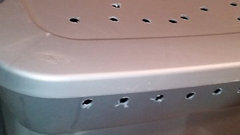
From Gardenweb link on posting pictures http://faq.gardenweb.com/discussions/2766391/how-do-i-add-pictures-to-my-posted-messages
The Short Version
Adding a picture on any forum
- Upload your image (60K or less in size) to somewhere on the web for storage.
- Type codes into your forum message to add the image.
- To create a link to the image: <a href="insert image address here">insert image description here</a>.
- To display the image inside the posted message: <img src=” file location and name”>.
- Submit the message.
Adding a picture on forums allowing direct upload from your computer
- Type your forum message and select Preview.
- Select Browse button to locate and add the image file on your computer.
- Submit the message and image file.
monomer
Original Author10 years agolast modified: 10 years agoThanks to everyone who cared enough to offer suggestions... it is appreciated. I created a really quicky youtube vid assembled from some of my pictures ... the music came with the software I used to create the video so don't ribbed me about it.
https://www.youtube.com/embed/1u9yvCkVHWk
Hopefully the pictures are self-explanatory. Note the natural drainage channels in the bottom of the bin all converging to the center... I used this structural feature to advantage by putting a drain hole in the middle and later when supported on bricks (shown in the last photo) it forms a slight sag in the middle causing any leachate to drain towards the hole. That blue bowl can now be slid underneath to capture any leachate. The clear plastic pie plate is domed enough to direct any water to flow outward toward the edges of the bin and then down into the drain channels where it flows under the plate to reach the drain hole. As you can see, the weight of the bedding is distributed over the plate and thus not stressing the drain hole area at all. The plate and the wire screens are all hot-glued into place. The low temperature PVA hot-glue works extremely well. It took me less than 30 minutes to complete the bin, including the 4" of composted leaves on the bottom (which is not in the photos) and the 6-8" top layer of coco coir and mixed with old worm bedding. Not in the photo is the shredded cardboard/paper topping everything to overflowing.
I purchased all my bins at Lowes where it is usually $13.99 however yesterday the wife and I were in Costco... dang if they didn't have a mountain of the same bins for $7.99 each. You simply can't beat that price for such a perfect 27-gallon storage bin for turning into a worm bin.







monomerOriginal Author