Software
Houzz Logo Print
charlieboring

Homemade Potting Soil

10 years ago

I am planning to make my own potting soil in order to save money and
produce a good soil for plant growth. I took a look at what ingredients
are available at reasonable cost. Here are the possibilities: Leaf
compost (mould) (free from the county transfer center at least in the
fall); Garden Soil (purchased on sale from Home Depot for $2.00 a cubic
foot); Top soil (purchased on sale from Home Depot for $1.37 a cubic foot; Worm castings (free from my worm factory); and Shredded limb compost (free
from the county transfer center for most of the year); Manure and humus
mix (purchased on sale from HD $2.37 a cubic foot), Peat moss (not on
sale and kind of expensive). Considering the above, I am going to try
the following mixture: 2 parts leaf compost sifted through a 1/4 inch
wire sieve, 1 part garden soil, 1/4 part top soil, 1/2 part humus and
manure, and 1 or 2 cups worm castings. I would like to vary the mixture
to see which mixture works best. Any suggestions?

Comments (9)

  • 10 years ago

    Charlie

    Trial and error. Just try some ideas that work within your budget and availability of resources. I was going to suggest what I use for small potted plants, but my soil may not match yours and even if it does, the soil I use is well worked over time with amendment, etc. It also depends on what you are planning to grow in the pots. Also, it depends on your climate. +

    You've got some great suggestions in your original post. I recommend you spend some time creating, documenting and find out which works best for you. I'd also suggest you keep using potting soil for things that you do not want to fail until you reach your conclusions.

    I have healthy clay soils where I'm located. My clay loam is good for moisture retention in our quasi desert summer temps, but it's too much so for pots and very heavy. I throw in well-rotted twigs at the bottom of the pots to compensate. Like mini hugelkulture. Works pretty good for me.

    I fertilize them organically with home made compost and bunny berries. It took me a while to find the right ingredients for me, my climate and the desired plants.

    bon

  • 10 years ago

    That's the first half of your mix with all that OM--The other half should be vermiculite, perlite, or some other inert fast drainage material.

  • 10 years ago

    Reel - What about sand?

  • 10 years ago

    You cannot treat potting soil as if it were the same as inground soil. Since drainage is so restricted in any container situation, you want a very textural, fast draining potting media that limits compaction or compression and that much soil/organic matter is not going to work well. Fine ground bark, turface or other high-fired clay product, perlite or pumice or granite grit should be major ingredients. If you use any sand it should large diameter, very coarse sand - like builders sand. And no vermiculite - once it becomes fully absorbed with moisture, it collapses and becomes an impediment to fast drainage rather than enhancing it.

    It boils down to a matter of just being able to grow plants in a container or providing them with a suitable environment to flourish. Yes, you can grow plants for a single season in what you propose but you will not get the root development for the plants to flourish and produce as intended nor will your soil mix hold up for any longer than just a few months.

    Did you bother to check out the links I provided in my earlier post? They are really extremely informative and will help you make some important decisions to ensure the success of your container plantings.

  • 10 years ago

    After reading everyone's advice and doing some research, I am modifying my recipe for homemade potting soil to grow vegetables such as cucumbers, green onions, radishes and beets. Again, I trying to use ingredients that are available at reasonable cost, where possible. I am going to spring for a large bag of peat, about $10 at Home Depot ($5.00). I will use 5 gallons. Leaf compost (mould) is free from the county transfer center so I am going to run some through my 1/4 inch sieve and add about 2 gallons. Worm castings (free from my worm factory) so I am going to add 3 cups. Add 4 cups of coarse sand, about $0.75 from Home Depot. Add 1 cup of garden lime, about $0.50. Add 1/2 cup of epson salt, about $0.25. Total cost for about 8 gallons = $6.50. Any suggestions?

  • 10 years ago

    As an advocate for fast draining, coarse textured potting media, I wouldn't use anything resembling what you are proposing. But what worries me the most is the large dose of lime and epsom salts!

    Homemade mixes DO need added calcium, but I strongly recommend that you use dolomitic lime rather than garden lime, and no epsom salts. Dolomite is calcium magnesium carbonate.

    The typical dose would be 1 tablespoon per gallon of mix, I believe. Liming minerals need to be added with some idea of what your starting pH is and what you want it to be! Worm castings tend to be alkaline, leaf mould is more neutral than acid, and peat will be in the low range. Who knows, you may not need to adjust the pH at all! Should that be the case, you'll need to use gypsum as your calcium source; it won't change the pH.

    Plants do best when grown in a slightly acid pH.....adding too much lime or dolomite could really mess things up for the duration of your growing season.

    What will be your fertilizer choice?


  • 10 years ago

    Rhizo - What fertilizer would you recommend and how much. The castings should act as a fertilizer also.

  • 10 years ago
    last modified: 10 years ago

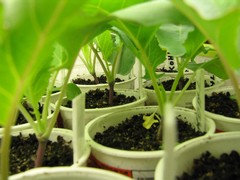
    I use the same mixture to do my seeds that I use to grow my plants, the very same mix, only with the seed I strain it much finely...1 part vermiculite, 1 part peat moss, and 1 part my compost. I've been using this for 3 seasons and have excellent results....here's a photo of a kohlrabi plant in my seed starting tray. About once a week I'll add a10/ 20 percent solution of fish emulsion until planting time.