Software
Houzz Logo Print
dollfanz

To Hoovb, or anyone else,

10 years ago
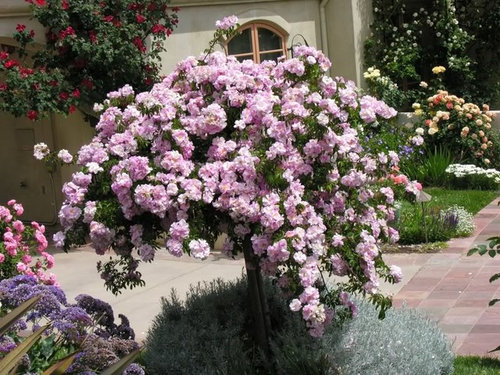
What is planted under that rose tree. It's so beautiful.


Comments (38)

  • 10 years ago
    last modified: 10 years ago

    Looks like Artemisia to me.

    :-)

    ~Christopher

  • 10 years ago

    It could be Snow in Summer. You could also get a similar look from Santolina chamaecyparissus, Cobweb Bush, Curry Plant, Licorice plant (Helichrysum petiolare) and a host of others. The trick would be finding which one is happiest with your soil, humidity, heat and water. But that one looks like Snow in Summer to me.

  • 10 years ago

    I think you've got it, Kim. with Snow in Summer. Artemisia is a good guess and I was even thinking perennial dianthus for a minute. Licorice plant sounds good, too. Guess I'd better check some photos. The more guesses, the more confused I get. Diane

  • 10 years ago

    Just looked at a few images, and I'm putting my money on santolina, Kim. You're still the winner. Diane

  • 10 years ago

    Thanks, Diane. On the right side of the image, it appears as if there may be some small white flowers, which fits with Snow in Summer. Santolina has yellow blooms.

  • 10 years ago

    You're right, so first choice is Snow in Summer, but for me, second choice is Santolina. I always sheared my Santolina off, so the yellow blooms were totally gone. Hoov could have done that. Diane

  • 10 years ago

    I like both plants, but Snow in Summer lacks the "stench" Santolina so generously provides. If you have rabbit issues, both should be resistant because of the fuzzy, dry texture, but Santolina has the added "benefit" of a very strong stink many find highly objectionable. Some like it, but some also like the scent of lantana foliage. Some people find it "minty". I find it "cat box". I like lantana santolina where they're happy. I just don't like touching them or brushing against them and releasing the foliage stink.

  • 10 years ago

    I guess hoov isn't going to give us the answer now, so we'll have to live with the suspense over night. Diane

  • 10 years ago

    What rose is that, please? It's stunning!

  • 10 years ago

    My guess would be Renae.

  • 10 years ago

    Kind of looks like a dianthus or....maybe lavender.

  • 10 years ago
    dollfanz thanked User
  • 10 years ago

    Thanks for that info, Christopher. What a shame such a beauty is gone. I'm pretty sure the mystery plant isn't lavender, which I grow. Dianthus was my first guess, but I'm sticking with Snow in Summer or Santolina. Diane

  • 10 years ago

    That is heartbreaking. I looked at her blog and it looks like a lot of her roses took a hit. :(

  • 10 years ago

    I think she mentioned a while back that she was removing some roses and putting in plants requiring less water because of the drought. I hope that's all. She might be watering everything less, too. Diane

  • 10 years ago

    Oh hey, just saw this.

    I'm trying to remember what that silver plant is. Not snow-in-summer, not Artemisia.

    Think, think, think: right, it is indeed Santolina chamaecyparissus.

    The photo is a blast from the past, back when we had lawn and still had 'Madame Alfred Carriere' by the front window. The Madame tried to eat the house and nearly succeeded. Yes the Renae declined dramatically-dug up, it was all crown- and root-galled. That was a heart-breaker.

    There's an Aloe 'Hercules' there now. That 'Brass Band' on the right hand side of the photo is still going strong. All the roses around 'Renae' are gone. Agaves, Kalanchoe orgyalis, and Grevillea 'Superb' there now, besides the Aloe 'Hercules'. That side of the driveway is dramatically drier than the other side, where there are still lots of roses. I've removed 40 or so roses because of the drought.


    dollfanz thanked hoovb zone 9 sunset 23
  • 10 years ago

    Another nifty silver plant for something like that for Mediterranean climates is Pyrethropsis hosmariense, aka Rhodanthemum hosmariense, easier to remember the common name 'Morocco Daisy'. Does not have the herbal scent of Santolina, and it's a much shorter grower. All it needs is a shear-off of the flowers in early summer. Pretty, long-lived, silver.


  • 10 years ago

    It's also very easy to strike from cuttings too, if you want it in a large massed effect.

  • 10 years ago

    Yay for the Santolina guessers. I removed mine because it got so messy looking after a few years, but yours looks lovely, hoov. So sorry you had to remove all those roses, but it's very understandable. Maybe you can restore some of them if the water situation changes. How is the drought going in your area?

    I'd love to try Morocco Daisy, but I don't think it's for sale much around here, which is odd. I need to do more looking.

    Thanks for tuning in and settling the mystery of the silver plant. It was fun debating its solution. Diane

  • 10 years ago

    A silver plant I found today for warmer winter zones (down to Sunset z16) is Calocephalus brownii "Silver Stone'. Drought resistant, to 12 inches.

    Love your combo Hoov.

  • 10 years ago

    Cushion bush ( C brownii) is a popular landscape plant here, because it provides useful contrasts with cordyllines, aloes, other succulents and grasses. My favourite silver-foliaged plant is Tanacetum Ptarmiciflorum, otherwise known as silver lace bush. The white daisy flowers are quite attractive, or it can be trimmed to prevent them forming.

    Hoovb, would love to see photos of the 'Now'. Melodye

  • 10 years ago

    What a stunning rose!!! But then every rose in your picture looks amazing!!! Sooooo many flowers!!! GASP!!

    Carol

  • 10 years ago

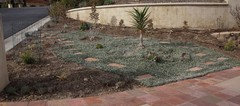
    Here is the "now", ozmelodye. The plants I put in are all really small, so right now it doesn't look like much. The little decidious magnolia will be moved to a more moist location very soon. The ground cover is the indespensible Dymondia margaretae.

    I adore silver plants and now must look for that shimmering Tanacetum. I've grown the Calocephalus off and on for a long time--love that plant. Leucophyllum candidum, Dichondra argentea, Eucalyptus 'Moon Lagoon', and Sideritis cypria are other silvery favorites.

  • 10 years ago

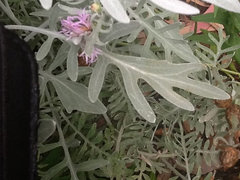
    Hoovb, thanks, that is already showing the signs of a becoming a most impressive dry garden. I really like the use of the Dymondia, it is used here as well but not enough. I wish more people here would use their imaginations and plant things others than Yuccas and gravel! I don't know if you are able to find Centauria cineraria, but that is another bushy accent plant I use in my borders. It is another that can be permitted to flower or trimmed for just the foliage effect. The flowers are like lavender pink cornflowers.

    Melodye

  • 10 years ago

    Hoove, I admire your willingness to try something quite different from roses, and do an excellent job of it. I'm sure this new area will be an elegant new garden space.

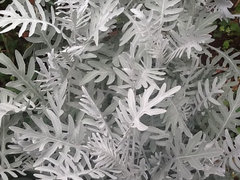
    Melodye, I hope I'm not mixed up, but is the gorgeous silver plant above Dymondia? It reminds me of Silver Lace dusty miller, which is hard as all get out to find around here. It's not a shrub, of course. Maybe it would be in warmer climates. Silver Lace doesn't look like the everyday dusty miller that's so easy to find. Diane

  • 10 years ago

    The unfortunate thing about common names for plants is that the same name may apply to more than one plant. And many plants have multiple common names. Centaurea cineraria is sometimes called Dusty Miller, but so is another plant -- Jacobaea maritima, which used to be called Senecio cineraria. The foliage does indeed look almost identical, but the blooms are different. The plant shown in the pic by Melodye shows mauve-lavender blooms, but the plant nanadoll is thinking of has yellow blooms. And I know that plant, nanadoll. It's frequently sold in flats as annuals. Here, some plants manage to make it through Winter and grow larger, blooming during Summer.

    :-)

    ~Christopher

  • 10 years ago

    Thanks, Christopher, my photo is of Centaurea cineraria. The Jacobaea maritima is the plant known as Dusty Miller here and usually still sold as Senecio. Apparently another plant called commonly called Dusty Miller is one I mentioned in an earlier comment, Tanacetum Ptarmiciflorum. I noticed when I checked, that it is known as Chrysanthemum Ptarmiciflorum now; it is much more delicate looking than the Centaurea.

    Sorry, Diane. I was in a hurry and forgot to identify the photo :-( Melodye

  • 10 years ago

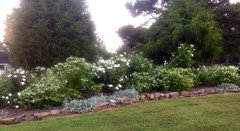
    Silver companion foliage around white roses, against a dark green hedge--fabulous!

  • 10 years ago

    Hoovbe, that is a gorgeous combination! Have you an area in your garden where you can put it into effect? Melodye

  • 10 years ago

    I have Lamb's Ear edging my white garden, but it spreads like crazy...have to thin it out a couple of times yearly. I would love to replace it with Dusty Miller, but that won't overwinter here.

  • 10 years ago

    Yes, lambs ears can be a problem for me too, and end up as weeds. That is beautiful, Pat_bama. What roses do you have planted there? The graduated sizes really make a statement. What a pity about Dusty Miller. Are any of the other silver leaved plants better for your climate? Melodye

  • 10 years ago

    That's the back side of the white garden in that shot. Roses you can see in the picture are Pope John Paul II at the far left and then two Moondances with a Sombreuil you can't see in between them that I'm trying to train to climb into the cedars. There's a Prosperity, Kaiserin Auguste Viktoria and a Bolero to the right that aren't visible in that picture. And a little Kronprinzessin Viktoria being eaten by four o'clocks. Here's the front side with a Sugar Moon at far left, JFK in the middle and Secret's Out at the far right. Noisettes Jeanne d'Arc and Mary Washington are in front of each cedar, but not visible in this picture.

    unfortunately, most silver leaved plants that I know of either won't overwinter here, get too tall for edging or don't like my acidic, wet clay soil. I'm open to suggestions, but probably shouldn't hijack this thread any longer for them...should do a new post.

  • 10 years ago

    Lovely garden and not an Iceberg in sight :-)) wonderful! Melodye

  • 10 years ago

    I loved that picture of your standard Renae too Hoovb.

    The new area looks so good. I know it's been tough going lately but wow you still got so much done regardless. Did you finish rose pruning yet? I'm still chopping up canes to put in the trash when I want to be putting down mulch. I sprayed twice now with horticultural oil and now I wait to see what happens.

    I was looking at old pictures back when I had grass and a zillion thirsty plants around the rose beds. It's so different now. I used to have a sprinkler on a tall pipe that threw water over the whole garden.......baby's tears and ferns popped up like weeds between the flagstones in the shady parts and fuchsias grew into standards. I miss our old climate and September - January rains.

    Our neighborhood has mostly the old gardens but with the grass dying or not getting enough water to look happy. People don't know what to do with it and the garden crews come and mow the barely alive lawns. A few had complete makeovers and look good. A few had the lawn removed and replaced with drought tolerant plants but the mix of old and new looks awful......worse than before. I don't want to fall into that trap. It's tricky when you aren't starting over with a blank page and have to work old things in. I think you have done that so well in your own garden.

  • 10 years ago
    last modified: 10 years ago

    pat_bamaz7 -- I think you should look into some of the silver-leafed Heuchera out there. Salvia argenta can be raised from seed, and if you don't want it getting big and blooming in year-2, you can just dig them out in Autumn. For something more ground-hugging, there are many creeping Sedum in shades of blue-gray and into silver. For shady areas, there are Lamium, Pulmonaria, and Brunnera cultivars with silver markings.

    :-)

    ~Christopher

  • 10 years ago

    Christopher, Thanks so much for the suggestions! I do grow some heucheras in shadier areas, although most don't like our heat/humidity/clay or suffer with our soggy winters. The Salvia argenta suggestion might be spot on, though. Will definitely look into that. I have some of the taller Frosty Morn variegated sedum in that bed, so the creeping varieties might do well, also.

  • 10 years ago

    Look for Heuchera cultivars with H. villosa in their ancestry. These are more tolerant of your conditions.

    :-)

    ~Christopher

Sponsored
Bella Casa LLC
Average rating: 5 out of 5 stars17 Reviews
The Leading Interior Design Studio in Franklin County