Software
Houzz Logo Print
0plantqueen0

Bromeliad Potting Soil

10 years ago

Can cactus/succulent potting soil be used with bromeliads? My guzmania needs to be potted up a couple inches, and while I've heard orchid mix works well, there's none at my local stores.

Comments (20)

  • 10 years ago

    Most cactus mixes aren't even good for a cactus (too much peat), but they can vary. Generally, it is best to combine these mixes 50-50 with perlite.

    tj

  • 10 years ago

    Hi everyone.

    Oplantqueen - Since I started growing bromeliads I have tried many different potting mixes and have come to the conclusion these plants will grow in almost anything as long as it will hold a little moisture but is well drained. Ideally it need to also contain a little nourishment but if not, this can be supplied by foliar feeding.

    As an experiment, I once grew a group of plants in the following single ingredients: not a mixture of ingredients as was the norm.

    Charcoal, Skoria, broken brick pieces, and polystyrene chunks. Because these were all inert substances with no food value, the plants were give supplemental foliar feeding each few weeks and they grew well and eventually reached maturity and flowered.

    This wasn't rocket science as it was just mimicking what they did in habitat where they grew on trees and rocks and just used these things as a base for attachment. Any nourishment they received came from broken down leaf litter and small animal droppings which fell into the central cup and leaf axils of the plant and mixed with water and rotted down to make a "soup" (liquid fertilizer) which was absorbed slowly but continuously by the plant's foliage.

    These days for convenience sake I make a simple mixture of one part bark based orchid potting mix, one part good quality general potting mix and one part Coir Peat chunks with an added sprinkling of Perlite. Fertilizing is by foliar feeding every three weeks or so or when I remember - there's no hard and fast rule.

    The important thing is that whatever you use, it must be free draining.

    All the best, Nev.


  • 10 years ago

    Hello Everyone!

    I grow my cacti and succulents in a free draining mix and usually buy the cacti mix and add to it bark, perlite, charcoal and a small amount of orchid mix and everything seems to thrive on it but using the brought mix on it's own I am not happy with as the plants do not grow as well and some end up dying.

    The mix I use for my bromeliads is a combination of pine bark suitable for pots and planters, orchid mix (that has charcoal in it) and a small amount of perlite (either fine or jumbo). Normally I either mix it in a nine litre bucket made up of about 3 1/4 bark, 1 quarter orchid mix and about 2 cups of perlite. But most of the time I make my mix up in a big wheel-burrow and bucket it out from there as I need. I like to use polystyrene down in the bottom of the pot for good drainage and scoria or gravel up top to stabilise the plant rather than using bamboo sticks or wooden skewers that I find tend to damage the leaves if left in too long around the plant. This mix I like to use with my Neoregelia's but when it comes to potting my Vrieseas I prefer to add even more course matter to the mix like scoria thrown in amongst the mix as well as some of the polystyrene broken up small also thrown in amongst the mix. I used to be really anti using the polystyrene but now it has become my best friend when it comes to growing broms as the root system really takes to the stuff and it really does help with drainage.

    Take Care & Happy Gardening!

    Trish

  • 10 years ago
    last modified: 10 years ago

    Hi everyone.

    I'd like to add a little to Trish's comments about polystyrene; I initially started using it in the bottom of the pots to improve drainage and found that the roots liked to grow around it so much that I too have used it in the mix instead of, or as well as Perlite as it helps to aerate the mix.

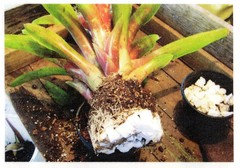
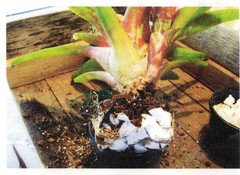
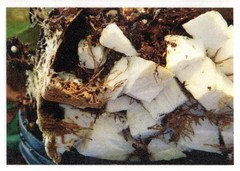
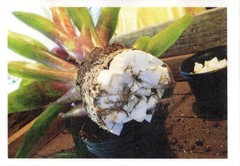
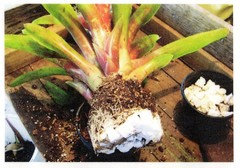
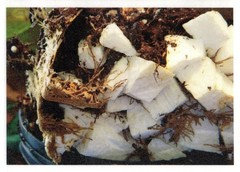
    On closer inspection of the roots of a pup which had been potted with no roots two years previously (See pictures 1, 2, 3, and 4), I was encouraged to try using it as a "stand alone" potting medium.

    However, because it is inert and has no nutritional value whatsoever, any plants growing in it need to be fertilised regularly to provide nourishment. If this is done, and plants are watered as normal, I find the plants grow just as well in this as any other growing medium, plus it has the following advantages:

    1. It's free

    2. It's clean as it doesn't contain any bacteria

    3. It's light so is ideal for plants that need to be suspended.

    4. It won't remain wet so minimises the chance of rot

    1. Probably the most important benefit is that you are recycling a product that is otherwise useless and is an environmentally harmful product to dispose of as it won't break down when put into land fill and at many waste disposal centres needs to be specially treated before it's disposed of .

    So next time you have a spare pup and some left over polystyrene that has to be discarded, try it as a growing medium and you'll be surprised at the result, but don't forget to fertilise.

    All the best, Nev.

  • 10 years ago

    Hello Everyone!

    Nev your above pictures are a fantastic example of how much bromeliads like polystyrene; that's why I like breaking it up in my pots; especially with my Vriesea's. I also wash and re-use it more than once, especially with the amount I use now days.

    Take Care & Happy Gardening!

    Trish

  • 8 years ago

    Would styrofoam work as well/the same as polystyrene? Thanks.

  • 8 years ago

    Hi everyone.

    Kylie - Firstly what do you mean by styrofoam?


    In many instances people think these two products are one and the same and the names are interchangeable. This is not the case - Basically, if it's white its polystyrene and if it's blue it's styrofoam.

    I can't answer your question as I've only ever used polystyrene. If you want a longer explanation go to the site below.

    https://www.youtube.com/watch?v=5qSSchUSbyY

    All the best, Nev.

  • 8 years ago
    last modified: 8 years ago

    I'm thinking of the stuff coolers are made of (which is white) and the peanuts used for packaging. I can see it is different from polystyrene. Just wondered if it would make a good substitute.

    Thanks for the link.

    edit: Question answered. Thanks, Nev. So I can use my old coolers for broms, right?

  • 8 years ago

    Beautiful planters, Carol. I definitely don't like styro in potting soil and I wouldn't let that stuff get in my garden. Anyway I use Al's 5:1:1 for all my plants. I probably won't use styro for my broms. I guess I'll stick with orchid mix or something similar for now.

  • 8 years ago

    Grit from paper mills. A mixture of sand/ dirt and ground up bark. Works beautifully for me. It’s the stuff taken off trees before making paper.

  • 8 years ago

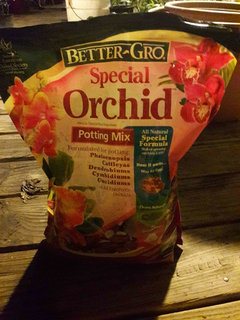
    I finally went with this:

    It has nice chunks of bark, charcoal and big chunks of perlite. I potted a Phalaenopsis and an Aechmea chantinii in it. So far so good. Got it at Lowes. I also bought Miracle-Gro orchid mix for comparison. It was nothing but questionable bark alone. What a rip-off.

  • 8 years ago

    Hi everyone - There are probably as many different potting mixes as there are growers; everyone has their own special recipe which they think is better than any other.

    The thing is; bromeliads will grow in anything as long as it's "well drained" and this is the critical aspect of all potting mixes.

    They will even grow in inert substances which have no nutritional value whatsoever, things like broken bricks, skoria, polystyrene, coarse gravel and similar substances. However, when using these inert substances, you must supplement them with some type of foliar fertiliser.

    I have experimented with different potting media over the years and was very surprised to find just how well they grew in polystyrene with supplemented foliar fertilising. I think the main reason for this is the excellent drainage it provides, which is an essential no matter what potting material is used. The downside is that it's very light and pots easily blow over in the wind which is a problem for me as I live in a windy area.

    We should never forget that most commonly grown bromeliads are epiphytes (Grow on trees or bushes) and as such have roots which are constantly exposed to air which provides excellent drainage. We only grow them in pots for our own convenience or for decorative effect, however we still must aim for perfect drainage, this is essential.

    Part of an experiment I once did was using 50% bark based orchid potting mix and 50% regular potting mix. The bottom third of the pot was filled with polystyrene to guarantee good drainage.

    After six months I took the plant out of the pot to check root growth and was surprised to see how the roots had grown down and into the polystyrene in preference to the potting mix.

    This couldn't have been due to the nutrition in the polystyrene as it is an inert substance; so I can only put this good root growth down to the excellent drainage provided by the polystyrene.

    For the last ten years or so I have been using the same potting mix mentioned above which is based on 50% bark based orchid potting mix and 50% regular potting mix.

    The bark based potting mix is an orchid potting mix which is similar to that shown by Kylie above, and the regular potting mix is one that is just a generic type organic potting mix to use with all potted plants.

    I don't add any fertiliser as both potting mixes have a small amount of Osmocote added and I find this adequate to provide sufficient nourishment to make my plants grow well, and I abide by the old saying, "when you're on a good thing, stick to it".

    All the best, Nev.


  • 8 years ago

    I second everything said by Nev. Great photos of the roots in those polystyrene cubes! Our mixes are about exactly same. What Kyle is using is fine if you only have one or two plants, but it's waaaaaaay too expensive if you have 50+ broms (far too expensive for me). As Nev said, it's all about the drainage. I have a big plastic storage container/tub/bin and into it goes one bag of potting mix and one bag of small pine bark. 50:50 mix. If it still looks too heavy, throw in some more pine bark. Always err on the side of too much bark. Then pot 'em up!

    Carol

  • 8 years ago

    Do you guys use fertilizer? If so what kind please?

  • 8 years ago
    last modified: 8 years ago

    I currently do not use any fertilizer at all. But based on [recent comments by Nev[(https://www.houzz.com/discussions/need-bromeliad-and-buddleia-help-dsvw-vd~5359918?n=8), I may try a water-soluble fertilizer with a high-potassium component (the last number in the N-P-K; K=potassium) on my Guzmanias. It would be fun to see what happens. I have a few with which I could play around.

    By the way, I have learned that in bromeliad-speak, growing them without any fertilizer is called "growing them hard". :)

    Carol

  • 8 years ago

    Hi everyone

    Kyle - I could tell you which N:P:K is the best for bromeliads, but I think it would only confuse things because the NPK percentages in Australia are measured differently to the NPK percentages in the U.S.

    To help you better understand about N.P.K/, go to: https://www.gardenmyths.com/fertilizer-npk-ratios-what-do-they-really-mean/

    You would properly be best to go to a nursery or somewhere with a horticulturalist in attendance and ask their advice for which N.P.K. would suit you best.

    All the best, Nev.

  • 8 years ago

    Thanks. Right now I'm trying DynaGro FoliagePro which I use on all my other plants. So far, so good. I just thought there might something the expert brom growers use.

  • 8 years ago

    Hi everyone.

    Kyle - I'm not familiar with the potting mix you are using, but that's not important. What is important and is something I've mentioned many times [previously, and that is it must be well drained.

    Another thing that's sometimes overlooked, is to check if the commercial potting mix you have purchased, contains any fertiliser. If it hasn't, well and good; you can add what fertiliser you think is required.

    If however the mix already has fertiliser in it, you need to allow for this so you aren't "over fertilising" in which case you'll finish up with lots of lush growth and no foliage colour or flowers.

    All the best, Nev.

  • 8 years ago

    I am using Better-Gro Orchid Mix pictured above. It's a blend of western US fir bark, coarse perlite and hardwood charcoal. It doesn't contain fertilzer.

    When I get more pups I think I'm going to experiment with styro. The stuff they make coolers from.

Sponsored
AIS Renovations
Average rating: 4.5 out of 5 stars15 Reviews
Custom Craftsmanship & Construction Solutions in Franklin County, Ohio