Software
Houzz Logo Print
hebertju56

Question about pot size

Hello everyone,

I recently acquired a ming aralia Polyscias fruticosa. The salesperson told be to keep it in its small pot, as it likes to have its roots 'snug'. It is not root bound and does not have roots coming out of the bottom of the pot or from the soil line, but I can see many small roots around the root ball when I slide it out of the pot. This is not the first time I've heard that some plants prefer their pots to be on the small size. Can someone tell me why? It just seems so counter to nature to have a plant want it's growth to be prevented.

Comments (20)

  • 10 years ago

    The reason is mings do not like their roots disturbed. They are also very prone to root rot. They will lose leaves at the drop of a hat. If you can up pot without disturbing the roots and be sure you have a very well draining soil, that would help a lot. I've found that when I had a ming, if I kept the pot size larger than the root mass it was less likely to complain when it potted up. When the roots start to circle, it really needs a new pot. This is not the time of year to be playing in its soil though.

  • 10 years ago

    Most places on the net and people think that certain plants like to be root bound as root bound usually flower. And most people view flowering plants as happy plants.

    Spider plants and peace lilys are often thought of as plants that like to be root bound. Though being root bound causes stress and the stress causes that plant to think it might not survive so it tries to reproduce before the inevitable. And when they flower or produce babies it's usaly seen as its happy and not a last ditch effort to reproduce before it dies.

    That being said no plant likes to be root bound or have tight roots as that doesn't happen anywhere in nature. I'm sure if a Spider plant was planted outside it would send roots every which way and not just coil a bunch of its roots around each other.

    And also for the reason Mentha said as some plants don't like having their roots disturbed. Though that doesn't mean they like to be root bound or kept in the same pot for years on end.

    Usually when it comes to repotting plants I always go one or two pot sizes up.

  • 10 years ago

    Appropriate pot size is determined primarily by soil choice. If you're using a very water-retentive soil, you need to be very judicious about how much you increase the soil volume, but some soils allow you to use pots as large as you like without need to worry about over-potting. No plant prefers to be grown under rootbound conditions. Here is something I wrote a while back that explains why that myth exists:

    I would like to talk a little about, and hopefully dispel the myth that certain plants 'like' or 'prefer' to be grown tight (under root-bound conditions). Maybe we can also understand that no plant will 'do well' when it's pot-bound if you are using a plant with plenty of room for its roots as your standard of judgment. If plants did better growing under root-bound conditions, it would seem that Mother Nature would have arranged for in situ (where they naturally occur) plants to grow with their roots in tight little cones or cubes, yet we never see that occur. While it's true that we may be able to use the STRESS of our plants being root-bound to bend plants to our will and achieve OUR goals, the fact is that this serves US well, and not the plant.

    Lets examine what 'growth' is. Growth is simply a measure of the increase in a plant's biomass, how much bigger it has become (the weight of the sum of it's parts), and is the actual measure of how 'well' a plant is doing. We know that tight roots restrict growth, reduce the amount of extension, and reduce the potential for an increase in mass, so even if we THINK plants are doing well because we use the stress of tight roots to get them to bloom or grow in a particular habit that we like, the truth is tight roots are stressful and plants would rather have plenty of room for their roots to grow so they could grow as mother nature intended. No one is more aware of the negative influence tight roots has on growth than the bonsai practitioner who uses that tool extensively to bind down the plant's growth habits so the will of the grower, not the plant, prevails. Using tight roots as a tool to achieve an end is all about the grower's wants, and not the plant's.

    If we chase this a little further, we can see the reasons that it is suggested that particular plants might like root-bound conditions. Tight roots alters the plant's growth habits and the stress of tight roots can cause other physiological responses like bloom induction. Again, this is happening because of stress, and is the plants unhappy response. Bright flowers make the grower happy, but the plant's perspective may be entirely different.

    Where I was really heading when I started to write this is: There is a relationship between plant mass (size), the physical characteristics of the soil, and the size of the container. In many cases, when we are advised that 'X' plant prefers to be grown tight, we are being told that this plant won't tolerate wet feet for extended periods. Someone somewhere assumed that we would be growing this plant in an out-of-the-bag, water retentive soil, and "a big pot o' that soil stays wet for a long time", so we better tell these people to grow this plant in a tiny pot so the plant can use the water in the soil quicker; then, air will return to the soil faster and roots won't rot.

    If you place a plant in a gallon of water-retentive soil, it might use the water fairly quickly, at least quickly enough to prevent root rot; but if you put the same plant in 5 gallons of water-retentive soil, the plant will take 5 times as long to use the water and for air to return to the soil, making it much more probable that root rot issues will arise. So lets tell 'em to grow these plants tight to save them (the growers) from themselves ......... because we KNOW they're all going to be using a soggy soil.

    Key here, is the soil. If you choose a very porous soil that drains well and supports no (or very little) perched water (that water in the saturated layer of soil at the bottom of the pot), you can grow a very small plant in a very large pot and make the plant MUCH happier than if you were growing it tight. You still have the option of choosing those plants you prefer to stress intentionally (with tight roots) to get them to grow as YOU please, but for the others, which comprise the highest %, it makes much better sense to change to a soil that allows you to give the plant what it wants than to stress the plant so it won't die. That's a little like keeping your dog in a sleeping bag 24-7 to ensure he doesn't get cold.

    Al

  • 10 years ago

    Thank you! I really appreciate the details. I would rather have a plant as mother nature intended, and not stress the plant and have to worry about it being more vulnerable to pests and diseases.

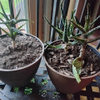
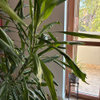
    Here is a picture of the plant and the pot in came in about a week ago. I have watered it once but spray it often. Here is a picture of its root ball just before I'm going to water it again (it is barely moist throughout and dry on top):
    As you can see the set up is pretty flimsy and I feel like the pot is not doing much to help it at all; I would really like to transplant it into a bigger, heavier pot. Do the benefits of a bigger pot in appropriate soil outweigh the risks of upsetting the roots in a transplant at this time of year? Thank you again for your time, and my aralia thanks you too!

  • 10 years ago

    I know people are going to scream bloody murder, but this is how I like my roots to look when I pot up. Most people wait until the roots fill the pot and start circling all over but I find it's less stressful to pot up when they roots still have a little room in the pot. I would still wait though. you can put the nursery pot inside the heavier pot until it's time to repot for added weight.

  • 10 years ago

    Thank you Al. I have a last question (I hope!). What soil do you recommend (recipe not in previous post) for proper drainage?

  • 10 years ago

    Read this: http://forums2.gardenweb.com/discussions/2842847/container-soils-water-movement-and-retention-xxii?n=385

    The two soils you'll see talked about most on here are the 5:1:1 mix and the gritty mix. Lots of info on them. They're homemade mixes, so you'd need to go and get each part and make your own.

  • 10 years ago

    Thank you Dave :-)

  • 10 years ago

    Looking at things from the plant's perspective, I think it's reasonable to base delineation between soils one might consider acceptable or unacceptable on whether or not you can water correctly when using them w/o having to sacrifice notable loss of potential or vitality due to a soil that remains soggy for extended periods. That might not be the universally accepted dividing point, but it's difficult to argue that it doesn't make good sense. That means the soil needs to be comprised of primarily coarse ingredients, though it can include a smaller % of fine ingredients so it holds enough water to make both plant and grower happy. Using an appropriate medium literally transforms the growing experience for a large % of growers because it relieves the grower of the need to fight your soil for control over the plant's vitality. It allows you to have control over root health and nutrition in ways heavier (more water-retentive) soils don't allow.

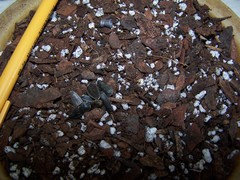
    Once you are at the point where you are using a soil you can water correctly, there is still plenty of room for improvement, and usually those improvements can be made with minimal additional effort. I use this medium for almost everything I expect to be in the same pot/soil for 2 years or more:

    For plantings that will last for 1 or 2 growth cycles, (veggies, mixed floral displays, some very vigorous perennials [hibiscus, datura, brugmansia, .......]) I use this:

    The medium in the top picture would be (close to) perfect for Aralia because it holds very little (essentially no) excess water. It's the water in soils that occupies the spaces between soil particles that wreak havoc with root health.

    If you have interest in learning more, just let me know. I'll provide some links to information that should help you with a framework on which you can build. Those who make the effort to learn as much as they can about growing always advance exponentially faster than those that rely on experience as their primary source of advancement. I'm always especially interested in helping those who do want to learn and exhibit an enthusiasm for nurturing plants.

    You'll find recipes for the soils pictured at the end of this thread about Container Soils. The recipes represent good starting points, but the concept described in the thread is much more valuable to you than the recipes. It's also a very good place to ask any 'soil questions' you have.

    Al

  • 10 years ago

    Dear plant lovers,

    I have (finally) found all my ingrédients for the gritty mix for my aralia. Al suggested I pot up rather than repot. How do I pot up without disturbing the roots if I want to put it in the gritty mix? Do I just place the root ball in a slightly larger pot and fill the rest up with gritty mix? I can't imagine that the gritty mix will offer much benefit if the roots are sitting in the original commercial soil. Can I repot into 100% gritty mix? It's what I would like to do as I am so eager to finally be able to offer it the gritty mix! I have heard repotting is better in summer, but given that our summers are almost non-existant, does it really matter when I repot? Thank you

    Julie

  • 10 years ago
    last modified: 10 years ago

    im not sure potting up with the gritty mix would be wise. I'm guessing the current soil the plant is in is peat based? It's going to be impossible to water correctly as the peat based soil inside will hold a lot of water and the gritty mix won't hold much at all.

    id pot up with the same soil or something at least pretty similar.

    Reotting into the gritty mix would be fine, but that plant doesn't really like its roots disturbed so there's that. Plus, the best time of year to do it would be in later June. Even though you say your summers don't exist, the plant knows what time of year it is.

    plus you're in zone 5a like I am. We absolutely have distinct summer and winter seasons.

    I wouldn't do it this time of year especially to a plant that doesn't like its roots disturbed.

  • 10 years ago

    I usually change the soil within a few weeks of getting a new plant, this can be any time of the year. I prefer to do this since most plants are going to stress when they leave a greenhouse setting already. If I wait until the plant is established in my home to repot, I am stressing the plant twice. This has worked for me at least. The only time I wait to repot is when the plant is blooming. I have more problems with potting in the summer than I do in the early spring. I find that plants are a bit more forgiving when they are just breaking dormancy or just going into their growing season. Plants will alternate times of top growth and root growth so I like to give the plant a little time to establish their new roots before they go full on into leaf development.

    When I switch soils in a plant, I like to remove all the soil. I find that the easiest way to do that is just to carefully bang the root mass on the ground or something hard a few times to loosen the soil from the roots. I find this a lot less stressful on the plant than raking the roots or loosening them with my hands. Very few roots break this way also, if you are careful. This will be a lot easier with a little room in the soil than later when the roots are compacted. You can expect a bit of leaf loss, this is normal no matter what you do but it does help.

  • 10 years ago
    last modified: 10 years ago

    "..... given that our summers are almost non-existant, does it really matter when I repot?" Yes, it matters, and the farther north or south of the equator you live, the MORE it matters. Plants react predictably to photo-period and photo-intensity. Even if they're in a dark corner of a room, far from a window, they will experience their most robust growth period of the growth cycle in the month before and the month after the summer solstice. This means that most houseplants repotted during that period will recover faster and experience less stress than at any other time. I'm not saying that repotting now is a death sentence, but I wouldn't do it unless it was a last resort situation. I also think that because you don't have a lot of repotting experience, that you would be better served if you plan things so as many factors as possible favor success.

    If it was my plant, I'd pot up (if you think that's necessary) into a very slightly larger pot and a medium that is very much like the one it's in now, after taking off maybe the bottom 1" of the root mass. It would also be my plan to keep the plant as happy as possible between now & June. I'd use the time between now and then to learn what I can about soils, repotting, long term care of plants in pots, and any other aspects of plant care you think would be helpful.

    Al

  • 10 years ago
    last modified: 10 years ago

    Julie, hope I am not pointing out something you already know,: there is difference between re-potting and potting up.

    Re-potting includes change of all soil (using a much better mix than the soil plants came in) and most likely root pruning (could be extensive-depending on root system). It could be more stressful on plant, that's why it is recommended to do it when growth is most robust - Al explained above.

    Potting up is just putting it into little bigger pot, with little root disturbance and adding the same or very similar soil.

  • 10 years ago

    Thank you for your input everyone. You have convinced me to be patient and to wait until end of June to repot it. I'll send pictures when it is done.

    Cheers!

    Julie

  • 10 years ago
    last modified: 10 years ago

    Sometimes it's really hard to switch our minds from the supersonic speed of our normal hurry/scurry life to what seems to be the workaday pace plants are on. We're so used to things happening at FF speeds that WAITING for periods measured in months for a houseplant to finally come around to the point where it's prime time for heavy work is actually hard to do. I get that, probably much better than most because of the YEARS spent waiting on bonsai to develop. I promise though, that as long as you're the kind of person who can feel good about making an effort to make life easier for your plants, you'll be glad for your accommodations, even if the only thing you did was to exercise a little patience on their behalf. If you stick with nurturing plants as part of your life routine, and you continue to make an active effort to learn what you can, when you can, about those things that make growing easier and better for you and your plants, you'll find that not only will the rewards be multiplied many times over, but the plane on which you interact with your plants will continue to rise.

    Al

  • 10 years ago

    Beautiful philosphy :-) And I suspect that learning to nurture plants has far reaching consequences in our own lives, as it becomes a form of meditation that allows/induces us to slow down...

  • 10 years ago

    I was going to mention more about the benefits to both you & your plants by getting more in sync with their natural rhythms, but I didn't want to come off as going all "new-agey" on you. ;-)

    Al

  • 10 years ago

    Lol! I'll take the new-agey label :-)

Sponsored
Buckeye Basements, Inc.
Average rating: 5 out of 5 stars40 Reviews
Central Ohio's Basement Finishing ExpertsBest Of Houzz '13-'21