Software
Houzz Logo Print
chickencoupe1

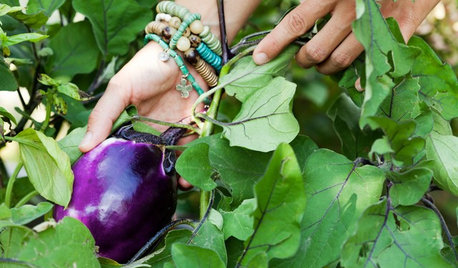
Eggplant: Let's do this!

10 years ago

Many times. All kablooey! I start about the same as peppers. They're foreign to my starting method and I scratch my head.

Black Beauty eggplant

What is going over my head or crawling through my cranium that's not registering? They're puny, weak and die easily (if they start at all). I'm pretty good with fresh pepper seed and tomato galore, but eggplant?

Disappointed!

bon

Comments (15)

  • 10 years ago

    Eggplant is more of a cooking season for me. I hide it. We don't each much, but ONE plant would be nice. Just saying ha

  • 10 years ago

    Eggplant seed is more like pepper seed in the sense that it germinates and grows better at higher temperatures. Your eggplant seed should sprout in 5-7 days if you can put the flat or whatever you're growing it in on top of a freezer or some other warm spot where it is exposed to temperatures in the mid- to upper 80s. It will germinate at lower temperatures but much more slowly. Then, it ought to grow just fine, but don't keep the soil too wet because the eggplant doesn't appreciate wet soil and sometimes you get issues with damping off when the soil-less mix you're growing seeds in stays too wet. Egglant isn't any harder to grow from seed than peppers or tomatoes, but it is a little slower to sprout at average room temperatures. I don't grow eggplant any more because we don't like it, but I grew it for a few years and found they grew just fine, especially in drought years. I gave away tons of eggplant after trying unsuccessfully to get my family (including me, lol) to eat it.

  • 10 years ago

    Thanks. I shall garden-soldier onward.

  • 10 years ago

    I am going to attempt eggplant also. Free seeds and I think they will look nice on the market table.

  • 10 years ago

    Last year I got one plant but sometime before it bloomed it just disappeared. I hear they are flea beetle magnets. If I get plants this year I am going to try a large pot.

  • 10 years ago

    I don't have trouble starting them, but I find them hard to grow because as Amy said, the flea beetles love them. I had to keep mine covered until they bloomed, then the leaves still had holes in them. I had never even heard of a flea beetle until I moved to this part of the state, so maybe you will get lucky and not have them.

  • 10 years ago

    Flea beetles may be the problem. I lose them when they go outside during the harden-off period. I KNOW I've seen tons of flea beetle damage on other plants, but not much of a problem on those plants.

  • 10 years ago

    Flea beetles do love eggplant (and tomatoes, potatoes and other nightshades) and some species visit other plants as well, particularly cole crops. Some species are drawn to radishes and, since radishes grow very early in the season, you can use radishes as a trap crop planted some distance away to attract the flea beetles to the radishes and away from the eggplant. If I was going to do that, I'd succession sow radishes weekly and then spray the plants each time that flea beetles were damaging that. Using that method, you could kill a lot of flea beetles before you ever have eggplants or other nightshades in the ground. Or, you can just grow your eggplant under row cover. Since eggplant is self-pollinating like tomato plants, you can leave them under row cover as long as you wish. Some of the organic pesticides used to help control flea beetles include products like Pyganic, other pyrethrin peoducts (preferably not with PBO added), neem oil and Spinosad. If you use conventional pesticides, then Sevin or any product containing bifenthrin probably would work on flea beetles. Unfortunately, organic pesticides don't kill them all and organic pyrethrins are short-lived in the garden and likely will need to be applied more than once. I keep a spray bottle of Take Down RTU in my garden shed to use as needed, and rarely use it, but like having it handy if something like flea beetles show up in large numbers.

    In addition to trap cropping, using row covers and spraying the plants with an insecticide, you could protect the plants by spraying them with Surround or by dusting them with diatomaceous earth.

    Some people densely sow seeds of the plants that flea beetles bother, based on the theory that the flea beetles will kill some of the plants but likely won't get all of them. They then thin the surviving plants as needed to the proper spacing once the flea beetles have done the worst of their damage.

    With eggplants and with some of the cole crops that flea beetles attack, it is a good idea to get your transplants to a larger size before putting them into the ground since the attack of the flea beetles is hardest on very small seedlings.

    I don't see flea beetles down here very often. When I do see them, they are more of a minor issue and not really a big problem in all but the coldest springs. Once the temperatures warm up to a certain point, I rarely if ever see another flea beetle. Since we warm up earlier down here than most of you do in the rest of the state, maybe that is why flea beetles are not a big problem here. Or, possibly, I might have some sort of beneficial insect in my garden that feeds on them. Even when I do see them, they usually don't do very much damage before they disappear. Now, just because I said all that, I'll probably have flea beetles show up and eat everything down to the ground this spring.

  • 10 years ago

    Is eggplant agreeable with squash? I only have a little row cover and had planned on doing yellow squash with successive planting of that French winter squash (that I was supposed to do last year). I could squeeze what eggplant I need under that.

    This has been a great thread because I've never really bothered with the flea beetle problem. This post made me look up its damage and the damage is very familiar.

    BUT that damage is limited although heavy. I must have something in my environment that is keeping the beetle in check. Yay! It never gets out of hand except one time when mid summer attack devastated my Seven Top turnip (leaf) crop I had planted as rabbit fodder. They really loved Seven Top.

    I could use that as a trap crop and some radishes. Yay!

  • 10 years ago

    Flea beetles liked my Asian greens a lot, too. And ground cherries. I have worried that they will be a problem since they were fed so well last year. I planted my egg plant with cat nip since it was supposed to repel them. I didn't see a lot of damage, but later the plant was gone. Possibly a rabbit? It grew to about a foot, and the whole plant was gone. I should research what eats flea beetles. Will try the radIsh trick. Dawn, how about a thread telling us what you do for trap cropping? I remember you talked last year about trapping cucumber beetles early on. Is there anything else you routinely do?


  • 10 years ago
    last modified: 10 years ago

    Ping Tung

    Bon, you should try Ping Tung. I've ordered some for the Philippines. I'll try to grab a few seeds for you to try. Salvador says there's a difference. You could tell us if there really is any :)

  • 10 years ago

    Ping Tung is the one I normally grow.

  • 10 years ago

    Lisa, that would be awesome. I'd love to give it a try. Thanks!

  • 10 years ago

    Bon, I cannot think of any reason to not grow eggplant and summer squash together. Winter squash? Hmm. Most winter squash are vining and run rampantly so might be likely to swallow up the eggplant. If the winter squash you're growing is more bushy and refined in nature it might work. Otherwise, to make it work you need to keep an eye on the squash plant, and train any vines/runners away from the eggplant. Make sure your eggplant is a good distance away from the squash when planted too.

    Amy, I do a gazillion types of trap cropping, so to talk about it all would require writing a book and that's never going to happen. What I do varies from one type of plant to another and even from week to week, month to month, and season to season, so if there's some specific crop you want to know about, ask and I'll try to answer.

    With regards to the cucumber beetles, they are everywhere here where we are surrounded by many thousands of acres of pasture land that is largely untended, other than maybe being sprayed by a broadleaf weedkiller at some point each spring and then being grazed, cut and baled later on.

    The beetles often emerge from overwintering in late January or earliest February and are out flying around before I even have any new plants in the ground. Because they are so early, there's a well-established population of them milling around before I plant anything at all, and by the time I'm planting, the population is overwhelmingly huge. So, to catch and kill those little buggers, I start sacrificial cucumber seeds early and set the young plants out on the patio table or in the garden or both when the plants have 4 to 5 leaves. I have them in disposable containers, usually paper or plastic cups.

    Cucumber beetles flock to them. I then kill the beetles on the plants, or if the plants have dozens of beetles on them, I bag up the infested plants in zip-lock bags, zip them shut, and put them in a black trash bag to be hauled away with the household trash. Then I move another cucumber plant or two from the light shelf or greenhouse to the outdoors to be the new trap plant.

    If you start a whole flat of cucumber plants early (and choose a variety not touted for pest tolerance) you can trap and kill oodles and oodles of cucumber beetles before you ever put any kind of cucurbit in the ground. Every cucumber beetle you kill is one less beetle that will be reproducing and causing issues later on. Cucumber beetles do not feed only on cucumber plants because they can attack virtually any and all plants in the garden, so by killing the earliest generations, I hopefully am keeping the overall population down. And, for anyone wondering, one of the major issues with cucumber beetles is that they carry and spread disease, so the fewer of them you have around, the better.

    Usually by the time I'm planting cucumbers, squash and melons in the ground, our cucumber beetle population is fairly small. It eventually will grow as the general popuation is highly mobile and flies around searching for their preferred plants, but usually by then at least my main pickling cucumber (County Fair, chosen expressly for superb disease tolerance) is well-established and the cuke beetles don't damage them much. On a warm, spring day, I see cucumber beetles everywhere on everything, so trapping them early and killing them can only help. Trap plants work great when they are the only available cucurbits. Once you have cucurbits in the ground, the trap plants in containers aren't all that helpful since the cucumber beetles have many more options at that poing.

    You can use Blue Hubbard squash as a trap plant for squash bugs and SVBs in the same way. Grow them a short distance from your actual preferred squash plants, and plant the Blue Hubbard earlier so it can start trapping pests. Then, try to catch and kill all the squash bugs and SVBs that flock to it. This works really well if you have your main squash crop under floating row cover so that the Blue Hubbard isn't just the best option for the pests---it is the only option at that point.

    Dawn

Sponsored
Peabody Landscape Group
Average rating: 3.5 out of 5 stars8 Reviews
Columbus' Reliable Landscape Design & Contracting