Software
Houzz Logo Print
hzdeleted_15962258

Fiddle Leaf Fig pruning

10 years ago

Hello everyone,


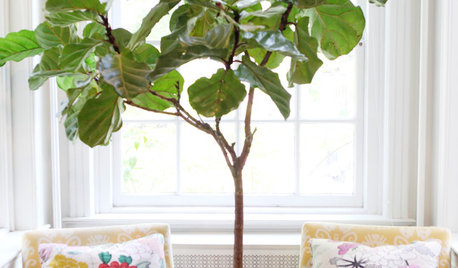
I've had this fiddle leaf fig for 3 years now. It's about 6' tall, I love it. I'd really love it to grow taller though (I'd like to see it grow to the ceiling!), it just seems to be spreading out and getting wider. I was thinking that perhaps some strategic pruning would encourage vertical growth. I've never pruned it before and am honestly a bit scared to do it. Any advice would be appreciated!


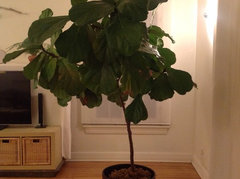
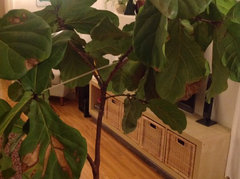
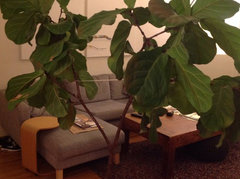
Below is a photo of my tree. There are some brown spots due to sunburn when I had to leave it outside for a couple of days while our building was fumigated. That was two years ago and it has since bounced back but would hate to cut off all the healthy new growth leaves.


Below is a photo of a specimen I love. Granted mine will probably never look like this, but it like the verticality, the sculptural quality of the trunk, and having most of the leaves high up.


Thank you in advance for any insight!

Comments (10)

  • 10 years ago
    last modified: 10 years ago

    Because there is no light above the tree, it's growing on both sides to stretch to the light.

    Do you have another place you can put where it'll recieves more light for the top of the tree?

    i don't think it's going to do what you'd like happily where it currently is.

    putting it outside next summer would definitely help. Just avoid direct sun as it's leaves are not currently accustomed to that.

    User thanked Dave
  • 10 years ago

    Thank you Dave. That does make sense. Unfortunately, that window on the right is the tallest in our place, the head of window being 8' high. Perhaps moving it out of the corner and more directly in front of the window would help.

  • 10 years ago

    That could help. Where are you located and which direction does that window face?

  • 10 years ago

    We are in Los Angeles and that window is East facing. The smaller window on the left is North facing.

  • 10 years ago
    last modified: 10 years ago

    South and west facing Windows receive the most light. South being the best. Northern facing Windows receive the least amount of light not making them the best choice for trees light this.

    Id make sure to leave the Windows uncovered too as the curtains will block out a lot of light.

    If you prune and keep it outside when the nighttime temps are above 60° that'll give it the best growth. It'll likely shed leaves when brought back inside though.

    id read this if you haven't yet: http://forums2.gardenweb.com/discussions/1493078/ficus-trees-in-containers

  • 10 years ago

    Hello Tapla, and thank you for your response. I have been reading some of your other replies to other fiddle leaf fig owners. Thus forum is very lucky to have you!


    In regards to the twin trunk composition in the image I posted - I realize that my tree will probably never look like that. I like that tree for the shape, the long trunk, and the verticality. The branches on mine have become very spread out.


    I read your link on root pruning and I'm quite certain it's time. I've had the plant for 3 years and have not pruned it whatsoever. Roots are starting to come out if the bottom and the top of the pot. For a novice gardener, which tools will I definitely need to acquire?


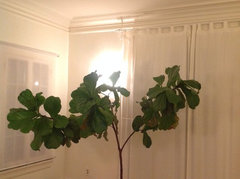
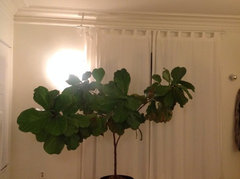
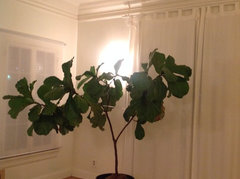
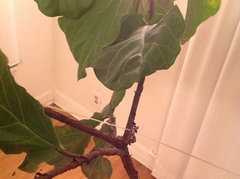
    I've taken some more photos. Please let me know if there are any more you need in order to advise. And thank you!


  • 10 years ago

    Thank you for your kind comments.

    You asked about tools. One important tool is patience. One bible passage that is so appropriate for growers is found in Ecclesiastes 3:1, and says, "To every thing there is a season, and a time to every purpose under the heaven ...... a time to plant, and a time to pluck up that which is planted .....". Plants have natural rhythms that find them very strong in part of the growth cycle and weak in part of the growth cycle. Being in sync with the plant's natural rhythms means less stress on the plant and shorter recovery times. So a quick outline would be

    * Get the plant outdoors ASAP (when nights are reliably above 55*)

    * Let it build some strength/ energy reserves

    * Repot it around Memorial Day - first of June into an appropriate soil

    * Do the hard pruning 2-3 weeks later after growth has resumed

    * Between now & then - monitor soil moisture carefully with a wooden dowel rod or equal, flush the soil thoroughly the next time the plant needs watering and take steps to make sure there isn't too much excess water in the soil, withhold fertilizer until you see signs the plant is pushing (growth), keep it warm and in very bright light.

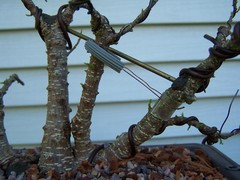
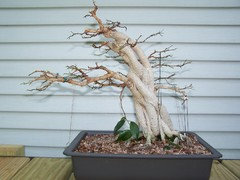
    If you commit to being careful about monitoring soil moisture, you can remove one side of the low trunk bifurcation (Y) now. I tend to like taper in trunk thickness, so my first choice would be to remove the thicker side of the Y and work with the thinner side, but if the thinner side is too far off the vertical axis, use the thick half of the Y. What you'll end up doing is cutting off one of the sides of the Y and leaving a long leafless stub. We're going to use that stub for mechanical advantage in pulling the side you leave into a more attractive position. Something similar to what you see in the pic below. See my plan to increase mechanical advantage so I can bend the trunk in the middle to a more favorable position?


    Which half of the Y is currently closer to vertical? Do you have a sense of which side of the Y looks more like a tree 'should' look, or as preference insofar as which side you'd rather work with?

    Al

    User thanked tapla (mid-Michigan, USDA z5b-6a)
  • 10 years ago

    Hi again @tapla. And thank you for your response. I've given it some thought and I think I'd like to work with the left half of the low Y. It looks more like a tree and is much closer to vertical than the thinner right side.


    How far up the right side of the Y do I prune? Can I try to air layer or propagate before pruning?


    There is a lot of weight pulling that left side over with the very long leggy branch growing out. Do I need to worry about the left side falling further out?


    What materials will I need to fasten the left part of the Y to the pruned right branch? Is there a particular technique I should know about?


    It's been a relatively cold winter here, but it looks like night time lows will be consistently mid fifties. Although it's possible they might dip back down. Would I need to bring the tree back in if I see the night time temperatures will be low fifties or high forties?


    I know that's a lot of questions, I just really don't want to kill my tree! I love it, but know it's time to prune, and I would love to see it grow to 8' vertical. I appreciate your patience and advice!

  • 10 years ago

    You can remove the subordinate half of the "Y" anytime, so feel free to layer it if you like, or cut it back to the first little branch distal to the trunk, which should force some back-budding on it. You might just get lucky and get a new branch of the stub that will complement the composition. That big, heavy branch that's almost horizontal has to go or be significantly reduced to keep its thickening in check. Heavy branches that high on the tree don't look natural.

    If you want to pull the branch you're keeping as the leader, you might be able to use the stub of the smaller half of the "Y" as an anchor. If that doesn't work, you can use a steel rod and some zip ties to make it conform to the shape you want. I'm sure you know how to use leverage to your advantage. If it's not all that far off the vertical, you can do some significant correction of its attitude when you repot. by how you situate the root mass.

    I'd be patient and watch the temps. If it's not a huge effort, I'd move it in & out as temps allow. If you repot it this year and it has a year to recover, you can prolly defoliate the entire tree around Memorial Day '17. If you do that when the tree is full of reserve energy and at the peak of its ability to make food, you'll end up with some significant back-budding and a pristine flush of new growth.


    I regularly use defoliation as an energy management tool and to increase ramification/ reduce leaf size in bonsai.

    Al