Software
Houzz Logo Print
hazelinok

Columnar apple trees

10 years ago

Does anyone have experience with, or thoughts/opinions to share about columnar apple trees?

Comments (9)

  • 10 years ago

    My apple trees are about 20' from a cedar although I don't know what kind. It about 40' tall. I'm pushing my luck I guess. This is the 3rd year for them. Hopefully I'll avoid the disease. I do spray fungicide and dormant oil.

    hazelinok thanked mksmth zone 7a Tulsa Oklahoma
  • 10 years ago
    last modified: 10 years ago

    The naturally short, narrow habit is very useful but not all the cultivars perform perfectly in all areas - same as with other apple varieties there are regional variations in results.

    hazelinok thanked Embothrium
  • 10 years ago

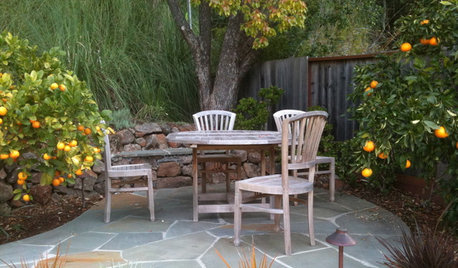
    Do the citrus trees do well in containers? Does it get hot enough to have good production? I'm guessing you bring them inside for the winter possibly even fall?

  • 10 years ago
    last modified: 10 years ago

    Citrus trees are mostly for fun and because their blossoms have the most heavenly aroma. If they never even set and ripened fruit, I'd have them just to have the scent of their blossoms in late winter and spring. They do ripen some fruit most years, but it is a relatively small amount due to the relatively small size of the trees. You aren't going to get a year's supply of citrus fruit off a handful of trees in containers, but we are happy to have what they produce in a good year. The trees produce very well given that they are confined to containers. They aren't big like my aunt's orange trees in San Diego though.

    I grow them in large containers outdoors on the patio in summer until it gets really hot and then move them to a grassy area where reflected heat is not so bad. In autumn I move them into a greenhouse. I don't heat it, though, although heat would be an option if needed. It is just that they seem to do fine without it. I'm in southcentral OK, and our lowest nighttime low this winter so far has been around 21 degrees, so the greenhouse has largely stayed above freezing even without heat. On sunny days, because of the greenhouse effect, I have to open the doors and vents pretty early or the greenhouse overheats even though I have 50% shadecloth on it. The fruit trees do just fine in there.

  • 10 years ago
    last modified: 10 years ago

    Okay. So my husband saw columnar trees at K and K. He decided to surprise me with a couple of trees--scarlet sentinel and a northpole. Oh my goodness. They are so cute and sitting on my front porch and I have no idea what to do with them.

    So...the organic apples I buy at Natural Grocers...I wonder how their growers do it. I haven't researched it yet. Of course, mine are columnar apple trees and won't produce the amounts that a normal tree would.

  • 10 years ago

    To begin with, ask yourself how many apple orchards you see in Oklahoma and part of the answer to growing organic apples lies therein. We don't have the climate for growing apples organically here, and the prospect of Cedar Apple Rust makes it almost impossible in our state. The growers who grow apples organically are doing so in a climate much more suited to growing apples, and it still is very hard to grow organic apples.

    Many home gardeners who grow apples as organically as possible (fungicides likely still needed), do so partially by covering their fruit to keep coddling moths and other pests off the fruit. You can do a search at the Fruit and Orchards forum to see what they use. I think some use nylon knee-highs, some use zip-lock or paper bags, and some use purchased fruit bags (maybe made of muslin, I can't remember). All of this is more work than I'd do. I generally just grow stone fruit trees instead of pome fruit trees because the stone fruit trees are more suited to our climate and grow well enough for me organically, though borers eventually get the trees after 10-12 years. With apples and pears in OK, often fire blight will get the trees at about the time they finally are old enough and large enough to start producing. You might Google and find the names of your columnar apple trees and see if you can find out if they have any tolerance of or resistance to fire blight. Fire blight is devastating to the plants it affects and is extremely hard to control, even with regular spraying.

    hazelinok thanked Okiedawn OK Zone 7
  • 10 years ago

    We had apricot trees a long time ago when we lived in Norman. Didn't get fruit every year, though. I wasn't much into gardening then.

    I am glad to see this post because we were thinking about growing the columnar apples and/or pears. Think we'll go with peaches or plums.

    Susan

  • 10 years ago

    My friend, Fred, has a huge apricot tree in his back yard. It is so tall that in the years when it makes a crop, you have to use the tallest ladder you have to harvest it. I assume if he had pruned it early in its life, it wouldn't have gotten so tall and unmanageable. It doesn't make a crop often, but when it does, the crop is huge and fresh apricots are so tasty. When Fred was in his mid-80s, as a concession to the advancing years, he bought some new fruit trees and planted them, and I believe they all were dwarfs. I've never planted an apricot tree here, but just thinking about his makes me want to plant one. He's 92 or 93 now and I would imagine those dwarf trees are producing fruit for him now, though he hasn't mentioned them lately and I haven't asked.

    I'm considering turning the big back garden into an orchard next year. It would be a whole lot easier to plant dwarf fruit trees in hardware-cloth root cages to protect them from the voles that are so bad back in that sandy soil than to fight the voles every year when they randomly start eating almost every vegetable crop. The only other option for keeping that big fenced area as a garden would be to build hardware cloth-lined raised beds, and after spending the last 18 years building raised beds in the front garden bit by bit, I'm not feeling highly motivated to start the whole routine all over again with the back garden.

    I have been leaning strongly towards turning the back garden into a fruit garden with fruit trees and blackberries grown with their roots in cages and with a hardware-cloth lined raised bed for strawberries. Maybe I'd leave a small portion of it for veggies because I do like growing all the vining veggies on that 8' tall fence since it is much sturdier than the front garden fence and is superior to it as a trellis. I hate to concede defeat to the voles, and I'd never totally abandon a garden plot we worked so hard to create and to fence, but the voles have made gardening back there a real challenge. They might not bother anything at all for months, but once they start randomly eating roots at night, you walk out to that garden daily having no idea what sort of dead plants you'll find that day. I'm starting to think the best answer it so have a dedicated fruit garden. As our original fruit trees are beginning to age out, and the nearby shade trees aren't doing them any favors either, a new area for new fruit trees seems like a good idea, and the back garden could be it.

    This year, in the part of that garden with the softest soil, which is where the voles are most often found, I'm going to grow an entire forest of castor bean plants and daturas just for them. I bet they won't eat the roots of either of those. That's the area where putting in fruit trees in root cages in the future makes the most sense.