Software
Houzz Logo Print

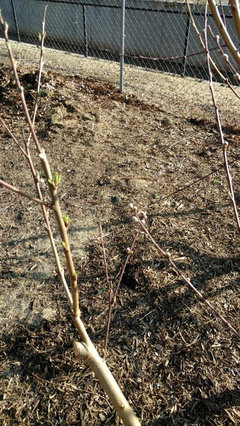
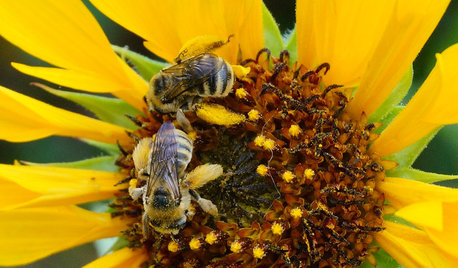
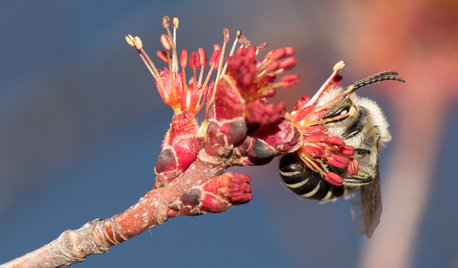
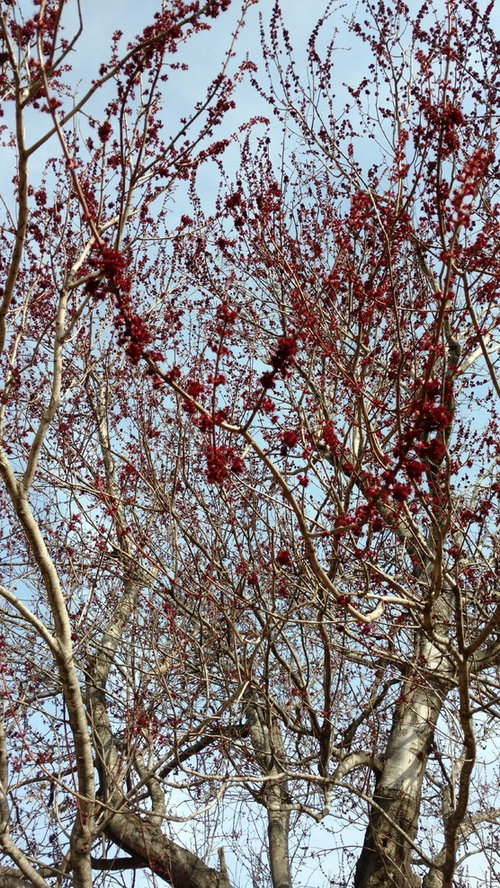
One of my maples is always early to wake up. Walked by it today to the sound of 100's of bees. Now if I can just find the honey. LoL

Comments (20)

  • 10 years ago

    How lovely! We've had bees all winter. I feed them sugar water and cracked corn all winter long. It sounds crazy, but they are perfectly happy with it. If I am late putting out the cracked corn on a decently warm morning, the bees are already out there buzzing around waiting for me at the usual feeding spot. They apparently are more punctual than I am, but then they don't have to feed the dogs and the cats first thing before going outside like I do. I've never tried to find their honey on purpose, but if I ever stumble across it......

  • 10 years ago

    Dawn has pet wild bees. How cool is that!

  • 10 years ago

    That is cool!! And it does not surprise me. Lol

  • 10 years ago

    With these warm days, my bees are bring in pollen like crazy.

  • 10 years ago

    The bees were really enjoying my broccoli Raab flowers yesterday. I was going to cut some for my dinner but I will leave them this week while it's warm. They need it more than I do.

  • 10 years ago

    These little hombres are hungry! With such incredibly warm temperatures as we've had throughout January and February they have been out earlier than usual and more often than usual. I always see bees out on the sporadic warm winter day, especially if it is bright and sunny, but this year they have been out almost every single day. The problem has been that there's not enough flowers in bloom for them all, although with every day that passes and as more plants bloom, that's becoming less and less of a problem.

    Right now at our house we have several wildflowers/weeds blooming, including dandelions, spring beauties, henbit and chickweed, and a couple of kinds of garden plants (dianthus, lavender and rosemary) in bloom for them. I wish I had more flowers in bloom, and with this week's unseasonably warm temperatures, I expect we'll have more plants blooming for them very soon. My verbena bonariensis plants bloomed in December and then a night in the 20s bit them back pretty hard. I have pruned off all the damage and expect they'll be back in bloom again soon. A lot of chamomile plants that pop up all over my garden are about 4" tall and it is likely the heat will make them bloom pretty soon. I hope they do, for the sake of the bees. I have a Variegated Improved Meyer Lemon tree in a pot in the greenhouse that is not too far from blooming and I'll move it outdoors to the patio this week so it can enjoy full sun (the greenhouse has 50% shade cloth) and heat and also be accessible to the bees when it blooms. I also keep a Texas lantana in a large pot in the greenhouse in winter. It blooms on and off all winter in a warm winter and I keep it right by the greenhouse door so the bees can find it when the door is open.

    Kim, Thanks for thinking of the bees. They need all the help we can give them, and they are one of the reasons I spray practically nothing, not even organic stuff, in my garden.

    We feed practically everything wild here, though not necessarily on purpose. So many wild animals (deer, rabbits, possums, coons, skunks, etc.) visit my compost pile to devour whatever they find there that it is a wonder I even get any compost out of it at all.

    While it is wonderful to have all this warm weather in winter, it worries me to be this hot this early. If we are hitting the 70s and 80s in February, as we have been, then what will June be like?

    Finally, I do think that the bees have me trained pretty well. The other morning I opened the front door to walk out, and there were bees flying (almost hovering) right at eye level at the front door. I told them "all right, all right, I'm coming". Want to be at one with nature? Become a gardener!

    Dawn

  • 10 years ago

    I love this Dawn. I do not spray either as I have learned from all of you that it defeats the purpose. I did spray neem oil last year but carefully only on my cabbage.

    This is the reason I lost interest in doing the school garden. The other parties involved are 100% pro chemicals.

  • 10 years ago

    Growing up I was taught that maple is the first real honey flow of the year. We never taste any maple honey because the bees need it to build up their population in preparation for the coming work.
    By February, for sure, hives have started getting really active on the inside, regardless of what a person can see from the outside. They desperately need to raise little ones (brood). Worker bees which have survived to this point, are old and getting a bit tattered. Replacements are needed for the coming honey season. Every day that temperatures get above the 40s, I feed my hives. Because they are starting to raise brood, the inside of the hive cluster is maintained at about 90 F. Bees produce warmth inside their hive by means of friction. They cluster tightly together and MOVE, rubbing against one another. This requires calories, which is what they get from honey.

    March is sometimes known as "the month of death," among beekeepers. The hive MUST build its population in order to survive. But there may not be sufficient nectar flow. Also, just when they are really tight and need food, it's possible that a snow storm blow in and leave them stranded (and starving) for a week or more. So, again, I feed all I can.

  • 10 years ago

    At the risk of sounding stupid, Dawn, how do you feed bees sugar water and cracked corn? Hummer feeder, dish, what? I am going to be getting the orchard bees that I ordered earlier soon, and I'm supposed to refrigerate them until the temp is above 53. You see, I am a bee virgin .....;)

  • 10 years ago

    Harriet, I do feed them in hummer feeders with the bee guards removed, and I put the cracked corn in little piles, about 20 of thme, one about every 4 or 5 feet, right on the edge of our gravel driveway. After the bees leave in the late afternoon, wild birds of all kinds (especially the doves) descend upon the cracked corn and gobble it up in no time at all.

    The sugar water formula is a little different in fall vs. spring. I use the fall formula for winter feeding too since the bees sometimes are out on warm winter days and, this year, they've been out on a lot of winter days. Once the weather warms up in late winter (like it already has), I use the spring forumula. The formulas can be seen on the link below from the American Bee Journal.

    American Bee Journal FAQs

    I didn't exactly set out to feed cracked corn to bees. While I've always tried to provide plants that bloom year-round for the bees, I noticed in the summer of 2011 that the bees were feeding at the hummingbird feeders and at the cracked corn I was putting out for the doves because that summer the horrendous heat and drought killed all the wildflowers. I put out additional feeders just for the bees, hanging them in elm trees near my back garden so they'd be in fairly heavy shade and then put cracked corn there in the shade for the bees. Before that I had sporadically seen bees visit the doves' cracked corn occasionally on a warm winter day, but since then, it has escalated to the point that there's so many bees that the doves have to eat very early---right around sunrise---in winter to beat the bees to the cracked corn. Once there's a ton of bees at the cracked corn, the doves won't go near it. Neither will our chicken or turkeys, though they have their own food in their feeders. Maybe they are afraid of the bees.

    George and Robert can answer all your bee questions here. I am not a beekeeper, but they are beekeepers. I am just a gardener who has a soft spot for all the animals, birds and insects in the cold, hard winter months....or the hard, hot drought months. I'd like to keep bees someday. Actually, I'd like for Tim or Chris to keep bees someday. Between our extensive gardens, dogs, cats and poultry, I don't need anything else that needs my time and attention but both my DH and DS spend plenty of time indoors while I'm outdoors. I hope one day that one of them will decide to keep bees. They both talk about doing it, but just haven't taken the plunge yet.

    Dawn

  • 10 years ago

    I read an article the other day that stated that in Africa they are keeping elephants out of their gardens by placing bee hives about 5 feet apart around the edge of the garden.

  • 10 years ago

    I find that hysterically funny. Wonder if it would work for coons, possums, rabbits and deer?

  • 10 years ago

    :) That would be a lot of hives...but wouldn't wonder! Our dogs don't go near ours!

  • 10 years ago

    Yesterday we hit 79.9 degrees at our house and there were bees in the garden working the flowers. There's still not enough in bloom for them, but they did have the following flowers: lavender, strawberry, dianthus, daffodils, rosemary and, in places I haven't yet weeded, chickweed and henbit, although I am about to get all the blooming weeds pulled. There's still plenty of henbit and chickweed blooming in the pastures, along with dandelions, spring beauties and bluets. Some of the chamomile is about to bloom, so soon there will be those flowers for the bees as well, and one peach tree seems determined to bloom. Its' flowers are pinking. while the plums that usually are in bloom early seem to still be sleepy, and I am glad. I'm still amazed elephants avoid bees.

    Oh, and the yellow jackets were swarming yesterday. Our son apparently has a nest up in the attic of the house he is building, and something he was doing yesterday set them off. He got stung several times and told me he killed 57 yellow jackets. He also said there's at least 2000 lady bugs overwintering in his house. He's at work today so I am going to go down there to his construction site later and open the doors and windows in the hope that the lady bugs will take the opportunity to leave their winter abode.

  • 10 years ago

    Unfortunately beehives won't deter raccoon, possum or even deer.

    I helped check a couple of hives for a friend, yesterday. She hadn't harvested last year. Her bees were in fantastic shape! I may have an idea for my own bees now: leave a LOT MORE honey on them. I grew up, keeping bees, on the East Coast. Oklahoma is very different, especially for bees.


  • 10 years ago
    last modified: 10 years ago

    That's too bad. I was hoping that if they deterred elephants, they'd deter my largest garden pests. Oh, well.

  • 10 years ago

    Bees will have something else to find soon. Here is my O'henry peach. It way too warm for the stone fruit trees. The others are a ways behind but getting close to blooming.

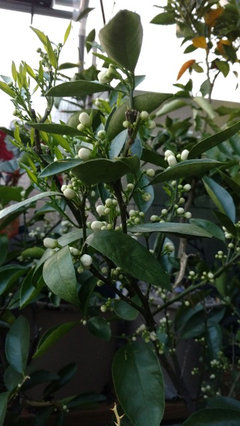
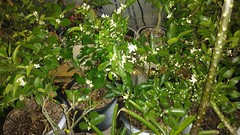
    If they don't like that they can come in the greenhouse for some orange pollen

    amy. I got lazy and didn't bring them out.


    Mike

  • 10 years ago
    last modified: 10 years ago

    Mike, I have peach blooms that are likely to blossom by Tuesday or Wednesday. You cannot stop that train once it is running down the track, and we havehad highs in the 70s and 80s, so the trees are very eager to bloom.

    Down in the D-FW meto area today, I saw native plum trees in full bloom. Elms and willows have leafed out. I wanted to ask them all "Don't y'all know it is February?". Then I got home and saw that our sand plums are budding. I expect the citrus trees in the greenhouse to be budding and blooming, but not the plants that are outdoors in the ground. I hope it is not too late for the trees to stall and not bloom this early or we are likely to lose the entire stone fruit crop to whatever late freeze seems inevitable....and it won't even really be late. It will be on time, but the trees are just going to bloom too early.

    Orange blossoms produce my favorite scent. I just adore it. The bees disappear from my garden when the citrus trees are blooming up in the greenhouse. If I want to see the bees at that time, I can find them there.

    Dawn

  • 10 years ago

    They are some of my favorites too dawn. I've got all of them going now. Lemon, lime, naval orange, and my new dekopon mandarin.

Sponsored
Schlabach Woodworks
Average rating: 5 out of 5 stars21 Reviews
Franklin County's Reclaimed Wood Professionals