Software
Houzz Logo Print
tiffy317

Soil Help Needed

10 years ago
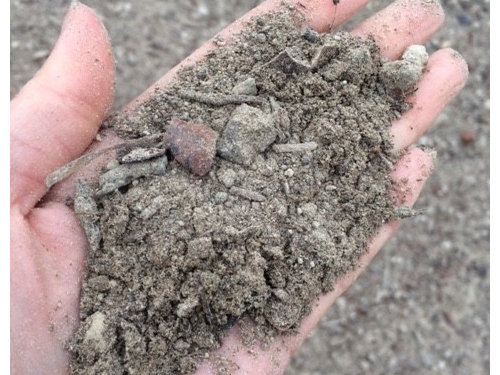
Hi all, we are brand new to gardening after browsing this forum. My husband recently built multiple raised beds and this weekend we ordered soil for them. The soil we ordered was described as "50% composted materials, pecan shell mulch, fish emulsion, pond sand and granite." and a "loam free material."

We were very excited but when it arrived it was very gray in color and look like it lacked any of the dark colored compost we were expecting to see. It also seems very sandy, although it's much lighter weight than sand.

Has the compost just decomposed over time? If so would the nutrients from the compost still be there? Should we add more compost? We were also thinking of adding some Peat Moss since it seems so sandy.

Any suggestions?

Comments (16)

  • 10 years ago
    last modified: 10 years ago

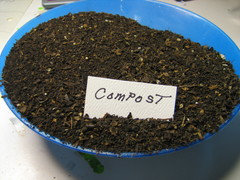
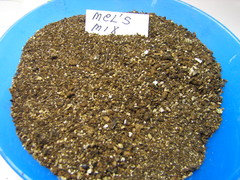
    Hi Tiffy, it's been my experience that most of what is purchased for garden growing medium is just some one else s waste products. That's not to say there's not some good stuff out there, this is my opinion that others may debate. I was fortunate when starting composting, our local recycle center had some nice stuff, al that was needed was some additives. Now after doing my own composting, I use the same material for starting seeds as I do in my beds....This is (again my opinion) what growing medium should look like.

    The mix is equal parts of compost, vermiculite and peat moss.


  • 10 years ago
    last modified: 10 years ago

    While it does look a bit sketchy, you can't really judge by looks alone. Give it a good spray with a water hose and take another look. Maybe post another pic.

    While it's moist, give it a good squeeze in your hand, then poke it with your finger, Does it make a blob? Does a poke just make an impression? Does it not compact at all, and stay as a 'sand'? Does it crumble into medium sized 'clumps'? A poke should make it crumble into medium sized, non-compacted, friable clumps. This test will not really tell you the composition, but it will reveal texture. The only real way to know the composition is from a soil test. And even then, they are only testing for certain things.

  • 10 years ago
    last modified: 10 years ago

    Tiffy please don't take this the wrong way but people from all over the world post things on the internet - Where in this glorious world are you located? Your location can yield replies from some locals which could be helpful to you.

    Since peat moss adds no nutrient value I would not be spending money on peat but the soil test mentioned above. Once you mention where you are I am sure someone can recommend a reliable soil testing lab in your area. fwiw - many universities have soil testing labs.

    Once you know what the lab says about the soil and makes recommendations you will know what to do next and what to make of the place that sold you this.

    I would ask that place exactly what they mean by "loam free material."

    Keep in mind most labs will want to know (as we also do) what it is you plan to grow.

    HTH

  • 10 years ago

    Hi tiffy317, I think what you were holding is sandy soil. That thing will repel water, leach away plant nutrients, attract cats to dig and do their business etc.

  • 10 years ago

    This stuff looks like a good start that can become good soil in time, with management.

    I see gravel. Never a great thing but if it's a small fraction of it, no worries.

    The gray color is probably fine silty particles coating everything. Not a big problem.

    Overall it looks very coarse though, i.e. sandy and silty, and it will probably drain quite fast. If you have finer soil on your place already, blending some of that in might be a good idea.

    I see shredded wood or bark, which is not compost but will decompose eventually and provide organic matter.

    I too wondered what 'loam free' means. Loam is a certain balance of sand/silt/clay particles with sufficient organic matter. Calling something loam free is...weird.

    tiffy317 thanked toxcrusadr
  • 10 years ago

    Loam is considered the best soil for a garden that exists, except it is not very readily available.

    https://hort.purdue.edu/ext/loam.html

    kimmq is kimmsr

  • 10 years ago

    Me thinks that most of us know that <Loam is considered the best soil for a garden that exists,>

    Not sure who says or thinks this <except it is not very readily available.>

    My soil test says I have "Sandy Loam".

    Quoted from the above link -

    • A loamy soil, then, is one that combines all three of these types
      of particles in relatively equal amounts. Loamy soil is ideal for
      most garden plants because it holds plenty of moisture but also
      drains well so that sufficient air can reach the roots.

    My question was "I would ask that place exactly what they mean by "loam free material." "

    Or better yet knowing that "Loamy soil is ideal for
    most garden plants
    "
    why they would even mention"loam free material?"


  • 10 years ago

    I think that Tiffy's soil looks great; I'd be well pleased, just going by the appearance. I suspect that she was expecting something that looked like it was straight from the compost pile which would have been terrible in a raised bed.

    The mineral component in a garden soil, the particles of sand, silt, and clay, are the most important structural elements.....everything else should be a small percentage of that handful of soil.

    tiffy317 thanked rhizo_1 (North AL) zone 7
  • 10 years ago

    It has the look of a particle size distribution that's going to set up hard in the hot summer. Time will tell, and if that happens, more compost helps the texture.

    tiffy317 thanked toxcrusadr
  • 10 years ago

    I'd still like to see it after it's been wet a little. I've seen lot's of examples where dust (like that 'granite' addition) gives an unfamiliar color to a medium. Once wet, such soil often looks great. But as already discussed, soil color or appearance does not necessarily have anything to do with quality or performance. Hopefully the OP can return with a report on the texture and other characteristics.


    As far as loam... here where I live, the only loam that's easily found is what we make ourselves. If though, it's good quality clay you're after, you've come to the right place!

    tiffy317 thanked rgreen48
  • 10 years ago

    Soil tests are overrated, but this is one time where I think it is worthwhile. OP has no idea what she has. Maybe it works and maybe it doesn't (although it being overpriced is a VERY good bet).

  • 10 years ago

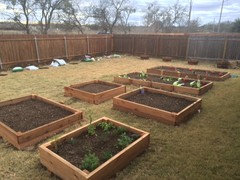
    Thanks for the input everyone. I was nervous that it was so gray in color since I was expecting more of a dark potting mix look, but it was just really really dry when it was delivered (we haven't had any rain in a while). It still seemed a little sandy so I listened to some of your advice and added some compost. In the end it started looking very good and I'm pleased with the results. I don't have a close up, but here it is in the garden beds my husband built - you can see how it really darkened up after a little rain and adding the compost.

  • 10 years ago

    Yea the beds look fine. But w/o the overrated soil test you don't know IF you have sufficient nutrients/minerals to grow whatever it is you want to grow. And certainly you can spend the next year or two figuring that out by watching how your plants do.

    When planning a garden the first step is selecting a location - sunny yet not too wet. Step two is the soil test from a soil lab - not from those home test kits.

  • 10 years ago

    Just an idea. If you haven't planted yet, I would fill to the brim. If you have a lot of organic matter (compost) in there, it will drop down. If you've already planted, don't worry about it and add some more next season. I usually add my own compost each year and top off every other year or so. Nancy

    tiffy317 thanked nancyjane_gardener
  • 10 years ago

    a general rule of thumb it is the organic matter in soils that give them the dark color. Soils lacking adequate amounts of organic matter tend to be greyish to blonde.

    " Influence of Organic Matter on Soil Color

    Soil has living organisms and dead organic matter, which decomposes into black humus. In grassland (prairie) soils the dark color permeates through the surface layers bringing with it nutrients and high fertility (Kansas State Soil). Deeper in the soil, the organic pigment coats surfaces of soil, making them darker than the color inside. Humus color decreases with depth and iron pigments become more apparent. In forested areas, organic matter (leaves, needles, pine cones, dead animals) accumulates on top of the soil. Water-soluble carbon moves down through the soil and scavenges bits of humus and iron that accumulate below in black, humic bands over reddish iron bands. Often, a white layer, mostly quartz occurs between organic matter on the surface where pigments were removed (Wisconsin State Soil)."

    From the article linked below.

    http://www.nrcs.usda.gov/wps/portal/nrcs/detail/soils/edu/?cid=nrcs142p2_054286

    kimmq is kimmsr

Sponsored
Bella Casa LLC
Average rating: 5 out of 5 stars17 Reviews
The Leading Interior Design Studio in Franklin County