Software
Houzz Logo Print
john11840

Fertilizing Vanda Orchid

10 years ago

I got my wife a beautiful, blue Vanda for Valentines Day. We had a strong storm come through yesterday and lost most of the blossoms. Should we start fertilizing now or let it rest a while? I have Better-Gro Orchid Plus 20-14-13. We are in south Florida.

John A

Comments (26)

  • 10 years ago

    Follow the directions and fertilize now but when the cold snaps come back off.

  • 10 years ago

    so much information to give... so little circumstances and growing conditions given about where you are growing this plant....

    What is vanda growing in? basket, pot, free hanging, glass vase, mounted on tree, staked over a pile of mulch?

    Where is vanda placed? in full sun, under a tree, inside a greenhouse (what percentage shade?), in shaded patio, in screened patio?

    how frequently do you water it? how do you water it?, can you tell when your plant has had enough water?

    how is air movement in the grow area? Pictures do tell a thousand words.


    All these variables have an effect on the vandaceous plants and modidfy its requirement for fertilizer. Vandas are perennial growers, if you keep them in bright light and in low temps above 60 degrees.

    Post some of these variables and more informed data can be provided...

  • 10 years ago

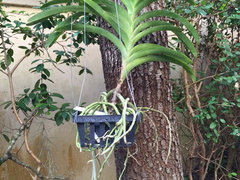
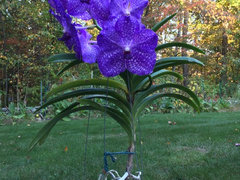
    Thanks Ben. Here are after and before storm photos.


    The photos answer some of your questions.

    It gets 1 to 2 hours of sun per day.

    I just bought it last week and haven't watered it since the big rain 3 days ago.

    Air flow is good around it.

    Temps have ranged from mid 50s to mid 70s since it's been there.

    Any suggestions would be appreciated.

    John A

  • 10 years ago

    Thanks for the suggests, Harvey.

    John A

  • 10 years ago

    Nice blue vanda, here are the bad news.... vandas need lots of moisture, high humidity, strong light (No full sun), good air movement and steady fertilizing. Your biggest challenge will be giving it enough moisture. A proper watering schedule should have roots totally soaked (they turn from white to green when they are wet) at least twice each morning. BTW, vandas love rain.... Easiest way is to get a mister attachment to a hose with timer... we'll see how committed you are to growing this plant. Lack of moisture will manifest in the older leaves turning yellow, then brown then falling off. At that point your lovely vanda will become what is affectionately called a "palm tree". The palm tree look is a few dead roots, a couple of live roots, long stem and just a couple of leaves at top. This is the plant trying to survive, even though the moisture is severely lacking. The shedding of leaves is how the plant is trying to adapt to a less than ideal moisture intake. By this time the plant is so stressed and is susceptible to many virus or fungus diseases and it is not worth keeping. A good way to improve water intake is to place plant into a 6inch cedar or teak (preferred) basket and then place the 6 inch into an 8 inch basket. Remove any dead roots, then secure all baskets with plastic tie wraps and soak the plant's roots and baskets in a bucket of water daily for 15-20 minutes. This will soak the wood and allow for continued water absorption by the roots until the wood dries up in a couple of hours or so. I have seen this method fairly successful in vandas retaining all their leaves... next time... fertilization.

  • 10 years ago

    I fertilizer mines all year in very small doses.....I figure if I try to mick nature in which fertilizer is always available to them, why not in captivity especially when the roots are not held up in a soil mix?

  • 10 years ago

    I rarely water mine and they grow in full Florida sun. I rarely fertilize. When I do I pour some water from a watering can over the roots. That's it. Mine flower well.

    These orchids get the least care from me. Florida has long dry spells, and they seem to handle it.

    Your biggest problem will be sunlight. When you bring it in, put it in the sunniest window and you can water over the sink. When Spring arrives, get outside.

    Here's one which is blooming now. I can't remember watering it. We had rain about 2 weeks ago.

    Jane

  • 10 years ago

    Jane, that is a nice ascocenda, growing in the shade of your mango tree. ascocendas can be blooming machines and will bloom easily in much less than ideal conditions. Most vandas... not so much.

    Giving a vanda novice grower your advice that you "rarely water mine and they grow in full Florida sun." and implying that that is good method to grow/bloom vandas is not a good idea. Following you suggestion on a pricey vanda is a sure way to send an expensive plant to the big greenhouse in the sky fairly quickly... The only vandaceous plants that can withstand full South Florida are terete, semi terete, mokara, arachnis type vandaceous plants that can be acclimated to full sun. I have successfully grown all those types in full sun in south florida. Strap leaves vandas as the one posted to start this post will surely burn and dry up in a couple of days. The most sunlight you can give them is about 70 percent, same as "screened in" pool enclosure. Let the color of NEW growth on a plant guide you to the amount of light that it can withstand. The ideal shade of green is a light green, a dark green indicates too much shade and if starts to turn yellow it is too much light and possibly may burn the leaf. The best way to adjust to the proper level of light is gradually move the plant to a brighter spot and keep a close eye on it.


  • 10 years ago

    Fertilizing vandas is just part of overall culture for the plant. Vandas are always growing, providing you keep low temps above 60 degrees and bright light is given (not more than 50 percent shade) for at least 6 hours a day. Good air movemet is also required for a healthy growing condition. The recommended rate of fertilizer that I have been given by the best vanda growers in south florida is a tablespoon per gallon of water and have used mostly 20-20-20 water soluble. I have found that key to good vanda blooming cycle is to delevelop a good feeding regimen and to not skip any feeding, especially when plant is actively growing new roots

  • 10 years ago

    Ben, I do apologize that my comments were probably not the best advice to a new grower. However, I find Vanda's the plants which most people in Florida neglect. The Ascocenda pictured, has been flowering since December. I hung it on the Mango for the photo as it was growing high up on a Plumeria which was leafless. I grow Vandas in full sun outside.

    I am not recommending what I do as the OP lives in CT and must grow his Vanda indoors over winter. He will not have the humidity I have in Florida.He will have to water or at least mist the roots.

    I have never watered the roots on any Vanda twice a day nor twice a week. I don't know anyone who does. But, I live and grow them in South Florida. Different climate.

    Not sure where you live Ben, but I do agree, the OP needs to keep his plant well lit and watered during the winter months.

    Jane


  • 10 years ago

    Since I am a "snowbird" I am now in South Fla for the winter. Will go back to CT early April. Other folks, including the nursery where I bought it, have said let it rest since it had the storm damage. For right now, I have fertilized it once and am keeping it watered.

    John A

  • 10 years ago

    Jane, I differ with you. I do what ben mentioned. And all the experienced growers I know do the same. The test for good roots is no breaks, big diameter and large translucent tips. Good for any orchid, including vandas.

    Jane, perhaps yours are potted? Most are not but maybe you found the perfect combination of pot, potting material and the rest of the culture. I do know of many various successful paths of growing orchids. Looks like you found a different way...

  • 10 years ago

    I used to work for a man that grew mostly orchids in his greenhouses in Vero Beach, Fl. We watered the vandas daily with a hose and they were in a shade house with just a few hours of early morning sun.

  • 10 years ago

    My Vanda has new root tips growing that are black on the ends. Is this normal.

  • 10 years ago

    I've been following the somewhat mixed advise above and patiently babying the Vanda since I first posted last February. A new spike started to appear about a month ago, and it has now rewarded us.

  • 10 years ago

    well done. a beauty!

  • 10 years ago

    that is a beeeuutful plant, I see the coerulean color background and the sanderiana shape and ascocentrum tendency for frequent blooms.... is the tag legible? I know one of these blues has an FCC from AOS...

  • 10 years ago

    Ben - The tag is clearly visible. It reads V. Pakchong Blue - Bomjorg. Nothing about FCC.

    John A

  • 9 years ago

    It's starting to lose its first blossoms now. It kept them about 4 - 6 weeks. Is that normal?

    John A

  • 9 years ago

    4 to 6 weeks seems about right. Now for you to winter this plant in z6. They like 50 and higher with humidity. Do you have accommodations for that? Good luck...

  • 9 years ago

    Harvey - Thanks for the reply. I've been babying this guy since it bloomed and bring it inside every night that it gets below 50. That won't be a problem this winter since we are snowbirds and it will go to South Fla with us.

    John A

  • 9 years ago

    A traveling vanda!

  • 9 years ago

    All the blooms are gone now and the spike has turned brown.. Should I clip the spike off?

    John A

  • 9 years ago

    Yes, clip it.

  • 4 years ago

    Jane and others —
    The below is by RF Orchids - located in Homestead, FL (Robert Fuchs) on growing Vanda and they grow gorgeous, huge Vanda, mostly on wire only, some with strap basket and not much if any media. Robert Fuch is a leading expert on these plants, a breeder and AOS judge and current president and officer of American Orchid Society. He knows what he is talking about and his plants show it without being overpriced. He has won many awards and has a website RF Orchids. I don’t personally know him but I know what his plants look like.

    “WATER:
    Vandaceous orchids in slat baskets should be ­watered daily, preferably early in the morning. Give them a good drink with the hose, or a dunk in a bucket or sink if you only have a few plants, and let them dry. High daytime humidity is essential, especially on sunny days, and additional misting once or twice a day in bright weather will be helpful. On hot, sunny days around 80% humidity is appropriate. Water more sparingly in winter, during long cloudy spells, or after repotting. In any season, avoid watering plants late in the afternoon. Vandaceous plants should be dry before nightfall.

    FERTILIZING:
    Vandaceous orchids are heavy feeders. Once a week during the growing season, give the plants a solution of a complete, balanced fertilizer. High-nitrogen fertilizers will inhibit flowering and are not recommended for these ­orchids. All plants should be flushed thoroughly with plain water once a week to remove built-up salts. If you use an automatic proportioner, plants may be fertilized as often as daily with a more dilute solution. Whatever feeding plan you follow, remember, it is important to be faithful to the ­regimen you have ­established. We use Peter’s 20-20-20 (All Purpose with micronutrients; Jack’s Classic All-Purpose is packaged for consumer sales) fertilizer weekly during the growing season. Inside the greenhouse, under a controlled environment, we use the standard, recommended concentration of 1 teaspoon per gallon. During the winter (non-growing season), we apply the same proportions every two weeks rather than weekly. In addition, at every third feeding we substitute Peter’s (or Jack’s Classic) 10-30-20 (Bloom Booster). This substitution ­applies to plants in all seasons of the year. And once a month we add 1/4 teaspoon of ­SUPERthrive, a concentrated vitamin and hormone solution for plants, to each gallon of fertilizer solution. SUPERthrive is a root stimulant, not a fertilizer.”

    Note:
    Both of these companies have tabs on their website for how they grow Vanda. And Motes has YT channel with 4-5 hours in 4 videos on growing orchids, mostly Vanda in south Florida.

    Motes Orchids (Miami Fl) Dr Motes recommends watering each time until the roots turn dark green. He has written a number of books and articles (including for the American Orchid Society) on growing Vanda (their specialty) in South Florida.

Sponsored
Bella Casa LLC
Average rating: 5 out of 5 stars17 Reviews
The Leading Interior Design Studio in Franklin County