Software
Houzz Logo Print
bman_152

Hard Pruning?

10 years ago
Hello!

I just bought my first house this winter, and am looking at planning my yard projects now that spring is within sight :) This is my first time ever having any sort of yard/plants/etc to maintain, and I am very excited about the oppurtunity to learn about the proper care & maintenance practices..

Anyway, I'm hoping that I could get some advice regarding some hedges I have...


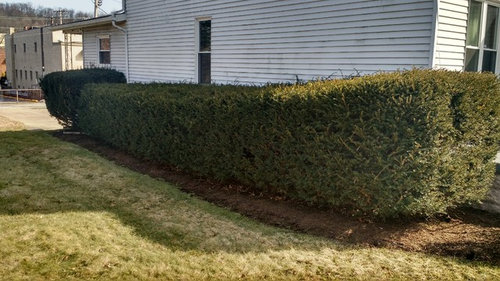
The hedges are evergreen (I think they are Yews??) & look very old/established/overgrown.. I would love to cut them to a smaller/neater/more manageable size.. Their current size ranges from 6'h x 6'w in the middle to 8ish' x 8ish' on the ends.. Ultimately, I'd love for them to be roughly 4'x4' with a more consistent size (aka not huge at the ends)..


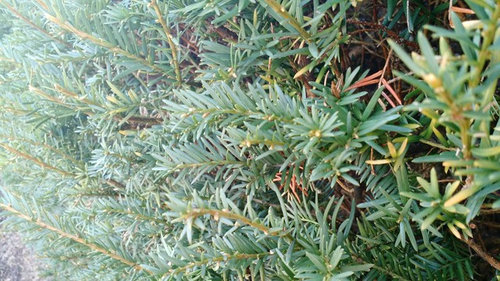
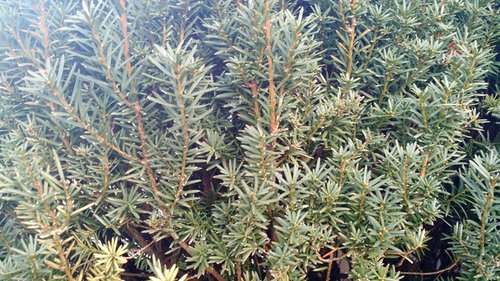
The hedges have a very flaky bark & thick, succulent needles (not soft, but not super pointy either).. The one at the end is a slightly darker shade of green if that matters.. It looked to still be the same in texture/growth.. They are growing in SW PA..

*yes, I did quickly shear them in the middle of the winter.. Hence the sickly/rough/broken branches.. I know this is the ultimate no-no, but had to do something to clean them up.. The previous owner let them get very out of control (18" branches sticking out of the top).. Now that they are mine, id love to give them the care that they deserve..


My plan:

I was planning on cutting the hedges to roughly the 4'x4' size in early March (essentially cutting off all the needles & leaving just the main branches), and planting a cheap/temporary plant in front of them while they fill back out.. (They feature quite prominently from the street)..


My questions:

1- how long do Yews take to fill back out? I've seen a ton of conflicting information about this..

2- any suggestions on how to make them less of an eyesore while they fill back out? I just moved into the neighborhood & don't want to take the chance of offending the neighbors.. I was planning on planting something in front of them (perhaps a vine or creeping plant) while they regrow.. Is this a bad idea?

3- is my plan (above) misguided? Should I be cutting them to the stump, ripping them completely out and starting over, or leaving them as-is?


Anyway, I know that many of my questions have been addressed before (in one form or another), and I've been having a blast browsing through the GardenWeb forums! I've read up on everything I can find, but am still not too confident that my plan (or even the plant species) is correct..


Anyway, I'd like to thank you in advance for taking the time to read my novel of a post & for any information/help/suggestions that you provide :)


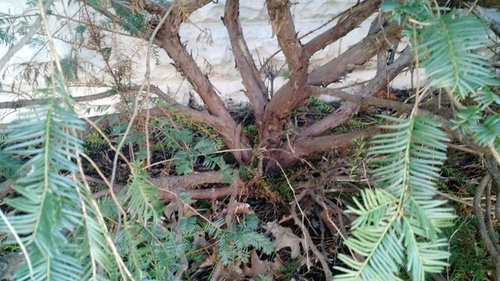
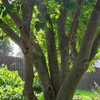
The hedges


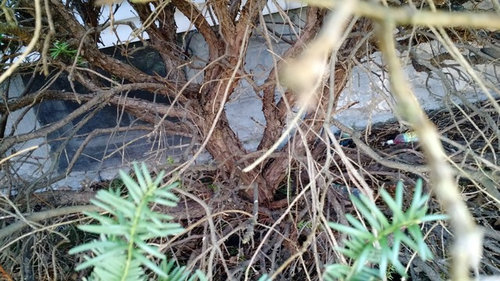
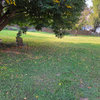
The inside

(Sorry about the litter.. Just noticed it when I posted the picture)


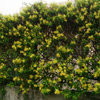
The needles

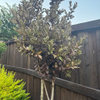
The darker (end shrub) needles

Comments (15)

  • 10 years ago

    an extremely old... [in suburban terms] .... over trimmed ... improperly planted old hedge line ... IMHO


    the best thing you could do.. is to EVENTUALLY remove them.. and plant your own future nightmare .... lol


    with that in mind.. do whatever you want.. based on others experience ... but if it all fails to impress you .. just get rid of them ...


    one problem with you finding various answers... is that growth rates can be extremely affected by winter ... e.g. ... they will regenerate much faster ... in places that have an 8 to 10 months growing season ... as compared to one where the season is 6 months [due to ground freeze and winter] ...


    you are going to get all kinds of answers.. watch where the advice comes from ...


    we have covered this many times before [unsearchable titles] .... and if memory serves... its about 50/50 as to peeps coming to the eventual decision to remove them ...


    ken


    ps: anything can be done .. its just a matter of how long you want to look at the uglies .. before they recover ... i like to tell peeps .. if it looks ugly out back on acres #4 .. i might have a lot more tolerance for a multi year experiment.. as compared to it being right out the front door.. where i have to look at is... many times per day .... at least yours doesnt appear to be right out the front door ...


    bman_152 thanked ken_adrian Adrian MI cold Z5
  • 10 years ago

    Ken,

    Thank you for the advice & information! It's really helped me a lot..


    Though replacing them with my own future nightmare ;) sounds quite appealing, I think I'm gonna try my luck trying to salvage them.. The worst that could possibly happen is that I get the oppurtunity to replace them with a landscape better suited to my needs/style :)

  • 10 years ago

    To keep them at 4 ft, they will need to be cut shorter. Two to three feet is about right. Kept watered and fed, they should look like something by next spring. Yews aren't really slow growing plants. The 18 inches you cut off this winter may have been only one year's growth.

    bman_152 thanked mad_gallica (z5 Eastern NY)
  • 10 years ago

    Ahh cool! That makes a lot of sense.. Thanks!! Will chop them down to 2-3 feet & fertilize/water well :)


  • 10 years ago

    I agree with mad gallica but yews will look ugly and bare for at least a year. If you are disciplined with your pruning, yews will be wonderful to work with after the corrective pruning and assuming there are no underlying diseases from prior neglect, but one thing at a time. Prune away! I live in Houston area FWIW

  • 10 years ago

    If you cut off all the actively growing buds it will take a year or two for dormant buds to awaken and another year or two to return to growing strong. They will look powerful ugly for two to four years.

    tj

    bman_152 thanked tsugajunkie z5 SE WI ♱
  • 10 years ago

    Thanks so much for all of your comments/ suggestions! Definitely looking toward a multi year approach with the Pruning now..Top, then sides.. Or possibly thin it out a lot to allow light to the dormant buds, then chop it once the inside starts growing..


    Anyway, thanks so much!

  • 10 years ago

    Hello!

    Thank you everyone for all of the advice! I did some experimentation in early march, and I thought I'd share the results.


    I tried 2 things:

    #1 - Thinning out the hedge to encourage new growth inside.. I did this on one of the hedges in the row (very much so.. its a bit patchy now).. I didn't see any significant new growth.. a couple very small buds here & there, but overall, not exactly what I was hoping for.

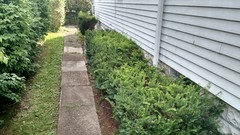
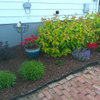
    #2 - I chopped 1/3 of the height off the hedge.. I chickened out of doing this on the main row (its very visible from the street), but did it to a less visible row of hedges (see picture). Its still has a bit of filling in to do (particularly around the gutter), but overall, I'm quite pleased with how quickly it went from "almost dead" to "green" :)


    On another note, the hedge all the way in the back wasn't part of this experiment & didn't get the kind of love that these ones got.. Though it was also chopped 1/3, it was much later in the year & done in a very quick manor to access a utility (hence the odd angle at the top)

  • 10 years ago

    thx for the update .. brilliant idea.. wish i had thought of it.. lol ...


    its filling in better than i ever expected ... but you need to relax a bit.. these are trees ... they work in their own time ... not yours.. so it may take a year or 3 to fill all the way back in ..


    brilliant idea.. to experiment on plants unseen ... give you info so as to work on the more public plants ...


    ken

    bman_152 thanked ken_adrian Adrian MI cold Z5
  • 10 years ago

    I love follow-ups! Thanks for taking the time. I like that you pruned them below the siding in the photo immediately above since they are planted so close to the building. If you replace any of the foundation plants, leave enough space between the projected size of the plants and the building to get in to to maintenance. With shrubs I usually give at least 2', one for me and one for the shrub to overgrow projections from a reliable source such as the Missouri Botanic Garden.

    Whether to keep them long-term or replace can be answered by whether they fit what you want to look at for your landscaping and if they function well to meet needs such as shade, bird habitat, etc.

    bman_152 thanked NHBabs z4b-5a NH
  • 10 years ago

    I like the height and also the more casual shape. Bravo!

    bman_152 thanked kitasei
  • 10 years ago

    bman-if you're still around, lol-I have not read this complete thread, so will apologize in advance if I'm merely repeating something already said.....but do avoid the ultra-common mistake of cutting inward towards the base of the plants. For the life of me, the only reason I can think of why this poor practice is so universal is monkey see-monkey do. In fact, if the basal portions of the plants are kept ever so slightly wider than the top, sunlight will continue to hit all parts equally and the plants will eventually be lush and full. Cutting inward towards the bottoms is the route to leggy, unattractive plants with much dead stuff showing.

    bman_152 thanked wisconsitom
  • 10 years ago

    Thanks everyone :) After this experiment, I definitely feel much more comfortable with the Yews & think I am ready to take on the big ones this spring :)


    wisconsitom:

    Thanks for the advice! Was definitely planning on keeping the hedges with a wider bottom than the top.. If all pans out as I am hoping, I actually plan to attempt shaping the hedges to more of a circular mound shape.

    As far as the smaller hedge row in the back goes, the bottoms are already mostly bare (only about 12" of green at the top). I do plan on hopefully fixing that in the future, but want them time to recover a bit since i just chopped off most of the needles this year.

  • 10 years ago

    You've got the right idea. I also prefer a rounded, mounded top, although truth be told, I have exactly zero sites these days where I do sheering-style pruning of anything! Oh wait, my mom's got some boxwood she wants me to touch up!