Software
Houzz Logo Print
jccaclimber

Hostas alive, but not sprouting

10 years ago

I grew up in Ohio and spent 10 years in Indiana where hostas grow like beautiful weeds. Fall of 2014 I moved to Dallas (zone 8a). I planted hostas in the closest thing to shade I had on the front of my house (sadly west facing) in 2015. Aside from feeding the local rabbits they did well. Last winter I took some mature (5-15 eyes) transplants from my parent's house in Ohio and planted them behind the house (east facing).


The new hostas behind the house are doing great. 8 inches tall, full of healthy leaves. The ones in front of the house are not so good. They are all marked so I dug through the mulch/dirt to find them. Some I couldn't find, these are probably gone. The confusing thing is that others are there, have the starts of eyes, but just aren't growing. They've been this way for a couple weeks, and still look completely dormant.


Why is this? Too warm a winter? Would digging them up and throwing them in the fridge or freezer for a couple weeks help? I found another thread (linked below) that seems similar, but most of what I've found searching is hostas baking in the summer, not having issues in the winter.


Similar issue:

http://forums.gardenweb.com/discussions/3741305/bitter-very-bitter-over-hostas

Comments (12)

  • 10 years ago

    The roots may have rotted. Can you carefully dig up one of the non-sprouters and see what is going on? I've had some in pots that actually unfurl then die. When I lifted the plant out of the pot, there were mostly rotten roots and just a few firm white ones.

    -Babka

  • 10 years ago

    JC, not all hosta do well in our soil and our climate (I'm in Dallas, too). Our water and soil are alkaline and most hosta like acid. It doesn't really get cold enough here for some types. If you heavily amend the soil deeply and have good drainage, some varieties will do fairly well. Many others seem to do well for a couple of years and then fade away. I have some lists of hosta that have done well at the arboretum and in trials in East Texas, zone 7b. If that interests you, I'll did them out.

    On the bright side, they do very well in pots. They seem to get enough cold temps if they are up out of the ground. I had a freak thing last year and lost many of mine (confluence of weather, construction and neglect). However, prior to that, I had hosta that I'd had in pots for 20 years or so. If that interests you, many of us grow in pots and will be glad to help.

    bk

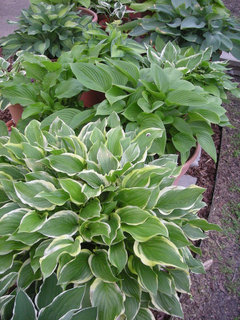
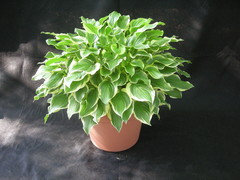
    Some of my hosta:


  • 10 years ago
    last modified: 10 years ago

    Babka,

    I started digging one up, it looks to still have roots, so I did not pull it the rest of the way. I did notice one that has just sprouted in the last day or two in the front yard, hopefully more will follow.

    BK,

    Nice to know that some of these can do well here, those look very nice. Is it possible to leave the pots in the ground for the ease of in ground plants, then lift the entire pot up above ground level for the winter so that they get a good chill? I'm young so lifting something heavy out of the ground once a year won't be a show stopper, although keeping the hole from filling over the winter might.
    Perhaps I could make the pots stick out of the ground ~6 inches to the plants still get cold, but also still take moisture from the ground. I love hostas, but not enough to individually water pots regularly.
    Since you are in the area, what do you do to keep rabbits away in areas that are not fenced? I am considering putting bishop's weed* around them as a general ground cover, but am open to other ideas.

    *Before someone jumps in and tells me what an awful plant this is, we have used it to fill holes in the beds at my parent's home in Ohio for 10+ years. It hasn't taken over the beds, we still like looking at it, and seem to have a knack for successfully removing it when we want to put something else there.

  • 10 years ago

    I looked up Bishops Weed on Aggie Horticulture and found very little. Same with a couple of books on local gardening. It may not grow here. Be aware that what works in Ohio will not necessarily work in Texas. Texas is not the easiest place to garden. Dallas is more difficult than East Texas due to the alkaline soil. It's also a little drier.

    You might try listening to Neil Sperry on 820 AM on Sunday morning from 8:00 to 10:00 AM. He grew up in Texas, but got his masters degree in horticulture at Ohio State (his dad was a professor of agriculture at A&M). He also has a website and a facebook page. He's very big on adapted plants. (He suggested I find something else to grow other than hosta.)

    On your pot in a pot in the ground idea, I think it will work. It occurred to me few years ago, but I didn't follow through. My idea was a 5 gallon bucket sunk in the ground with the hosta pot inside during the growing season. During the winter, take the hosta out and leave it out in the open. Cover the 5 gallon bucket with a lid in the winter, so that it won't fill in. (Home Depot has spray paint for vinyl if you have an ugly bucket.)

    Let us know if we can help.

    bk

  • 10 years ago

    You ought to go to the arboretum. You can see what hosta will do in the ground (some do fine) in our climate and soil. If you like what you see, then go for it. Choose the ones that do well there, as many haven't. Most of the varieties are in one of the not often seen areas.

    bk

  • 10 years ago

    bk....I assume that all of the hosta at the arboretum are planted in the ground? Are most of what have done well for them the fragrants?

  • 10 years ago

    Yes, they are in the ground. They are in raised beds, under crape myrtles back in the area that has the picnic benches for the children's groups who visit the park.

    I haven't been there in a couple of years. We lost our head guy to a big arboretum in Sydney, Australia. He was the hosta nut. We also had a big problem with HVX that destroyed half the garden. (Thank you abbott-ipco for your contributions to the hosta trials.) At that time, they had added hosta in several places as landscape plants, including some Aphrodite in full western sun. It wasn't doing real well, to say the least.

    Generally speaking, yes, the fragrants have done best.

    I'll post the list.

    bk


  • 10 years ago

    This is the old list. There was a second list, but I can't find it.

    Here's the list:

    Invincible (plantaginea Hybrid)

    Sugar & Cream (Honeybell
    sport)

    Dixie Chick (Invincible x
    Masquerade)

    Abba Ready

    Sweet Standard (Honeybell
    sport)

    Emily Dickinson (plantaginea
    hybrid)

    Potomac Pride (H. 'Blue Umbrellas' x
    H. yingeri 'Treasure Island' cross)

    Plantaginea

    Honeybells

    Royal Standard

    Regal Splendor (Krossa Regal
    sport)

    Krossa Regal

    Francee

    So Sweet (Green with cream
    edge- compact)

    Blue Cadet (Blue green medium)

    Patriot

    September Sun (Chartreuse
    green/yellow with dark green edge)

  • 10 years ago

    It is possible that they are still dormant from being too dry. Hostas don't just stay dormant from cold but will also stay dry dormant. Have you started watering them? You mentioned, I think, that they are drier than the ones that came up.

  • 10 years ago

    I'll try watering them, I hadn't considered that and I don't normally water my grass either. We've had a lot of rain, but being under a live oak the ground there isn't particularly wet even during light rain. I need to change the water in my fish tank, so there are 200 gallons of lightly fertilized water ready to go.
    I have a volunteer event I'm planning to do at the arboretum in the next month, so I'll look around at their hostas afterwards. Thinking about it I need to get back there anyways. I made a part to fix something in the Children's garden, but then lost the contact info of the person I was going to work with. Too many projects and not enough brain cells.

    The concept of fragrant vs. non-fragrant hostas is new to me. A quick google search says that all fragrants descend from h. plantaginea, but that doesn't mean much to me. Are there any other important distinctions other than maybe smelling different?

  • 10 years ago

    Well, you don't have as many choices. (I've read this as it's posted, but have not read it today, so I may be repeating myself or someone else. ) You have mostly green and green and white. Most of the leaves are smooth. When you get far enough away (genetically speaking) from plantaginea to get thicker leaves or blue or more yellow, you lose a lot of it's value to us southern folks.

    So Sweet is my all time favorite hosta and it's fragrant. It's a good example of what a fragrant looks like, too.

    The hosta at the arboretum are at the far end from the Children's Garden and in the back area.

    Here are some links for you:


    The hosta library where you can see photos of most hosta


    http://www.myhostas.be/ -where you can find out more about a hosta


    Don R's hosta lists where you can find a list for most any kind of hosta, including fragrant


    Let us know if we can help.

    bk

Sponsored
Mary Shipley Interiors
Average rating: 4.8 out of 5 stars34 Reviews
Columbus OH Premier Interior Designer 10x Best of Houzz