Software
Houzz Logo Print
amyinowasso

Southern peas

I bought some cow peas this year, I have some PEPH from last year. I have been assuming these were bush like, and Sand Hill's description is not always helpful. Should I have support for these? I grew PEPH from 2 different venders and the plants really were different. Do they come in different varieties? This is what I bought.

Kentucky Red

Lady Peas

Penny Rile

Whippoorwill

Forgive me, I was raised by Yankees and cowpeas were not part of my childhood.

Comments (7)

  • 10 years ago

    Amy - I've never grown the Kentucky Red but have grown all the others. I a piece of mesh like chicken wire or other fencing sort of angled away from the plants but still upright on either side of the plants and run them the whole length of the row. That kinda keeps them off the ground and from sprawling every where.

    And the pods from the Lady Peas and the Whippoorwill's make yummy jelly!

  • 10 years ago

    That's why I got the Lady peas, what does whippoorwill taste like?

  • 10 years ago

    Kentucky Red is vining. If you have a support or trellis for it, it will climb. If there is no support provided for it, it will sprawl across the ground.

    Lady pea is a bush pea.

    Penny Rile is a bush to semi-vining type. Often it seems bushy at first, but will run or climb 3-5' if it gets the chance.

    Whippoorwill is a vining type that will sprawl if not supported and will climb if trellised.

    I usually grow my vining type southern peas on a trellis that runs along the northern edge of an east-west running raised bed. The trellis consists of 8' green metal t-posts hammered deeply into the ground and the trellis usually is woven wire fencing. The vines climb to the top of the trellis and then cascade back down towards the ground. I grow some southern peas, including Mandy (aka Red Ripper) on the 8' tall garden fence. This one can run or vine 10-12' or more, so I usually grow it on the fence because it is such a monster vine.

    The southern pea family is a huge and diverse family. It includes pink eye purple hulls, some purple hulls without pink eyes, crowder peas, cream peas, lady peas, etc. Many of the southern peas are unique family heirlooms handed down for decades within one family. Southern peas come in many colors, shapes and sizes, including black, white, green, red, speckled, and with differently colored eyes....pink eyes, green eyes, black eyes, from large to very small (the size of a grain of rice) and with hulls that often are green maturing to yellow, though purple hulls (as the name suggests) mature to purple. Other southern pea varieties are improved varieties bred by various southern universities, often bred to reduce them from running/vining types to bush or semi-vining types for ease of harvest or bred to have disease resistance to blackeye mosaic virus.

    Lady peas are usually green or maybe white, very small in size and have a creamy texture when cooked and a mild flavor.

    Crowders get their name because the peas look all squashed together and crowded into the pods. For the most part, they have a much stronger flavor. Don't ask me to describe southern pea flavor because you know I will tell you they taste like southern peas! They don't taste like any other veggies you raise, so I don't know of any other way to describe it. Properly prepared southern style, there's nothing better, but of course I believe that because I grew up eating them my entire life. They are more like beans than peas if that helps and, in fact, belong to the bean family. They are vigna unguiculata. Pink eyes usually have pink eyes, green eyes have green eyes, and black eyes have black eyes. Not all purple hull peas have pink eyes though. "Knuckle Purple Hull" is more like a crowder in flavor than a pink eye purple hull. This is why the different varieties can get confusing....there's so many of them and there's many similar ones. When buying seeds, you often find them listing in catalogs or on websites in different ways....as cow peas, field peas, southern peas, etc.

    Whippoorwill is a very old variety, and is one of the best for great flavor. After you have grown and cooked some southern peas, if you find the flavor too strong for you, try lady peas. They are milder in flavor.

    Purple hulls are my favorite type because the pods turn purple as they mature, ensuring you never pick them too early. If you harvest southern peas too early while the pods are still immature, they are very hard to shell. If mature, they shell easily. I have a friend who loves fresh southern peas so much that he simply can't wait and always harvests the first batch still green, which means he has a devil of a time shelling them and learns his lesson (again) about picking them too early.

    Southern peas can behave really oddly. Some years they seem to stay nice and sedate, all neat and bushy and well-behaved. Other years they run, sprawl, climb, leap and jump like kids on the playground....going anywere and everywhere no matter where they are expected to stay. Some are happily bushy as long as there is nothing to climb, but if they can cross a pathway and then climb to the top of a tomato cage, they will do it. For that reason, I try to avoid planting bush types in a raised bed next to a raised bed of tomatoes because the path between the two beds becomes unusable when the peas start reaching across the path to climb the tomato cages.

    You can make hull pea jelly from any southern pea hull, but purple hull pea jelly is my favorite (and I think it is the prettiest jelly too).

    I remember many evenings of my childhood spent sitting on the front porch with my mom and siblings, shelling southern peas while Luna moths and other moths flitted around the porch light. I hated sitting still and shelling peas, but I did it because I wanted to have those peas for dinner the next night. Now I don't mind shelling them other than the fact that it is time-consuming when so many other harvesting/preserving tasks need to be done at the same time.

    Southern peas are one of the most heat-tolerant crops we can grow here all summer long. They are drought-tolerant up to a point, but perform better and produce better with regular irrigation. They are a great succession plant as they can be planted anytime you want once the soil warms up sufficiently. I often plant them as succession crops to cool-season crops or early warm-season crops like early corn. I generally sow the last southern pea crop of the year in late July or early August because once the autumn temperatures are really cooling off in October, their productivity really drops.


  • 10 years ago
    last modified: 10 years ago

    I grew PEPH from 2 different venders and the plants really were different. Do they come in different varieties?

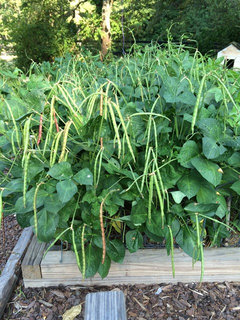
    The answer to your question about different varieties of PEPH is Yes. There are different varieties that have different growth characteristics. The first three years I grew PEPH peas I had to use a tall trellis to keep them supported. Then someone told me about a variety called Top Pick. This variety does not run as much and can be corralled with a small support such as a small two foot fence or some other type of corral to keep them upright and not falling into the pathways. I will be growing them again this summer and hope they have the same growth characteristics this year. Here is a picture of the Top Pick variety.

    This is actually three rows of plants in a 4 x 8 bed. There is a small 1-1/2 foot fence between each row and on the outside of the bed keeping the plants from falling all over each other and from falling in the pathways.

  • 10 years ago

    Amy, I did forget to add that there's quite a few different pink eye purple hull pea varieties out there and they can be quite different from one another. I haven't grown Top Pick like Yolos has, but I've grown the similar QuickPick which is a determinate, bushy variety that also produces the pods at the top of the plant. My favorite PEPH is the plain old PEPH that I grew up eating, but there also is a six-week PEPH that is pretty good and makes a great mid-summer succession crop since it produces so quickly. I also really like Knuck Purple Hull, but it is not a pink eye. We used to grow Texas Pink Eye or Texas Scarlet, but I've branched out a lot since then and grown peas in many different shapes, sizes and colors. I usually grow 6 to 8 varieties a year, and at harvest time, I just mix them all together, shell them all together and eat them all together.

    I've yet to grow a southern pea variety that I haven't liked though, although the black-eyed ones are my least favorite. To get an idea of just how diverse the southern pea family is, go to rareseeds.com and look at the huge range of colors available. SESE also has a lot of different kinds, and I've grown most of them. Since I like most all southern peas, I just have fun growing some different ones each year. It keeps my garden from being too predictable.

    Dawn

  • 10 years ago

    Thank you Dawn, I will have to consider their growth when I plant them. My garden map keeps changing, LOL. I bought the first batch of PEPHs with one of my seed orders, no variety name that I recall. The second pack, from a local nursery, was much shorter, but I don't think it had a variety name either. I will say the plants didn't look as good as Yolos', but it was a wet spot and nothing has grown well there. The seeds from both were mixed together. It will be interesting to see what they do in a better location.

Sponsored
High Point Cabinets
Average rating: 5 out of 5 stars21 Reviews
Columbus' Experienced Custom Cabinet Builder | 4x Best of Houzz Winner