

Johnny, you might like this article
Comments (28)
 10 years ago
Thanks for the article. Here is my plan for the ten acres we have been allowed to use at St. Francis of the Woods.
The entire 10 acres is currently in arrow leaf clover and Austrian Winter peas. When the bees have had their fill, we will mow it and immediately plow it under. Then, we will plant buckwheat, let it grow to just before making seed, mow and plow it under. Then, plant cereal rye, tillage radish and hairy vetch. We will let that grow until early spring when we will turn under the amount of land we will plant with Irish potatoes.
From that point on we will always have two soil building crops and two food crops going all the time.The crops will rotate around the 10 acres in succession.Please add your thoughts.
Johnny
PS - Our 12st garden is scheduled to receive 40 large truck loads of wood chips this year. I will try to find 40 more next year. I think it will take about three years to rejuvenate the soil there. Then, we will start rotating the soil building and food crops there too.
soonergrandmom
Original Author10 years agoJohnny, it looks like you have a great plan and have really done your homework. I see good winter cover, lots of nitrogen fixing plants, buckwheat for its fiberous roots system and making minerals available for future crops, while also attracting beneficial insects. Bees will be there to help you along. Cereal rye to help with surface compaction issues, tillage radish to open up the soil and eliminate compaction and increase water infiltration.
Your deer fencing should really irritate those deer that would love to be feasting there, but I suspect you will be feeding a few wild turkeys. LOL
Will you always be tilling in your crops or do you have plans for mowing and planting into one crop with the next?
Related Professionals
Tampa Landscape Architects & Landscape Designers · Middletown Landscape Architects & Landscape Designers · Tucson Landscape Architects & Landscape Designers · Magnolia Landscape Contractors · Mount Vernon Landscape Contractors · Columbus Landscape Contractors · Huntington Landscape Contractors · Saginaw Landscape Contractors · Cleveland Landscape Contractors · Pittsburgh Landscape Contractors · Pocatello Landscape Contractors · Calgary Landscape Contractors · Pine Bluff Accessory Dwelling Units · Macon Accessory Dwelling Units · Poughkeepsie Accessory Dwelling Units- 10 years ago
Good question. I would like to see a transition to no till but the experts are still adamant that no till requires chemicals. I have read about using a rolling crimper to kill the crop but I'm not convinced. Also, no till planting on a small scale needs more equipment development. Small holders have been left out of the picture, in America, for a long time.
I guess the bottom line is to keep our minds open and remain flexible.
My main goal is to get that soil healthy before I go to the old soldiers home.
I'll be working over a 1/4 acre garden today for a nice older couple. Drainage ditches, plowing, tilling etc... I wish we could put some organic matter in it but I'm scared of making it toxic with herbicides. Today's focus is drainage and seed bed prep.
Johnny
PS - As usual, please share your thoughts.
soonergrandmom
Original Author10 years agoI have no experience with this method but have done a lot of reading and everything I see seems very positive and less chemical use has always been a big selling point of the method, along with a builtin mulch. Have you seen how this 'little guy' does it. Make shift crimper
- 10 years ago
Yes I have seen that video. However, I still don't see any way to afford a notill planter. I am still waiting for someone to invent a notill drill / planter for small holders. My little tractor wouldn't even pull the drills I have seen and used.
If you encounter either a notill drill or notill row crop planter for small holders, please let me know.Johnny
PS - I have been bouncing around a plan to mount a disc coulter to the front of my lister planter. That would be an interesting experiment.
Johnny
- 10 years ago
Just on a small-scale in my garden, no-till is challenging because I'm having to remove weeds by hand before planting, which used to take 10-20 minutes per raised bed with my Mantis. I don't see how a small farmer could do it in an economical manner with using herbicides to clear weeds and residue from a field before planting. Cutting down cover crops and working them in by hand is time-consuming too. I'm not 100% no-till yet and wonder if I ever will be. My main reason to go no-till is for the sake of the earthworms and other soil-dwelling beneficial creatures. I wonder if my toads miss being rudely awakened by the Mantis tossing them up out of the soil? I've never killed a toad but I've startled and scared a few.
Gene Logsdon always has taken a viewpoint somewhat contrary to the conventional wisdom, so I decided to see what he had to say about no-till farming, and here's what I found.
- 10 years agolast modified: 10 years ago
Dawn,
Thanks for the article. So far, I am unable to vote either way. Growing food, like politics, is always local.
I have seen land mono cropped to the point there is nothing but clay dirt clods left (just Southwest of Guthrie) and the owners continue to do the same destructive things year after year.
I visited Pennsylvania once and took the time to look around the country side. I remember an Amish farm right across the road from a conventional farm. The soil level of the Amish farm was at least 10 inches higher.
I am interested in vertical tillage. Here is a very good explanation. http://www.verticaltillage.com/en/9374/what-true-vertical-tillage
Again, I may have to build my own because small holders are not an important part of the equipment manufacturers market. If I could, I would start with slightly wavy disks that could penetrate 12" of soil. They would be about 8" apart. Currently I have to content myself with a (spring trip) field cultivator that can penetrate about 18" if you have enough horses to pull it that deep. Usually I can only pull it about 8 to 12 inches deep. I use small non rotating shovels with small points. The points are about 10" apart.Most of the soil I am working with has been abused for so long the laboratory at OSU has difficulty finding any organic matter in it. Oklahoma soil has been farmed to death.
When soil is very dry, I use a single (18" deep x 2" wide) subsoiler on my little tractor. That breaks up the plow pan created by my plow. When the soil is dry enough, you can feel it fracture. Also, I use tillage radish for the same reason but at a different time of year.
- 10 years ago
I agree that most OK soil has been farmed to death. Ours was that way when we bought it, though it had been grazing land for a long time after they stopped farming. Then, I had to listen to the old-timers tell me what great soil "they used to have here", because everybody wants to hear how great their soil used to be 40, 60 or more years ago compared to how crappy it is now. Then I discovered cotton root rot (which affects thousands of plants, not just cotton, as you may know) in my soil. The early years were rough, but as the soil has improved, I have been able to see how much soil can improve with some effort on the part of the farmer/gardener or whoever happens to be the steward of the land. We had zilch organic matter as well, It was just pathetic, but at least when you start with soil that poor, there is nowhere to go but up. It took us at least 10 years to get the soil to where we felt kinda pleased with how it looks at the end of the growing season (which, to me, was more of a sign of how good it was than how it looks at the beginning of the growing season). Now, every year it is just better and better. Sometimes I look at it and cannot believe it is the same soil. And, of course, it isn't the same. It is much healthier now. Organic matter, whether added as compost, mulch that sheet composts in place, cover crops, compost crops....it doesn't really matter where it comes from or what method you use....organic matter is the key to fixing everything. Soil improvement just requires consistency and persistence.
- 10 years ago
No Till Farming,
No Till Farming was an experiment. Plowing crop residues back into the soil each year is the only way to build organic matter into the soil. Do the Amish practice No Till Farming? No Till Farming never has worked & never will.
- 10 years ago
Do you have anything to add to my soil remediation plan above? For instance, how deep would you turn under the various soil building crops and would you try to leave some stubble on top?
Johnny
- 10 years ago
Johnny Coleman,
I can only speak from a life of observation. I grew up helping my father & grandfather farm 300 acres in South East Central Oklahoma. What works on one type of soil may not work on another. If you read any farm magazine where some farmer talks about no till farming the second paragraph will tell what chemicals they are using to control the weeds and how the big chemical companies are having to come up with new and different chemicals all the time because of so called 'super weeds' as they have become immune to the older chemicals.
For myself I think that deep plowing helps hold down the weeds and gives the plant roots and rain water a place to go rather than run off or pond in the middle of the field. No till gardening in a small raised bed is not the same as trying to work several acres in a large field, it is a hole different critter. It helps soil that has set idle or never stirred very deeply. It is specially benefits clay soil or the black gumbo soils. I believe that any cover crop or crop residue will rot and help benefit the soil as the roots will have something to feed on.
Like I stated this is only my opinion and I am sure others will disagree.
- 10 years ago
We are not far apart on this, you and me. I have been plowing under cover crops. We grew a potato crop and a corn crop after plowing under a Winter cover crop of cereal rye, tillage radish and hairy vetch. Potatoes and corn are both heavy feeders and they got all the nutrients they wanted.
However, I'm dedicated to remaining flexible about better ideas. I realize some ideas are just pie in the sky.
Johnny
- 10 years ago
I'm not going to disagree with anyone about no-till farming or no-till gardening. Only about half my raised beds are no-till this year, and none of my grade-level gardening space is no-till. That's not likely to ever change. I like being able to go no-till with some of my raised beds but it is too labor-intensive to do it with all of them. I think no-till with raised beds would be a lot easier if a person used herbicides to kill off the weeds, but I do not use herbicides in my garden and never will. I'd rather cultivate the soil mechanically than use chemicals in my garden. The raised beds I have that are no-till now are only that way because I rototilled organic matter into them for many years to get the soil into the fine shape it is in now. I never would have gotten the soil in those raised beds as well-amended as it is without the use of a cultivator or rototiller to work organic matter down as deeply as possible into the soil.
And, in what might be considered a crushing blow to someone who believes in no-till, the only advantage to it that I have found is that there are more earthworms in the no-till areas. My no-till beds still have just as many weeds over the course of the season as my rototilled beds. The plants in my no-till beds do not perform any better or any worse than the plants in rototilled areas. So, other than protecting the earthworms, I'm not sure what else I have accomplished in the no-till raised beds. I do like the idea that I'm not harming the earthworms in the beds that are no-till, but there's still an adequate number of earthworms in the rototilled beds too. If mechanically cultivating the soil in the raised beds that are not no-till is harming my soil structure, I can't tell it.
I feel the same way about no-till organic gardening as I feel about double-digging a garden bed by hand every year. I think it sounds better on paper than it performs in real life. I have double dug some raised beds to get the soil beneath the beds into better shape since we started out with dense red clay. In the first year after a bed was double dug it did drain better than a bed that wasn't double dug, but its overall performance wasn't any better. After experimening with double digging only a couple of beds for a handful of years, I concluded the double-digging did not make a big enough difference in plant performance to justify the time (and back-breaking labor) of double digging. I then promptly dropping double digging from my routine.
I don't even know if I will continue no-till gardening with the raised beds that curently are no-till. Even just the practice of hand-weeding to remove the weeds prior to planting takes a huge amount of time, and time is always a precious commodity when you are maintaining a very large home garden. While I like the idea that I am not harming the earthworms by not mechanically cultivating, I'm still not sure the time that goes into non-chemical no-till gardening is time well spent.
Yesterday, while I was hand-weeding the raised bed in the front garden where I intend to plant beans today, Tim was out in the back garden with the big rototiller, getting the corn plot ready for planting. He cut down the tall weeds with the weed-eater and then rototilled them down deeply into the soil. There is no way on this earth I ever would have been able to do that work by hand in order to make the corn plot no-till. It's never going to be no-till. I'm okay with that. In the same time span that it took me to get half the bean bed weeded and ready for planting, he prepared a plot that is probably 8 times as big as the raised bed I was weeding, and I still don't have all the weeds out of that raised bed. I have half of it left to do before I can plant today. Gardening at grade level is different from gardening in raised beds, and I'm the first to acknowledge that. Most people in my neighborhood who garden do not have raised beds because raised beds cannot be worked with their tractors, and there's no way they are giving up their tractors. I don't blame them. one bit! So, while I have some no-till raised beds, I am not really a no-till gardener. Or, I am a part-time no-till gardener, and like I said before, I might not continue no-till practices precisely because it is too hard to prepare a bed for planting if you aren't using herbicide to rid the bed of weeds. It is only late March, and I've already had enough hand weeding to last me for the year.
- 10 years agolast modified: 10 years ago
Dawn,
No till is a technique that encourages conventional farmers to build their soil. Most conventional farmers had to be sold the idea of no till to get them away from destroying the soil through erosion and using up the top soil. A system had to be developed that would satisfy their bottom line. Farmers are, after all, business people. They have to see the financial benefit of a cropping system before they will consider it.
In that regard alone, I am glad to see minimum till and no till techniques evolving. I am also glad to see gardeners involved in the process because their hands are actually in the soil. Soil health is much more evident to them.
We all have skin in this game. Everyone must encourage preservation of soil quality so our descendants will have wholesome food to eat and clean water to drink.
Johnny
PS - I am convinced that tillage radish is almost as good as subsoiling with a steel tool. I will be using it again this year.
- 10 years ago
I hope you participate in our potato project. You will take home some great potatoes and you could look over the 10 acres I have been talking about. The two plots of land are only a mile apart. Vision Farms would benefit from your opinion.
I will bring a shovel to dig with if you want to look below the surface.
Johnny
- 10 years agolast modified: 10 years ago
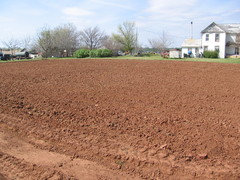
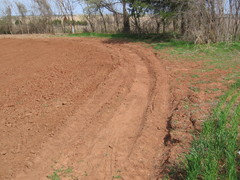
I finally got that 1/4 acre garden ready to plant today. Plowing, drainage ditches and tilling.
This garden needs about thirty tons of organic matter. It plowed like a dream but tilled like a graveled parking lot.
- 10 years ago
Johnny, That looks really nice, except for the lack of organic matter in the soil. It reminds me of our red clay when we started, except ours was more red. Now it is brown-black and a perfect example of restored soil, but we never stop amending because we want to keep it that way. I use all methods to add organic matter---cover cropping, compost cropping, and adding tons of organic mulch to the growing beds every year and letting it decompose in place. In the beginning we brought in lots of manure and other organic matter to work into the soil, but now we just use what we can produce here on our own property. The weeds Tim rototilled into the ground out back included some actual weeds but also vetch and clover. I also use buckwheat and rye a lot, and often raise grain type amaranths as compost crops to feed my compost piles, which are plentiful and large. Eventually the compost feeds the garden. When we have brush and dead trees to dispose of, we don't burn them. We pile them up in huge brush piles and let it decompose. It takes years, but eventually we have lovely decomposed wood to add to the garden. Even cardboard goes into the compost piles. If something can be used to improve the soil, we use it. It is a never-ending chore.
Dawn
- 10 years ago
Dawn,
The owner of the garden understands the need for OM but he seems reluctant to actually apply it. We offered to plant a Winter cover crop for him this Fall. I'm still perplexed about the soil. It plowed like sandy loam but our tractor mounted rotor tiller was jumping around like I was trying to till large rocks.
Johnny
- 10 years ago
I have seen that with very compacted sand that doesn't have any real loamy content in it, though not so often with sandy loam. I wonder if you did the jar soil test for texture if it would show any OM at all in it. Strongly compacted sand does not break up into sand so much as it breaks up into sandstone-like chunks of soil that remind me a lot of clay clods. That happened with our sandy-silty soil out back---it plowed up chunky just like clay, but has gotten better over time. With organic matter added, it improves quickly.
I don't understand the reluctance to apply OM unless it is a financial issue perhaps. I hope he'll take you up on your offer to sow a cover crop from him, or I don't see how his soil gets better.
- 10 years ago
Dawn,
I have read that wood chips break down faster if they are spread out on the ground instead of being piled up. Would you agree?
Johnny
- 10 years ago
Johnny Coleman,
If the soil was a little wet when it was broke it could be chunks of hardpan that dried and failed to soften up. If little rain fell after it was plowed, there wasn't enough to dissolve the clay chunks. It should get better .
- 10 years ago
Johnny, I think it depends on how dry they stay. When I worked big (2-4" long x 1-2" wide) chunks of bark mulch into my clay soil to improve it, I thought it would take them years to break down. Most of them were gone within a year, either decomposed or eaten by gigantic earthworms. I was astonishd. I tend to think they decomposed since I've never found gigantic earthworms eating chunks of bark in my garden. That was a fairly wet year. I think they would have broken down more slowly if we had been exceptionally dry. When on the soil surface in our typical weather (which is normally pretty dry), chunky bark mulch can take 2-3 years to break down and I know that based on how often I have to replenish wood mulch in shrub beds. Of course, the pieces of bark don't stay solid and suddenly break down in their second or third year. They slowly break down over time so at some point I notice all the lovely humusy decomposed wood lying on the soil surface beneath what is left of the mulch, and I'll realize I need to add a new layer on top. If you remember how hot and dry 2011 was, that year even the grass clipping mulch did not decompose. It just dried up and sat there. In February of 2012 we still had perfectly intact grass clipping mulch from the spring or 2011 that never decomposed sitting on top of the raised beds and on all the pathways. It was the oddest thing. It also may depend on the biological activity in the soil. If there are no microbes in the soil to eat up the bark, it will break down much more slowly.
Dawn
- 10 years agolast modified: 10 years ago
Thanks, I'll keep an eye on it. If it had been difficult to plow, I would have understood the other difficulties. Also, the drainage ditches were easy to scoop out with my old Ford 8N. There is a wheat field on the South border that drains into his garden. I diverted that flow around his garden. Also, I cut 1 foot deep drainage ditches on three sides.
Johnny
- 10 years ago
Dawn,
Based on your post, we will be leveling our wood chip piles soon. I have arranged for 40 truck loads.
Johnny
- 10 years ago
Johnny,
I use wood chips for mulch between the rows in my garden. I usually put them down in April. I try to till the garden in the fall usually after the first freeze. When I till the garden in February the chips are mostly gone except for the really big ones.
- 10 years ago
osuengineer, I'm glad to hear they break down fast for you too. At first I thought I was imagining things when all my wood chips disappeared so quickly. It seemed to defy logic. I guess our heat helps the soil digest them quickly.
Johnny, Go for it! It can't hurt and can only help. I know the conventional wisdom says not to add them directly to soil because they'll tie up nitrogen as they decompose. I am not sure that is true in our climate. I don't add extra nitrogen when I add wood chips and I do not see any symptoms that the plants are suffering from nitrogen deficiency. Better for you to spread them around and have them where you want them than to have one of our Okie tornadoes come through and carry them away to.....wherever.
The longer I garden, the more I am convinced that some of the conventional gardening wisdom is not accurate in every situation.
Dawn
- 10 years ago
If I were rich, I couldn't afford this level of advice.
Thanks all.
Remember, when you help me, you are helping to put good food in bellies that need it. We make a pretty good team!
Johnny
https://www.facebook.com/visionfarms/








osuengineer