Software
Houzz Logo Print
stanofh

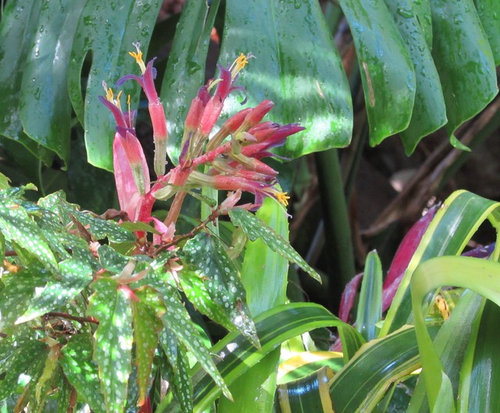
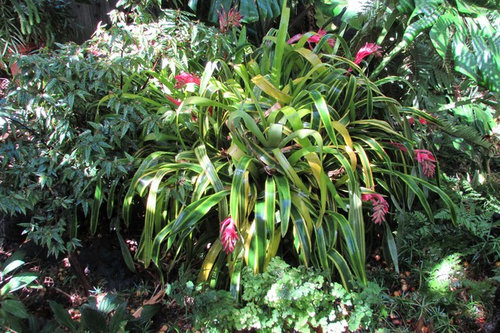
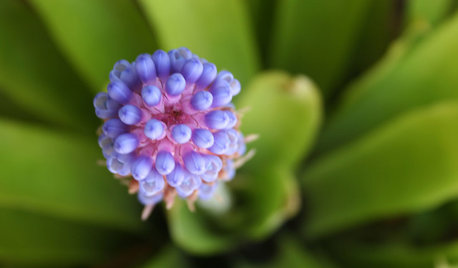
Billbergia pyramidalis variegated.

Show off now- of wait till next near..


Comments (13)

  • 10 years ago
    last modified: 10 years ago

    Is this plant mounted or in a hanging basket? Nice, whatever b, it is

  • 10 years ago

    Why are so many great Broms named after that Foster guy? lol,half of my Broms are his "favorite" "wine" etc.

    Its actually mounted on an old upside down apple tree stump. Maybe 15 years now on that. I started it from a small plant I bought at Kmart in the late 70's.

    btw- I once divided it-pre apple stump- and gave away some shoots. It was very slow to recover. I haven't touched it since.

  • 10 years ago

    Is it the same Foster brewing the beer? Is that how these crosses were dreamt up?

    Nice plant.

    tj

  • PRO
    10 years ago

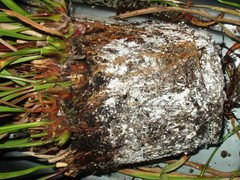
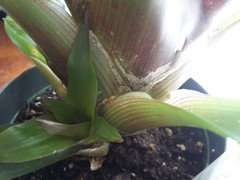
    Can either of of you advise what mealy bugs look like on the bomo. Or what other plants indoors.

  • PRO
  • 10 years ago

    Hi everyone.

    Stanofh - Mulford Foster was a famous American horticulturist/hybridizer who collected and bred many different bromeliads.

    Numerous bromeliad plants found today are named after various Foster family members and the genus Fosterella is named in honor of his work.

    Read all about this man at: https://en.wikipedia.org/wiki/Mulford_B._Foster

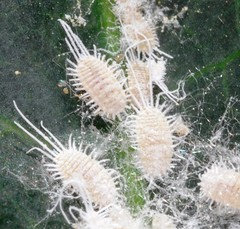
    Ackerman Flooring - Mealybugs are very small, soft-bodied, oval shaped insect that are covered with a white powdery wax coating.They are sap sucking insects which live mostly in the centre of bromeliad plants around their base where they feed from the foliage.

    See Mealy Bug: https://en.wikipedia.org/wiki/Mealybug

    There is also Root Mealy Bugs which live beneath the surface of the potting mix where they feed on the plant roots.

    Root or Soil Mealy Bug: http://www.optimara.com/doctoroptimara/diagnosis/soilmealybugs.html

    Mealy Bugs

    Root Mealy Bugs

    All the best, Nev.


  • PRO
    10 years ago
    splinter1804 thank you. so it's not that what's going on. someone said cotton white stuff were mealy but they were obviously wrong. so what is white and cotton like in between branches of my different plant.
  • 10 years ago

    Mineral deposits from your water, no harm.

  • 10 years ago

    I've been hijacked....

  • PRO
    10 years ago
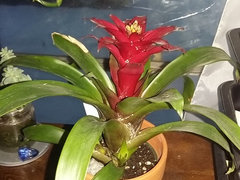
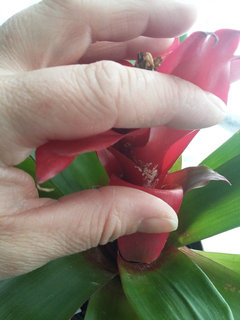
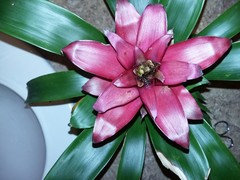
    I repotting my brom and wish that mineral stuff wasn't all over every edge. when I first got it a little weird flower stub would come up but now nothing looks healthy on it. I'm hoping transplant works well. there were a lot of roots I cleaned up and the soil I bought is much better draining. the tips of the leaves are drys I've misted them. any feeding ideas?
  • 10 years ago

    If you have a fresh-water aquarium, you can use water from that as it will have a bit of fish and snail urine in it. Soak tillies in that, too. Also, one can purchase bromeliad fertilizer. Mulford Foster was a name I saw a lot (pictures of him, too) when I went through the Bromeliad Society International Newsletter, which can be read for free (and some downloaded in PDF format) at http://journal.bsi.org/ (via http://www.bsi.org/new/).

  • 10 years ago

    Hi everyone.

    Ackerman - My comments are based on my
    experience with the Guzmanias I grow here on the South East Coast of Australia
    and may not necessarily work for you.

    I have found that Guzmanias
    benefit from a stronger fertilising regime than most other bromeliads, however
    different growers have different ideas no matter where they are and its largely
    a case of seeing what works for you.

    There are numerous fertilisers
    available and many have different strengths and compositions, and as you look
    through what’s available it’s easy to become confused as to what’s best for
    your particular plants.

    The three main ingredients in
    fertilisers are Nitrogen, Phosphorus, and Potassium and this is what they do:

    Nitrogen is for the green
    foliage.

    Phosphorus is to promote
    strong roots and shoots.

    Potassium is for fruit and
    flowers; (It also regulates water and nutrient movement in the cells).

    These three main ingredients are
    shown on the packaging as a percentage in an N:P:K ratio. Nitrogen (N), Phosphorus (P) and Potassium (K) and there is sometimes a list of the trace elements as
    well.

    It’s important to know there
    are 3 micro elements that can be harmful to bromeliads and should be no more
    than “trace elements” (present only in minute amounts) in the fertiliser. For
    example, excess Boron (B) will cause leaf tip burn, Zinc (Zn) and Copper (Cu) will
    kill bromeliads at higher levels.

    I have found that like many of
    my other bromeliads, Guzmanias benefit from a higher percentage of Potassium
    (K) than Nitrogen (N) and with a low Phosphorus (P) level. High levels of
    phosphorus can cause leaf tip burn so this is something to be aware of. All bromeliads require Magnesium (Mg) which
    must be in the form of magnesium sulphate (MgSO4). This is usually in the slow
    release fertilisers, but if not, it can be added to a soluble fertiliser, if
    necessary, as Epsom Salts.

    I add a controlled release
    fertiliser (Osmocote High K) to the potting mix and because I have found Guzmanias
    also respond well to liquid fertilisers, each couple of weeks and I will also
    use a half strength foliar fertiliser to provide this. I have found this will give nice healthy looking green leaves with a larger
    and more colourful inflorescence than usual.

    I use various types of foliar
    fertilisers and change them around regularly. The ones I use are “Phostrogen”
    N:P:K is 14%:10%:/27%), "Thrive" N:P:K is (14%:2.6%:/21%), "Flourish" N:P:K is (16%/4%/25.7%)
    and "Manutec Bloom Booster” N:P:K is (6.19:14.6:16.8). All of the above are readily
    available commercially in Australia.

    I hope this may be of some help.

    All the best, Nev,

Sponsored
Wannemacher Interiors
Average rating: 5 out of 5 stars26 Reviews
Customized Award-Winning Interior Design Solutions in Franklin Cnty OH