Software
Houzz Logo Print
utzybuzzy

Help with edging a low garden

10 years ago

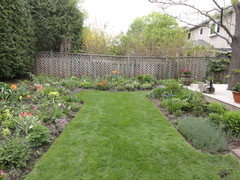
When we first moved to our house I didn't think of raising the beds so I planted mostly level to the ground. How would I edge around existing flower beds that low and look nice. TY!

Comments (11)

  • 10 years ago

    with an edging shovel ...


    as with any cutting tool.. keep it sharp as you can ...


    use the GW search ... also


    ken

    https://www.google.com/search?q=how+to+use+an+edging+shovel&ie=utf-8&oe=utf-8


    http://forums2.gardenweb.com/discussions/1678894/pictures-of-garden-edges?n=30

  • 10 years ago
    last modified: 10 years ago

    Good video, Ken.

    I'd tend to call it a spade (rather than a shovel; viz. it's rectangular, etc.), or an English spade.

    The problem with the edging tool is that (I'd say, at least in my gardens) 4 inches is not deep enough; the flange allows one to push it in with the foot, but prevents the blade from going deeper.

    David Tomlinson (Merlin's Hollow) edges once a year and goes down a foot. I find that this has worked well with my large perennial gardens, but does not with our own small one. There, I aim for about 6 inches but always need to do it again in the fall.

    Edging frames a mixed perennial bed, especially when it's spring (low) and fall (likely not so overwhelmingly tall and crowded as in summer).

    I find all my perennial beds slowly rise over time; notably, from adding organic matter. David's large area of herbaceous perennial beds also rise slowly from him adding 2 inches of wet maple leaves every fall. His alpine area is on scree.

    I'm never quite happy with the lines!

    Last May 15.


  • 10 years ago

    a spade is a spade.. and straight shovel is not a spade in my book... but you can call it bob.... and hes your uncle.. if it pleases you ..


    i tried all the half moon .... etc.. edging tools.. the straight shovel was the best.. and useful for many other projects... like digging square holes... lol.. and chopping ice .. etc ...


    and i would prefer the 3 foot version .. not the 6 footer ... i would pay extra for a metal handle ...


    ken

    http://www.lowes.com/cd_edging_1300368453_

  • 10 years ago
    last modified: 10 years ago

    Think that looks nice, NHBabs and that efficient/neat puremichigan.

    I find, with longterm perennial garden maintenance, the few plastic lawn edging products I've used break down or at least, with intensive gardening, get damaged/move over a number of years.

    I also find, again longterm, with a slowly rising perennial bed surface, bricks need uncovering/repositioning and if placed higher, need repositioning.

    I do like the idea of there being a stone/brick mowing strip.

    A problem with brick/stone edging, is that without landscape fabric (doesn't aways stay in position/stay undamaged itself), or the like, grass gets to grow in between the bricks/stones.

  • 10 years ago
    last modified: 10 years ago

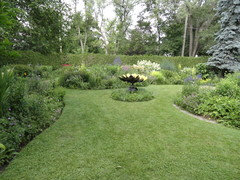
    David Tomlinson, at Merlin's Hollow, corrals many of his beds with paths. His garden is set up with traditional "rooms" but the beds, etc. within, all have curvilinear lines.

    Every aspect of the garden's creation was the work of David himself. His paths, for instance, are excavations one foot deep, filled with gravel. Over the years, I've never noticed grass growing into his paths, nor seedlings succeeding in colonizing them.

    Part of the herbaceous room (last July 12).

    Edging one side. gravel path on the other.

    A close-up.

  • 10 years ago

    I generally include a mowing strip - a row of bricks, laid edgeways, soldier style...or block paviours or setts. This removes any need for tedious half-mooning or spading (a shovel is what we use to move sand) and keeps a nice neat edge. Lay a footing of 4:1 sand to cement and place paviours on top. Point between bricks with silver sand or, if using flat slabs, grouting cement.

  • 10 years ago

    I haven't found so far (more than 10 years) that my plastic edging has broken down, and because it's there the lawn grass doesn't grow into the garden. In a few places some of the rough field grass has managed to creep under, so I will need to find a deeper edging.

  • 10 years ago

    Never hand weeding at Merlin's Hollow which was designed as a minimum-maintenance, ecologically friendly perennial garden for Southern Ontario.

    David jokes that I've regressed to Victorian bedding, but bedding with perennials.

  • 10 years ago

    Ah, I have a lasting fondness for that Victorian bedding, usually heavy on the sedums and invariably designed to represent a town emblem (especially those old British seaside towns) or (my favourites) floral clocks (but not the Linnaen type).

    In fact, this successional planting is beloved of that late garden treasure, Christopher Lloyd...but without having either an army of volunteers (a la National Trust) or endless cheap labour (Victorians), unsurprisingly, this practice is dying out. I certainly haven't lifted my wallflowers for years.

  • 10 years ago

    "Endless cheap labour", as you say, Camp.

    David has made the point that back then gardening was a trade with a hierarchy topped by head gardeners and the training of apprentices below. He says that at some point the professional gardeners of his generation, as he, went to Kew and consequently became landscape designers. In his case, he then went on to urban space and environmental planning and environmental reconstruction.

    As you'd know, the economics of the situation is evident in things like the break up of the old great estates and the reduced money and interest available for high-maintenance gardening in public gardens and elsewhere.