Software
Houzz Logo Print
noteybecky

Newbie trying to get lights for overwintering plants

10 years ago

I've been reading as many threads as I can and I'm still not quite sure what step to take next.


I have a ~3 SQFT area(19"x23" and 4' height) that I'm growing some succulents in. Unfortunately the lights I've been using aren't enough, and the plants are suffering as a result (leggy, too green). I don't recall exactly what lights they are because of a cleaning spree that got rid of the original packaging...


I won't be using these lights year round, just for a half a year to overwinter my plants until I can bring them outside for spring. I also am not using all of the greenhouse space, just half of it(for now). The greenhouse is also covered with plastic, and I worry about the lights melting it if they're too hot.


I'd really appreciate your guys' help, I'm having a tough time figuring out what would be best. I know I want a 6500k light because I'm more concerned about general growth then flowering/fruiting, but that's about it.

Comments (12)

  • 10 years ago
    last modified: 10 years ago

    Depending what succulents you grow, between two and six 4' T5HO fixtures would be cheap and effective.

    If you can list which species you grow, that could help give more specific advice!

    And maybe a photo of your greenhouse? =)

  • 10 years ago

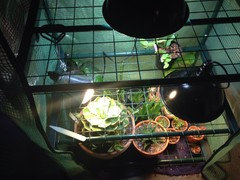
    Hey, sorry for the slow reply. Here's a photo


    It's mostly sun-loving plants(Kissho Khan Agave, Aloe Vito hybrid, some aloe veras, sanservia, a mango sapling, pothos, and other stuff), with the exception of the easter cacti(they don't seem to mind the setup I have right now, but I've hidden them in shadier spots before).

  • 10 years ago

    I like the T5HO but the greenhouse isn't wide enough to accommodate it, unless I hang it vertical(which I might, have to think about it). I appreciate your help. I'm thinking that I'll have to have some reflective paper opposite the light if I get the 4' and hang it vertical so the plants don't lean to one side... or just get the 2', but yeah I see what you mean about the cost effectiveness.

  • 10 years ago
    last modified: 10 years ago

    "I won't be using these lights year round, just for a half a year to overwinter my plants until I can bring them outside for spring."

    So, zone 6a, do you live in the southern hemisphere? If not, you will bring them outside in one month. Why fret about artificial lighting now?

    "I also am not using all of the greenhouse space, just half of it(for now). The greenhouse is also covered with plastic, and I worry about the lights melting it if they're too hot."

    Why are you putting arid loving plants into an enclosure that increases humidity?

  • 10 years ago

    I was fretting because I'm starting to see some detrimental effects of under-lighting on some of my plants. I might purchase the lights later instead of right now-but I still wasn't sure what to get, so I don't see the problem in figuring out beforehand what will work best.


    That's all I have and it keeps them warmer. They're all in a gritty mix and watered sparingly-often when the room is warmer I'll open the flap up and get them some air. It's my third year overwintering them in this greenhouse, and while they have survived I want to do better then that.

  • PRO
    10 years ago

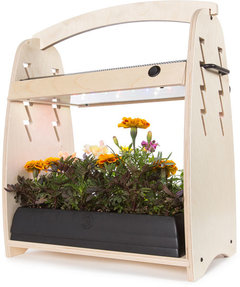
    Hi!! Our team developed a product specifically for high light requirement plants. We developed a habitat which uses high quality LED lights which generate very little heat and allow plants to grow very effectively. From my personal use I've been growing my succulents in it for a couple months now. Come check us out at Ledhabitats.com take a look at the Habitat pro


  • 10 years ago

    " plants are suffering as a result (leggy, too green). I don't recall exactly what lights they are because of a cleaning spree that got rid of the original packaging..."

    Then tell us GENERALLY instead of EXACTLY what kind of lights they are, i.e., incandescent, CFL, or LED and wattage. The wattage should be written on the bulbs.

    The best way to make plants leggy is to use incandescent bulbs and, for all I know, those fixtures contain incandescent bulbs because you didn't show us a photograph from the bottom. In that case, the easiest and cheapest remedy for you would be to simply replace the incandescent bulbs with CFL bulbs within those fixtures.

    Led Habitats: "Warm yellow light promotes rapid growth"

    Show me scientific evidence. Here is scientific evidence that light near 590 nm is bad for plants:

    http://forums.gardenweb.com/discussions/3698430/fyi-evidence-that-yellow-light-585-595nm-is-bad-for-plants?n=1

  • PRO
    10 years ago
    last modified: 10 years ago

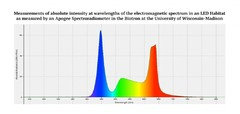
    @aruzinsky. It's true that there are little benefits of light truly around the 590nm spectrum and in high concentrations is harmful. This wavelength of light is pleasant to the human eye. Thank you for finding a correction to my wording as its not the yellow light that promotes growth, it's the output of red and blue wavelengths. Im correcting the site as we speak, good catch. Regardless, we have found that our minimal output of yellow light around 590nm has not degraded plant growth in our tests . It's a tough balance between aesthetically pleasing light and light that promotes quality plant growth. Below is the light spectrum output from our light for clarification.

    Hope this answers your concern

    Robert

  • 10 years ago

    "Keep in mind the sun outputs this wavelength in most of its output levels. "

    If my hypothesis, the less yellow light, the better, is true, then plants would grow better in sunlight filtered by Didymium or neodymium glass. As far as I can tell, no such experiments have been published that test that hypothesis.

    "As you can see here the yellow light output is quite minimal"

    But, not nearly zero and there are much less expensive lights for which it is zero, e.g., some triphosphor fluorescent. And, in the absence of light near 590 nm, Caucasian skin tones look better, hence, the market for GE Reveal bulbs.

    " So far I've yet to see an artificial light grow plants better then the sun and it contains these wavelengths."

    My tomato seedlings do better under artificial light than under daylight in an unshaded greenhouse. For example, see

    http://forums.gardenweb.com/discussions/2005610/how-to-easily-supplement-fluorescent-with-incandescent-light

    In particular, it is easier to grow stockier plants under artificial lights that lack far red.


  • PRO
    10 years ago

    @aruzinsky. . That's quite possible, I'd be interested if you ran that experiment. Our original prototype had control over the spectrum of light output from the LEDs. However, no one liked the color of the light emitted. Not to lose sight of the original posters concerns, while its definitely possible to grow a better plant in a science lab. The product I offer tends to grow a better plant with less experience, due to low heat output and the ability to easy adjust the distance of light to seed/ seedling based on current state of the plant. The quality of our LEDs output the necessary wavelengths required for proper photosynthesis and can completely solve the problem the original poster had. If you decide to run these tests checkout fastplants.org for a good resource for seeds to do your research.

    Thank you for your dedication to growing a better plant indoors.


  • 10 years ago

    3 ft2 is pretty small. 1 or 2 Mars Hydro 300 watters will do it easily. keep them 8" above at least.

Sponsored