

Chickens
We have decided to get some chickens. I personally would like grown up hens, DH is not opposed to Atwoods chicks. Any recommendations as to where to get them? Any breeds better than others?
Comments (35)
 10 years ago
Lots of chicks & pullets for sale on Craigslist by farmers in the Tulsa area. Rhode Island Red and Leghorn are two of the most popular egg layers. I grew up with chickens but, sadly, live in a neighborhood that doesn't allow poultry of any kind...
Someone in Collinsville/Ramona has RIR pullets for sale: http://tulsa.craigslist.org/grd/5487337912.html
Related Professionals
Cumberland Landscape Architects & Landscape Designers · Columbia Landscape Architects & Landscape Designers · Knoxville Landscape Architects & Landscape Designers · Williamsburg Landscape Architects & Landscape Designers · Muskegon Landscape Architects & Landscape Designers · Saginaw Landscape Architects & Landscape Designers · San Diego Landscape Architects & Landscape Designers · Port Saint Lucie Landscape Contractors · Emporia Landscape Contractors · Louisville Landscape Contractors · Atlantic City Landscape Contractors · Memphis Landscape Contractors · Des Moines Landscape Contractors · Eugene Landscape Contractors · Wilmington Accessory Dwelling Units 10 years ago
If you buy them from a retail store, be sure you are getting pullets and not straight run or you'll end up with half roosters. Some stores only sell straight run while others sell pullets, though you cannot always trust them either----sometimes employees or customers inadvertently mix together the straight runs and pullets and you think that you are getting pullets only to discover later that you got straight run. I thought I'd throw all that in there because it is so easy to get all caught up in looking at all the fluffy little adorable chicks and end up going home with a bunch of males that never will lay a single egg.
We always have a wide variety of poultry so that we'll have a variety of eggs in various sizes and colors. Right now we have Ameracaunas, Welsummers, Mille fleur de uccle, Black Australorps, some chickens that are crosses of the above breeds, and a ton of baby chicks that aren't big enough to lay eggs yet that include White Leghorns, Cukoo Marans, and a bunch of fancy rare ones that Chris ordered as eggs, has hatched out and still is hatching out in the incubators and whose names I never can remember (or probably pronounce). We've had many kinds over the years and they've all been well worth having, providing lots of eggs, insect control and chicken bedding/manure for the various compost piles. We do tend to lean more towards brown eggs (some solid light brown, some darker brown, and some lighter brown with speckles) and colored eggs (the Ameracaunas lay eggs in shade of green and blue) but we do have some hens that lay white eggs.
Since our chickens free-range during the day (and are locked securely in a predator-proof coop at night), we don't get pretty, fancy ones like the frizzles or the crested Polish. I think frizzles are beautiful but don't know if free-ranging frizzles would stay beautiful. They might get leaves, twigs and grass hung up in their pretty frizzled feathers. IWe had crested Polish in the past and they don't have good peripheral vision because of their crests, so they have a hard time keeping themselves safe from predators while free-ranging. All our Polish also were nervous in nature and chattered loudly nonstop which got old over the years. I like listening to chickens and the quiet little sound they make, but not the loud cackling ones that the Polish made.
Really, as long as you choose a breed that lays eggs regularly and that can tolerate our heat, I think you'll be happy with any breed you get.
- 10 years agolast modified: 10 years ago
Another thought on chickens. Egg production slows as chickens age. So, if you buy full-grown chickens, you risk getting older ones that have stopped, or soon will stop producing.
Funny story: In Portland chickens often are seen as pets so some clever soul developed the idea of a retirement home for chickens that have past their prime: Here's an article on the topic
AmyinOwasso/zone 6b
Original Author10 years agoI'm really ticked. TSC in Skiatook was out of the coop we wanted. Broken Arrow and Pryor were out. Bartlesville supposedly had one left. I called to put it on hold, but when I got there it turned out someone else had already put a hold on it. WASTED afternoon. I've spent the rest of my day researching other coops, various breeds and otherwise learning all I can.
Thanks for your replies. Baby chicks are cute, but, 18 to 26+ weeks before they lay, plus the possibility of roosters is the reason I would like to buy juvenile hens (is a hen a pullet or is a pullet a special kind of hen?) Of course they cost a lot more. But the ones from Craigs list above are $10 each. Might spend that much in feed to reach 2 months of age. I will probably let DH make final decision. This is supposed to be his project. Can ducks and chickens live in the same coop? We have to have a stupid coop before we buy the critters.
 10 years ago
Sorry about the coop. How frustrating!
I only have 4 hens, but they lay enough eggs for the 3 people in my house, plus sometimes a few to share--depending on if I bake or make deviled eggs. We usually get 2 or 3 a day, but my girls are young. Just turned 1. Some days (like today) we got zip, but yesterday we got 4. It's rare day that we get 0 or 4. We usually eat eggs for breakfast on Monday and Saturday (just because those days I have time to cook breakfast).
Anyway...
The Red Sex Link and Black Sex Link chickens are good for a couple of reasons. You can tell the boys from the girls from day one. They lay well--almost every day. And my Red and Black are very sweet natured--one is timid and one is outgoing, but both are easy to handle. I think they're pretty too. I'm sure there's other reasons people don't like them. Atwoods and Tractor Supply almost always have the Red Sex Link pullets.
I also have a Cochin--it took her FOREVER to start laying. And a mystery blonde chicken. She's little, so a bantam of some sort. She's the only white egg layer of the group.
I'll probably get another 4 next year. Unless I get two rescued chicks that a friend of my sons found abandoned in the Southmoore High parking lot. She's trying to find another home for them (because I really don't want new chicks this year) but is keeping them for now. She lives in OKC...and I'm not sure how her parents feel about keeping chicks. I hope she got a heat lamp for them. I'll take them if she can't find a home for them. My luck they'll both be boys and I've heard that the ratio of hen to rooster to be no less than 10 hens per/rooster.
My son's piano teacher keeps ducks, geese, and chickens all together.
How many chickens do you want?
Good luck finding a coop!
- 10 years ago
Can you order the coop you want from TSC online? Some TSC products are available on their website, but I don't know if coop kits are one of them. Sam's Club also has at least 1 coop model, and I think CostCo too, though I am not certain if they still have them. When I was in CostCo last week, there was something else on display where the coops had been. If you have an Atwood's near you, they have had several models in the stores for a couple of months now.
A pullet is a female chicken, generally under 1 year of age, and when sold commercially by a hatchery, the pullets they sell/ship are usually roughly 15 or 16 to about 20--22 weeks old.
Some ducks and chickens can peacefully coexist and get along just fine. However, you may need separate waterers/feeders for the ducks. With their larger bill, I don't think they could eat well or drink well from the standard chicken feeders/waterers. Sometimes drakes will harass young chickens, but a feisty rooster generally can put a halt to that.
I went down to the grow coop (the house our chicks graduate up to after leaving the brooder as an intermediate step before they eventually move into the big coop with the full-sized poultry) and looked in the window at the chickens in there, and saw that we have Black Copper Marans (not Cukoo Marans), White Leghorns, Buff Orpingtons, Rhode Island Whites (like R.I. Reds, but in white) and Delawares. I think Chris is moving some of his high-faluting fancy French fowl whose names I don't know down to the Grow Coop tomorrow. They hatched out only 2 days later than the youngest birds in the Grow Coop so they should be able to integrate well into the larger flock, and they can grow on together for a while before they move to the main coop.
Our turkeys all disappeared for most of the day today and Chris thought they weren't coming home and either had followed a wild turkey off into the woods or maybe had gone across our neighbor's back pasture chasing grasshoppers or something and couldn't find their way home. I went out after dinner and called them the same way I always do "Turkey Jerkeys! Turkey Jerkeys!" and they all came up out of the woodland and mostly put themselves up in their coop. They know I am calling them when they hear those words, and they always respond with a gobble to let me know they heard. Having poultry can be an adventure.
AmyinOwasso/zone 6b
Original Author10 years agolast modified: 10 years agoI don't think we can have roosters in town. Even if we can, I don't want to hear them at dawn. There are 2 of us, but we eat a lot of eggs. I have 4 kids who wouldn't turn down free food. I've been looking at coops that will house 4. We want something cheap in case we decide chickens aren't for us. If we want to continue, in a year or two we will go bigger and better. Really, I want them for manure, and bug eating. But I don't want that to cost a fortune and cause a fly explosion. Can you tell I'm still waffling? Years ago we had a pair of geese. They attracted a lame duck (seriously, there was something wrong with her leg). The goose ran the duck off when she laid eggs and later a drake moved in for free corn. I had to fence the patio to keep the geese off. The dog became an indoor dog, cause you can't keep a goose out of dog food. And they kept the tomatoes trimmed as far as their necks would stretch through the fence. One gossling survived and a rabbit adapted the geese (he was white and he must have imprinted on the gander. We had quite a managerie for an urban back yard. I'm not sure I want to go back there.
I've looked at TSC's website. And several others. It was just that I didn't want to pay shipping if I didn't have to.
- 10 years ago
Our wild turkey that hangs around has a bad leg. Two or three summers ago it appeared in our yard, hopping on one leg. The bad leg appeared to be broken. We fed it daily and if we didn't have food out before it showed up, it would stand in the driveway beside the pickup truck and stare at the back door until we came out to feed it. I really didn't think it would survive, but it did. The leg healed and after a few months it was walking on two legs again instead of hopping around on one. Last year I don't remember seeing it a single time. This year, perhaps drawn in closer by the sound of Chris' turkeys, it suddenly reappeared, still walking with a limp. It doesn't let us get as close to it as it did that summer when we were feeding it, but if you put a little turkey food outside the turkey's fenced run, it will stand outside the run and eat while our turkeys eat inside the run. I'm not sure how much they hang out together when our turkeys are free-ranging, but when they disappear into the woods, they always go into the exact area where the wild turkey hangs out.
- 10 years agolast modified: 10 years ago
And.....one turkey hen did not return to the coop last night and didn't come when called, which is not like her. Either she's gone broody and is sitting on a nest somewhere deep in the woods, or she's run off with the male wild turkey, who also was conspicuously missing yesterday evening. I just bet they are together. Chris tried to look for her, but encountered a very large copperhead which got him sidetracked. He called me, I took him a gun, and he shot the copperhead, but after that, there's no way the turkey was going to come to him because she is not a fan of loud noises. There's really too much snake activity now to go off into the woods looking for her now anyway.
AmyinOwasso/zone 6b
Original Author10 years agoSorry to hear that. I've joined some "chicken" groups on face book. Someone posted about a turkey with no mate that tried to mount a chicken. He squashed her. (Things about poultry I had never considered). Hope you find your turkey and avoid those snakes!
- 10 years ago
Thanks. It happens. The best possible ending is that in a few weeks she'll come wandering up out of the woods with little turkey chicks following her. She's always been more of a roaming type bird than the others. I kinda think she ran off with that bad boy, the wild turkey. He has come around every day to eat with our turkeys and now the two of them are missing together. Hmmm. Maybe they are having a secret affair.
Turkey mating is bizarre to see. It is a wonder they are able to reproduce at all.
The two males will have to share the remaining female, who is younger and who does not seem particularly impressed by the two males and all their strutting around and fighting and trying to woo her. She just goes off and sleeps on the shady patio and ignores them. I was hoping the remaining three turkeys would lead us to the missing one today, but they don't even act like they've noticed she is gone.
AmyinOwasso/zone 6b
Original Author10 years agoSo Atwoods has a chicken coop in their ad this week and I went out to see if they really had it or just had one or whatever. They did not have the one in the ad, but a different slightly smaller one. I am getting pretty disgusted and I can't even repeat what DH had to say about it. We are considering building our own. I'm trying to figure out predator proofing. Is 1/2 inch hardware cloth small enough mesh? That stuff is expensive. One article on line said you could fold 48" wide 1/4" mesh at a right angle and attach 2 feet to the bottom of the run and lay the other 2 feet out on the ground. The idea being predators try to dig at the bend and eventually give up. I have seen a rat snake here before. Do you have to bury the wire to keep snakes out, or make a floor of it? If you floor it, how do you clean it? What about rats? A lady in Tulsa lost her birds to rats (they live in the Tulsa sewer system, we had to deal with them when we lived in Tulsa). Or possums and skunks. DS said he saw a fox in the drainage ditch the other night, but our yard is fenced to keep dogs in. I assume it would keep foxes and coyotes out. Don't know if it would keep out possoms and skunks. I've seen roadkilled raccoon fairly close here, too. If you were building a new coop, what features would you put in? I felt like the ready made houses needed more ventilation, so we could remedy that. And they're like waist high, walking in would be better. DH has this "cooke sheet" pan that sits in your driveway to collect oil and fluids when you work on your car. I thought a couple of those might make it easer to clean.
- 10 years ago
I can't give any good advice on building a coop, but there are several for sale on C-list. I had to laugh: Someone in Sand Springs has developed a company called Oklahoma Rent a Chicken. They offer "starter" packages for $499 that includes a coop, two laying hens and a bag of feed, etc. Don't know anything about them, but struck me as a funny concept.
- 10 years ago
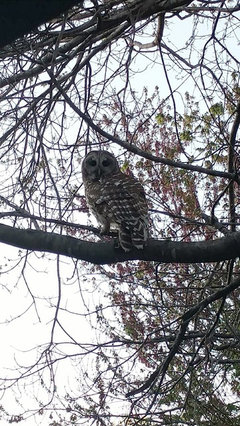
This guy would love for me to get chickens. He was 10' off the ground right outside the back door.
 10 years agolast modified: 10 years ago
Here's a thought. (Sorry I didn't see this thread til now). Most of the coops they sell in places like Atwoods and Tractor Supply (Even Walmart now!) are kind of small. When I see them I almost always think how the bantam Cochins would be great in them. They're about 1/3 size a regular Cochin. They're hardy, thrifty and lay well. The eggs, of course, are small. But they are abundant. You could have more of them in a small coop, and, if you chose to let them out at times, they probably wouldn't range very far.
- 10 years ago
mksmith, what a beautiful owl! But the sight of him/her eating one of your chickens wouldn't be so beautiful. It's crazy it was just sitting there, watching you and letting you take it's picture. Did it deliver a Hogwarts letter?!
I have full size Black Cochin. She is very sweet, pretty, and quirky. She started laying eggs a little later than the other girls, but she gives us one about every other day.
- 10 years ago
Most predators come out mostly at night, but we've had trouble with dogs (likely feral dogs that were dumped "in the country") getting chickens in broad daylight. We've also had issues with foxes, racoons, bobcats, skunks, possums, coyotes and even ring-tailed cats in broad daylight, including me having encounters with them while they were trying to get into the chicken coops and runs in broad daylight. This included a rabid skunk repeatedly hurling his body against the chicken fencing trying to knock down the fence, and that was in the middle of the day. You cannot assume predators won't be out in the daytime, because if they are hungry enough or if they are rabid, they will be. Otherwise, the worst daytime predator is hawks, so we provide lots of cover in the form of shrubs for our chickens to dart underneath to hide. We've even had both bobcats and hawks sit on top of the chicken coop, watching the chickens in the yard and getting ready to make their move, even when we are home and outdoors. Never assume anything with predators and do everything in your power to keep your poultry safe. For years we had owls that sat in the pecan tree that shades the coop and hunted at night. Since our chickens and guineas were safe and secure in the coop, I liked having the owls around. The owls kept them safe by preying on animals that came to try to get into the coop. The owls are not as aggressive in daytime as hawks are and generally fly away if a person walks outdoors, so as far as I know, we've never had an owl get a chicken. We have had hawks get them, though not often. Nowadays, the crows come and eat some of the cracked corn I put out every morning for the doves. (This is quite a distance from the coop.) This has made the crows very territorial and they chase off every owl and hawk that flies near our property. They do it all day long, and I have developed an affection for the crows since they are such good guardians of the chickens (though, of course, they're really just protecting their cracked corn, and our poultry benefits from that).
You can use 1/2" predator hardware cloth, but for covering ventilation areas and windows, 1/4" is better. Yes, it is expensive, but replacing your entire flock can be quite costly, especially if it is a large flock. Some snakes can get through smaller openings than you'd ever believe, and so can rodents. For a fenced run, only use heavy galvanized wire fencing. We used fencing with 2" x 3" openings for the entire run, which is large, and attached 1/2" hardware cloth to the bottom two feet. We did have buried fencing, but eventually poured concrete along the perimeter to keep everything from digging under. Coyotes, coons and dogs are smart and eventually figured out to dig deeper and wider to find a way under buried fencing. If you leave any sort of opening of any size whatsoever weasles or ferrets can find their way into the coop. We learned that the very hard way----and it happened after our big coop had successfully kept out predators at night for 6 or 7 years.
Doors need very good latches that racoons cannot open, and coons can open many types of latches, so make your latches coon-proof. We lock our doors during times of high predation so they cannot get inside unless they find the key, which is hanging on a hook in the laundry room.
We built a wooden floor in our big coop, and after last year's non-stop rain, it is soft and a rodent has chewed through the wood. We are getting ready to replace the floor, but it lasted 12 years so I can't complain. I wish we'd poured a concrete floor to begin with, and I think that is what we will do now to replace the wood floor. That probably will be a summer time project so the concrete can dry as quickly as possible since the coop must be used at night to keep the chickens secure.
Both of our chicken coops have a walk-in door so humans can walk into the coops to gather eggs and to clean the coops. They also have smaller access doors that are just tall enough to allow the tallest rooster to use them that you can raise and lower (using a rope or wire you pull on). Those smaller doors allow the chickens to go directly out into the fenced chicken runs, which have sturdy framing and fencing on top as well to keep out flying and climbing predators. Those doors are within the wall of the coop, with framing on the exterior, that makes it impossible for a coon or other creature with nimble fingers to raise that sliding door by slipping their fingers underneah it. Both coops have an escape feature that is a wire you can pull from the inside in case a door slams shut behind you and the latch catches, trapping you inside the coop. This is an important feature with any walk-in poultry housing in windy areas because a good gust of wind can indeed slam shut the door behind you with enough force that the latch closes and secures the door.
When Chris built his turkey coop, he and Tim made it very secure with features similar to our coops, but his turkey run doesn't have a fencing floor and I wish it did. He did bury the fencing of the run walls and extend them out in an L shape, I think, though I wasn't there watching when he did it. That coop is further from both houses than I'd like and I worry we won't hear a predator if one is out there trying to get a turkey, but so far he hasn't had any predator issues. When the turkeys free-range, they tend to come up closer to the houses and stay fairly close, except for yesterday when, for whatever reason, they cut across one neighboring ranch's pasture and crossed the road and headed up the driveway of another ranch. We are not sure if they went there to visit the goats, horses, cows or dogs, but the neighbor called and Chris went racing over there to gather up his turkey's and bring them home. I am not a huge fan of turkeys and think they are more trouble than they are worth. They are not as docile as the chickens and like to roam widely, more like guineas do. The newer grow coop where we let the little chickens grow and gain some size after they come out of the brooders (which are all quarter-inch hardware cloth with wooden floors to keep the coons out) has a wood floor and no chicken run to go outdoors because it is too close to the edge of the woods, which is filled with predators, including snakes. The juvenile chickens only stay in it for about 4-6 weeks, depending on the breed. Chris usually moves them to it as soon as they are getting too large for the brooder, which isn't very tall. As soon as they are as large as our smallest banty hen, we move them to the big coop where they can free-range daily with the whole flock. Young chickens are not as cautious as older chickens, but the older poultry, especially the roosters, keep an eye on them and rein them in if they are being too careless or free-ranging too far from the coop.
No matter what you do, eventually a predator of some sort will find a way to get your poultry, but we rarely lose one to a predator any more, and usually it only happens when they are out free-ranging and get too far from the house. Our own dogs are in their fenced dog yard and will bark if some predator is lurking in the woods, so that helps alert us. Our very first coop, no longer in use, was not nearly as secure as Tim thought it was when he built it (while I was in another location building a garden), but we learned from that and made our next two coops much better. First we had a smaller coop (now the domain of banty chickens that don't like to roost with the big guys) and that had a concrete coop floor and hardware cloth buried under soil in the chicken pen part. With the larger coop, the floor was wood and that 79" of rain last year got to it, but it was old and already likely was needing to be replaced anyway. The run with that coop only has a dirt floor but with buried perimeter fencing/concrete only around the perimeter and not underneath the whole run. Since the door between the coop and run is closed at night, it doesn't matter if something digs under the fencing at night because they still cannot get into the coop.
Do not underestimate racoons. They have tried (unsuccesfully) to tear shingles off the coop roofs to get inside. They have tried to tear quarter-inch hardware cloth off windows and ventilation areas (secure it with screws, nuts, or bolts, not nails). I wonder if they didn't realize solid wood decking was under those shingles? Tim also didn't have hardware cloth over some of the roof ventilation areas in the beginning (even though I wanted it there and lost that argument because of the cost) and predators came through impossibly small openings, and now there is hardware cloth over everything. We built our first coops in the pre-internet days when it was really hard to find information on things like building chicken coops. Now you can just Google and find all sorts of plans, directions, guides and info. For our first small/very secure coop we used plans from a Mother Earth News article from the late 1990s, and just modified them to make the coop slightly larger. For our large/very secure coop, we designed it ourself based on what we learned from building the very first coop that was on the edge of the woods and wasn't nearly predator-proof enough. If we ever build another, it will be built as strong and sturdy as Fort Knox, but I doubt we'll ever build another because I think the coops we have will last.
I know a lot of people love chicken tractors but we don't have them and never will. Our terrain, being a creek hollow, is very uneven with lots of slope to it and it would be impossible to build a chicken tractor that would work well on such uneven ground. Free-ranging works fine because all the trees and shrubs provide lots of cover, and I'm usually home during the day when the poultry is out. I doubt we'd let them free-range if I wasn't at home. Probably in that case, they could only free-range on weekends. I've had to leave the chickens out free-ranging, sometimes for pretty much the whole day while gone to wildfires, and I've sometimes even left a fire to run back home and close up the coop at sunset. Usually that's not necessary if Tim is at work because he arrives home before sunset and can stop by the house and close up the coops before he heads to the fire station to get another truck and join us at the fire. If he is out on the fire line, though, I've run home to close it up. I can usually combine that with a run to buy more food or drinks, or to refill the ice chests with ice if our ice is melting or has melted. You have to find the plan that works for you.
Regular fencing, of the type used around yards, whether it is chain link or wooden privacy-type stockade fencing, will not keep out the predators in our neighborhood. Coyotes can jump or climb it, and so can bobcats, ringtailed cats, and coons. Dogs can dig under it. We have learned those lessons the hard way. Remember that hungry animals can spend 24/7 finding ways to circumvent your fencing and housing, and they often do. The hungrier they are, the more desperate and daring they are. We've had coons come knocking on the doors and windows of our house, trying to find a way in. Granted, being so close to the Red River means we have a lot more predators than the average person. My brother lives in the country in a well-developed area far from lakes and rivers and never has had the predator issues we have. One of our neighbors has open chicken runs with no roof over them, but he sets traps around the runs at night and kills predators that get caught in the traps. He also has dogs that keep the predators away to some extent. You have to find what works for you in your location. We were appalled to learn that what works for us is only something built like Fort Knox. Anything less than that doesn't protect the poultry as well as it should, and those are lessons learned from the school of hard knocks (and dead poultry).
AmyinOwasso/zone 6b thanked Okiedawn OK Zone 7 AmyinOwasso/zone 6b
Original Author10 years agoMark, that owl will also take care of rodents. Have you heard it? Looks like a Barred Owl, their call sounds like "Who, who cooks for you". Spectacular pic. Maybe it has a nest near by.
Thank you George, but that link brings up more I didn't know. Lots of vaccinations. When does THAT happen. I never thought of chickens visiting the vet. Finding a vet that deals with birds isn't easy...at least for pets like cockatiels.
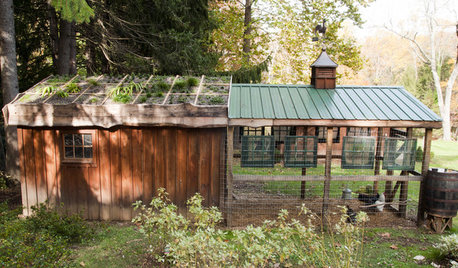
Hazel, a list of things not to do would be helpful. We're considering a hoop style set up, covered with hardware cloth and a tarp to keep the rain out, like this. We will have to come up with insulation before winter. The site is shaded by a maple tree.
- 10 years ago
Amy. I have. It is a barred owl. In fact we have several in the neighborhood. I hear them talking to each other. We also have another owl. Not sure what kind but it's what I would call a "hoot" owl. Also have a few red tail hawks. It's amazing the wild life we have living in a residential area. I'm at 116th and memorial. There is an area about 1/2-3/4 of an acre in the greenbelt behind us that is un touched woodland for lack of a better name. That is where most of the animals are being forced to live with all the neighborhoods going in. I don't have chickens so I'm not too worried. I wish the owls and hawks would do some work on our squirrels. They are getting very numerous.
AmyinOwasso/zone 6b
Original Author10 years agoWe have babies. Bought a coop at Atwoods because DH didn't want to build. 2 white rocks, 2 brown sex links (when I google I only get red and black?) And 2 silver chamagne. I swore I heard champagne, but all I find is campine? And it was _____ silver champagne, can't remember the first word. Spotted one at the top in photo.
I've already had to pull two out of the waterer. How do you stop that?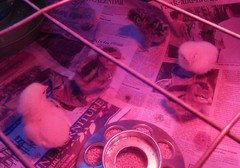
- 10 years ago
Put marbles in the waterer. That way, when they step into it, they don't go under. They can drink between the marbles.
AmyinOwasso/zone 6b thanked Macmex AmyinOwasso/zone 6b
Original Author10 years agoThe water is only an inch deep, they just don't need to be walking in it. One of them already seems to be puny, I suppose getting them at Atwoods might not have been the best idea. Of course it's one of the little champagnes(?) That I bought because the markings are so pretty.
- 10 years ago
Cute!!!
Amy, I got my chicks from Atwoods. I bought 5 but one died about a week later. We lost power during a storm and they didn't have their heat lamp. I rushed them to my Mom's a couple of hours later to get them some warmth. One never bounced back and I came home from work to find her dead a couple of days later. The other 4 have been really healthy except one was sick in October. I actually brought her indoors and put her in the extra bathroom in a washtub. (Keep in mind that she was full grown) I think something was wrong with her crop, but I"m not sure. I fed her plain yogurt and water for a couple of days. And forced a syringe of red wine down her (Read somewhere that was good for crop problems). Also kept an oil diffuser in the bathroom with my favorite oil blend when I'm feeling ill. After 2 days, I came home and she was standing up and ready to go back to the coop. She ate and was fine.
The water container I bough was really small, so I didn't have the problems of them falling into it. I had to buy a bigger one once them moved to their coop.
- 10 years ago
You can put baby chicks in a small box with a "hot hands" hand warmer. This works when the power goes out. And it is also how we transport them to the auctions.
 AmyinOwasso/zone 6b thanked Sandplum1
AmyinOwasso/zone 6b
Original Author10 years agoThe sickly one died last night. The other 5 look healthy. They are in the garage, which is the cat's domain (she's not allowed outside). She appears to be afraid of them, doesn't want to go in there without us. She has a cat door. They are in a tub, with fencing over the top so she can't get to them. She'll get awful hungry if she doesn't get used to them.
- 10 years ago
It seems like there's always a sickly chick in every batch. Sorry you lost one, Amy.
I bet your champagnes are campines. There's no other chicken breed I can think of that would have a name similar to champagne other than Chantecler, and they're not a common breed and I don't think their chicks have the markings that yours has. The first word could have been Belgian since campines originated in Belgium.
Regarding the sex links, there are brown sex links, and also gold, black and red ones. Since many different hatcheries create the own sex-links (which are hybrids) by crossing two different varieties together, they often give their unique breeds new names to differentiate them from the handful of original sex link breeds introduced further back in time.
I cannot imagine how a cat can co-exist in the garage with chicks without wanting to kill them. You are trusting your cat more than I trust our cats. I don't even let the cats go into the room with the incubator for fear they'll hear the chicks peeping on that last day before they hatch or as they begin to hatch and might jump up on the table and accidentally knock the incubator off the table.
Our cats don't bother chickens at all once the chickens are about 8 weeks old or so, but we don't let the young chickens out to free[range until they are at least 8 weeks old. I've seen our youngest cat, who is not yet 2 years old, follow young chickens around, sort of stalking them, but he doesn't bother them because he knows he'll get sprayed with the water hose if he gets too close to them. Our other, older cats barely even look at the chickens because they are used to being around them and they all live together in peace and non-violence. When we first got banties I was concerned the cats might prey upon them due to their small size, but they left them alone (and our big Welsummer rooster probably wouldn't have let them get near the banties anyway).
A neighbor's small (very small) dog recently showed up in our yard and he was watching the chickens with great interest, but since they were all his size or larger, he didn't bother them. He almost seemed afraid of them.
AmyinOwasso/zone 6b
Original Author10 years agoThanks, Dawn. My cat doesn't even kill mice. She plays with them, hunts them, but has no idea what to DO with them. I've had cats who brought me half eaten "presents". DH had to kill 2 she found in the house last fall. And she looked at him like "hey, that was my toy". I've been watching her. She seems to be afraid of them. I have no place else to put them. If she gets too interested I will have to bring them in the house where I can close a door.
I "swabbed" their butts with a wet Qtip yesterday, in case the chick that died had pasty butt. One seemed a little dirty, but I have no idea what I'm looking for. I know you're supposed to keep them at 95* the first week. But my lamp temp varies and sometimes it is hotter. It's at one end, so they can walk away to be cooler. Trying to figure out if I should raise it a little. When do you take off the wing bands?
Hazel, I'm sure I will name them. The campine is the only distinct one right now. the two white rocks look alike and the two brown sex links look a like. The white rocks are bigger and dominant.
- 10 years ago
I was confused about the wing bands and the information that I found online didn't help. I called Atwoods and they said to take the bands off. I was so afraid of hurting them. My husband removed them easily without incident.
Do you know what the band color means? All of my chicks had red bands except Marjorie had a pink band. She was slightly bigger--older, I think by a couple of days, so I wondered if the band color meant the day of the week they were born.
AmyinOwasso/zone 6b
Original Author10 years agoMine all have blue bands. Day of the week sounds logical. Did you cut the bands off?
- 10 years ago
I thought I was going to need to cut them off. I really was freaked out by it. That's why my husband just did it--I think he was tired of me being a weirdo about it. He did it when I wasn't home. I was researching it to death.
He said he didn't need to cut them off--I don't know how to explain how he got them off. He bent them a bit and pulled the part that went through the hole back through the hole. That doesn't make sense does it?! Haha. I'll probably be weird about it again if we buy from Atwoods next time.
- 10 years ago
Wing bands are used by different entities or persons for different purposes. Some poultry suppliers band only the female chicks so that customers who want only females can be sure they're getting only females. Some suppliers may band each hatch for tracking purposes. People who show poultry in poultry shows may band their birds for identification purposes---and some poultry shows may require all entered poultry are banded for ID purposes. Atwoods is the only local seller I've seen selling chicks with wing bands, but the ones we bought there this year didn't have wing bands and were sold as straight run, and we got about 50% females and 50% males. Luckily, Chris has friends who only bought pullets and now want roosters, so we'll give them our extra roosters. Having only pullets sounds great, until you realize you need roosters to protect the chickens from harm, and you need roosters to get fertile eggs for hatching. In the past when we've bought chickens, turkeys, guineas or ducks from TSC or Orschlein's, none of them were banded. Ideal Hatchery does band theirs, but when we've ordered from Murray McMurray or from private breeders, none of theirs were banded.
Some bands can be removed with your fingers, and others may have to be cut off or pulled off/out with needle-nosed pliers.
Pasty butt occurs when chicks have diarrhea (common in their first few days of life) and sit in it and it dries to their butts. My son handles the pasty butt removal on all our chicks (and I am so glad) and he usually uses warm water and a Q-tip (while wearing disposable nitrile medical gloves) to soften it and then kind of pulls the dried "stuff" off their butt and disposes of it. Then he swabs them with a clean Q-tip to get any lingering bits of it off. If you don't remove it and a hard layer of it forms, it can prevent them from successfully expelling excrement from their little bodies. Usually pasty butt is not very common and only lasts a couple of days on any given bird.




hazelinok