Software
Houzz Logo Print
hzdeleted_24171244

Help with dry, shady area.

10 years ago
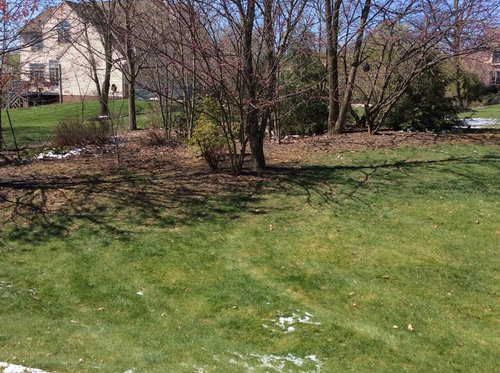
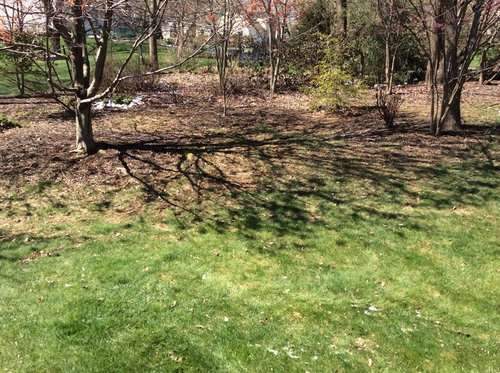
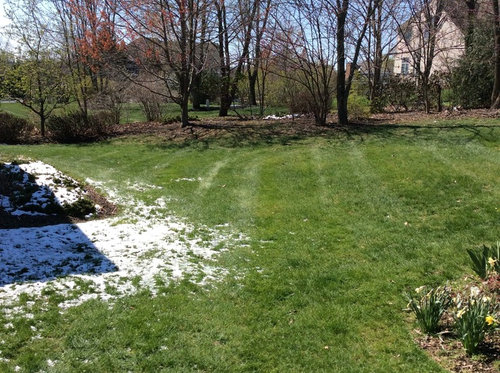
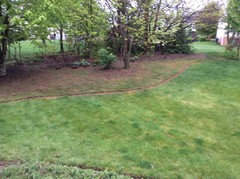
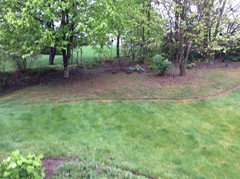
Looking for some advice on how to landscape this dry, shady are of my backyard. It needs some kind of delineation, but what? Would also like ideas on what to fill in with. Trees, bushes? Region 6. Deer and rabbits abound.

Comments (22)

  • PRO
    10 years ago

    Divide the lawn from the treed area with a distinct edge. It could be a "trench" edge or hidden metal edging. Or it could be a brick mowing strip or something like that. The bed line should be graceful ... not lumpy and wavy. Plant groundcover at the treed side. Research what groundcovers grow well there and and would fulfill your requirements (probably not too tall.) Shrubby/ taller perennials or such may go near, or at the back of the bed, toward property line.

  • 10 years ago

    Groundcovers that do very well for me in Z5B are ajuga (burgundy glow) and sedum (blue spruce is the one I like the best). I plant these in very dry places, and they will spread themselves. Ajuga is very low, probably no more than a couple of inches tall. Sedum is about the same, until it blooms.

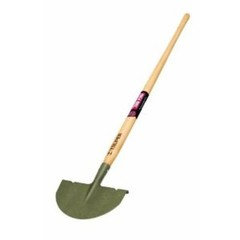
    I like to use the trench edge. I have a hand-edger like this. Easy to use - I just stand on it to trench out a wedge of soil.


  • 10 years ago

    Geranium macrorrhizum is a terrific groundcover for dry shade. In zone 6 it's semi-evergreen, and it's highly deer resistant with fuschia colored flowers in late spring. Epimedium sulphureum would also be handsome, though it does need the old foliage cut back in late winter. Also highly deer resistant.

  • 10 years ago

  • 10 years ago

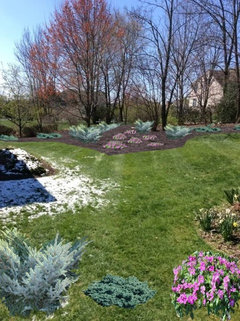
    Thanks so much for your replies. We have an edger, and I was able to learn about all the suggested plants on line, but I wanted to know if the evergreens you put on the photo are junipers?

    The smaller one looks like some we have that I think were called blue rug juniper, but we have a hard time keeping the grass from growing within the branches. I do like the plant, but is there something I can use to discourage grass?

    Again, thanks for your help.


  • 10 years ago

    On the picture you can see Tigertail Spruce, Blue Star Juniper and Vinca.

  • 10 years ago

    Great. Thanks!

  • 10 years ago

    The thrench edge is a great tool to keep the grass from the flowerbeds. You just need to make deep ( wide ) rows to separate the areas.

  • PRO
    10 years ago

    Agreed ... plants that like sun are not going to be happy under the trees. Neither would I use plants that would grow tall and bushy in the foreground ... unless you want to ignore the part of your yard beyond. I think it should be included in the view, which means a lower groundcover only in the foreground portion of the wooded area. Since everything is relative, how low depends on what else happening.

  • 10 years ago

    OK. I guess junipers are out, and I see what you mean about sort of blocking the back of the area with the tall, bushy plants. The back is kind of barren, so I'd like to put "something" there -- what do you think of mountain laurel? I like those drought/shade tolerant sedum, so that's a definite maybe for the foreground. Any other suggestions?

  • 10 years ago
    last modified: 10 years ago

    Did you not see my post about Geranium macrorrhizum and Epimediums? Both ideal for your situation. Sedums are for sun.

  • 10 years ago

    Sorry, I did see your suggestions. We went to the nursery tonight and saw the barrenwort. I don't know if there are other varieties, but the one I saw had little flowers that looked like columbine. They were kind of spindly, but maybe they get bushy when they get older?

    I loved the geranium idea but they weren't 't out yet. I did find these on line.

    http://www.hardys-plants.co.uk/images/content/file/pdfs/geranium%20-%20shade.pdf

    I also found this guide which mentioned.the barrenwort, too.

    http://statebystategardening.com/state.php/il/newsletter-stories/solving_the_horrors_of_dry_shade/

    i have a few weeks to get the area edged and ready for planting, so I'll keep reading and visiting nurseries.

    thanks for your time. I appreciate the help.


  • 10 years ago

    There are many, many cultivars of Epimediums, some spreaders, some clumpers. The best spreader (though quite slow) for dry shade is E. sulphureum, with yellow flowers in early spring. It is evergreen, but gets pretty tatty looking by the end of winter. Looks best if the old foliage is cut back in late winter before the new foliage and flowers appear.

    The G. macrorrhizum will need no attention at all once established. BTW, most geraniums are loved by deer, but not this one.

  • 10 years ago

    Update. I got the edging done trying to follow your tip about one smooth line.

    I also found the " big root " geranium, some astilbe, a few varieties of hosta and the coral bells ( you can see some of the hosta and a couple ferns I already planted just to get them out of my garage.) It's been non-stop rain for the past few weeks here in PA, but I'm wondering if someone could give me advice on where exactly to place the new plants. I can move anything, but I'm stuck with the trees. The big tree on the left is a maple, the tree on the right is a beech, and the smaller trees are all redbuds. All the plants are in gallon containers and I can get more of everything. The nursery is only a mile away.

    I'd like to find something low for the front part of the bed, which is going to be more dry than the back of the bed. Everything gets mulched when the plants are in.

    The bush is a tree peony, and I don't know how it survives. It looks sick, yet every year it sends out new growth and flowers.


  • PRO
    10 years ago

    I can't help but think that somewhere at the base of everyone's motivation for making landscape improvements is the desire for creating more beauty. Usually, this it at, or near, the top of the list. Even though every time I mention how not good it is to keep low-hanging limbs on trees in the yard, it causes a near revolt. Nevertheless, I'm going to say it again. It's not good! I have to think that most of the time people leave low limbs remaining because they are afraid of not knowing the effect of removing them, and also because they are trying to maintain privacy and view the low hanging limbs as more of it. Trouble is, they either screen their own house from a desirable public view, or they screen their own yard from themselves! ... making it seem smaller and giving it a character that would give any claustrophobe a good case of the heebie-jeebies. The general impression one is left with is that someone is making a statement of neglect, as the overall appearance tends toward looking disheveled.

    There is a better way. What helps improve appearance is to make it look like things occur intentionally and are being maintained. Trees should not look like they are creating head-scraping ceilings or facial obstructions, but like there is plenty of clearance above whatever it is that the tree is sheltering ... in most cases it's humans or houses.

    It's the case that trees, by design, have a gap between their canopy and the ground. Leaving this gap low -- so that it will not work for humans -- intuitively looks as wrong as doorway that is only 4' height. When one wants to screen the lower level, the plant form of choice to use is the SHRUB. It has no gap between its canopy and the ground, so that the view beyond it is cut off completely. If one is screening objects that are outside of one's property, it is usually best to locate the screening shrubs as close to the property line as possible in order not to cut off one's own yard from view. Trees screen higher elevation objects and can be placed wherever the screening is needed, taking other factors about tree placement into account, and making sure that the canopy does not obstruct the view or physical activity of humans.

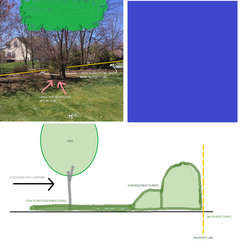
    In the first picture, below, we see not only a low-hanging tree canopy, but large shrubs directly below coming up into its "armpits." This is wrong on at least two counts and works against adding beauty to the scene. In order to NOT screen one's own yard, the tree canopy should be raised and the large shrubs should be placed behind the tree, nearer to the property line. Below the tree should be low plants, like a groundcover, and there should be a distinct separation between the two forms so that neither is impeding the other's space. In the sketch is shown a generic scheme about what works better and still accomplishes the goal of screening outside of the property line.


    A good rule of thumb for limbing up trees is that one can safely go 50% of the total height. While it may seem a little high at the beginning, keep in mind that very shortly after removing limbs, the tree will be spurred on to greater growth. As well, as it grows and remaining limbs become longer, they also become heavier and will at some point in the future, hang lower in a never ending process. A few weeks after creating a 50% of height clear trunk, it, all by itself, becomes a 40% clear trunk, which probably seems a better balance to most people. Part of the reason for keeping on top of this is because if one lets it go, limbs have a way of becoming thicker such that much more work is needed to remove them.

    Though the snippet picture (in the previous post) does not explain how the bed line fits into the overall yard, it does look improved by being smoother and by giving clearance to the tree's trunks. What will look good below it is a lot of some low plant ... not a little of "this and that."

  • 10 years ago

    I know that it's hard to believe, but we did trim a lot of lower limbs from the trees. I gues it wasn't nearly enough. OK. I trust you. We'll try trimming more and I'll stuck with the geraniums beneath. Thanks again for the help.

  • PRO
    10 years ago

    In my experience, lower limbs is such a common condition that people are totally used to it and consider it the norm. They remove a limb here or there and think they're maintaining "the standard." Evaluate each tree based on the 50% rule and make a judgement about what to do. Keep in mind that I'm offering a GENERAL RULE as a guide. There might be oddball situations where this rule MUST be broken. However, it's not likely these oddball situations would occur in a very high percentage of situations. You can always be consoled in knowing that if you follow my advice about this, and then have a freak-out moment on account of it, in time, the balance will be restored more to your liking. If you're really a doubting Thomas about it, try it in a more obscure area where it wont' make such a difference and then evaluate the results over a multi-month period of time.

    If one fears foreign food and resolves never to taste it, they will never know how good some of it tastes!

  • 10 years ago

    That's OK. I like rules and someone who knows better telling me what to do. ( I spent twelve years in Catholic school with nuns, so you can bet that I'm going to follow whatever guidance I can get from the experts!) LOL.

    I do have one question. - can I safely move the tree peony now before it blooms, or should I wait until fall?


  • PRO
    10 years ago
    last modified: 10 years ago

    It depends on how much the tree peony has leafed out. If it's one of those things coming up under the other real tree, then I'd push on the side of relocating asap, even if it meant no bloom this year. If you think you could do without killing it, I would go for it. I almost never let bloom sway my decision about what's good for the long term. Then, I have so many blooming things, there's constant distraction and I know eventually it will be back even if I've disturbed it for awhile. When it's back it will be in a better, more happy place and perform accordingly.

    From what I hear, nuns like a LOT of order.

  • 10 years ago

    With some of the rarer ground covers you may have to mail order them, bare root is cheapest. I do this all the time, nine times out of ten it works out great! So don't limit yourself to just what you can get at the local big box.

  • PRO
    10 years ago

    I agree. If you're after certain or special things, sometimes the only way is mail order. And develop propagation experience so as to make things multiply quickly. It's fun and rewarding.