Software
Houzz Logo Print
rouge21_gw

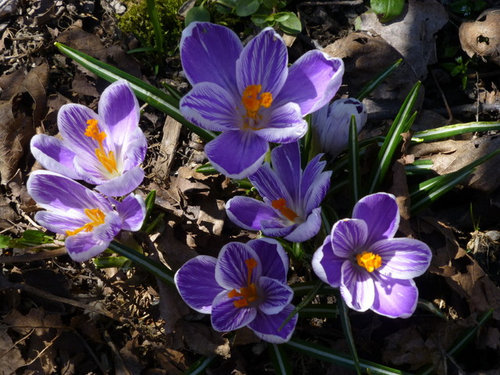
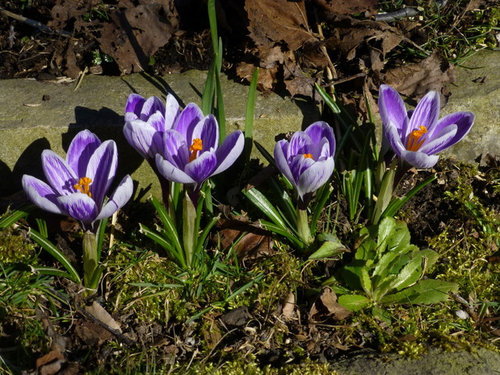
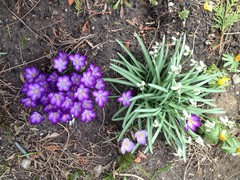
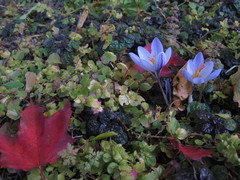
Spring blooming crocus fill the gap

You guys and gals have known this forever as for sure it is a very common bulb but last fall for the first time I planted lots of them. I am so glad I did...actually I wish I planted lots more as in my neck of the woods they provide wonderful color prior to the daffodils doing their thing.

It seems that rabbits like the foliage?

Do they naturalize? With such small foliage it seems I could plant them into the lawn.

(Now that I think of it maybe I should include autumn flowering ones).

Comments (15)

  • 10 years ago

    Thinking this may have been a difficult spring for at least the crocuses planted in more exposed locations; we had an early unusually warm period followed by several weeks of harsh, cold weather. It may also be that the giant Dutch crocuses (Crocus vernus cultivars) have been more affected than the earlier species crocuses.

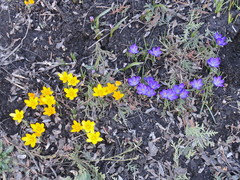
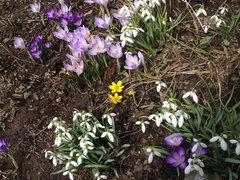
    Below Crocus x luteus 'Golden Yellow' (Dutch yellow) and C. tommasinianus 'Barr's Purple' (January 17, 2016).

    Re spring bulbs: I'm currently having a challenge with both Puschkinia and species Chionodoxa in another garden. None were planted there since 2003 and I've been digging them out early each year since then. This year they're back in parts of that garden in full force and they're spreading more widely into the lawn.

    Unfortunately, both Puschkinia and Chionodoxa are poisonous and spread rapidly by seeding. Also unfortunately, the voles love crocuses and the voles appear to be the main reason why I've always found it necessary to plant more crocuses each fall.


  • 10 years ago

    Daffodil, Hyacinths, Tulips, Snowdrops and many other bulbs are also poisonous so I don't think you need to worry about Puschkinia and Scilla in particular. I'd love to have them self sowing in my garden.

  • 10 years ago

    I've not seen any of the other bulbs mentioned act invasively here.

    The problem for me is that Puschkinia and species Chionodoxa seed vigorously (at least here) into adjacent properties. I believe that gardeners should have some thought for their neighbours and that includes the idea that the neighbours shouldn't automatically be expected to have the same garden tastes as them.

    For me, one aspect of "invasive" is the lack of a natural control agent; I guess in this case, the voles!


  • 10 years ago

    Rouge, any of the C. tommasianus types will naturalize with abandon. For some that abandon is too much, but I just let them do their thing, and accept the fact that I will have to look at their leaves for some time. I would not want to be without it. Same for all kinds of early bulbs. I love to pair my tommie 'Ruby Giant' with the very early large flowered 'Vanguard' with beautiful two toned flowers.


    The later Dutch ones are good naturalizers too, less enthusiastically though. I find the chrysanthus types do not persist very well in my heavy clay soil. I think they need better drainage than I can give them.

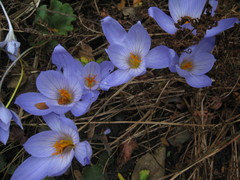
    As to fall crocuses: absolutely. They do not multiply much for me, but they are extremely tough and persistent, even in rather shady spots. Some are (too) close to a maple tree, so very dry, others are in an area that should be too wet, but nothing seems to faze them. Last year I planted alba and a rosy purple, no pictures yet, but these are my faithful blue ones.


    rouge21_gw (CDN Z5b/6a) thanked gdinieontarioz5
  • 10 years ago

    Gorgeous pics gdinieontarioz5.

    Re Fall flowering bulbs....I am a bit embarrassed to ask....does one plant them in the spring or is there enough time (for them to be able to flower) to allow one to do it later in the summer?

  • 10 years ago
    last modified: 10 years ago

    Interesting pic Floral. That little slice of your suburbia looks more "American" than almost any such picture I've seen of the UK. One story houses having large front gardens...seems more American. Throw in a couple looming douglas fir in the background and it would definitely be Seattle. With your limited land I think of stereotypical UK suburbs as being 2 story houses with a short front garden often 1/2 taken by a parking spot; if there's a gardening space it is around the back. The only counter-clue is the stripe on the road edge, we don't use those usually.

    Just an observation! I always like your picture postings.

  • 10 years ago

    Fall crocus bulbs are sold in the fall, same time as spring bulbs. They then flower that same fall, and the leaves come up in the spring, looking just like regular crocus foliage, only you wonder where the flowers are ;-). Sometimes they start flowering in the store. No problem, just plant them and they will be fine the next year. You can also buy them on-line of course, but most nurseries around here carry a few varieties.

    rouge21_gw (CDN Z5b/6a) thanked gdinieontarioz5
  • 10 years ago

    davidrt - you are right that is not very typical. There was a fashion in the sixties for 'American style' front gardens without fences or hedges. It didn't last long. It takes a lot of land and people didn't really take to being on show to the world. BTW that isn't where I live. It's miles away near London.

  • 10 years ago

    I get good seeding and 'naturalization' with Galanthus, Scilla siberica, Scilla bifolia, and Puschkinia. The crocus, even the tommies, are slow spreaders in my garden,

    Wouldn't worry about poisonous, as most of us don't plan to eat them. The deer munch on them and their chief cause of death around here is the auto, not their diet.

  • 10 years ago

    For me, the point about them being poisonous is that they're poisonous to voles; consequently I get no help from the voles in controlling them.

    If it's correct that ants move the seeds around, perhaps they're not poisonous to ants.

    Just came in from a job eradicating species Chionodoxa and Puschkinia. Actually while I was working on my customer's garden, someone from a landscape maintenance company came over and asked me what the species Chionodoxa was and how her company could eradicate it. Apparently one of her customers had planted a line of them at the back of her garden (she said about five years ago). Now her customers is distressed to find them all through her lawn and wants them removed.

    Clearly species Chionodoxa and Puschkinia need a warning label when they're sold, since they can both compete with goutweed and crown vetch in the grief they can unwitting gardeners.

    I'd suspect that if you just want bit of colour from a garden in spring, species Chionodoxa and Puschkinia are great. If, on the other hand, you want changing colour from a wide diversity of perennial plants, through a whole growing season, you may not be so predisposed to them. I'd assume that the the size of the property/garden involved is a further consideration.


  • 10 years ago

    Sunnyborders, have you found little bulbs to be damaging to perennials? I know that chionodoxa, puschkinia and scilla can become a pest in the lawn, if you don't want them there, and I don't know whether they compete with the grass, but I have no difficulty growing "a wide diversity of perennial plants through a whole growing season" in a little bulb 'infested' garden ;-).

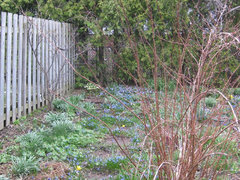
    This picture was taken this afternoon. Scilla in the foreground, chionodoxa at the back, snowdrop and winter aconite foliage all through the border on the left:

    Same path in June 2014, when there were about as many little bulbs as now:

    Picture this afternoon, 'ground cover' of puschkinia:

    Same area last year. Because I lost an old snowball there, I have changed a lot, and planted a greater variety of plants. All are showing signs of life now:

    Not many scilla types here, but foliage of tommies. snowdrops and winter aconites all over.

    Last year June, picture taken from the other side:


    November last year:

    I can understand people wanting to get rid of them, and I understand people not wanting to have all that foliage, alive, dying and dead, but I have not found the little bulbs to be harmful in any way to other plants.

  • 10 years ago

    Personally, I love to see those little happy flowers in the spring lawn. Then of course, I think the main purpose of a lawn is to keep the mud down between the flower beds. I'll start mowing in a couple of weeks, and the bulbs don't seem to mind nor does the grass seem to resent them. I guess it's another case of "chacun à son goût".

  • 10 years ago
    last modified: 10 years ago

    Great pictures and interesting question, gdnieontario5.

    Styles of mixed perennial gardening obviously differ.

    I do use all of a spring succession of bulbs (at least in our own small garden), snowdrops, species crocus, crocuses, the pink giant chionodoxa (must be a hybrid: but I still deadhead it to be on the safe side), species tulips, tulips and daffodils. Much of this requires adding more/replacements each fall. Like the rest of my gardening it's therefore relatively labour intensive. I'm also very big on sunshine gardening to be able to maximize the extent of flower colour possible through the growing season. I also like neat, closely planted/maintained mixed perennial beds. As said, David Tomlinson (Merlin's Hollow) jokes to me about me bedding with perennials.

    I can not say whether chionodoxa, puschkinia or scilla have been detrimental to the other spring bulbs or to the alpine and herbaceous perennials that I try to cram into my mixed perennial beds. I've never allowed any of these three to overrun any part of any garden I've installed or maintained. In fact since 2003, I've not planted any of them anywhere.

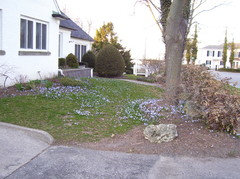
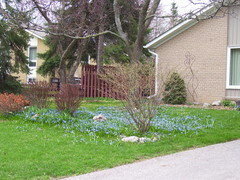
    As said, my aim is for neat and varied beds, not for any effect seen in the first two (albeit mid April) gardens below (both species chionodoxa).

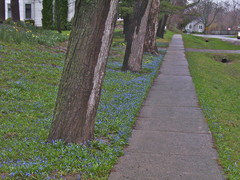
    I do personally find the well established Siberian squill in the last picture attractive. There's winter aconite behind it. As perhaps per the scilla in gdnieontario5's picture, it seems to pack closer than the species chionodoxa and puschkinia, even when they're all given the time. Still it's presumably intended for a display before the large deciduous trees there leaf out. And perhaps the sidewalk hardscapes it.

    I'm not complaining about tastes different from my own, but about a lack of information about the potential behaviour of species chionodoxa and puschkinia. None of the spring bulbs I personally chose to use behave like them.

  • 10 years ago

    Sunnyborders, I think you are right that it is a difference in gardening style. No one has ever called me or my garden neat ;-). I have a friend who on the one hand sees why I love the fact that I can sit in March or early April surrounded by hundreds of crocuses, winter aconites and snowdrops, but on the other hand she is horrified by the thought of living with a virtual jungle of their foliage for many weeks. And that was before the squill types were up... The perennials come up through them all without problem, and when I divide or move plants, I just dig, whatever gets lost in the process will be back soon enough. That said, once I feel a plant is doing well in a spot where I like it, it will usually stay there till it needs to be divided. As long as they pay their rent, they can live in peace. And I can...

    As you do, I especially like the effect in your last picture. I remember a big, old house I saw around here almost thirty years ago. It had a large front yard with towering trees and a virtual sheet of vividly blue Scilla under them. The house is long gone, replaced by a restaurant, but every time I pass by, I again see the sea of blue in my mind's eye.