Software
Houzz Logo Print
guest016548

Anthurium soil mixes? Can 5-1-1 work?

10 years ago
last modified: 10 years ago

Hi all, I've bought my first ever anthurium today. I believe the pot it came in is far too small and I would like to re-pot it into something larger. The soil the anthurium is in seems to be more or less 80% peat moss. I'm going to guess this isn't very good, right? Would you recommend I remove a good fraction of the peat when repotting? In my limited experience, most peat moss soils have resulted in in either a soupy or hydrophobic disaster. I've had success with Al's 5:1:1 mix in the past for my container azalea, blueberry, and dwarf lemons and was wondering if putting an anthurium in a 5-1-1 mix would be a good idea. It seems anthuriums enjoy a high porosity/fast drainage and I have read of Aroid experts growing their plants in mostly orchid bark. I wanted to hear if anyone has personally tried anything like this. Please also share what soil mixes you use and how often you re-pot.

Thank you,

Comments (66)

  • 10 years ago

    Danelle, Fox Farm is a brand I've not seen here, but I see it can be ordered from Walmart. I'll check for it in the store though. Is the one you're using 6-4-4?

    Russ

  • 10 years ago

    6 4 4. Works for me. I bought it at a hydroponics store. I think other people on this forum prefer other things. It calls for watering a certain amount every other watering but I just devide that amount in half and use it every watering. I'm a fan of the school of thought: weakly -weekly fertilizing. Instead of heavier less often I like weaker more often. This way the plants always have access to food,. You flush the soil a bit with every watering and you don't have to track you fertilizing schedule. Tmi? :)

  • 10 years ago
    last modified: 10 years ago

    Thanks for the suggestion, Russ. I actually screen my bark to 1/2 inches (most of the pieces are 1-4"-1/2" undecomposed bark bits), so it's similar (I think) to some the less coarse orchid bark mixes I've seen at HD. Do you think this would be okay? The Farland product you mention uses really fine aged/composted bark pieces from what I've read on the container gardening forum. My 5-1-1 mix is rather "crunchy" and airy, and very fast draining, at least in my dry environment.

  • 10 years ago

    Your bark sounds good FTG. You're right, the Fafard is composted and much finer than the pine bark mulch I also use from Walmart. I do find that unscreened, the Walmart bark does retain a lot of water.

    I'm curious. You're screening the fine stuff out of the bark you have, but are there pieces larger than 1/2 inch that you also have to screen out or is that the biggest size you expect in it? Also, what do you do with the fine material you screen out?

    Danielle, you're among a very large number of people who like the much weaker dose of recommended amount at every watering. From the looks of your blooming anthurium, it agrees with you.

    I'm wondering if the small anthuriums with correspondingly smallish blooms I see for sale here are the same as your plant, but they're just young ones. Nothing on labels says that they're miniatures, so maybe I'll get a couple of them and see if they'll grow to the size of yours. They are A. andreanum hybrids with the same shape leaf as yours.

    I read on an Oglesby website that anths require more magnesium than most tropicals, I'm sure the fertilizers you both are using have it as a minor element. Interestingly, they recommend 1-1-1 peat moss, composted pine bark (not too much dust) and perlite or Airlite which I think is a styrofoam bead product.

    Russ

    Larry (Los Angeles, 10a, Sunset Zone 19) thanked Russ1023 (central Fla)
  • 10 years ago

    Russ,

    Either way you will have some nice new anthuriums!!

  • 10 years ago

    Danielle, I saw a nice one today at a Lowe's, I'm pretty sure it was a miniature since it had many blooms on it. They were red with a pretty green blended in at the lobes. Very attractive.

    I read where the miniature hybrids produce more blooms at once than the larger hybrids, but of course the mini's blooms are smaller.

    I was in a hurry and didn't buy this one, but if I see another one I'm going to get it. They were $10.

    Russ


  • 10 years ago

    While I was at Safeway today I noticed a large white anthurium. Had it been pink I would have snatched it up;. Still very tempting. I forget do you have safe ways near you?

  • 10 years ago

    Danielle, there are no Safeway's here, I don't know if they're even in Florida. Isn't it a grocery store? Somewhere else I've lived they had Safeway stores, Texas, Louisiana or Oklahoma.

    I found a very pretty Thai aglaonema not long ago in a Publix grocery store, so I always check the plant section.

    White blooms would be nice... purity.

    I've always been partial to peach-colored flowers. My folks have a double peach hibiscus in their front yard in Cocoa Beach, I'm trying to root some cuttings of it right now.

    Russ

  • 10 years ago
    last modified: 10 years ago

    i've had large Anthurium 'Alabama' since dec 2013 in constant bloom. i used 1:2:1 fertilizer ratio (orchid bloom formula) recommended on pro hawaiian site. and my blooms were as big as original ones. then last year i was a little absent minded and fed it with reg 15-15-15 which resulted in noticeably smaller blooms. in aug i finally fed it with high P formula and it responded within a month with a larger bloom.

    but of course they need sev hours of dappled sun to bloom well. In general, if yours are not blooming, try giving it better light. Mine do best in west-NW exposure with some morning sun too from NE . and i only shield them with sheer curtain in high summer. the further north you are the more sun it can take, as it will be much weaker then the tropics.

    it's good to give it epsom salts once a mo for extra magnesium too (which is true of all aroids).

    here's a very good info on culture

    http://www.oglesbytc.com/cultural-notes/anthurium/

    i am curious how yours will do in 5-1-1 mix. as far as i know all sites that grow them recommend at least 30% of peaty soil mix , the 1:1:1 bark perlite peaty-mix seems to be used very often. you can also use coco-chips instead of bark. or split in half - some coco-chips some bark. coco-chips rewet very easily, while bark once dry needs to be soaked for 15-30 min (submerging the pot) - which i would not do with anthuriums...that could rot the roots.

  • 10 years ago

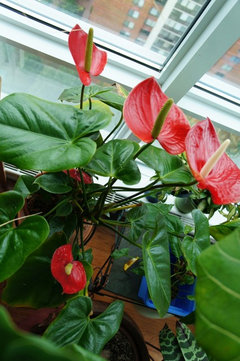
    oh, and here is the pic of mine blooming it's head off last fall - including the two baby offsets, if you can see.

    but it slows down in winter to only 2 flowers at a time, while in july it's 4-6 on top and ev leaf gets a flower. so more light in spring gets it going by june again.

  • 10 years ago

    russ, i just noticed your comment about rooting tropical hibiscus. I rooted within a month in perlite on heating mat. while before it sat in water with seaweed extract for 6 weeks doing practically nothing. I took cuttings of 'Snowqueen' (cooperi) in FL :).

    i am getting my first flower buds now...:))).

  • 10 years ago

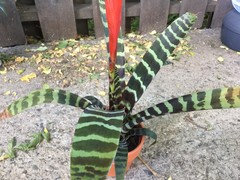
    Petrushka what is the spotted plant in the lower corner of photo?

  • 10 years ago

    you have sharp eyes :).

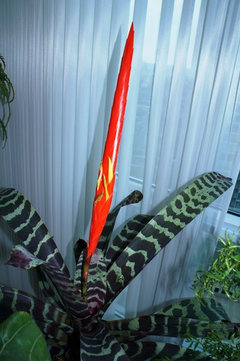
    it's a bromeliad, Vriesea splendens. It's a good brom for indoors - med sized and blooms in the same light as anthuriums. and very showy too. produces a pup that grows to size in 6mo and then another year to bloom. i am having my 2nd rebloom right now actually :). look see

  • 10 years ago

    Danielle, Petrushka's spotted plant looks like a bromeliad, if it is I'll be interested to see which one. Less common broms are getting more plentiful here in Home Depot and Lowe's.

    Petrushka, you're a wealth of info on anthuriums. The requirement for extra magnesium is good to know. I've never seen anths with names on them in BB stores, so may I ask where you found your Alabama? The only types here are the Andreacola hybrids with smaller leaves and small but more numerous blooms. They're supposedly more resistant to the usual anthurium diseases.

    On coco chips, is that pieces of coconut husks? Never seen that here. Like pumice only available locally on the west coast, this must be a product local to you but not generally elsewhere. Of course I haven't looked for it specifically.

    I've rooted double peach hibiscus cuttings in a crunchy medium in a plastic drink bottle. I sometimes put hibiscus cuts in water for a few hours prior to planting in a medium, but I wouldn't root hardwood cuts of any kind in water. I do know folks who root in water, but it's not my preference. I've seen Hibiscus cooperi only a few times in landscapes here, wish I had thought to get a cutting. The variegation is stunning but I didn't think much of the small red flowers. But I'm a foliage guy anyway.

    Thanks for the input and the pic!

    Russ


  • 10 years ago

    Petrushka, you posted the Vriesea pic while I was writing the above, beautiful brom! I don't know about splendens, but I've found Vriesea's a bit more humidity-needy than the usual Neos and Aechmeas. Splendens has been on the market for a very long time, so maybe it's the exception.

    Russ


  • 10 years ago
    last modified: 10 years ago

    well, as i have lotsa plants indoors and they are water-wicked in semi-hydro (i am in NYC), my humidity never drops below 65%, even in winter. But i got both of the above in Miami FL in winter when it was only 50% outside and they were doing splendidly ;).

    incidentally i have a few smallish neo's and aechmea - neo's are superslow with pups and both require sev hours of good strong sun to bloom. so vriesea is much easier to bloom for me. though i did bloom aechmea fasciata finally after 4 years, when i xferred it into my sunniest strongest west window .

    i got 'Alabama' at PHOE (palm hammock orchid estate in South Miami) - they get some shipments from apopka, but it's sporadic with bloomers. they have plenty of giant bird's nest anthuriums though. and Rhizo begonias are just stupendous...died and gone to begonia heaven type...;).

    yah, i was in transit, no supplies of any kind, couldn/t even find perlite in small pack - so had to keep all cuttings in water for a while for xfer. luckily we were driving back so it was not a problem. i cut hardwood tips on cooperi and then read that semi-green roots in water faster, so did 2nd cuttings before departure. i can't really fit reg tropical hibiscus in my crowded quarters, but i thought cooperi might be interesting to experiment with. the foliage is amazing just by itself. it's grown as short hedges in landscaping in south FL.

  • 10 years ago
    last modified: 10 years ago

    so fun!!

  • 10 years ago

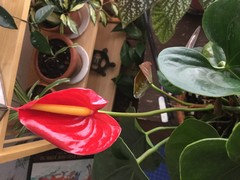
    Beautiful Danielle, the red color on these is so bright, like fingernail polish.

    Petrushka, I've never been to Palm Hammock but heard about their begonias. I used to have hundreds of them in San Antonio, some friends and I started the Alamo Branch of the ABS there some decades ago. I don't grow many anymore, I moved back home to Florida in 1993 and switched mostly to aroids.

    Yes, softwood cuttings are easier in water, did you get multiple cuttings to root in water? Also, did any of the hardwood cuttings root and survive?

    You're a good grower if you can maintain such nice plants in NYC.

    Russ

  • 10 years ago
    last modified: 10 years ago

    Hi folks, sorry I kept you waiting. I finally found the time to make buy new materials for the 5-1-1 mix and report my anthurium. Examining the nursery soil, it was 85% peat moss with random 1"-1.5" pieces of bark nuggets. Even though I bought the plant a month ago, the large and numerous (all white thankfully) roots were beginning to girdle the plant. They seem to have explored most of the soil inside. I decided to bare root the plant and in the process lost 1/6 of the roots trying to tease this mushy bizarre nursery mix off. The roots of the anthurium remind a lot of the ones in orchids. I tried my best to incorporate the 5-1-1 inside the roots so as not to leave air pockets that were too large. I'm not sure it was such a good idea to re-pot plant while it was blooming, unfortunately I feel I had no choice in the matter seeing as it was rootbound. I've inserted some 1/4" wooden dowels to monitor soil moisture. I only water when I'm able to cleanly remove the dowel from the soil and it doesn't feel moist - a tip I adopted from tapla. Seems to be a good way to prevent overwatering so far - even though that's quite hard to do with the 5-1-1 mix.


    Any suggestions on recovery tips? Should I give it a light dose of fertilizer?

    Thanks

  • 10 years ago
    last modified: 10 years ago

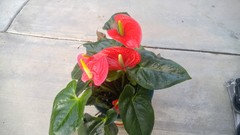
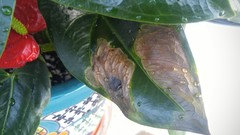
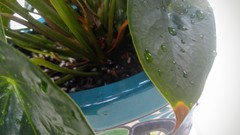
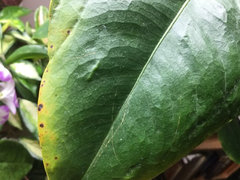
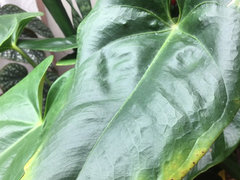
    Some photos after the repotting

    Is this leaf scorch caused by sun scald something else? Do you all keep them under grow lights or something? The sun here can be quite intense and unrelenting at times. I'm having trouble finding a suitable location for it indoors.

    Does this look like fertilizer burn or sunburn? I may have had a heavy hand in fertilizing one time or not diluting enough.

    Any comments are appreciated

  • 10 years ago
    last modified: 10 years ago

    Such a pretty plant. :) Did it come with the damage or happen after you had it for a time? Mine came with a bunch of damage like that. I think it was just damage from moving. It could be that or sun burn maybe.

  • 10 years ago
    last modified: 10 years ago

    Thanks! This anthurium has been putting out new leaves and blooms this past month, it is very satisfying to watch! I am positive the plant did not come with these blemishes. It was probably from the time I placed the plant near a patio glass door for some time...

  • 10 years ago

    don't feed it right away - wait for 2 weeks. you realize, that you will need to feed it constantly in 5-1-1? anthuriums prefer organic ferts in 1:2:2 ratio roughly, which is impossible to get. they won't bloom as much with too much nitrogen. so 3-1-2 is not advisable in bloom stage, only for young seedlings putting on leaves. and in weak concentrations at that.

    your plant looks so good, i dare say there was no need to repot it. they like to be pot bound - they grow in nooks of trees in debris - in very small amount of very loose decomposing substrate.

  • 10 years ago

    oh, and those big round spots - that is unavoidable by early spring...damp and chill at the roots...they really love roots at 75F and top temp at 85F...

  • 10 years ago
    last modified: 10 years ago

    petrushka

    I copied you! :)

    Stopped by Safeway to see if they had anything that I wanted. They had so much amazing stuff; But this one was the winner. Any pro tips to keep it alive? Do you know if the brown tips mean over watering or not enough humidity?

  • 10 years ago

    older leaves get like that, perhaps nothing to worry - keep it slightly moist, let the top inch or two dry out. i see it's in a clay pot - that's good , that will pull extra moisture out of the mix.

    mine is in jungle mix , approx smth like 1/3 perlite 1/3 medium-small bark or coco-chips and 1/3 soiles mix (cactus or african violet is good). they don't like to compeletly dry out - so not more then half-way anyway. It'll keep the spike for 2 mo, it'll start greening up. If you don't like it - you can cut it off. It'll produce a pup somewhere close to the middle, may be even in very center, as it's still holding the spike. very slowly the old-plant will decline (6 mo perhaps) and new will grow. it bloomes on 2nd yr given good conditions.

    I think it looks smashing with red anthuriums! good catch :)!

  • 10 years ago

    Thank you for the helpful info! :)

  • 10 years ago

    Nice. I'd love to try an Anthurium but I fear I'd kill it.

  • 10 years ago

    Surprisingly mine hasn't died and is still putting out new blooms every now and again. You should consider it. Over-watering and soil compaction are leading causes of death, that's why I think you should consider Al's 5-1-1 mix or as others have suggested orchid bark and peat-based potting soil in a 1:1 ratio.

  • 10 years ago

    Whats this 5-1-1 mix i keep seeing mentioned?

  • 10 years ago

    The orchid bark and peat mix in 1-1 is fine, maybe some coarse perlite too. I like orchid bark, large chunks of styrofoam or perlite, and charcoal plus some pine bark mulch and/or Miracle-Gro. The 5-1-1 stays too wet too long for me and it's rotted roots on anthuriums. It could be modified with more chunky stuff if one wanted to stay with it. IMHO, 5-1-1 is excellent for most kinds of trees, shrubs and landscape material, but it's not an all-purpose mix for everything.

    Russ

  • 10 years ago

    Can someone explain the 5-1-1 mix?

  • 10 years ago

    5 parts screened pine bark fines/mulch, 1 part peat moss, 1 part perlite, lime. Very good for trees and shrubs, Ficus benjamina and similar tropical trees do well in it. The bark breaks down slowly, so is a long-lasting mix.

    Heavy bark mixes have been used by wholesalers in Florida for landscape material for many, many years, probably because of it's availability, it drains well, and it's cheap.

    Here's a thread that explains it better. A little involved, over-thought and over-praised for my liking, and contentious in some places. But many are on the band-wagon and swear by this mix.

    http://forums2.gardenweb.com/discussions/1378483/taplas-5-1-1-container-mix-in-more-detail

  • 10 years ago
    last modified: 10 years ago

    My word 'heavy' above, regarding bark mixes in Florida, refers to the large proportion of bark rather than weight, as in 'heavy on the bark'. These mixes are actually fairly light.

  • 10 years ago

    Ah I avoid using peat but I get what you mean. I tend to use a general purpose potting compost and mix with vermiculite / grit in various ratios depending on the plant.

  • 10 years ago
    last modified: 10 years ago

    Many growers consider vermiculite to be too soft for use in mixes, it collapses over time and loses it's aggregate status. Unlike perlite, it also holds water which can be both good and bad.

    I started growing plants decades ago with soilless mixes developed by Cornell and University of Calif and championed in the 1960s by Elvin McDonald who wrote books about it's benefits. These were simple mixes of peat moss, perlite and/or vermiculite, they're still wonderful for growing tropicals and my favorites, aroids.

    I suppose you're familiar with the famous English soil mixes pioneered by scientists and John Innes in the 1930s, see below.

    John Innes Seed Compost

    This mix is used for sowing and cuttings until the seedlings are ready for pricking out or the cuttings have rooted. To mix your own (all ‘parts’ are by volume):

    2 parts by loose bulk medium sterilized loam
    1 part by loose bulk good peat or peat substitute
    1 part by loose bulk coarse sand

    To each 9-litre (2-gallon) bucket of the mixture add:
    10g (1/3oz) superphosphate
    5g (1 teaspoon) ground chalk

    John Innes Potting Composts

    a) Soil mix

    7 parts by loose volume medium sterilized loam
    3 parts by loose volume good peat or peat substitute
    2 parts by loose volume coarse sand

    b) Fertilizer mix (John Innes Base)

    2 parts by weight hoof and horn meal (or 2/3 of a part by weight Nitroform*)
    2 parts by weight superphosphate
    1 part by weight sulphate of potash

    John Innes Compost No 1

    This mix is used for short-term potting such as for bedding plants or vegetable transplants which will subsequently be planted out.

    To each 9-litre (2-gallon) bucket of soil mix add:
    28g (1oz) John Innes Base
    5g (1 teaspoon) ground chalk

    John Innes Compost No 2

    This mix is for plants, trees, shrubs and climbers, including fruit trees, bushes and vines, which are to remain in the pots for some considerable time.

    To each 9-litre (2-gallon) bucket of soil mix add:
    56g (2oz) John Innes Base
    10g (1/3oz) ground chalk

    John Innes Compost No 3

    No 3 Compost is for vigorously-growing plants such as tomatoes and chrysanthemums.

    To each 9-litre (2-gallon) bucket of soil mix add:
    84g (3oz) John Innes Base
    15g ground chalk

    John Innes Ericaceous Compost

    A recently developed product that is suitable for use with ericaceous or ‘lime-hating’ plants.

    Peat-based or peat-free media with ‘added John Innes’

    Adding John Innes potting media to soil-less media is sometimes done to improve buffering, trace element content and weight of these potting media. As John Innes potting media contain many fine particles gardeners should be wary of adding John Innes materials to other media as the ‘fines’ may fill or block the air spaces within the media that are vital for drainage and aeration of the root zone. This is no doubt taken into account by manufacturers of media that is labelled as having 'added John Innes' and formulations adjusted for adequate drainage and aeration.

    *Nitroform (urea formaldehyde) is available through the post from:

  • 10 years ago

    Yea I used to use john innes for my cacti and bonsai but we dont see it in shops anymore so I just make do with what I can get, general purpose potting compost mixed with either perlite or vermiculite, depending on what's available. I wasnt keen on the look of perlite in my plant pots as it comes to the surface and aggregates lime scale from the water. Plus it has to be sieved of perlite dust which if left in acts like clay when wet. Ill use perlite if the shop doesnt have vermiculite. I dont have a car and am unemployed at the moment, so I use what I can get.

  • 10 years ago

    Interesting that the Innes mixes aren't sold anymore in your area, I wonder if that's an England-wide situation. I guess the peat mixes have taken over the market. Many things from the past were much better than the new and supposedly better. If you have access to pine bark mulch, it is cheaper than peat moss and makes an okay soil mix with only a couple of additives. For me, pine bark mulch, perlite and small pea gravel in 1-1-1 is growing sansevierias and succulents as well as anything else I've used.

    Russ

  • 10 years ago
    last modified: 10 years ago

    No its still widely available in England, its just my town is a one horse town, and they shot the horse. And there's a been a move away from using peat for many years here for good reason.

  • 9 years ago
    last modified: 9 years ago

    Just thought I'd update, anthurium is doing well in this mix and I still get a few blooms, even though I only fertilize 1/4 strength once a month. Still dealing with low humidity issues, A/C usage makes it worse. The leaves have dry brown spots like in previous photos. Only solution it seems is to put it in some sort of greenhouse?

  • 9 years ago

    Lauren, I never tried it but in the 'old days' folks used to put plants on a big shallow tray with water in it to raise humidity levels around it. They put pebbles down to set the plant on and raise it above the water, but anything would work as well. They also used to spritz plants a few times a day but that's a lot of work for what little benefit it might do.

    What about growing it outside in the shade, is humidity higher there?

    Anyway, I'm glad it's doing well other than the humidity issue. Thanks for checking in.

    Russ

    Larry (Los Angeles, 10a, Sunset Zone 19) thanked Russ1023 (central Fla)
  • 9 years ago
    last modified: 9 years ago

    Russ or anyone: I believe I was over watering my anthurium. I have reduced watering and am letting the surface dry out checking with pencil. I had a touch of rot on some pf the leaf sheaths at base and discoloration on established leaves.

    Could this be a nutrient deficiency?

  • 9 years ago

    You check the tip of the pencil? I tend to use an unstained wooden dowel (3/16") sold at Lowes/HD and wait until all the soil media becomes pretty dry (easy to do with 5-1-1 or similar fast draining mixes). I check the moisture of the wooden dowel by placing it on underside of my wrist (the skin is more sensitive there).

  • 9 years ago

    Danielle, I checked posts above and I didn't see what you eventually potted this anthurium in. If you're letting the mix dry to an inch or two down, you're watering is okay. You'll get used to what it looks like after a particular number of days and you won't need a tool to check it.

    Do you think you're overwatering based only on the yellowing of leaf edges? I'm not very checked out on deficiencies, but I did look at a couple of websites on the subject and saw some pics with similar damage that's on your leaves. Have you fertilized this plant since you've had it?

    Russ

  • 9 years ago
    last modified: 9 years ago

    Thank you Russ! The leaf color and a bit of rot at base is what is scaring me. Yes I have been fertilizing it. I just changed my watering to 1 table spoon per gal water every time I water.

    That's a good idea I should google some pictures. It is potted half orchid mix half potting soil. I have some 5:1:1, orchid mix and moss left over. I might repot it the next time I water it. Or maybe just really let it dry down more.

  • 9 years ago

    Danielle, your mix sounds fine, I would leave it alone. But what is the 'potting soil' you mixed with the orchid mix? A peat mix like Miracle-Gro?

    It sounds like you just switched to fertilizing full strength with every watering, which is too much... but were you thinking blemishes were from deficiency? What strength were you watering with previously?

    The normal dose if you're going to fertilize with every watering is 1/4 of full strength.

    Russ

  • 9 years ago

    Any source on anthuriums preferring 1:2:2 fertilizer from organic sources?

  • 9 years ago

    I've never seen that ratio mentioned for anth's Lauren. I have seen 3:1:2 recommended by a Hawaiian commercial anthurium grower's website but organic wasn't mentioned. If you have some 1:2:2 or saw some that you're considering, I'd just give it a try. It does look like a bloom-promoting type with the lower nitrogen and I do like the idea of organic over synthetic.

    Russ

  • 9 years ago

    i have info from pro growers that states to feed young not yet flowering plants with 1:2:2 ration (usually 5-10-10 or 7-15-15 or 16-16-16) weekly. and switch to 1:2:1 for flowering.

    just make sure to give it a weak dose, but often. organic is good, as they grow naturally burried in loosed decaying matter - so they absorb weak 'compost soup' when it rains. and it rains daily ...


  • 9 years ago

    here's a post about 1:2:2 fertilizers.

    NPK 1:2:2 ratio

    i can see lots of 'fruit and veggie' ferts at kmart and on amazon too.

    there was a study done in 1995 measuring leaf content of nutrients. and they concluded that low N is better for flower production specifically for A. andreanum.

    Larry (Los Angeles, 10a, Sunset Zone 19) thanked petrushka (7b)
Sponsored
Buckeye Basements, Inc.
Average rating: 5 out of 5 stars40 Reviews
Central Ohio's Basement Finishing ExpertsBest Of Houzz '13-'21