Software
Houzz Logo Print
hzdeleted_32133126

Hello!

10 years ago

New to the forums, just wanted to say hello from Florida. I am a bromeliad collector, little bit of everything but mostly concentrate on billbergias and just started getting into some bill hybridizing/crossing.

Hope to make some new friends and learn some things along the way.

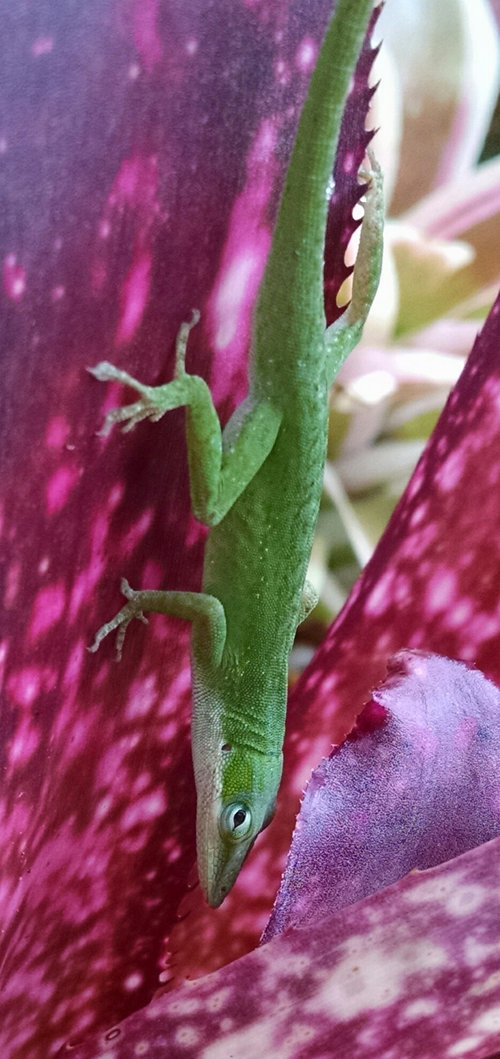
I'll leave you with a picture of a little guy who I've seen hanging around the garden for the past few days. Green anole on bill 'Teng EE'.

Comments (5)

  • 10 years ago

    Hi everyone.

    Thegardnergardener – Welcome to the forum; you’ve
    certainly come to the right place to discus and learn about bromeliads.

    I’m from Auastralia and I first came here several years
    ago and have learned so much since I joined and the more I learn the more I
    realise I’ve only just touched the tip of the iceberg.

    That’s a great looking lizard in your picture, fantastic
    colour; we have lots of skinks in our garden but unfortunately they are just
    light brown and nowhere near as spectacular looking as your specimen. It really
    doesn’t matter about the colour so much as the fact they are in your garden,
    because when these creatures come and visit, it’s a sign of a good healthy
    environment.

    You say, “just started getting into some bill
    hybridizing/crossing”; my advice to you would be to “beware” as I too started hybridizing
    a few years back, and when I started I
    was advised by a very well-known hybridist to “cull ruthlessly”, unfortunately
    I couldn’t bring myself to discard healthy little seedlings and consequently
    they became my downfall and almost took over the whole yard, so my advice to
    you is “cull ruthlessly”.

    That’s a nice looking Bill. ‘Teng Ee’ in your picture and
    as for hybridizing I think it could make a pretty decent parent as it is
    showing great colour and comes from very good stock with proven parents of Bill.
    ‘Afterglow’ and Bill. ‘Hallelujah’ both with several registered hybrids to
    their names (Afterglow 26, and Hallelujah 96) and hopefully it will pass on some
    of these good traits to its offspring.

    Anyway, keep in touch and keep sharing your pictures and
    progress reports on how your hybridizing is going and perhaps the method you
    use to sow your seed as there’s no doubt others here who would like to have a
    try as well.

    This is where it started for me; organized and under
    control


    This is where it advanced to, out of control and
    overcrowded – simply because I didn’t cull ruthlessly

    All the best, Nev.

  • 10 years ago

    Hey there Nev, thanks for the comments.

    Awesome picture of seedlings and to see what they turned into. Any specifics on advice you were given about selection and culling? How long do you give them before you start culling, do you wait till they flower? What do you look for to make the determination? I too think I will have a hard time getting rid of any seedlings as there will always be doubt in the back of my mind especially since I am a novice at this.

    Here is a pic of one batch of seedlings, pic is from a week or two ago.

    1 batch is bill 'casa blanca x pink champagne' and the other not pictured is 'casa blanca x (sangre x afterglow)'.

  • 10 years ago

    Hi everyone.

    Thegardnergardener – There are probably as many different
    answers to your questions as there are growers, as each one has their own method
    of culling.

    To help with answers to your questions I’m posting some
    info from a past forum discussion (No names) on this very subject and the answers
    are from five different growers ranging from beginners like myself to
    professional growers and hybridisers.

    The Forum Questions:

    1) At what size of the seedlings should I cull plants?

    2) How long (on average) does it take for seedlings eg. Neo.
    Kiwi Megan, Blushing Tiger to start showing their variegation, markings, etc.?

    3) Do all white seedlings stay white and need to be
    culled or do they get colour at a later stage?

    4) When do green seedlings start showing the variegation,
    etc.

    5) I am growing the seed in sealed plastic containers and
    have a lot of seedlings that are between 2 and 5cm tall and want to pot them up
    for the first time. What is the best way to harden them off, as I work during
    the day and can't open and close containers every couple of hours?

    6) Bearing in mind that I am trying to copy known and
    named plants, how do I make the decision on when not to cull a plant(s) that
    may be very different but nice looking?

    I apologize again if I am asking stupid questions, but I
    don't want to waste time and space on total duds. Now that the time is near to plant out
    seedlings, this can become a very real problem with wasting space.

    Any help in this regard would be appreciated!

    ANSWER 1:

    One thing I can tell you is that growing named Neos's
    from seed doesn’t really work. In your example N. Kiwi Megan, that is a
    variegated plant, mine didn’t self-pollinate so I assume the seed you’re
    growing has been pollinated by bees, ants etc. so those seedlings are hybrids.
    They won’t be variegated. That said, others that are selfers like N. Milagro won’t
    produce plants that look like Milagro. However selfers that are zonated will
    give you seedlings where the zonation varies.

    I only cull once I have seen some colour and make a
    decision from there.

    White seedlings will be curtains in no time.

    Green seedlings won’t show variegation... see posts on
    variegated seedlings further back in this section (hybridizing)

    Put your seedlings into community pots under shade cloth.
    2 -5cm is big enough

    If you happy with the outcome of the cross and the plants
    appeal to you then keep them, if you get a few really nice ones, nothing stops
    you from registering them.


    ANSWER 2

    Everyone will have different answers to your questions,
    and like what’s been said on previous posts, “there’s no such thing as silly
    questions”, and we all learn from the answers; and when you think you can’t
    learn any more, it’s time to give up as you’re having yourself on!

    There are many more knowledgeable people here than I who
    can comment on your questions, but I'll give my answers based on what I have
    found here in my own collection in Australia

    Answer to question
    1:

    Culling gets down to your own choice and how much space
    you have to grow plants on. I find that the longer you grow them on the more
    accurate your assessment of quality will be. Of course there will be obvious
    "duds" identified right from the start.

    Answer to question
    2:

    I find the time taken to identify colour varies greatly
    depending on the amount of fertilising you do. If you fertilise often to force
    seedlings to grow fast, it will often be at the expense of colour, and your
    seedlings’ foliage won’t give a true indication of the colour they are capable
    of and will remain mostly green, likewise the degree of light they are
    grown under will have a bearing as well.

    Answer to question
    3:

    White seedlings (albinos) will go brown and die very
    quickly so you won’t need to cull these as they will cull themselves.

    Answer to question
    4:

    I haven’t much experience with variegated types but I
    have found that most of my variegated seedlings have shown the variegation when
    quite tiny, although on one occasion I did have one that didn't show any
    variegation until it was about 3” high.

    Answer to question
    5:

    I grow my seedlings in sealed Take-Away plastic food
    containers with no drainage holes in the bottom. When plants almost reach the
    top of the container, I remove the lid, cut drainage holes in the bottom using
    an angle grinder and then relocate them to an area to harden off. Although it’s
    still a protected area, I stand these containers on a 30mm bed of damp Coco
    Peat in the bottom of a cut down polystyrene box. I find this creates the right
    humidity which seems to suit them. When they get to 3” high they are moved to
    the shade house and potted up individually (when I get around to it).

    Answer to question
    6:

    You can’t “copy” known and named plants by growing from
    seed, as each plant is unique. The most
    accepted way of doing this is by “tissue culture” and that’s a whole different
    ball game. When growing from seed, each seedling will be different genetically
    although some will look very similar, but once again the culling process is a
    matter of personal choice and if you’re like me you will find it hard to
    destroy healthy little plants just because they don’t meet your expectations,
    whatever they may be.

    ANSWER 3:

    You say, "My questions/problems relate to growing
    the named cultivars from seed."

    "Bearing in mind that I am trying to copy known and
    named plants."

    When you say that, do you mean that you just want to
    increase the amount of N Kiwi Megan, N Blushing Tiger plants you have for
    example by growing them from seed?

    You cannot do that.
    I mean, you can, but they will not be N Kiwi Megan or N Blushing Tiger
    anymore. They will be Blushing Tiger F2's (Second generation) and the whole
    seedling batch will look different from each other and from the mother
    plant.

    If you just want to produce more of the same plants: You will have to remove as many pups as you
    can from each plant or use tissue culture.

    ANSWER 4:

    I'm not sure how much I can add to what's already been
    said. You've gotten some good answers
    from all, but just to reinforce them, here's my take:

    Answer to question 1:

    There is no one-size-fits-all answer to when to
    cull. For me, it all depends on what I'm
    looking for. Different traits show up at
    different points in the process.

    Answer to question 2:

    Again, it depends on a) what type of traits you are
    talking about, and b) your growing conditions.
    I have year-round outdoor growing where I live, so assuming I have
    spotted the seedlings off into trays as soon as they have hardened off, and
    they are getting plenty of light and not being over-fertilized, I look for
    markings to show up between about 6 months to a year. With zonates, the best ones tend to show up
    fairly early on, but more subtle markings can improve with age. Marmorates may require a bit more time to
    evaluate.

    As has already been said, with hybrids, if your goal is
    to replicate the mother plant, seed is not the way to go. The only way to do that is by vegetative
    propagation, i.e. pups or tissue culture.
    You can grow species from seeds, but seed collected from a hybrid
    reshuffles the genetic deck. If you're
    lucky you might get something close to the original, but the more complex the
    parentage, the lower the odds.

    Variegation is in a different category from other
    markings. It is not genetic in origin,
    and as such cannot be reproduced by seed.
    It also isn't passed on through tissue culture. The only way to replicate a particular
    pattern of variegation is by pups. The
    leaf margins are the key to what to expect from seed-- a green margined plant
    will produce all green seedlings, and a white margined plant will give you all
    abinos..... at least 99% of the time.
    There is always the odd exception, but it's generally not something you
    can count on or control.

    Of course there are ways to breed for variegation, but
    that is better left for the advanced class.
    Suffice to say that it is an even more hit-or-miss process than regular
    hybridizing, even if you (mostly) know what you're doing. Many many variables involved.

    Answer to question 3:

    As several have said, albinos are self-culling. They usually drop off within a couple of
    weeks.

    Answer to question 4:

    If the green seedlings came from a green margined
    variegate like Kiwi Megan, don't expect any variegation to ever show up. It doesn't work that way.

    Answer to question 5:

    I'd have to see what sort of containers you're using and
    where you have them to give a good answer, but if there's a lid and you can
    prop the lid open to allow air circulation, I'd do it. You don't need to have them covered unless
    they are out in the rain.

    Answer to question 6:

    Hopefully by now we've eliminated the idea of copying
    named cultivars. That's probably not
    going to happen. Be sure that the name
    on your tag reflects that. What you have
    is either a generation of F2s (in the case of self-pollinators), or new hybrids
    (if some outside pollen got onto them).
    Blushing Tiger is a habitual selfer, so all of its seedlings will be BT
    F2. There might be some decent ones in
    there, and a few have already been named and registered. So far, however, I have yet to see one that
    has the mother's red cup at anthesis.
    That doesn't mean it couldn't happen, but it's a long shot.

    Naturally, if that blush is what you're going for, you'd
    have to grow them all the way to maturity to assess that. You can eliminate any with poor markings by
    the time they're half grown, however. If
    form is important to you, you can select for that when the seedlings are still
    very tiny. You should be able to pick
    out the ones with the widest leaves before you can see markings or coloration,
    although crowding, shading and heavy fertilization will make this a lot
    harder. There are usually degrees of
    vigor within a grex too, so if you see some that look sickly at any point in
    the process, it's probably better to cull them out. What makes it difficult is when the ones that
    are weak or sickly are the ones with the best color, form or markings. Unfortunately, this sort of thing happens all
    too often. How you address it is really
    an individual thing, and it will develop with experience.

    ANSWER 5:

    There is nothing more fun than collecting seed, sowing it
    and watching it germinate. However, the rest of the process is the long, boring
    and frustrating part.

    Growing species from seed is less frustrating since you
    can always just give them away, but those hybrids must be grown and culled and
    grown and culled and sometimes you start to wish you had never sown them in the
    first place.

    REPLY;

    Hi to all,

    Thank you very much for all the info and private messages
    regarding this. This has already helped
    me so much and once I have worked through all the info, I am sure that I will
    only improve in my attempts. It is a
    privilege to share your knowledge. I will post some photos of my seedlings in a
    month or two for comment. I still find
    it hard to cull a perfectly healthy plant even if it is a green job. Will have to be a lot more ruthless.

    I hope this information helps you more than it confuses you.

    All the best, Nev.


  • 10 years ago

    Thanks for taking the time to post that and passing along all that great info Nev.

  • 10 years ago

    Welcome, thegardenergardener. You will find nice folks here as Nev has already shown.

    Nev- great tutorial as always.

    tj

Sponsored
AIS Renovations
Average rating: 4.5 out of 5 stars15 Reviews
Custom Craftsmanship & Construction Solutions in Franklin County, Ohio