

KATYDIDS & CLENSEL
Hi everyone - I thought you may be interested in reading of my experiences with these Grasshopper pests and how I deal with them.
How many of us have been shocked to find
our favourite bromeliad with the beautiful leaves chewed or an inflorescence
bitten almost through and immediately though that the culprit was a
grasshopper, but no matter how thoroughly we searched we couldn’t find any
trace of the offender.
GRASSHOPPER
DAMAGE
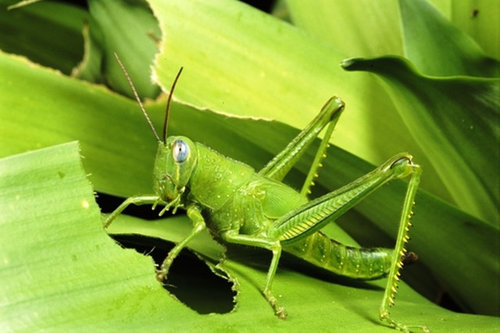
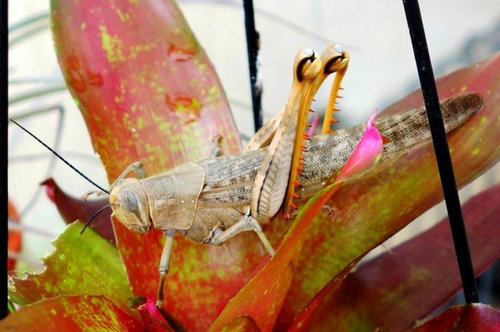
Grasshoppers come in various colours and
sizes but they all have one thing in common, they are all destructive! Once grasshoppers
find a nice source of food, they usually hang around until caught and killed,
and they’re not always easily seen as they hide beneath the leaves. The best
time to see them is when watering in early morning or late afternoon and this
is the best time to catch them also, as they seem to be very sluggish in their
movements during these cooler parts of the day, and as soon as the water comes
near them they try to get away from it and at this time they’re more
vulnerable, easily seen, caught and killed.
Sometimes no matter how much you search,
you never find the grasshopper which means they have either moved on to greener
pastures or possibly they weren’t the offending insect in the first place.
The culprit may well have been an insect
called a “Katydid” which are similar to grass hoppers and are just as
destructive, but they mostly do their work at night. So go and check over your
plants with a strong torch, but be warned, they are masters of camouflage, and
not easily seen such as the one in the picture below which looks like a leaf.
KATYDID
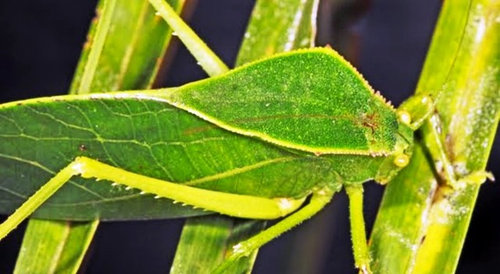
I haven’t seen any of these or grass
hoppers since I started using a product called “Clensel Insect & Mite
Killer Spray”, which I purchased from the sales table at our local bromeliad society monthly meetings. This product is a natural and efficient
garden pest controller and is an effective weapon against many common garden
pests such as aphids, spider mite, psyllids, mealybugs, green fly, white fly
and scale insects.
It is organically certified and has been
an effective natural controller of various garden insects and pests for over 25 years;
long before being “green and natural” was the “in thing”, and is a proven
product with an avid following. See: http://www.clensel.com.au/insect-mite-killer/
Clensel is not a poison; it contains Oil
of Citronella which is a plant based insect repellent with strong anti-fungal
properties. Unlike Pyrethrum based insect sprays, Clensel will not kill all
insects; especially beneficial garden insects needed for cross pollination such
as bees.
It’s safe for Indoor use, washes off
easily with water, has no withholding period nor is it harmful to the soil. It can
also be used on most plants and flowers, including fruit and vegetables. (For
your delicate plants, just use a more diluted solution)
Clensel does not contain Petroleum based
ingredients (such as Paraffin). It contains Potassium Oleate, which is obtained from
potassium salts and a mixture of natural fatty acids, which coats leaves in a
protective cell and being an ecological insecticide is ideal for usage in
glasshouses.
I don’t spray it on my plants as
recommended, but just occasionally spray around and under the pot rim and the pot
base. I also do this routinely each time I re-pot all plants and find it works effectively
and seems to keep insects away when used in this way. It’s most likely the repellent action of the Oil of Citronella in the insecticide that acts as a
deterrent, and since I started using it in this way five years ago I haven’t
seen any sort of chewing insects on my plants. Friends tell me it’s also very
effective when sprayed on the different types of scale, and as it isn’t
petroleum based like many pest oil sprays it should be well suited for use on
bromeliads.
Many growers are now becoming more aware
of the toxic effects of many commonly used insecticides, fungicides and
weedicides and the long term devastation they can cause to our environment and
I think Clensel can be used with confidence as a suitable natural alternative
in the control of many common insect pests.
I hope the above information may help other growers to control these destructive chewing insects in a way which is less harmful to the environment.
All the best, Nev.
Comment

Related Professionals
Quincy Landscape Architects & Landscape Designers · Lancaster Landscape Architects & Landscape Designers · Provo Landscape Architects & Landscape Designers · Tuscaloosa Landscape Contractors · Fort Smith Landscape Contractors · Crestview Landscape Contractors · Morgan City Landscape Contractors · Harrisonburg Landscape Contractors · Brainerd Landscape Contractors · Jamestown Landscape Contractors · Carson City Landscape Contractors · Middletown Architects & Building Designers · Hartford Architects & Building Designers · Toledo Architects & Building Designers · Edmonton Architects & Building Designers