Software
Houzz Logo Print
johnsfine

Trying to grow ferns

10 years ago
last modified: 10 years ago
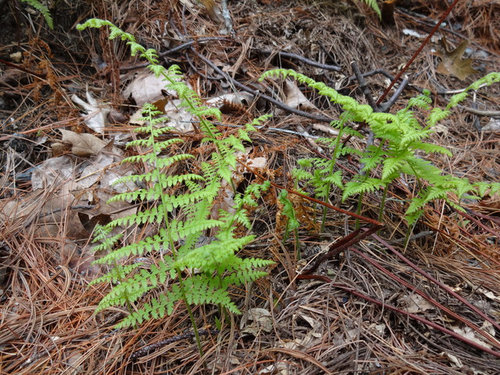
I'm trying to grow ferns, transplanted from elsewhere on my property on a steep sloop shaded about half the day. I tried transplanting clumps of ferns many times (over a few years) into this area and weeded and watered. Several of the clumps came back weaker each spring than the year before. The rest died more quickly. But elsewhere on my property similar ferns do well without help under a range of conditions.

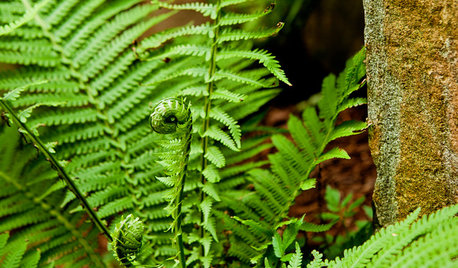
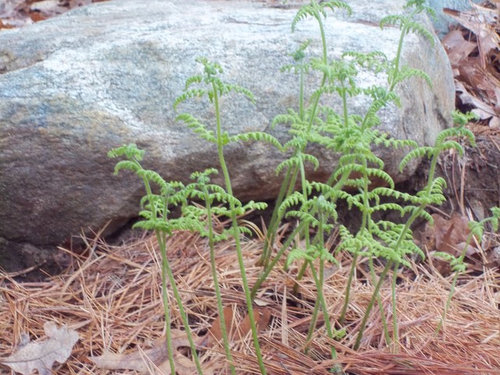
First photo, one of the (then) best clumps two years ago, a year after it was transplanted.


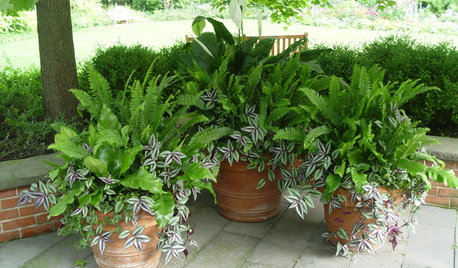
Second photo is a clump I transplanted two days ago.

These are far more advanced than any of the ones transplanted in prior years (very few of those have started yet at all this year and those barely started).

They don't now look to me like the same variety of fern, though last year I thought they were.

What type(s) of fern are these? What can I do to encourage them where I want them.

Last summer, the strongest by a wide margin clump of ferns on my property was in a depression that since the prior fall had been filled and heaping mounded with packed wet leaves. I was amazed any plants could punch through that depth of debris, but then I guessed it must somehow help the ferns, so I left a couple inches of wet leaves over the winter where I want to encourage the ferns. That idea seems to have proven a failure. BTW, that strongest clump had slightly more water naturally and slightly less sun than the area I'm trying to encourage. The second strongest clump last summer was on the nearly vertical side of a giant pile of pine needles that had been there several years. That spot got very little water and nearly zero sun and has essentially no soil other than decomposed pine needles. I was worried that where I want ferns is too steep. But that spot was steeper.

Third best clump last summer and the one really fast early start this spring was that clump I just transplanted (looked a lot better before I transplanted it). It was under a gutter-less roof edge so it got 10 time more water each storm than other places. It got about half day sun there as the new location does. There was an inch of gravel with 2 inches of dirt below it and 2 more inches of gravel below that. The ferns pushed through the top inch of gravel, which was enough to block most plants. The roots did not appear to extend into the lower gravel. I picked off the top gravel stone by stone, slid a metal sheet as carefully as I could between the dirt and the lower gravel and moved the dirt and ferns to the new location. Then I covered with pine needles to keep the dirt from drying in the sun. (Under that transplanted dirt layer is a very loose mixture of leaves and dirt).

The range of conditions on my property in which ferns thrive is wide enough they don't seem to be picky about anything I understand. But they must be picky about something I don't understand.

Comments (12)

  • 10 years ago

    Ferns are usually fairly shallow rooted and are quite particular about where they will grow. It can be difficult to second guess what will please them when you want them in the ground. I've lost many that I planted where "they would look really nice" and, in my mind, conditions would be good. But the ferns didn't think so. Then I have some that are real die-hard types that just take over. It all revolves around which species you want. So, I can offer you a lot of empathy, but unfortunately not much wisdom.

  • 10 years ago
    last modified: 10 years ago
    Most ferns (not all) don't like wet feet either..they grow naturally in very shallow gritty soil. So...if you transplant them to "good" soil..they're quite unhappy. I would venture to say this is true of the species shown.

    They're colonists (many of them) moving in after lichens and mosses have decomposed enough to create a thin soil.

  • 10 years ago

    I forgot to mention Eastern Massachusetts in my first post. That may help with ID'ing the fern and with advice on growing it.

    When we bought the house, there was a thick tall patch of ferns forming a circle about 5 foot diameter in a small depression (where some old tree roots implied a big stump had been removed) in the part of the yard that gets the most sun (about 75% of the day). I understand ferns prefer shade. That patch was so thick any new fronds were totally shaded by the others until reaching full height (too much shade) while the tops of tall ones got too much sun. But that patch was healthy for many years (and I thought beautiful) before my wife told a landscape contractor to rip it out. The ferns in the first picture and almost all the ferns around the property are very clearly the type of that original patch and very likely descended from what the contractor spilled when ripping it out. Those never did as well as that original patch but did well enough in such variety of soil, shade, water etc. conditions that I can't guess what they might be picky about.

    I still would like to know the name of that variety and if the clump I just transplanted was a different variety, its name. Last year, I really thought the clump I just transplanted looked the same as the rest. Does it look totally different now as a result of environmental factors of getting an earlier start in the spring and getting 10 times as much water and growing primarily in gravel? Or was I confused last year and it is a different variety that may depend on getting flooded in each rain but then drained well.

    I see the dbarron comment about ferns not liking "good" soil. But the best patch last summer seems to be a contradiction to that: In 2014, tall weeds that we're allergic to sprang up in the rich soil in a big depression where a giant tree had uprooted itself years before. Fall 2014, I filled that area with a mound of heavy wet leaves, thinking it would be too thick for any plant to punch through in the spring. But spring 2015, the ferns and some weeds punched through even though the thick layer of leaves remained. I'm pretty sure (from results of other leaf piles) that a thick layer of wet leaves on bare dirt under the snow all winter causes a lot of worm activity mixing organic material into the soil and leaves the soil loose and rich by spring. That must have been the soil conditions under the remaining leaf pack where those ferns did so well.

  • 10 years ago

    Looks to me like hay scented fern, Dennstaedtia punctilobula. Look that up and see if it matches. A common species, has a spreading underground stem so it does not form tidy clumps like, for instance, ostrich fern. I usually see it in rather open woodlands, not in deep shade, and in comparatively dry settings. Not in wetlands. It can form big colonies, covering whole hillsides in time. For all that, it's kind of fragile when you try to transplant it.

  • 10 years ago

    I looked at several pages showing Dennstaedtia punctilobula. Most show the same overall shape as the fern in my first picture above (with enough consistency to imply the fern in my second picture is a different variety). Most of those pages don't have any picture with enough detail to distinguish from the several other varieties with similar overall shape.

    But I found the following page, which does have high detail photos and they do not look to me like they could be the same type of fern I have. Of course I'm not certain that page with more detailed photos is an accurately classified fern.

    www.illinoiswildflowers.info/grasses/plants/hay_fern.htm 


  • 10 years ago
    last modified: 10 years ago

    In my experience, the fronds of transplanted ferns don't develop further. At best, they stay green for weeks, hopefully feeding the roots and later new fronds emerge. More often, the original fronds turn brown quickly. If those develop, I'll post a picture. But I doubt they will. Also, this time I transplanted the entire patch of ferns from the source location (bigger than was visible in that picture, because the rest look a lot worse after transplant). In previous years (transplanting from other locations) I split off a more manageable chunk to transplant and could then compare the rapid growth of the remainder in the source location to the poor performance of the transplanted bunch. Anyway, that means I can't take an identification photo of more developed fronds in the source location (and I have no photo of them as they looked last year).

    A recent closeup of the barely emerged fiddle heads in the same spot as my first picture above clearly shows the stems are hairy. Are you saying that distinguishes them from other varieties? Or only if they are still hairy when further developed?

    In past searches, I thought my ferns looked most like this one:

    https://en.wikipedia.org/wiki/Thelypteris_noveboracensis

    What details ought I to check to see whether that ID fits better or worse than your suggestion? Consider this phrase from that link "It is distinctive by its pinnae tapering to the base of the frond". I don't know what that means. I see a lot of photos online of ferns in which the largest pinnae are near the middle of the blade. The ferns I have most of (all the earlier transplants and maybe the recent one) large blades have the largest pinnae second or third from the bottom of the blade with the one or two below them only a tiny bit smaller with many smaller ones above them tapering down to much smaller. Is one or both of those what "tapering to the base" means? Would not tapering to the base mean the largest pinnae are lowest?

    Edit: Now I'm pretty sure you're correct. I found this comparison:

    http://www.mlbs.virginia.edu/organism/telypteris_noveboracensis_dennstaedtia_punctilobula

    If that page is correct, I can rule out New York fern and add more support for Hay Scented. Most of the many pictures I found online of "New York fern" seem to have the biggest pinnae 2'nd or 3'rd from the bottom as my ferns do. But the above link seems to imply more expertise in contradicting that shape, so either those online pictures were mis-identified or I'm misunderstanding perspective in them.

  • 10 years ago

    It's hard to judge the shape of a fern blade (that's the leafy part of the frond) in a picture of the living fern. You need a picture of a frond that has been picked and flattened out if you want to study it. You probably have about seventy species of ferns in Massachusetts. Some will be very rare. Some will not even look like ferns. Some will be both common and confusing. Identify by size, habitat (wet or dry), evergreen or deciduous, shape of the blade, shape and "cut" of the individual pinnae, habit of growth (sprawling or rosette-forming), location of spore-bearing pinnae (some ferns, like cinnamon fern, bear their spores on a separate stalk), surface of the pinnae and/or the stem (smooth, scaly, hairy, or scaly and hairy), plus individual field marks that you pick up if you work with them for a while. There are field guides, but I don't know what's out there these days. Been a while since I bought one. You might be able to find keys and pictures on line that will be helpful.


  • 9 years ago

    Cut: I'm pretty sure this is called "thrice cut": 1'st cut: The pinna connect individually to the rachis, 2'nd cut, the pinnules connect individually to the vein of the pinna. 3'rd cut, the more developed lobes are almost completely separated at the vein of the pinnule. 4'th (not called a cut) the more developed lobes are cut part way into ?? sub lobes ?? but never cut all the way to the vein of the lobe. 5'th (not called a cut) in the largest lobes the vein in each sub lobe branches and the outer edge of the sub lobe is rippled (reaches further out at the tip of the vein) starting a fifth level of cut.

    In the area where the transplants from 3 or 4 years ago are almost completely failing (and many fiddleheads of ferns transplanted 2 years ago similarly fail) the common failure is that the stem shrivels up starting somewhere underground, while the small blade above still looks healthy. Once the shriveled part extends up a small fraction of an inch above the ground, the frond falls over. The failing plant still sends up new fiddleheads, most of which similarly fail. So I assume the rhizome hasn't died first, but most fronds fail starting somewhere above the rhizome but below the ground. Does that give a clue of too much or too little water or specific pests or missing nutrients? This fern type does so well in enough variety of moisture, sun, organic content, slope, and other factors elsewhere on my property, that it can't be very picky. The ones I transplanted this spring look surprisingly healthy. The ones transplanted a year ago, not much worse. This seems opposite the usual transplant behavior (most of my transplants of other perennials fail to appear the next spring. Those that return well are established and should do better the next year.

    I'm convinced the correct ID is hay scented fern, despite atlamol's comment. In answer to some of that:

    size: I haven't measured the largest. Most are under 2 feet. I think the largest are over 3 feet.

    habitat (wet or dry): Grew very well in the wettest spot (runoff from a roof) but also in much drier spots. None of my property holds puddles for long after a rain, so wet means wet underground not surface.

    deciduous

    shape of the blade: Very little tapper at the bottom (largest pair of pinna are second or third from the bottom). Gradual tapper to the tip. Pairs of pinna just miss being directly opposed on the rachis at the bottom, with the relative offset increasing higher up to a 50/50 alternation near the top.

    habit of growth: haphazard. definitely not in a line as sites have described (but not shown photos) for some ferns and definitely not an organized cluster (pictures that I think connect to the word rosette).

    Spores I haven't figured out yet (I may not know what to look for).

    Hairy, not scaly.


  • 9 years ago

    Hoho! You are really getting into this. Well, as I said back on May 6, hay-scented Fern is kind of fragile when you try to transplant it. Your experience is similar to mine, but I just gave up on trying to transplant the species. The sporangia (patches of spore bearing tissue) on hay-scented fern are almost on the edges of the pinnae, not on the flat lower surface. When you see them you'll know what I mean. Very distinctive.

  • 9 years ago
    last modified: 9 years ago

    We move ferns from our woods into our landscaped areas once in a while and they never seem to thrive after being moved. Once in a while one will appear a couple of years after the fact and surprise me but by and large they just never take the move well.

    I've had far better luck just buying something and planting it- those always seem to do really well.

    It's a mystery!

  • 9 years ago
    last modified: 9 years ago

    I understand ordinary transplant failures: The plant gets steadily worse after transplanting and dies. I've had lots of those with these ferns. I understand the transplant failures where a spring transplant seems to do OK all summer but never reappears the next spring. Had some of those with these ferns. But the ones that do reappear the next spring seem to get stronger during the next summer, yet they reappear weaker the spring after that and weaker again each spring after that. Those are the ones that make me feel I'm missing some key factor.

    I don't want to fix (or even measure) the acid soil on my property. My wife has purchased various plants from nurseries (including asking to be shown only acid resistant plants) and those don't have a better track record than plants I simply moved around on the property (but they cost more). I keep expecting plants that thrive where they aren't wanted on my property should do OK moved to where I do want them. That isn't proving true, but at least they cost less.

Sponsored