Software
Houzz Logo Print
vitorama

What potting medium do you use?

10 years ago

I've read many of your posts, current and previous, and I'm reading comments that some are using a potting mix including pumice(?!) and other things I've never thought to use. I've always used straight up Miracle-gro potting soil. What kind of mix does everyone use? Please be as specific as you can. Thanks!

Comments (24)

  • 10 years ago

    I use a potting mix (whatever I have on hand) cut with 50% pumice - which is plentiful in California, plus a teaspoon of granulated sulfur. And if I had some time release fert, I'd include that too.

    vitorama thanked NextObsession?
  • 10 years ago

    Ditto akrrm. I don't remember who recommended that, but it was someone here on GW.

    vitorama thanked Katrina
  • 10 years ago

    I just came across this thread Container Gardening Soil by someone who knows. I haven't had a chance to read it yet but thought it may shed some light here.

    vitorama thanked NextObsession?
  • 10 years ago

    I'm reading it and now understand why the cactus people sieve their mix components (to get rid of the fine particles and dust).

  • 10 years ago

    I read most of the article. I found it to be a bit verbose but informative nonetheless. Thank you for posting it NextO

  • 10 years ago

    This is interesting as well:

    "As to your question, it is possible to pot a tree in pure pumice. I do it all the time. It is one of the prime techniques for getting a weak pine strong again in Japan, for instance—they nest the old rootball in pure pumice. You can get crazy root growth and a very strong tree.
    It is one of the only particles that is a water retaining drainage material, and does not hold too much water, like Turface. As far as I’ve been able to tell, it’s fairly unique. (There are some iron-bearing skoria particles that are very light and are essentially pumice. The heavier ones I avoid.)

    So, yes, you can use entirely pumice. Bear two things in mind— it should be layered in the pot from large to small on the top, and putting orchid moss/sphagnum moss on top is necessary to prevent too rapid drying of the top in the summer. (this is, incidentally, typical technique in Japan for mixes with pumice and akadama). And secondly, you may be watering a bit more than you’re used to.

    I’m glad to hear Ryan is promoting pumice as well. I think we’ve been seeing the same things. And yes, consistency in the particle size is essential—if you do any chopsticking at all, to settle the soil around the roots, particles of different size will stratify exactly opposite what you want for drainage/drying: big on top, small on the bottom. So, yes, definitely sift your pumice to several sizes. The big stuff can be useful on the bottom for your pines and whatnot, the 1/2″ size, and the smaller stuff of about 1/8″ on the top. But sphagnum mixed with perhaps the top layer is not a bad idea. I shred the sphagnum over a big screen and apply it last. So I don’t mix it in as Colin does but I can see the possibility."


    Article & comments

  • 10 years ago

    Is pumice like the lava rock you can buy at HD for your bbq? I know that is a dumb question, but I can't recall seeing pumice for sale as a potting medium in NJ.

  • 10 years ago

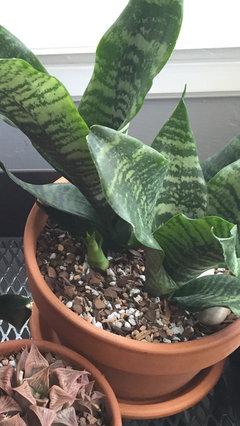
    I'm trying out Al's gritty mix for my small collection. I've been known to overwater and kill plants so I'm hoping this helps. It's been about a month and so far so good. The water runs right thru the pot. I didn't mix it myself but purchased a box from an etsy seller to try out first. (Don't mind the sad, sunburnt hawthornia in the corner).

    vitorama thanked Jen S (SoCal z10a)
  • 10 years ago

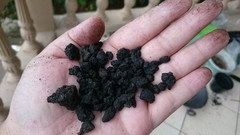
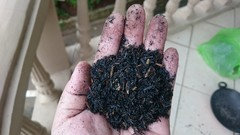
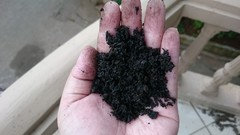
    At the moment my potting mix consists of sand (well, here it is called sand but really small sized dark colored volcanic rocks, very porous similar to pumice), rice husk (either raw or charred/charcoal), and compost (made from manure). The ratio is adjusted to the type of plants. For example, for succulents it's roughly 10:2:1 (rock:husk:compost), while for other plants that would do better in regular garden soil, I'll increase the ratio of the rice husk and compost.

    This is the sand: (please excuse the dirty hand :p)

    The rice husk:

    And the compost (well, this one is not pure compost, it's come premixed with rice husk charcoal):


  • 10 years ago

    Pumice is a pale gray color, it's on the west coast and not readily available to you except for the product for horses, Dry Stall - from what I gathered after reading all the comments.

    Good idea Jen, I have decided to slowly convert all my succulents to gritty mix too.

    vitorama thanked NextObsession?
  • 10 years ago
    last modified: 10 years ago

    If you can't find pumice, perlite is an adequate substitute and much easier to find in the eastern states. It also weighs a lot less.

    BTW I usually use a 50/50 mix of potting soil and perlite. I will probably have to find something a bit heavier because it rains all the time here but for now this is my default go to mix.

    vitorama thanked Mentha (East TN, Zone 6B-7A)
  • 10 years ago

    I lucked out today - open 40# bags of pumice $4 off because they're broken bags. I got some mini-bark too. Not sure what or if I need a third component - still researching. I suppose the important thing is sifting out all the dust and bits to end up with a uniform particle size. The local Korean supermarket had lots of baskets & collanders - I got one for $2 for rinsing. Here goes....

  • 10 years ago

    If you are going for the gritty mix, the third ingredient is Turface, a calcined clay used on baseball fields. If you're in CA try Ewing Irrigation.

  • 10 years ago

    I have a lot of my sans in some sort of aggregate medium. I was trying to omit any organic fraction for a while, but except for the super drainage ones, they grow out of their pots so fast it doesn't matter if there is an organic fraction or not.

    I just repotted an S. elliptica hybrid today. It was trying to run away.


    vitorama thanked Nil13 usda:10a sunset:21 LA,CA (Mount Wash.)
  • 10 years ago

    Beautiful plant Nil13!

  • 10 years ago
    last modified: 10 years ago

    Thanks, it just started really taking off last year and each pup just keeps getting bigger. The biggest rosette (the one with the 'foot') is 32" from tip to tip.

    vitorama thanked Nil13 usda:10a sunset:21 LA,CA (Mount Wash.)
  • 10 years ago

    Thank you, I sorted out that pumice is a substitute for Turface (or Napa 8822) so the 3rd component would be chicken grit or crushed granite #5 - I've got 2 building/landscape suppliers near me, I'm pretty sure my cheapest route is with crushed granite. Pumice (and the mini bark) hold water, if I add another water absorbent component it will hold even more water - not sure if that's best with Sans. Are you using Foliage Pro? How do you like it and how often to you feed and water compared to whatever you used before gritty mix?

    Beautiful growth on that X elliptica - 32" is impressive!

  • 10 years ago
    last modified: 10 years ago

    Pumice is definitely not a substitute for Turface. The water retention curves aren't even remotely comparable. It is a substitute for the grit, just one that holds a bit more water and has a lot less bulk density. You could also use lava rock (AKA cinder or scoria holds a little less water and has more bulk density than pumice) for the grit. The formula doesn't really matter it's the philosophy of using aggregate particles that matters. You can mix them in whatever proportions suit your needs. I have some really tall and huge Aeoniums. The only way I can keep them from falling over is if I have a medium with a huge bulk density. So I use 3 parts pea gravel : 1 part Turface. Works great. I had an S. 'Moonshine' in 3 parts pumice : 1 part Turface for a while until it crawled out of the pot. Once you get the feels for the ingredients you can make your mix do whatever you need.

    I don't use FP. I use nutricote CRF and a Grow-More (they are local and inexpensive) water soluble.

  • 10 years ago
    last modified: 10 years ago

    Also, yes bark holds water and quite a bit of it. It's still has a lot of airspace though and that's very important. Bark's problem is decomposition. As it breaks down it fills in air space. Turface (or calcined diatomaceous earth like UltraSorb) holds a ridiculous amount of water but it's inside it. It's not really a wet surface in the pot that is conducive to rot. Pumice with like 10% organic matter is used by the Huntington for cacti. So you can image pumice drains really well and doesn't hold a lot of water. Replace the organic matter in that recipe with Turface and you have a great cactus soil that will never break down.

  • 10 years ago

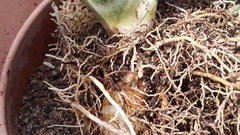
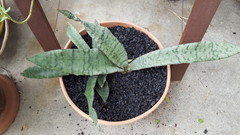
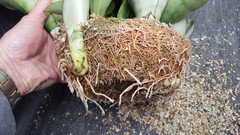
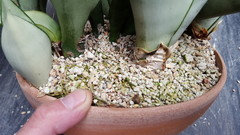
    Here is a S. 'Moonshine' grown in 3 pumice : 1 turface with a fairly high spray irrigation regiment (80% et0 winter SoCal). There's a ton of rust but there's also algae on the pumice.


    vitorama thanked Nil13 usda:10a sunset:21 LA,CA (Mount Wash.)
  • 10 years ago

    Now that's a rootball! You have all been very inspirational!

  • 10 years ago
    last modified: 10 years ago

    How long has it been in the turface/pumice? How long did it take to fill the pot? I must be reading it wrong Turface is calcined clay not DE.

  • 10 years ago

    It was in there for probably 9 months.


    Yes turface is calcined clay. You can substitute DE for it. DE (axis) is probably better but getting it in bulk but less than a truckload has been difficult.

Sponsored
Peabody Landscape Group
Average rating: 3.5 out of 5 stars8 Reviews
Columbus' Reliable Landscape Design & Contracting