Software
Houzz Logo Print
ianbeatty

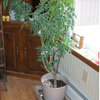
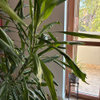
Schefflera cuttings

10 years ago

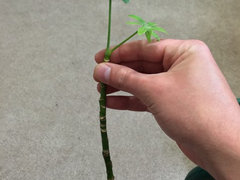
Was wondering what people's thoughts were on the best way to root them and how long might one expect to wait before the first sign on roots appear? The cuttings were taken roughly ten days ago and have been in soil for about five

Comments (21)

  • 10 years ago

    Which do you think grows roots faster,, rooting in water or just shoving into the soil

  • 10 years ago

    Jz,

    i would have cut a lot of the foliage off of that. It's a real strain on the plant having to deal with that many leaves without a root system. Usually 2/3 petioles with their leaves would be ideal.

  • 10 years ago
    last modified: 10 years ago

    Someone deleted their comment. The following was a response to that.

    You should cut some leaves off. It'll give the cutting a much better chance. As I said, that's a lot of foliage to support with no roots.

    Sure, anything can happen, but your rate of success with go up if the plant has less folliage to support.

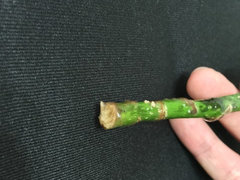
    One root starting from the bottom.

  • 10 years ago
    last modified: 10 years ago

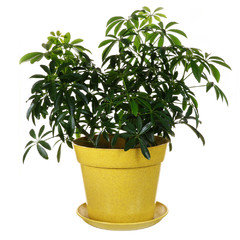
    Dave, is that the cutting you brought back from Florida (I'm thinking of a different photo of a bunch together that you posted in another thread)? I've never seen one with so much white on the leaves -- it's lovely. Is that a result of being in good sun (outdoors, in Florida)? I've only grown them indoors, and while I've had some nice variegation, it hasn't been that pronounced. Just curious.

    Thanks for the good advice about trimming back leaves to reduce the burden on the cutting, which is struggling to both support leaves (with no roots) and make new roots at the same time. Makes a lot of sense to me.

  • 10 years ago

    It is one of the Florida cuttings! The white on the leaf isn't from sun, it's verieagted, but I guess it just doesn't know how to properly do it haha.

    The plant I took it from had some all green leaves, all white leaves and some that were variegated.

  • 10 years ago

    That's very interesting. Maybe it's just the way that specific plant variegates, or maybe it's the good light. I know with some plants, the better the light, the stronger the variegation. Either way, it's beautiful -- almost all-white with just a border of dark green. I'm sure it will do great at your place, too. I'd love to see pictures further down the road!

  • 10 years ago

    Dave, thanks for the advice. I'll try it with my next cutting. The one showed above was already given to a friend. This young schefflera is growing extremely fast!

  • 10 years ago

    Though
    roots form readily and often seemingly more quickly on many plants
    propagated in water, the roots produced are quite different from
    those produced in a soil-like or highly aerated medium (perlite -
    screened Turface - calcined DE - seed starting mix, e.g.).
    Physiologically, you will find these roots to be much more brittle
    than normal roots due to a much higher percentage of aerenchyma (a
    tissue with a greater percentage of intercellular air spaces than
    normal parenchyma).


    Aerenchyma
    tissue is filled with airy compartments. It usually forms in already
    rooted plants as a result of highly selective cell death and
    dissolution in the root cortex in response to hypoxic conditions in
    the rhizosphere (root zone). There are 2 types of aerenchymous
    tissue. One type is formed by cell differentiation and subsequent
    collapse, and the other type is formed by cell separation without
    collapse ( as in water-rooted plants). In both cases, the long
    continuous air spaces allow diffusion of oxygen (and probably
    ethylene) from shoots to roots that would normally be unavailable to
    plants with roots growing in hypoxic media. In fresh cuttings placed
    in water, aerenchymous tissue forms due to the same hypoxic
    conditions w/o cell death & dissolution.

    Note
    too, that under hypoxic (airless - low O2 levels) conditions,
    ethylene is necessary for aerenchyma to form. This parallels the fact
    that low oxygen concentrations, as found in water rooting, generally
    stimulate trees (I'm a tree guy) and other plants to produce
    ethylene. For a long while it was believed that high levels of
    ethylene stimulate adventitious root formation, but lots of recent
    research proves the reverse to be true. Under hypoxic conditions,
    like submergence in water, ethylene actually slows down adventitious
    root formation and elongation.


    If
    you wish to eventually plant your rooted cuttings in soil, it is
    probably best not to root them in water because of the frequent
    difficulty in transplanting them to soil. The brittle "water-formed”
    roots often break during transplant & those that don't break are
    very poor at water absorption and often die. The effect is equivalent
    to beginning the cutting process over again with a cutting in which
    vitality has likely been reduced.

    If
    you do a side by side comparison of cuttings rooted in water &
    cuttings rooted in soil, the cuttings in soil will always (for an
    extremely high percentage of plants) have a leg up in development on
    those moved from water to a soil medium for the reasons outlined
    above.


    Al

    mr. white (6a) thanked tapla (mid-Michigan, USDA z5b-6a)
  • 10 years ago
    last modified: 10 years ago

    Al, super helpful and informative, as always. I learn so much from your posts. Actually, I learn more from your posts than from any other site or page online. Thanks for taking the time to share your prodigious knowledge.

    Real life being what it is, I can't always achieve those ideal conditions (the optimal growing medium, light levels, etc.) but it's still helpful to know what that ideal is, and why.

    N

  • 10 years ago

    Al,

    I've never had luck rooting in anything but water. I've tried rooting hormone too. I'm not sure what the issue was.

    I always water root (I know there are better methods) only because it's worked for me.

  • 10 years ago

    Ty for answering my question Al.

  • 10 years ago

    My pleasure.


    Al

  • 10 years ago

    Al, they are in plain old Fafard soil now but I have various mediums laying around, is there something they would prefer other than the soil?

  • 10 years ago

    Scheffs LOVE a medium that holds little or no perched water. They like a soil you can keep damp or moist, and don't revolt if the soil dries down to a rather dry state - at least not until the soil is almost completely dry. It's better to avoid drought stress, but given the choice between too dry or too wet, too dry will be much less limiting until the point where the plant starts to shed leaves ...... and it is rather reluctant to do that.

    The old Fafard mixes used to be much coarser than they are now since Sun Gro acquired Fafard. The nursery mix is about the best, and even that could use a large fraction of added perlite (3 parts nursery mix:1 part perlite). If you can find a source of pine bark in an appropriate size range, you can make your own and have no reason to ever look back. I started making my own soils about 25 years ago and haven't used a soil prepared by anyone else since. The difference is like night & day.

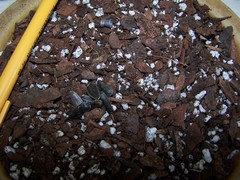
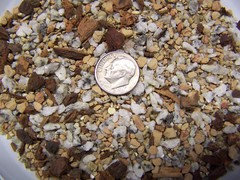
    What I use:


    Al


    mr. white (6a) thanked tapla (mid-Michigan, USDA z5b-6a)
  • 10 years ago

    Al, I use your Gritty mix or a close facsimile there of for the majority of my cacti and succulents ( except lithops and split rocks) and they seem quite happy. For the a few I use Bonsai soil I had , but that dries out quicker...they seem Happy, I'm sure once I get the watering down they will be happier. I'm just starting to spread out into house plants( other than my pothos) and a few small trees so the learning begins again, I'm assuming the mix in the first picture is your 5.1.1. ? Forgive if I've messed up the numbers, quite tired at the moment. The nursery I've started going to has a good variety of barks so that will be easy to get and mix it all up

  • 10 years ago

    Yes - the top pic is 5:1:1.

    I stopped at a nursery today to look at a tree I've been thinking about for the landscape. On leaving, I strolled past the bark & mulch and found probably the most perfect bark I've come across for the 5:1:1 or screening for use in the gritty mix. I wasn't driving my truck, but I was thinking "score". I'm just about completely out of fir bark, and I use too much to buy it in anything but 2-4 cu ft bags. This stuff looks like maybe 75-80% of it is between 1/8-3/8" if the size gradient is consistent.


    Al

  • 10 years ago
    last modified: 10 years ago

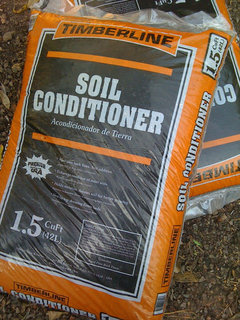
    Did the bags of mulch you found have a brand name?

  • 10 years ago

    Lolol. I KNEW someone would ask, and I forgot. I shoulda took a picture! I do remember it was packaged as "soil conditioner" and was in an orange bag. I'm going to a bonsai show EARLY tomo AM, but I'll drive right past the place on my way back. I'll try to remember to stop & look ...... or I might stop at work for my truck & grab a few bags.


    Al

  • 10 years ago

    Was it this by any chance?

  • 10 years ago

    Oops - I was wrong - it WASN'T packaged as 'soil conditioner'. It was packaged as 'pine bark mulch'. Brand on the package was 'Robin Hood' and it was in 2 cu ft bags.


    Al

Sponsored
Wannemacher Interiors
Average rating: 5 out of 5 stars26 Reviews
Customized Award-Winning Interior Design Solutions in Franklin Cnty OH