Software
Houzz Logo Print
wheels_37

Ajuga spread

10 years ago

Was thinking about planting ting ajuga on a hill what spacing do I need to use to get it fill in by end of the summer

Comments (33)

  • 10 years ago

    Depending on where you live, you may want to consider that this plant is reported as invasive in several states. The link below is from the Missouri Botanical Garden's Plant Finder page:

    http://www.invasiveplantatlas.org/subject.html?sub=10094

    It is also on the New Jersey Invasive Species Strike Team's list of invasive plants.

  • 10 years ago

    If you live in one of the many areas of the country where ajuga is not considered invasive, plant at a spacing of 9-12" on center.

  • 10 years ago

    Even somewhere it isn't considered officially invasive, I'd rethink using it as a groundcover. The types that spread well as perfectly capable of spreading into lawn, and unlike most other groundcovers, it is a low enough plant that the lawnmower means nothing to it. It is high on my personal evil list for that reason. I'm also not sure how well it does the usual job of a groundcover and smother out weeds.

  • 10 years ago

    Interesting info.

    Not to exclude other interpretations, judging from the map, Ajuga reptans really likes Illinois, Massachusetts and Rhode Island, or the folks in those states have decided they really don't like Ajuga reptans (viz. reported it as invasive).

    Have found the species and several cultivars to be real spreaders here (e.g. coming under a fence), but it's not difficult to dig out of a flower bed. Guess the lawn's another matter. Sympathies, mad_gallica.

  • 10 years ago

    It IS a groundcover so very inclined to spread - that's the whole point!! And lots of groundcovers have an ability to creep into lawns or other areas, especially if not limited by some sort of border or edging. Personally, I have never found ajuga to be difficult to remove from where not wanted, unlike some other types of groundcovers that are a bear to remove.

    It is an interesting conclusion I have come to when discussing GC's with at least a national audience is that everyone has their thorns-in-the-side plant and that can differ widely by location. Other than some of the glaring "problem plant" GC's that everyone seems to have issues with, like Houttuynia cordata or Aegopodium/goutweed, my PITA GC is sweet woodruff. If it were up to me, I would never allow that to be planted anywhere. It spreads like a tsunami with this dense, mat-like root structure that goes everywhere, including right through the root system of any neighboring plants. To remove it, you have no alternative except to dig up and bare root any involved plant. Never again!!

  • 10 years ago
    last modified: 10 years ago

    GCs and PITA: new on me.

    Checked them out. Quite a few possibilities: e.g. Geriatric Care, People Ingesting Tasty Animals.

    Context: Group Chat?, Pain in the Arse (likely).

    The annoying thing is that the "glaring "problem plant"" invasives are sold, without warnings, to unsuspecting customers who may wake up one day to find that their only option is to move and leave the situation to new home owners.

    Eliminated sweet woodroof from our small garden. Just acted sooner than later.

  • 10 years ago

    GC=ground cover. You are dead on with the other one.

  • 10 years ago

    Thanks, NHBabs.

    Guess it cuts down on the typing.

  • 10 years ago

    Ajuga is a useful ground cover in my part of California.

  • 10 years ago

    to get it fill in by end of the summer


    ==>>> this part bothers me ... perennials.. usually need a year to settle in.. and grow some roots ... before they go all hog wild and start spreading around ...


    but that is dependent on so many personal variables.. like soil.. sun.. watering.. etc ...


    the hill sounds like a good use for this plant.. but i suggest you set your expectations appropriately ...


    ken

  • 10 years ago

    Here, ajuga seeds around, and if it gets into somewhere you don't want it, you have to get rid of every teeny bit of root or it grows back.

  • 10 years ago

    "The annoying thing is that the "glaring "problem plant"" invasives are
    sold, without warnings, to unsuspecting customers who may wake up one
    day to find that their only option is to move and leave the situation to
    new home owners."

    If already existing on the property (i.e., an 'inherited' plant), yes I agree they can be extremely problematic, especially when not maintained appropriately. However, groundcovers are intended to spread - that is their primary feature - so it makes a great deal of sense to research what you intend before you purchase it to make sure it is not too aggressive, too "invasive" for your needs. It's the "right plant, right place" concept that tends to get ignored. Having been associated with both the nursery industry and garden design/consultation for many, many years, I can state with almost no reservations that plant purchasers - the consumers - are far more inclined to impulse buys and "pretty flowers" than they are with almost any other retail purchase, except maybe clothing :-) As fro "unsuspecting", there is a certain responsibility they need to assume themselves to make sure the plant(s) they are selecting for their garden fill the need but don't cause further problems. And that means researching any aggressive or invasive behavior as well as any toxic issues that may be of concern to them. All this info is readily available online or in most garden resources - we don't need nor should we be expected to hand feed it to them :-))

    Ken, most herbaceous groundcovers (no woody stems) are ready to take off almost immediately after planting as most will exhibit a very fast spreading or rhizomatous growth. It is not uncommon to have a GC that fits that description and spaced accordingly fill an area in a single season.

  • 10 years ago

    Also, many of the ajuga cultivars are sterile so that eliminates the worry about seeding. I have 'chocolate chip' and it does spread quite a bit which is what I wanted but there are no seedlings popping up. It will invade lawn without edging but that is true of many ground covers. I am not sure that this particular cultivar would be good for a huge expanse since it is so low, weeds could still get through. It does a pretty admirable job in smaller spots though.

  • 10 years ago

    13 response great lots of opinion but iam looking for something like a 4 inch plant will spread to be an 8 inch plant or a 4 inch plant will grow to a 12 inch plant in a year. I have a hill that grows dirt I am sick of looking at it when I am sitting back relaxing and throwing down some brewskis or a couple of pitchers of margaritas. If someone will help me with the inches or the possible inches I would really appreciate it. I kinda want something invasive. Thanks for the help everyone

  • 10 years ago

    If you would like suggestions, you will have to deactivate the cloaking device and reveal your general location. As you can see, different plants perform differently in different places.

  • 10 years ago

    Gardengal48, will you please share some of your favorite ground covers?

  • 10 years ago

    The lower part of northern Indiana thank you

  • 10 years ago

    In case, you hadn't guessed, I am rather fond of ajuga :-)) I also favor Pachysandra terminalis, Rubus calycinoides (Taiwan creeper), Ceanothus gloriosus, Arenaria balearica (Corsican sandwort), native gingers, Vancouveria, Adiantum venustum and the Leptinellas (N.Z. brass buttons). And any of the creeping thymes for a very sunny location. However I doubt many of these are appropriate for Indiana.......

    Believe it or not, I am also a fan of lamiums (great for dry shade and they don't get out of control in my area), Euphorbia robbiea (will grow in almost total shade and minimal water where nothing else will!), and......wait for it.......the dreaded goutweed/bishop's weed - as long as it is contained (much like bamboo).

  • 10 years ago

    Gardengal did tell you 9 to 12 in on center for the spacing.

  • 10 years ago

    Is there any reason it needs to be 4" tall? I used orange daylilies, the old-fashioned kind that is commonly referred to as ditch lilies, along with Centaurea dealbata which has screaming magenta tufted flowers. Butterflies and birds like the combination (so do I since they don't bloom at the same time), and they have both expanded up to the edging I put down, but not gone beyond. I mulched when I planted so that weeds wouldn't grow while they were filling in. More like 14"-18" but I like that the tall ground covers shade out weeds. I don't think I spend 30 minutes a year weeding, and the bed is 50' long by 15' deep.

  • 10 years ago

    A previous GW thread on Lysimachia nummularia as a groundcover and the potential for experiencing Lysimachia-lawn:

    http://forums2.gardenweb.com/discussions/1626896/how-aggressive-is-golden-creeping-jenny

    With this one and Ajuga, it's a good idea to install a barrier at the edge of a bed/border if you're concerned about lawn invasion.

    I'll take either of them over Filipendula, which will occupy hours of my time this year digging its rhizomatous unwanted growth out of the perennial beds.

  • 10 years ago

    Babs, do you deadhead the daylilies or do they do well enough on their own?

  • 10 years ago

    What kind of barrier is good to separate the ajuga from lawn?

  • 10 years ago

    Any kind of rigid lawn edging will work. I prefer the metal to the plastic, but that is a personal choice. And some folks have concrete curbing as edging (which I really dislike, as you lose all flexibility for changing bed size). I would avoid using cobbles, bricks or rocks, as it is easy for any unwanted growth - the lawn itself, weeds or traveling GC's - to migrate through the spaces/cracks between the stones.

    And if you are diligent and prefer not to use edging, just cutting a clean line between lawn and planting bed with a sharpened spade or edging tool works equally as well.

  • 10 years ago
    last modified: 10 years ago

    Thanks GG for your ground cover suggestions!

  • 10 years ago

    This is an example of the attitudes that has me visiting GardenWeb less and less frequently. I see fewer and fewer examples of true gardeners and the gardening spirit ... just i want what i want, when i want it (usually "Now"), regardless of the consequences.

    Wheels 37 thanked agardenstateof_mind
  • 10 years ago

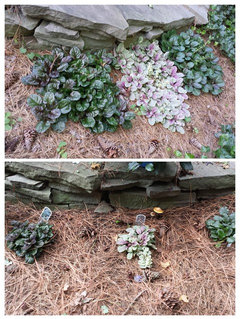
    This picture shows how ajuga has spread in my 7B North Carolina backyard in shade - (bottom picture from 30th August 2015, top picture from 10th June 2016)

  • 9 years ago

    I don't even drink it was pose to b a funny.

  • 9 years ago
    last modified: 9 years ago

    FYI...

    State(s) Where Reported invasive.

    http://www.invasiveplantatlas.org/subject.html?sub=10094

  • 5 years ago

    Has anyone got ajuga near their house foundation? If so, any problems? Thank
    Dotty from GA

  • 5 years ago

    "Has anyone got ajuga near their house foundation? If so, any problems?"

    What exactly do you think it might do? Crack the foundation?? It's a very shallowly rooted groundcover..........other than spreading rather vigorously (and some cases, invasively), it won't do anything bad wherever it might be planted.

    btw, unless the foundation is not structurally sound, even tree roots will have no affect on a foundation.

  • 5 years ago

    Most of the time, the advice is 12” away from the foundation to allow for air circulation - for the plant and to keep possible mold/mildew off house. But, since ajuga is so low growing I can’t imagine that would be a problem.