Software
Houzz Logo Print
iris_lau

Input on cause of ficus lyrata leaf drop

Hello. I got my fiddle leaf fig at the end of March. It had signs of being overwatered at the store and is in what looks like a fine standard indoor potting mix. The plan was to repot in June. I had dried it out, only watered when a bamboo skewer inserted all the way through the pot was dry (averages out to be about 14 days). It stayed up in front of a west facing window and got maybe 2-3 hrs of direct light, with the rest being indirect. I went on a 13 day trip, watered it just before I left (the skewer was dry) and when I came back yesterday, it dropped 50% of its leaves.


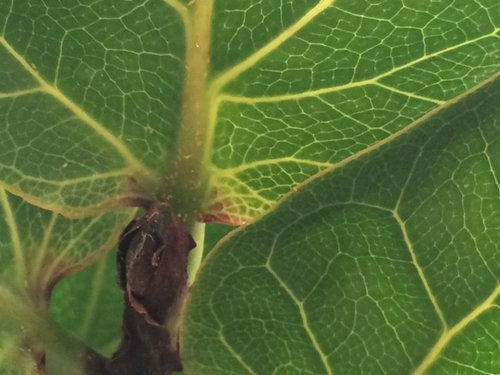
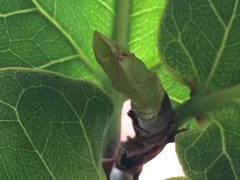
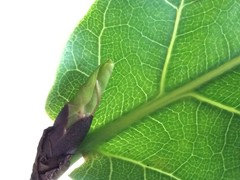
Wanted to know what your thoughts were on why it dropped the leaves. I didn't think anything changed except for maybe less circulation (no windows were opened when I was gone). Unless somehow I had over/underwatered it to begin with (which I didn't think I was). Or maybe bugs? I found these guys mid April or so on a leaf and I wiped it down with alcohol.


Any input is highly appreciated. I'm not sure what I should change or just stay the course and hope nothing else bad happens... I'm forgoing the plan to repot in June and holding off fertilizing.


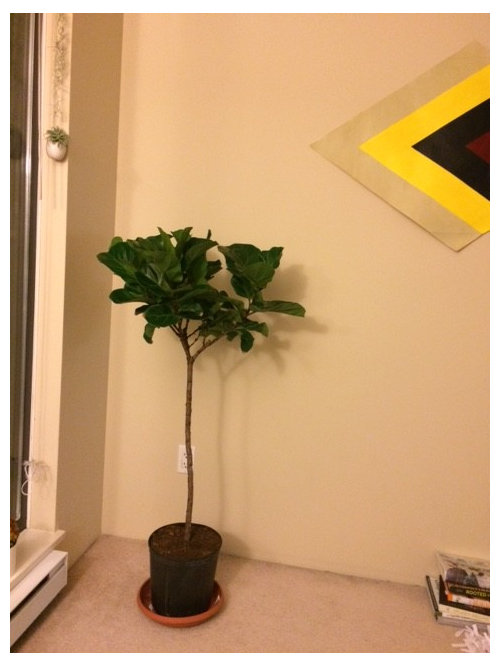
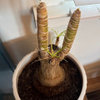
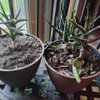
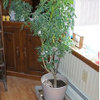
Before:


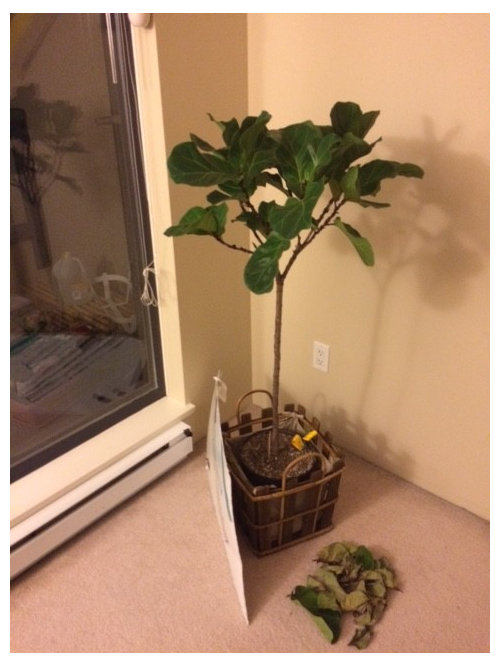
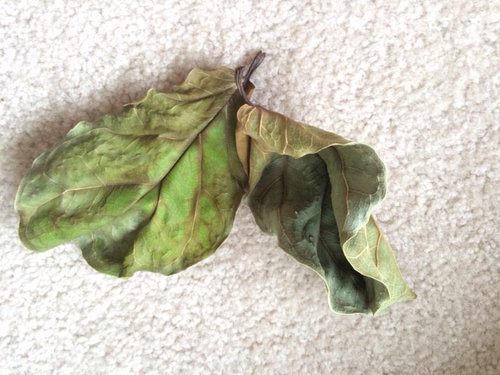
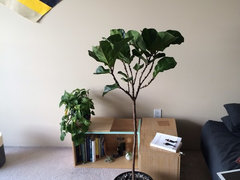
After:


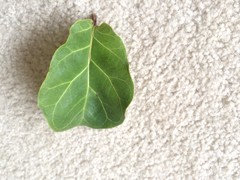
Bugs (white dots on the stem/base of the leaf):


Comments (39)

  • 10 years ago

    Did you close the window treatments while you were gone or turn the thermostat way down? Can't see anything definitive in the bug pictures, but sap sucking insect infestations can definitely cause leaf loss. Fertilized recently? Are you flushing the soil when you water? Dissolved solids (salts) from fertilizers and tapwater accumulate in the soil and the collection saucer from which they make their way back into the soil. This makes it increasingly difficult for the plant to take up water and causes a drought response (leaf loss) and/or fertilizer burn.

    Al

    Iris (8b, Vancouver, Canada) thanked tapla (mid-Michigan, USDA z5b-6a)
  • 10 years ago
    last modified: 10 years ago

    - I left the blinds up but the window itself closed

    - I left the thermostat to keep minimum temp at 17C. I know it did get to 25C in Vancouver while I was gone - potentially made my apartment a bit hotter than 25C without windows open.

    - Have not fertilized yet - was waiting to flush out the soil. I water till water drains out the bottom for a few minutes. I know the soil is super water retentive so was a bit hesitant to do this but I did. Bought it from store in March, dried it out for 3-4 weeks, watered till water drained out around 14 days apart as per skewer dampness

    Could the leaf drop be a delayed response to what happened to it before I bought it? If not, then it's something I did which I want to figure out so I can correct it. It just dropped another leaf. This one looks perfectly normal and green to me.

    Also, I can see some remaining pests on the leaves. I want to wipe them down with isopropyl/water solution again but so afraid to disturb the leaves and cause more to fall off. What are you thoughts on this?

    Thank you very much for your reply Al. I really appreciate it. This tree means a lot to me so I hope I can correct cultural elements to help it along.

    Iris

  • 10 years ago

    Yes, the leaf loss could be a reaction to something that happened weeks earlier, maybe sudden exposure to chill while in transit to PoP, or a stark reduction in light between the nursery where it was raised, then the shipping container, then possibly the dark store. It doesn't sound like something you did, unless it's related to over-watering and the poor soil. Your plan to repot in June is a good one - hopefully into a soil you can water correctly. From that point forward, you should expect things to smooth out & get easier.

    Al

    Iris (8b, Vancouver, Canada) thanked tapla (mid-Michigan, USDA z5b-6a)
  • 10 years ago

    So you think I should still aim for a Father's Day ish repot this coming June even with all the leaf drop and maybe perhaps it being in stress? Or maybe do it if it pushes new growth between now and June?

    Also do you think I should wipe down the leaves now risking more falling?

    Thanks again!!!

  • 10 years ago

    If possible - yes. Groiwers often find they're in a catch 22 situation when the plant is in decline and a repot is what's needed to fix it. Just try to keep watering under control and hope it stabilizes before mid-June. Wiping down the leaves isn't a problem. If the abscission process is so far advanced that the leaves fall off due to your wiping them down, there was nothing that could have been done to avoid their falling off in the very immediate future. IOW, you wouldn't be doing any harm because the leaf would already be cut off from the plant's normal processes.


    Al

    Iris (8b, Vancouver, Canada) thanked tapla (mid-Michigan, USDA z5b-6a)
  • 10 years ago

    Thanks again.

    So I had emailed the store for help at the same time when I started this thread and today I got a reply. The people there seemed to think that 14 days is also too much for the fiddle. I've been watering when the skewer comes out vaguely moist. How do you propose I gauge when it needs watering given the ultra fine particle soil it's currently in (it's finer than the indoor potting mix i put my other house plants in)?

    Iris

  • 10 years ago

    The calendar isn't what determines an appropriate watering interval; and you, not the guys at the store where you bought the plant, are in the best position to determine when your plant does or doesn't need watering. When the skewer first comes out dry or almost dry is the appropriate time to water. There ARE some things you can do that will shorten the intervals between necessary waterings, which would mean the plant has a greater fraction of unsaturated soil for a higher % of time, which is decidedly a plus. Follow this link to info on how to deal with water-retentive soils.

    If you're really concerned about the plant crashing or continuing to decline, and you have what you need to put together a medium you think will be forgiving enough to allow you to water correctly, repot now. There's no sense in letting a plant die for the sake of a few weeks. Is it better to repot when it's warm and days are longest? Yes, undoubtedly, but if you don't have that luxury .....

    Al

    Iris (8b, Vancouver, Canada) thanked tapla (mid-Michigan, USDA z5b-6a)
  • 10 years ago

    Here's the kicker... my life doesn't allow me the luxury of watering more than say once a week (I'm often away from home). I've read into multiple threads you've so kindly written about the benefits of the gritty mix or the 5:1:1 mix but I know that if I plant my plants in that, it won't work because I won't be able to keep up with the watering. I was waiting till replant time to ask you this question, but since we're speaking it may have to be now, if I were to buy a bigger particle size indoor potting mix (no extra fertilizer added), and add a bunch of perlite and maybe throw in some bark if I can find some (I have orchid bark only right now), + put in a wick. Could I somehow make it slightly better for the tree, knowing it's still not the best but better than right now?

    I apologize if you've already covered this elsewhere, the forums are very difficult to search... please link me if you have.

    Thanks again, you're a life saver!

    Iris

  • 10 years ago

    As the particle size of any given material increases, its ability to hold water decreases and aeration/drainage increases. If anyone was asked to describe a perfect soil from the plant's perspective, it would be one that doesn't hold perched water (because perched water limits root function, at a minimum, and wrecks root health in serious cases). That means that the soil would hold all of it's water inside soil particles, on the surface of soil particles, and at the interface where soil particles contact each other, leaving the inter-particular spaces full of air.

    When you start with a water retentive medium like Miracle-Gro and try to amend it by adding bark, it doesn't work well. You CAN decrease the o/a volume of water a soil can hold by adding bark and perlite to a medium, but you don't gain much when it comes to increasing aeration and the ht of the perched water table; that is until you get to somewhere around 75% coarse bark in the mix. Envision a pint of fine sand and start adding 4.5 mm BBs to the sand. In your mind's eye, you can see that at equal volumes of BBs and sand, there is still way more sand than needed to fill every air space between the BBs. It's only when you get to about 3X the volume of BBs (as sand) that you reach a threshold where air spaces start to appear between the BBs.

    It sounds like what you need is a soil with the potential to give you a week or whatever you need between waterings while you're away. Then, while you're around you can put into practice the tricks that force more water to drain from the soil when you water ...... like tipping large pots and or using a wick, or holding small pots over the sink and moving the pots downward, then sharply upward, forcing water that 'wants' to hang in the soil to exit through the drain hole (Newton's first law of motion).

    Growing is a series of compromises, we all decide the best course for ourselves. I can't decide for you, but I can give you what you need to make decisions based on information rather than a coin toss. ;-)


    Al


  • 10 years ago

    Thought I'd do an update and ask a few more questions. Leaf drop has stabilized since the last post... I'm down to about 25-30% of original amount of leaves and no new growth. I was reading some of the newer posts on F. lyratas and decided to try the depotting + putting onto newspaper for pulling off more water.


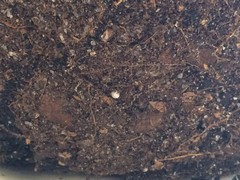
    This is a picture of the close up of the soil the plant came in:


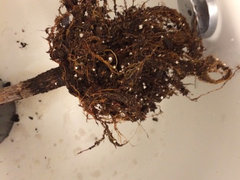
    So today, I did my first ever repotting (for me and for the tree!). Earlier than anticipated because I was getting worried after seeing the soil it's in. The soil was incredibly packed, difficult to remove and had a ton of sand in it. When I was done, the root ball was much smaller than anticipated.

    I probably should've tried harder to remove more soil but I had broken a few roots and getting anxious as it had been close to 20 minutes at this point. The roots were basically doused in water through the entire process though. It was 23C in Vancouver today but I did the re-pot indoors. I re-potted in an indoor container soil mix from the garden store (no specific composition %'s unfortunately. No added fertilizer. I added extra perlite (probably roughly 90% soil mix, 10% perlite). I re-potted Fiddles in a 10.5" diameter x 10" height pot with cotton string for wicks, as previously discussed. Then I watered a little, not till water flushed out of the bottom like I usually do, but just enough to wet the soil.

    Questions:

    1. Do I pull it way back from where it usually sits (2' from a west facing window), so that it has time to recoup before being exposed to strong direct light and heat in the afternoons? If so how long before I move it back to where it usually lives?

    2. Do I water like I usually do, when the "tell" is dry?

    3. When would it be safe to fertilize again?

    4. What's a good amount of time after repot (with no drastic responses from the plant) would you say when I'm safe and "out of the woods" so to speak. I'm a worrier...


    Thanks for the input!

    Iris

  • 10 years ago

    It's hard to tell, but seeing how small the root mass is, that container seems a bit large. Especially if you used regular potting soil with only 10% perlite. Seems like that was the same situation you started in.

    Not trying to bring any bad news, just what I'm observing.

  • 10 years ago
    last modified: 10 years ago

    Ok, so is there anything actionable for me now that it's in that pot? What would've been a better size of pot? Would it survive if I take it back out today and put it in a smaller one?

    Thanks anyhow!

  • 10 years ago

    What's the diameter of the root mass? If I had to use the soil you're using, I'd try to put it in the smallest pot that I could fit it in.

  • 10 years ago
    last modified: 10 years ago

    Approximately 6-7" diameter.


    Any thoughts on my other questions? Many thanks!

  • 10 years ago

    Thank you for taking the time to write me that! Very helpful!

  • 10 years ago

    Iris - NO ONE can give you meaningful advice about how to fertilize w/o knowing something about your soil choice and watering habits; and I'd love to debate any grower who offers one size fits all advice urging a new plant owner to avoid fertilizing his/her new charge for 6 months after purchase. In fact, I would consider that advice irresponsible when offered to anyone who is watering correctly, regardless of where they live or what time of year the plant was purchased.

    E.g., if I waited 3-4 months between fertilizer applications, my plants would be badly malnourished and lack the vitality required to bounce back after I work on them (do any heavy pruning or root work). In winter, I fertilize every plant I tend- every time I water, and the health/appearance of my plants has proven that to be a very healthy/productive strategy. In summer, my plants are outdoors where I water with a hose and have 3X as many plants to tend, so time doesn't allow me to fertilize every time I water, but I do fertilize at well beyond the recommended strength weekly, as long as mean temps are between 60-80*.

    Whether or not it's appropriate to repot a newly acquired plant depends more on what time of year it is and the plant's state of vitality than how long you've had it. EVERY plant I have purchased for the last 25 years has been repotted into a soil more conducive to good root health than the soil it came in at the first opportunity. The result of that habit is a plant that grows faster and is much healthier than it would have been had I not repotted it. So, the idea that your plants are going to come with some sort of soil that offers better growth or better root health than soils you can make yourself simply is not true. If I purchased ANY species of ficus other than F. carica (hardy fig) It would be repotted sometime sometime around the middle of Jun - no matter when I purchased it - I'd not hesitate to repot a Ficus the same day I bought it if I bought it in Jun; or, if I acquired it after the middle of Jun, I would repot up until about the middle of Aug (in MI).

    BTW - fresh soil is never 'fully charged' with minerals other than what is locked in the hydrocarbon chains that make up the soil particles, that is, unless someone PUT them there, which is the grower's job. We should focus on a container soil's structure and its ability to retain that structure for the duration between repots, and take full responsibility for supplying the nutrition plants need to grow normally. If you're using an appropriate medium, taking and keeping tight and efficient control of a nutritional supplementation program is ridiculously easy.

    Al

    Iris (8b, Vancouver, Canada) thanked tapla (mid-Michigan, USDA z5b-6a)
  • 10 years ago

    Iris...you got to do something about those bugs. You need an insect spray for plants ASAP

  • 10 years ago
    last modified: 10 years ago

    Al: should I be waiting for a period of time post repot to fertilize?

    Anthony: I've wiped down leaves several times now with a isopropyl alcohol + water solution. So far seems ok, occasionally see a bug or two and have to wipe down the group of leaves again.

    While we're on the topic of bugs... What do you guys think these are on the stem?

    and this??

    Thanks!

  • 10 years ago

    Wait for new growth to begin, which signals the root system is functioning well enough to support new growth. Fertilize at that point in time. Low fertility facilitates water uptake (a good thing when roots have just been worked on) and causes more rapid root colonization of the soil mass.

    If the little brown bumps on the stem in the first picture don't rub off easily and intact, they're lenticels, a normal part of the plant's anatomy. They are openings in the plant through which gasses are exchanged. The second picture looks like a scale insect just reaching adulthood.

    Al

    Iris (8b, Vancouver, Canada) thanked tapla (mid-Michigan, USDA z5b-6a)
  • 10 years ago

    Thanks Al, you're amazing to have on this forum!

  • 10 years ago

    ..... kind of you to say so. Thank you.

    Al

  • 10 years ago

    And I have 2 new leaves! I am pretty happy. I did end up switching the pot to a 2 gallon pot the day after the repot (looks really quite small for the plant but I rather deal with repotting again next year than have the plant suffer). I just ordered the famed foliage pro online too and will fertilize at the next watering.


  • 10 years ago

    Iris....Figs always leaf drop with environmental changes. You need a horticulture spray...don't mix your own unless you have those skills. Your soil and pot are fine with your watering skills.( I got a sheff that will leaf drop simply by rotating the pot. ? ) Keep plant away from a.c. vents.


  • 10 years ago
    last modified: 10 years ago

    Anthony - figs don't always shed foliage when an environmental change occurs, in spite of what you might think or what you might read on the internet. Also, the first step in deciding what type of remedy is appropriate in any given case is to identify the pest.

    Al

  • 10 years ago
    last modified: 10 years ago

    I think I've gotten the upper hand on the pests (spider mites, scale). Still find the odd one here or there but much less now. I keep an eye on it often and remove anything I happen to find. Hopefully that will work.

  • 10 years ago

    AL...the pest likely have nothing to do with the leaf drop. Iris recently relocated the plant and went on vacation. A fig would certainly go through a period of leaf drop under these conditions.

  • 10 years ago

    NO, Anthony. I never said anything about leaf drop and pests ...... and relocation/vacation might or might not cause leaf drop - depending on more specific factors, such as was the new site brighter or substantially dimmer and did the plant go dry during vacation which would cause a drought response a symptom of which is shedding foliage.

    Al

  • 10 years ago

    Be prepared for figs and leaf drop. Continue with good watering skills and bright indirect sunlight. It will recover.

  • 10 years ago
    last modified: 10 years ago

    If this were another type of forum...

    Random user: My car is broken down.

    Anthony: just keep driving it and it'll be fine. Cars don't need oil changes.

  • 10 years ago

    Dave....I thought for a minute you needed me to fix your car. I get alot of that.

  • 10 years ago

    AL..... Figs will drop their leaves, its just their nature. Leaf drop is a minor problem.

  • 10 years ago

    Any tree "will drop it's leaves" for a healthy number of reasons ..... it's what they're genetically programmed to do as a survival mechanism. Whether or not leaf loss is a minor or lethal problem depends on two factors - the % of leaves lost and the plant's state of vitality when the setback occurs. A few leaves lost from a healthy plant - no big deal; a high % of leaves lost from a plant that had been enjoying good health is a significant setback; a high % of leaves lost from a plant already in decline can be a lethal setback because the plant may not have enough energy reserves to push a new flush of foliage - which carries with it an extremely high probability of collapse.

    I'm actually grateful for the opportunities you provide others to turn the sweeping statements you make without qualifying them into perfect learning opportunities. Explaining why those statements cannot be broadly applied doesn't take much time and many people benefit from what others say in disagreement with you. Similarly, explaining why many of the offerings you leave are simply erroneous provides additional opportunities to consider more reasoned points of view.

    Al

  • 8 years ago

    hi iris,

    bumped up your old thread...not sure if you are still active.. noticed you are in vancouver. how is your fiddle leaf fig now?

    i recently got a FLF too and I'm looking into making Al's gritty mix. where did you buy the pine bark fines? i'm looking around online and wondered where i can get it in vancouver/richmond? is it the same as pine bark mulch? or pine nuggets?

    thank you!

    laurie

  • 8 years ago

    Iris - I'd love an update too!

    Laurie - I'd recommend AL's 511 mix for a FLF more than the gritty

  • 8 years ago
    last modified: 8 years ago

    hi robin, yes i want to make Al's 5/1/1 mix...can you advise if pine bark mulch is the same as the pine bark fines that Al suggests? ty!

  • 8 years ago

    In my country it's usually not the same : mulch is stringy and variable and has lots of sapwood and general gunk in it - more suitable for mulching the surface of garden beds.

    The only way for me to get decent pine bark fines here is by the truck load. They're commonly used in potting mixes but not sold seperately, not that I've found anyway.

    So for my small amounts I've used orchid bark mix instead. Have to do a little sorting for size. If you use that, check the size of bark pieces, there's different grades. I've read many people use reptibark so that could also be an option.


  • 8 years ago

    Hi Laurie! Glad to have someone in the area for plant talk! I actually never made the gritty mix because my lifestyle won't allow me to water that often. I ended buying quality indoor potting mix and combined with perlite 50:50. Watering when dowel comes out nearly dry. My tree is doing quite well! It had quite a lot of new growth this year :D 10+ leaves!

  • 8 years ago

    that's awesome Iris! would love to see pics of your baby when you get a chance. i love the shape of your tree! (lollipop!) did you get it like that?

    thanks Robin! good info about the mulch. i would have picked up a big bag of mulch!


Sponsored
Bella Casa LLC
Average rating: 5 out of 5 stars17 Reviews
The Leading Interior Design Studio in Franklin County