Software
Houzz Logo Print
stanofh

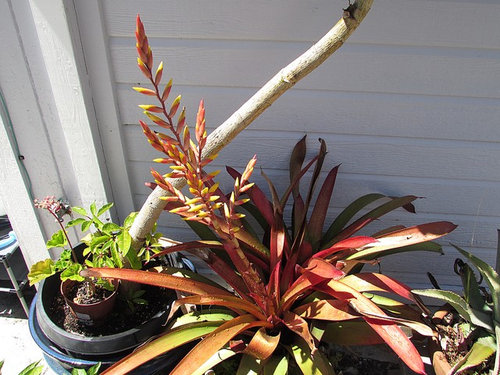
My nicest Vresia.

All it said years ago when I bought it was "Red". Its the only Vresia I ever paid a good price for at $40. I think I was looking for something large and a budget Alcanteria.

What do you think? nice huh? NEVER had a bit of frost damage even at a 30f or so over the years.

Comments (12)

  • 10 years ago

    "Highway" It came to me.

  • 10 years ago
    last modified: 10 years ago

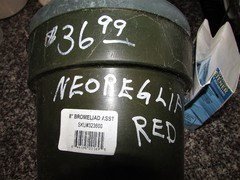
    Sorry Nev. I added the real name after going back on gardenweb. I had posted it in 2009. I had forgotten. I do still have the original pot around with Vresia and "Red" written on it.

    Once again "Highway" not to be confused with "Highway Beauty" the variegated version of this plant.

    btw, The topic starting first post? You can't edit that. I wonder why?

    Here's more: Its a direct descendant of Vrisea bituminosa,native to Rio,Sao Paulo,and in the state of Bahia. Grows on trees or one ground. Its in association with jumping spiders also.

    Is found as high as 3,000 '.but, for the tropics that still sounds tropical.


    Its a keeper!

  • 10 years ago

    Hi evereyone.

    Stan – Am I understanding you correctly that, “red” has
    nothing to do with the real name of your plant which is Vr. ‘Highway’?
    This is interesting as for some years I had a variegated plant called Vr. bituminosa
    x Vr. Saundersii which regularly produced a non-variegated pup, which I later found should be called Vr. 'Highway'

    After reading on one of the threads here called “RoRo vs
    Highway Beauty
    ” (http://forums.gardenweb.com/discussions/1773343/roro-vs-highway-beauty?n=8)
    back in 2008 I decided to follow up on ‘Highway Beauty’ on the BCR.

    I found
    that the non-variegated (NOVAR) Highway Beauty should just be called, Vr. ‘Highway’.
    I also found on the BCR that bituminosa is now treated as platynema. See: http://registry.bsi.org/?genus=VRIESEA&id=8684#8684

    However I’m getting away from the main point and that is
    that all of my plants of Vr. ‘Highway’ just have green foliage (a similar green tone
    to the leaves in Pic.1 on the BCR) and not the beautiful red that’s shown in
    your picture. My question now is: is your plant actually Vr. ‘Highway’ or possibly a red
    sport from Vr. 'Highway' or perhaps even a different plant altogether?

    It still doesn’t alter what I said about your plant originally
    (“It is a nice one”) and it's much more attractive than the Vr. 'Highway' that
    myself and many others around here grow.

    All the best, Nev.

    stanofh 10a Hayward,Ca S.F. bay area thanked splinter1804
  • 10 years ago

    When I bought it Nev,the pot only said "Red" and the price of course. It was mostly green with some reddish color at the leaf bases. When I moved it into sun...it changed hugely. All that red came out. Its getting near full sun to the near (but not quite) scalding point. It was 90f yesterday and it stood up to our dry air and heat -for one day.

  • 10 years ago

    Hi everyone.

    Stan - I've grown my Vr. 'Highway' and Vr. 'Highway Beauty', beneath 60% green shade cloth, 75% beige shade cloth and in an area of the garden where they get unprotected sun from about 10.00am until 3.00pm and on some of those days during January between the hours of 12.00 noon and 2.00pm, the temperature reached the high thirties to low forties (centigrade).

    The only difference was with the plants in the garden where the green of the leaves were a bit bleached in colour compared to the others. This makes me think we have two different plants as there certainly wasn't any hint of red in any of them (although looking at your plant, I wish there had been).

    All the best, Nev.


  • 10 years ago

    I found the original pot. If anybody knows how to read barcode,I guess the year is there. 2009?

  • 10 years ago

    Hi everyone.

    Stan - It looks to me as though they have either wrongly identified your plant or put it in a recycled pot as they haven't even got the genus correct as it is definitely a Vriesea and not a Neoregelia (wrongly spelled). I still think you got the best of the deal.

    All the best, Nev.

  • 10 years ago

    ha!,I didn't even notice that. Thanks Nev. It's nice to be a little lucky .

  • 9 years ago

    Now that the bloom has turned to straw color. Is there a way to find and grow seeds from it?

    Nev,can they be propagated from seed? Are they self pollinators?

  • 9 years ago
    last modified: 9 years ago

    Hi everyone .

    Stan - Stan –
    You ask, “Can they be propagated from seed? Are they self-pollinators?”

    To answer
    your first question, the answer is probably yes, most bromeliads can be grown
    from seed as long as the seed is fertile. Whether or not it’s fertile will only
    be known if you try and sow a little and see if it grows.

    As for you
    second question, “Are they self-pollinators?” I wouldn’t know about that but although
    you didn’t pollinate the plant, it doesn’t have to be a self-pollinator to
    produce fertile seed. Don’t forget “Mother Nature”; the birds and the bees (and
    many other insects) are constantly cross-pollinating and self-pollinating
    plants whenever they flower, so it’s possible to have seed even though you’ve
    had nothing to do with its pollination.

    You’ll know
    when the seed is ripe because the seed capsules which consist of a three sided
    hard outer wall, will break open and the seed will burst out.

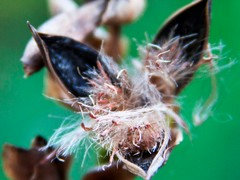
    Vriesea capsule as it breaks open and the seed bursts forth

    Vriesea seed
    differs to say Neoregelia and other berry type seeds as they are what’s
    commonly known as parachute seeds. Once the capsule breaks open and the seeds are
    exposed to the air, the fine hair like material which is attached to the seed
    will expand to take on the appearance of a tiny parachute and from that point
    on they are distributed by wind dispersal. If you imagine the hair-like
    material as being the parachute canopy and the seed at the bottom as being the
    person, you will see why they are called “parachute seeds”.

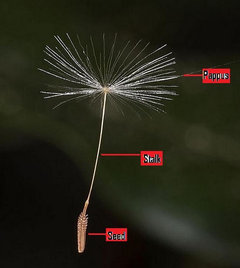
    A typical parachute seed, in this case a Dandelion seed

    You can take
    a few of these seeds and place them sparsely on top of some damp growing medium
    such as Peat Moss or Coco-Peat in a plastic take-away food container and by
    using a small hand sprayer to spray the seed, the damp (hair like filaments of
    the parachute) will help them to attach to the growing medium. Place them in a
    warm place (not in full sun) and mist spray them sufficiently to prevent the
    medium from drying out and you should have germination any time after about
    three weeks.

    Just
    remember though; just because the seeds came from your plant, when mature, the resulting seedlings may look
    nothing like your plant at all as they will be hybrids and all will be slightly
    different as they are usually the result of a mixture of genes from two
    different plants.

    Give it a
    try Stan, it’s a very interesting exercise.

    All the
    best, Nev.

    stanofh 10a Hayward,Ca S.F. bay area thanked splinter1804
  • 9 years ago

    Thanks Nev,I will watch and wait to see if the pods open with seed. I think I can report back on results in 2022?..ha.

0
Sponsored
Peabody Landscape Group
Average rating: 3.5 out of 5 stars8 Reviews
Franklin County's Reliable Landscape Design & Contracting