

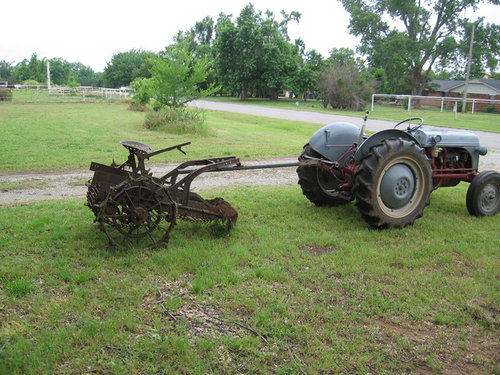
Potato harvester
Our potato harvester just passed its first trial with flying colors. The tongue was positioned too high before. It would make the front of the tractor lift off the ground in clay.
YAY!
Comments (31)
 10 years ago
Yay! I'm glad y'all worked that out.
Have you set a target date for harvesting yet?
johnnycoleman
Original Author10 years agoDawn,
No, it is still wet and raining here. As usual, Mother nature is being fickle.
Related Professionals
Wilmington Landscape Architects & Landscape Designers · Atlantic City Landscape Architects & Landscape Designers · Newport News Landscape Architects & Landscape Designers · Longview Landscape Architects & Landscape Designers · Albany Landscape Contractors · Gaithersburg Landscape Contractors · Rutland Landscape Contractors · Fresno Landscape Contractors · Colorado Springs Landscape Contractors · Gainesville Accessory Dwelling Units · Covington Accessory Dwelling Units · Newport Accessory Dwelling Units · Sioux Falls Accessory Dwelling Units · Green Bay Accessory Dwelling Units · Portland Accessory Dwelling Units- 10 years ago
Well, we had sunshine and blue skies today. It looked better than it felt. : )
Once you're used to 60 degrees and cool, misty, foggy, and cloudy conditions, full sun and blue skies make a high temperature of 81 degrees feel hotter than it sounds.
johnnycoleman
Original Author10 years agolast modified: 10 years agoWe are planting 1/6 acre of sweet potatoes tomorrow. It will be interesting to see how they turn out.
We will use out potato harvester to harvest them.
- 10 years ago
Well we warmed up a little today, but still not a pretty day. After 6 consecutive days with a high under 70, it felt a little more like May today, but not much.
- 10 years ago
Johnny, It is hard to believe it is sweet potato planting time already. I guess that's because it has been so cloudy and cool that it hasn't felt much like May.
So y'all, I looked at the forecast, and Chris texted me Reed Timmer's tweets last night about the upcoming potential for severe weather over the next few days, and our local TV met mentioned the possibility of severe weather this coming week (possibly as early as today for some parts of Oklahoma) and suddenly it felt like May again.
The nice thing about it not having been warm is that we haven't had daytime heating colliding with cold fronts and dry lines causing trouble, and I guess that's all about to change.
We have clear skies and sunshine early this morning, so I'm expecting a toasty warm and humid afternoon. The dew is heavy on the grass, and while I'd rather not have dew on the garden plants encouraging the growth of fungal diseases, it is nice to know we still have some moisture. May for us has had below normal rainfall, and I never like to go into summer with below average rainfall. Based on the forecast, I think that we might get enough rain over the next 10 days to bring May rainfall up to average.
I've linked the Storm Prediction Center's Convective Outlook page below. Right now, nothing looks too scary for us, but these update multiple times a day and each day's weather is affected by what happened the day before, so the potential for severe exists for at least parts of OK every day for about the next week.
Dawn johnnycoleman
Original Author10 years agoDawn,
I wonder if it would be advisable to mow the tops off the sweet potatoes before harvesting. It might mean fewer bog ups with the leafy material in the machine.
Also. we plan to side dress the sweet potatoes. Can you recommend a "best practices" fertilizer?
Johnny
 10 years ago
You know sweet potato vines are edible, right? I have cut tips to add to stir fry, but I guess the leaves can be eaten like spinach.
johnnycoleman
Original Author10 years agoAmy,
I know deer like them. http://www.prevention.com/food/healthy-eating-tips/sweet-potato-greens
Johnny
 10 years ago
Oh, the compost material from those vines (or turned into the soil)! Sweet potatoes are pretty easy.
- 10 years ago
Johnny, I've never grown sweet potatoes on the scale that you will be growing them, but when harvesting I do walk down the row and cut off all the tops with scissors or pruners first, just so I can see where the potatoes are and know most accurately where to dig. So, I do think cutting off the tops immediately prior to digging would be a good idea.
As for fertilizing, with sweet potatoes, you have to be really careful because too much nitrogen will give you tons of foliage and poor roots. It all relates to the soil.
If you are growing sweet potatoes in heavy, rich soil, what you'll usually get is very high yields of poor or low quality roots.
If you are growing sweet potatoes in very light, poor sandy soil that is naturally low in nutrients, you'll get low yields of high quality roots.
See the dilemma? You want to enrich your soil well enough (if starting with poor sandy soil) that you get better quality roots, but you don't want to enrich it so much that you get low yields. If starting with heavy clay soil that is highly fertile, you generally don't have to fertilize and the most important thing is just to add organic matter to the soil to make it lighter and fluffier. So, not knowing what soil you're starting out with in your sweet potato field, I'll just say this: you want to incorporate a pre-planting fertilizer that is balanced, so whatever generally works for you in that area without too much nitrogen, whether you're using a 10-10-10, 13-13-13 or 15-5-10...or whatever. Normally in the soils I'm used to, we use a pound of a balanced fertilizer for every 35 feet of row or for every 100 square feet of growing space if growing in a grid pattern in a raised bed. I am not sure how you translate that into a large field the size of yours. Then, because most sweet potato slips will start producing the roots roughly 30-45 days after planting, you come back and side dress at that time at a half-pound of balanced fertilizer per 35 feet of row or for every 100 square feet of raised bed if growing in a grid pattern instead of in rows.
I do not necessarily side dress my sweet potatoes because my soil they are growing in is so rich already. I did side dress regularly when I grew them in the sandy-silty soil at the west end of the garden, but that was in the pre-vole days. Since the voles arrived and began eating everything that grows underground, I had to move the sweet potatoes to a hardware-cloth lined raised bed that is a blend of sandy loam and clay with a lot of organic matter. Really, this soil is almost too rich for sweet potatoes, so I generally don't add any fertilizer to it at all.
One year I tried growing some in a container (a round galvanized 4' diameter stock tank) filled with a soil-less mix and I got beautiful foliage but poor sweet potato roots because that soil was too rich. Now, I usually plant sweet potatoes in a bed from which I've just removed Irish potatoes in late May or early June, and I don't add compost or fertilizer or anything else and that seems to work. There probably is enough fertility in the soil left over from when I added compost and pre-planting fertilizer before planting potatoes in February. This has been my solution to the voles-eat-potatoes dilemma ever since they popped up around 2011. It cannot be the permanent solution because I cannot grow potatoes and sweet potatoes endlessly in the same three raised beds (up from two raised beds last year), so I need to make more hardware cloth-lined raised beds that will enable better crop rotation.
My gardening bible is The Vegetable Book: A Texan's Guide to Gardening by the late Dr. Sam Cotner, long-time head of the horticulture department at Texas A&M University. I got his book out to see what he actually says about growing sweet potatoes, and here it is, in summary: He states that the amount and type of preplant fertilizer to be used should depend upon your soil type, its fertility and your rainfall. If your soil is on the heavy side and already fairly fertile, he recommends using about 1/2 lb of a fairly balanced fertlizer with a 1-2-2 ratio (like 10-20-20) for every 35' of row. He goes on to add that if your soil is sandy and poor, use the same fertilizer but up it to 3/4 lb. for every 35' of row. Then, he suggests your further customize it to your rainfall, using the higher amount if you are in a high rainfall area or if you'll be irrigating. He also suggested spreading it in a 2-foot band in the area where you'll plant your rows of sweet potatoes. He does caution not to add too much fertilizer if your soil is already rich, or you'll end up with small, stringy roots like I got when I grew in a container with a sterile, soil-less mix.
I've used this book since the 1980s and Dr. Cotner never has led me astray, largely because of the time he devotes to teaching us gardeners how to customize our fertilizing based on our soil and our rainfall. It took me several years to try fetilizing first one way and then another to see what worked best in my soil with the kind of rainfall I have, and I imagine you'll go through the same learning curve. What worked best for me was to use different amounts of fertilizer on different rows in the same year to see which produced the best yields. Sometimes I figured out what to do largely by figuring out what not to do. Is that backwards? Well, it worked. And, the customization never ends. About the time I figure out just how to prepare the soil and how to side dress it in a drought year with irrigation, along comes a rainy year or an excessively rainy year and the rules change and I have to do things differently. Unfortunately, even though we try to reduce gardening to formulas that we can follow, the reality is that the parameters change constantly and we have to change our methods accordingly. Sometimes I remember to side dress my sweet potatoes a month or six weeks after planting, and sometimes I do, but I seem to get good yields either way.
Don't forget to check your soil pH! Sweet potatoes grow best in acidic to slightly acidic soil with a pH from 5.5 to 6.5. In my case, starting with a pH slightly over 8, I have had to add a lot of sulfur and a lot of organic matter over the years to get my soil pH even somewhat close to what it needs to be for sweet potatoes.
Dawn
johnnycoleman
Original Author10 years agoDawn,
We planted in a nice loose mix of clay and sand. We will side dress at 5 pounds per row with 5-10-10. That will be about 15 pounds for 450 row feet. All of the rows are raised about 5 or 6 inches.
I'm not sure why but this plot is already somewhat fertile. We will be side dressing on the uphill side of the row. That means the nutrients will tend to move toward the plants with rain water movement.
Thanks again. Crossing my fingers! (:-)
Johnny
johnnycoleman
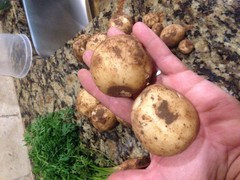
Original Author10 years agoFirst potatoes of the year. Both plants had seven potatoes each.
- 10 years agolast modified: 10 years ago
chickencoupe,
Sweet Potatoes don't particularly like any kind of shade. You can try it but don't expect much. I knew a man once that planted his sweet potatoes on the north side of a barn. A few sweet potatoes on the east end made some as they got morning to noon sun and a few on the west end made as they got afternoon sun but the ones in the middle that were in the shade of the barn didn't make any. I may be wrong about what happened but that is what happened that time. I had a row of sweet potatoes that got morning sun but about midday until dark they were in the shade of a mulberry tree and they didn't make any thing. But again maybe some other reason. - 10 years ago
Johnny, It must be the clay. Red clay is often full of minerals, hence full of nutrients. From the very beginning, I was shocked by how fertile our clay was, so mostly all we had to fix was its drainage issues.
Bon, Cedar trees are allelopathic so there's not many things that thrive close to them. After we cut down some cedar trees, it took 3 years or so before even grass and weeds would sprout and grow in the soil beneath where the cedar trees had grown. It took a long time for native plants to reestablish in that bare soil. The cedar trees also provide pretty dense shade.
I agree with autheray. Sweet potatoes do best in full sun. In order to get maximum yields from your sweet potato vines, they probably ought to get at least 8 hours a day of full sun, and that is not going to happen if they are growing underneath cedar trees. In the back portion of our woodland, about 800' from the house, there's about an acre of huge cedar trees. I hate it. Nothing grows underneath them, and copperheads are all over the place back there. I only go back there in winter because it is too dangerous in snake season. If a tornado ever hits our place, I hope it takes that entire acre of cedar trees.
Johnny, The potatoes look great. A couple of weeks ago I robbed some new potatoes from underneath a couple of plants so I could cook fresh Green Beans with New Potatoes, southern style (i.e. with bacon drippings). That dish is one of my favorite things about this time of the year.
Dawn
johnnycoleman
Original Author10 years agolast modified: 10 years agoDawn,
I wish I could make some fresh cornmeal, for you, to go with your favorite meal. A few folks here are making their own flour and cornmeal now. I can't take all of the credit, but I might take a little. Nope, that would be prideful.
Johnny
PS - I have made that dish a few times for folks that grew up North of here. Some were amazed at how good it is and some didn't see anything special about it.
- 10 years ago
OKiedawn,
Ha! Ha! Robbing new potatoes from under the vines used to be called "Grabblin new potatoes". Just another bit of useless old timey Ozark vernacular. Fun to hear people still do that.
- 10 years ago
You know, Johnny, some of those northerners boil everything to death. DH's father was from Maine and he boiled everything. His mom drew the line when he wanted to boil the Thanksgiving turkey. I guess it depends on what you were raised with.
johnnycoleman
Original Author10 years agoNo, I did not know that. I have spent very little of my life up North.
- 10 years ago
Johnny, Oh, go ahead and take the credit. A little self-pride in one's accomplishment is not the same thing as being too prideful. I am so proud of the way you are spreading the gospel of food independance. Folks who never had a chance to grow their own, harvest their own, cook fresh food from scratch or to even grind their own cornmeal and bake with it are learning very important life lessons from you and the others at Vision Farms and you should be proud. I am very proud of you. Every little pebble you toss out onto the water has a ripple effect and spreads and I believe the way that you are influencing others will continue to spread and spread and spread forever.
If people aren't smart enough to recognize that fresh green beans and new potatoes (cooked, always, with some sort of pork drippings) are the best food a spring garden has to offer, then there's nothing we can do for them and they will forever miss out on an incredible southern dish.
Amy, Ha, ha, ha. I heard all my life that we southern cooks are the ones who boil/cook our veggies to death. (I offer slimey boiled okra as a perfect example of that!) It strikes me as funny that maybe "those damned Yankees" (as my friend's old southern great-aunt used to say) are boiling things to death too. My friend's aunt was probably in her 70s or 80s back in the 1970s when my friend was dating a guy named Tim from Pennsylvania, and in her great-aunt's mind, the Civil War hadn't really ended and no respectable Texas girl ever would marry a man who was a Yankee. As it turned out, the great-aunt worried for no reason. My friend did not marry her Yankee from Pennsylvania, but a few years later I married a guy named Tim from Pennsylvania (not the same Tim). He claims to be a true southerner, though, having actually been born in Norfolk, VA, and not moving to PA until he was a toddler.
Autheray, Now, the use of robbing new potatoes is a phrase I grew up with but the concept of grabbing new potatoes is a new one for me. It is funny how the vernacular language changes from one place to another, and likely from one generation to another.
Dawn
johnnycoleman
Original Author10 years agoDawn,
We are planning a Spring Celebration Feast for friends of Vision Farms. The menu is grass fed beef steak, new potatoes, carrots, beets, turnips and cornbread with cultured butter.
One of our board members owns a small restaurant with a nice commercial kitchen.
Mouth watering already.
Johnny
- 10 years ago
Ha, I always thought of Southerners (Maybe just Okies?) as frying everything. I was raised by Minesotans. Mom rarely fried, probably more because she considered it fattening, than because it was a Minesota thing. But MN meals I remember were either hot dishes (aka casseroles, complete with mushroom soup) or roasted meat and potatoes. And deserts, lots of strawberry rhubarb desserts. Dad's family had a big garden and my Aunt's wilted leaf lettuce salad was to die for. And corn on the cob, if you were there later in the season. I got lost in a cornfield once. I'm rambling as a flood of memories come back to me. There is NO cornbread in turkey stuffing in MN. I still won't eat cornbread stuffing. I never had collards or southern peas growing up. Didn't get shrimp till highschool. We didn't eat much rice, either.
DH grew up in NJ across the river from Philadelphia. But he was born on an airforce base in LA. He has never ACTED like a southerner. Well, he has now been here longer than he was there, by a couple of decades, but he still misses Philly cheese steaks, the local pizza and the things they would get from the local bakery, like hoagie rolls and cheesecake. And Tasty Cakes, which are now available here (think Little Debbies if you've not heard of them.)
johnnycoleman
Original Author10 years agoAmy,
I got so tired of searching for good bread, I started making my own. I gave my recipe for wheat bread to a lady neighbor. She has made it twice. She was eating some fresh and hot when she decided to compare it with a bite from the bread she had been buying for years. She said it tasted nasty compared to my recipe. She gave the rest of the commercial bread to her dog.
Johnny
PS - She just purchased her own grain mill.
 10 years ago
As a born again Texan/ previous Yankee I was raised on casseroles and boiled to death veggies. They all tasted of butter and I salted everything. I never knew veggies could be good and had different flavors. And i never had cornbread...it was a sad experience lol
johnnycoleman
Original Author10 years agoluvncannin,I'm glad you have discovered good veggies.
Johnny
- 10 years ago
Johnny, Well, my mouth is watering too, and whatever breakfast I choose to have this morning will pale in comparison to the vision (pun intended) in my mind of the meal y'all are going to serve to the supporters of Vision Farms. How wonderful it is that y'all have access to a commercial kitchen!
Amy, My mom and all my relatives fried lots of everything, but we always also had salad at every dinner and generally 2 or more vegetables, and other than fried okra or french fries, the veggies were rarely fried. It is, of course, a requirement in our family that okra be fried or over-roasted. Sometimes my dad would fry up a delicious dish that had no name. It really consisted of whatever he could bring in from the garden that day, but my favorite combination was when he fried together sliced or diced potatoes, sliced okra, diced peppers and either sliced or diced onions. He'd fry it in bacon and other meat drippings (saved in a metal canister that sat on the counter and said "GREASE" on it, lol,) in a cast iron skillet and would chop up a couple of slices of bacon and cook that with the fried veggies. Then, when it was more than half-way cooked, he'd randomly scatter a couple of handfuls of corn meal over the pan of frying veggies, and stir-fry it with them. A plateful of this fried veggie concoction was a meal in itself and you really didn't even need to prepare a meat dish to go with it. Although.....it was especially delicious if you also had a bowl of either red pinto beans or pink eye purple hull peas and a slice of hot, buttered cornbread to eat with it. My dad would grin broadly and say "that's good eating!".
We probably ate a typical southern diet when I was a kid, but my mom was not all that crazy about cooking so her idea of cooking veggies was to open a can or green beans or corn or carrots and dump them into a saucepan to heat them up. It was my dad who'd make everything from scratch on the weekends, and he'd cook southern style veggies, whether fresh from the garden or from a market grower that had a market garden about 1.5 miles from our house, and he'd cook them in a way that made you drool.
Tim and I fried food early in our married years, but really cut back on the frying over the years so that we eat a fairly healthy diet now. We eat a lot of grilled meat and lots of homegrown veggies and fruit, and largely avoid fast food for the most part. Chris doesn't eat as healthy in general as we do and he eats more fast food, but being a firefighter who cooks at work, he is a great cook and knows many healthy ways of preparing food. He fights hard to get the guys at his station to eat in a more healthy way, but most of them are not nearly as much into healthy eating as he is.
I feel fortunate that I grew up with grandparents who gardened and farmed and prepared food from scratch always and forever, and with many aunts and uncles who did the same. Any and every family gathering was chock full of every dish imaginable, and I've never seen a family chow down on pickled food (they'd pickle and eat anything and everything) like my dad's family did. It wasn't until I was an adult, probably already in my 30s, that I finally understood that the reason pickled foods played such a large role in their meals was that back during the Dust Bowl and Great Depression years, his large farm family canned all their own food, and pickling was one of the safer methods in use then, so they developed a real appreciation for pickled stuff. I finally understood why you might see 10 different kinds of pickled foods on a holiday table. I assume each of the now-adult kids was bringing their favorite kind of pickled vegetable, and it was always the two sisters who made sure that no two families were bringing the same thing in order to avoid duplication. I used to wonder why we had pickled everything when I was was kid, but I understand it better now.
No one on this earth (including me) can fry a chicken that is as good as the fried chicken my mom cooked in a cast iron skillet when we were children, and believe me, I have tried to replicate it many times. She really didn't like cooking and used lots of convenience foods as they became available in the 1960s (she thought those little TV dinners in aluminum pans were the bomb!), but no one could cook better fried chicken. It is just that she didn't cook it nearly often enough!
One reason I love edible gardening so much is that it makes me feel closer to the older generations that went before us. When I am sitting and snapping beans or shelling peas, or when I am cooking them or we are eating them, I feel so very connected to all the relatives who taught us to cook (largely by example) and to preserve the garden bounty when we were young. I can still hear my grandmother's voice reciting whatever she had done on a given day. She'd say something like "I put up 6 quarts of green beans and then I did 9 quarts of beets......" and I still can hear those words in my mind as clear as day even though she's been gone for almost two decades. Now, I'm the one reciting to my family or friends, telling them how many pints or quarts of this or that that I've put up that day or that week. It is a continuity in our family that I like.
Kim, Well, you led a deprived life. Oh my! I grew up on cornbread and cannot imagine life without it. My dad's favorite meal, and one we had every single Wednesday (I don't know why it was always on Wednesdays) for my entire childhood was red beans cooked in a pot on the stove with chopped onions and chopped up bacon in them, some sort of boiled greens---turnip, mustard, spinach, collards, etc., and cornbread. He always had a bottle of pepper-flavored vinegar that he sprinkled on his beans, which he referred to as "pepper sauce", and I think he happily would have eaten this meal 5 or 6 days a week even though it was simple food.
I probably was in high school before I learned that some people ate fish that wasn't fried, or at least baked in the oven like fish sticks. To this day, in my mind, the only way to eat catfish is breaded in cornmeal and fried.
Tim was teased a lot about being a transplanted Texan back in the 1980s and 1990s. Eventually he lost his Yankee accent and could pass as a native Texan, but he always told people "I wasn't born in Texas but I got here as soon as I could". When we got engaged, I only agreed to marry him after he promised me that he'd never ask me to leave Texas. I wanted to be sure he wouldn't up and decide to move back to the Yankee land of snow and cold weather and short growing seasons after we got married, because I had absolutely no desire to live anywhere that the cold months outnumber the warm ones. When we began to tire of city living and began to discuss moving to the country to get away from the rat race of living in a large metro area, I was the one who suggested we look for land in southern Oklahoma, which still felt much more rural back then than adjacent areas of Texas. He was shocked that I'd consider leaving my home state, but I found the people here to be every bit as wonderful as the Texans I'd grown up with, and many fewer Yankees had infiltrated Oklahoma back then, but Texas was overrun with them. Oklahoma was the perfect solution for us.
Dawn
johnnycoleman
Original Author10 years agoDawn,
I hope to teach almost a dozen folks how to can with potatoes from the 2016 crop.
We had pinto beans with chopped onions and cornbread EVERY week. I still make them weekly. My breakfast the next day was last nights cornbread in whole milk and sugar sprinkled on top.
I wonder if there are any specials on canning jars.
Johnny


Okiedawn OK Zone 7