Software
Houzz Logo Print
contessa29

Need help with front yard landscape

10 years ago

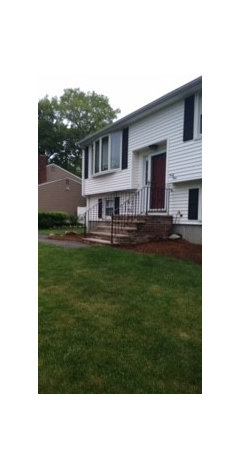
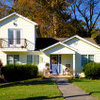
I recently took all my overgrown bushes out of the front yard. I want to do something that easy, and little maintenance (if possible) with a great curb appeal look. Any ideas is much appreciated. Thank you..


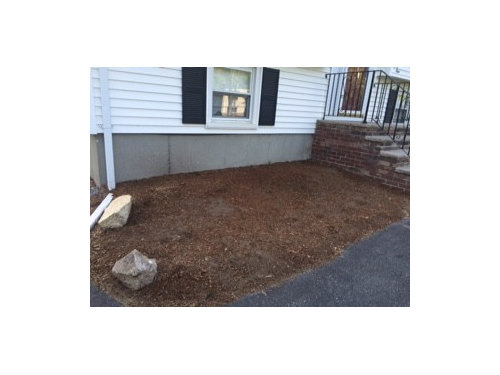
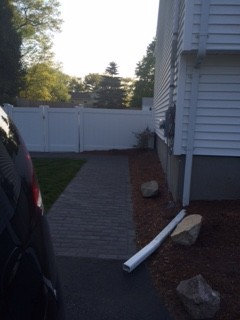
Side of the house


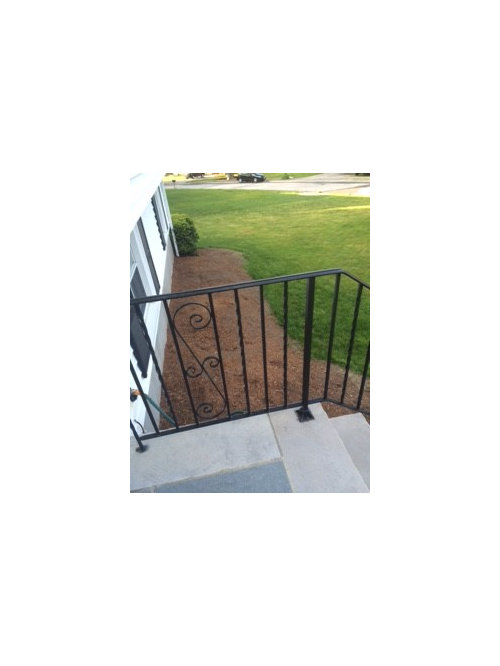
Right of the house


Left of the house

Comments (53)

  • PRO
    10 years ago

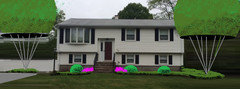
    This is the organization for a BASIC layout: trees that frame and shelter the house; shrubs that extend architectural features; groundcover that provides a base and ties together; annuals for attention and cheerfulness at the entrance. The bedline works, as much as possible, to funnel vision toward the entrance.


  • 10 years ago

    Thank you, Yardvaark. Do you know what kind of shrubs or groundcover, I should look at?

  • PRO
    10 years ago
    last modified: 10 years ago

    Based on the picture, you can get a pretty good idea of the ultimate size that a plant needs to be. I don't know where you are and what grows well there. You might consult with a GardenWeb forum for the region where you're located, or the forum for shrubs, groundcovers, perennials, etc.

    contessa29 thanked Yardvaark
  • 10 years ago

    Yardvaark, I re-read what you wrote. Is there a way not to have a BASIC layout, but a unique layout. Is this possible?

  • PRO
    10 years ago

    That's an interesting question. I think it is a mistake to think that "basic" and "unique" are opposites, or somehow at odds with one another. "Basic" does not mean common or typical. In fact, I doubt if you could find any place within a mile (or five) of your property that incorporates the the basic features I've promoted. It it more likely that you will see entrances somewhat smothered in plants or walks barricaded and foundation beds receding near the corners of homes. It is very likely that instead of plants arranged in masses or blocks, you would find strings of edging plants, alternating plants, and hedges directly in front of other hedges or trees growing up under other trees.

    What I'm showing you is on the plain side of basic. But there's no reason you couldn't break down areas of the plan and subdivide them in a greater variety of plant material, if you have some artistic skill and a sensitivity to the final outcome. You could add plants that are punctuation and spice. The problems of having not enough variety, or too much, I would say is heavily weighted towards the latter. So toward the former is usually the direction I urge, thinking that one can always add a little "punch" later when it becomes apparent to them that it is needed.

    While what I'm showing you happens to look a bit stiff and cold because of the drawing style, it's only a cartoon of what could happen in real life. When real plants are substituted for all the parts of cartoon, the look would be vastly different while still maintaining the same organizational structure. In fact, it could look MANY different ways, depending on what plants you use. It could be all green. It could be many colors. It could be nearly non-stop blooming. You would control this even if you copy the layout verbatim. There's nothing that prevents you from tweaking anything I've shown if you can improve it.

    Another consideration to think about is that I'm only trying to help you. I'm not trying to create a landscape plan for you, saving you from doing your own work or hiring a professional. It's up to you to take my suggestions (or anybody else's) and turn them into a working plan so that they are useful.

    While I'd be happy to help you add uniqueness to what I've already shown, you would need to give some specific feedback on how it could be made more unique for you. If you think something's wrong, lacking, too much, not enough ... you would need to say what it is so one would have an idea of how to go about making it more suitable for you.

  • 10 years ago

    Hi Yardvaark:

    Sorry for the slow reply - work gets in the way. ;)

    Anyway, thank you so much for taking the time to write me. I do appreciate all the help that you have given me thus far.

    You're right....This is very true!! :) This is my neighborhood, for sure!!!

    In fact, I doubt if you could find any place within a mile (or five) of your property that incorporates the the basic features I've promoted. It it more likely that you will see entrances somewhat smothered in plants or walks barricaded and foundation beds receding near the corners of homes. It is very likely that instead of plants arranged in masses or blocks, you would find strings of edging plants, alternating plants, and hedges directly in front of other hedges or trees growing up under other trees.


    You hit the nail on the head... This is what I think when I look at the photo.

    • bit stiff and cold because of the drawing style

    At this time, I do not want to add trees or ground cover to the front or size of the house. I just want people to drive by my house, look at it, notice that they like it some much, they want to mimic it. ;) It is very possible that this could happen with the BASIC diagram, but do feel that it looks a bit stiff and cold. I just feel it's lacking, but maybe it's just he diagram.

    Some of the plants that I seen walking around the garden center are Red-twigged dogwood, newport blue boxwoods, potentillas and mountain laurels. I just don't know enough and new to all this that I find it overwhelming....


  • 10 years ago

    When I was growing up in a similar house, the trees were white birch, the shrubs were low growing blue junipers, and the groundcover was vinca. The flowers were annuals, usually impatiens.

  • 10 years ago

    Try looking on Houzz or landscaping books for "inspiration photos." That will give you some ideas of looks you like.

  • PRO
    10 years ago

    Contessa, if you want people to notice, like, and want to emulate the yard you create, and you don't want to add trees or groundcover ... I'm not sure you're going to be able to accomplish your goal. While groundcover is not absolutely essential, it adds a quality of luxuriousness and sumptiousness that is hard to come by otherwise. A blocky house without trees is doomed to look like it just can't fit in. Or like it's part of a government installation.

    You mention being attracted to some shrubs at the garden center ... but this is the backwards way to approach landscaping. First, you should be finding out what jobs plants need to do (objectives to accomplish) in your yard and then start looking for plants that can fill those jobs ... rather than finding the plant and hoping you can employ it somewhere in the yard. Usually people can't so they end up with a bunch of homeless plants on unemployment. And later start wondering how they can get rid of the piecemeal look.

  • 10 years ago

    In the interest of the recent talk about fostering more discussion on the forum, I have a question or two for you, Yardvaark. I get the concept of highlighting the architecture by planting in line with the windows (what I think you've referred to as the 'windowbox' approach.) What I'm wondering is whether one can enhance the architecture as effectively, but with the reverse approach - that is, with lower plants below the windows and taller ones between and at the ends? In this particular case, the windows are quite low and the foundation is high, so my thought was it would be better to have taller things in between to cover up some of the foundation. (I suppose that could also be achieved with a taller 'groundcover', but then the shrubs below the windows would not stand out.) I also wonder whether some taller shrubs (in the 3-5' range) could be planted at the corners of the house? It might be a place to add some of the interest the OP is looking for. I would be interested to know your thoughts on this.

    To the OP, what is your zone, where in the country are you located, and what direction does the house face? All of these are critical considerations for what you can plant here. For instance, of your examples, not all should be used together because some love sun (potentilla) while others love shade (mt laurel). Since you are starting from scratch and describe yourself as overwhelmed, I think it makes sense to start with a relatively simple scheme such as Yardvaark has provided. As he says, the uniqueness can come from the plants you choose. Once you have the fundamentals in place you can add more punch from there as you find it's needed.

  • 10 years ago

    Contessa, I am curious about your desire for a unique layout. Do you have any inspiration photos that you can share with us?

    You want as little maintenance as possible so that eliminates many plants that would add interest. Vines, for example. Therefore, no arbor or trellis. No topiary because it would require shearing.

    You could buy an impressive garden sculpture, if you can afford it. It shouldn't require much upkeep.

  • PRO
    10 years ago

    Atmoscat, that is a great question and I'm glad you asked it. I promote the "windowbox" solution a lot, because it is easy to grasp, easy to implement, less expensive, doesn't smother the building with vegetation (and a lot of trimming work), looks goods, etc., and people get it. However, it is NOT the only pat solution. Hedges can work (but have potential disadvantages I just mentioned) and framing with shrubs can work (exactly as you describe ... shrubs at the ends/corners with lower plants -- often a groundcover below windows. The latter works well when windows are very low to the ground. One must make the call based on the particular circumstances.

  • 10 years ago

    Thanks for your response, Yardvaark! That's good to know, and I agree it should be a question of what works best in each individual case.

  • 10 years ago

    Yaardvark and other commenters on this thread -- thank you so much -- I am reading through and learning so much about different ways to think about designing the landscape in my yard -- I guess I just wanted to offer a "thank you" -- your time and efforts to help posters help a lot of other people, too! I would guess that a well-executed basic design could be quite unique because so few yards can achieve it...

  • PRO
    10 years ago

    " I would guess that a well-executed basic design could be quite unique because so few yards can achieve it..."

    You so hit the freakin' nail on the head!

  • 10 years ago

    Sorry for the slow reply. I have been away with limited access. I guess, I do no t know enough about landscaping design, but fully understand what your trying to convey. The reason I do not want trees is because there is a Japanese Maple that sits nicely in the front of the house. I just think it might look weird with another try directly behind it. With the other side of the house, we have a nice walkway there and when the snow gets plowed that is where the snow gets pushed, so I don't really want to have a tree there. I just feel that looking at the BASIC option as one open. I would like to have a few different pictures/ideas so I am not limited to other potential possibilities. With that said, I want to thank everyone for giving me something to think about and will look at photos and see if what I like is something that will work to my advantage as well.


  • PRO
    10 years ago

    FWIW, in order to render help here, one first needs to have some understanding of the property, including what exists in it now, and what surrounds it. The best and easiest way to do this is through pictures. In fact, that's pretty much the only way it can really be understood here. Looking at your pictures, Contessa, I see they are mostly close-up shots of patches of dirt, which tells very little about the context of the space. What's needed are comprehensive views that span an entire space & beyond, showing what's in the neighbor's yard that needs to be screened or dealt with in some manner. If there are existing trees that matter, they should be included in the pictures so that they can be considered. Since you don't yet have the solution you're looking for, I suggest you start over with a good set of pictures that conveys the complete span of the front yard, showing the trees that already exist, and some of the neighboring properties. In order to do this, you'll need to stand in line with the center of the house and shoot slightly overlapping pictures from far left to far right. All pictures must be taken from the same camera position where the camera is only pivoting. We should see the whole house facade. A few of the other current threads have some examples.

  • 10 years ago

    Yard, since you attached the Pro designation I can't message you directly but just wanted to let you know that I think you have the patience of Job!! More power to you for dealing so incredibly patiently with all these requests! It is just not in my make up to do anything similar - it's enough time and trouble dealing with paying clients :-)

  • PRO
    10 years ago

    Once in a while there are exceptions, but if it seems there is progress to be made I'm usually good with forging ahead.

  • 10 years ago

    Yard also has the skill of understanding the gibberish that is sometimes spoken by the person requesting assistance.

  • 10 years ago

    This is all the photos I have on my phone to upload. I'll try to take more over the weekend. Yard, thanks so much. I appreciate you hanging in there with me.

  • PRO
    10 years ago

    We would need to wait for the good photos to come (as I described above.) It would be VERY helpful, also, if you would set the phone/camera to take LARGER pictures. They should be in the medium size range. Not tiny like those above and not gigantic files either. For a great example of pictures well taken check out this recent thread. The camera is not too far away for capturing details of the foundation planting, AND there is a more distant, overall picture that is taken from the street that would show any street or lawn trees if they existed. In your case, we would see the Japanese maple.

  • PRO
    10 years ago

    Contessa, let's recap your original quest: to do something that is easy, low maintenance and has great curb appeal. Is it your position that you can accomplish these goals merely by replanting the existing front foundation bed? If not, what else do you think needs to be done in order to accomplish these goals?

    Can any of the recent pictures you've added be put together so as to show a complete unified scene, which includes the house and the setting?


  • 10 years ago

    vstavay, Thank so much for your help. What kind of bushes are those that you selected in the diagram?

  • 10 years ago

    Cypress, Rose Tree, Rose of Sharon, Salvia and petunias.

  • 10 years ago

    I must point out that Salvia and Roses both require deadheading, so not low maintenance. It does look nice though.

  • PRO
    10 years ago
    last modified: 10 years ago

    The pictures do not pick a good camera location and then photograph the whole scene from left lot line to right lot line. They are from all manner of angles and viewpoints. Also, you didn't answer the question about if you expect your goals to be accomplished by planting only the existing foundation planting area. The answer is, they won't.

  • 10 years ago

    I'm sorry Yardvaark. I will try this again. In all honesty, I don't know what to expect, and this is not my expertise so I don't know my other options. I'll try to capture more pictures for you.

  • PRO
    10 years ago

    Not looking for quantity of pictures, but those that follow the directions ... so whole scene can be seen.

  • PRO
    10 years ago

    You can plant small shrubs, or small trees give your front yard a decent look. You can also try to plant rose , Salvia etc. According to your's yard need and available space.

    contessa29 thanked Prunin Arboriculture & Landscape
  • PRO
    10 years ago

    These pictures have already appeared. You are not following the instructions: "... you'll need to stand in line with the center of the house and shoot slightly overlapping pictures from far left to far right. All pictures must be taken from the same camera position where the camera is only pivoting. We should see the whole house facade."

  • 10 years ago

    Yardvaark,


    I have used my phone with each picture. Honestly, there really is not much to the property other than what I have shown you on all of the pictures. I did what you asked from each side of the property, both far left/right. Sorry, if its not what your looking for. Thanks anyway for trying to help.

  • 10 years ago

    Contessa- Walk out from your front door to the street. Turn around and face the house. Swivel your body and take a picture that the far left side of the picture includes the property line at that side- which I believe would be your driveway. Then swivel so that you are facing your front door directly and take another picture. Then swivel so that your camera includes the property line on the right side of the house. Your feet should stay in the same place for all pictures. If your camera is small or your lot large you may have four pictures. Post all pictures. Yard or someone else will splice them together so the whole property shows at once. Kind of like a panoramic shot.

  • 10 years ago

    jesshs: Thank you. I'll give it one last try later today.

  • PRO
    10 years ago

    For clarification, I did not ask you to take pictures "from each side" ... but from the CENTER, aiming all the way to each side and including everything in between. No need now, of course.

  • 10 years ago

    No worries... I'm just trying to get it right for you and not doing a very good job at it. Someone just showed me how to use Panoramic on my phone, so perhaps I'll try that later and see what I come up with.

  • 10 years ago

    Don't use panoramic! It warps things too much. Just take the three photos as described by jesshs 4 posts up.

  • 10 years ago

    Ok, will do. Thank you, NHBabs

  • PRO
    10 years ago

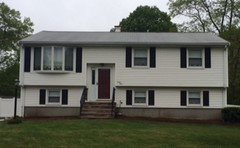
    Right there are the four pictures that nullify almost all the others ... saying the most with the least.

    Doing a little analysis, what's needed to improve "curb appeal"?

    What contribution does the Jap maple make to the overall scene?


  • 10 years ago

    lol

  • 10 years ago
    last modified: 10 years ago

    I understand. I know that the Jap. maple is the only thing in the front yard, so at this point it's the focal point, but I would like to tie in the foundation to create curb appeal, but I just do not know how to make that happen.

  • PRO
    10 years ago

    Which should be the focal point of this scene ... the Japanese Maple or the front entrance of the house?

  • 10 years ago

    Front entrance of the house

  • 10 years ago

    To my eye, the house would be better balanced/framed by planting another tree on the side with the mailbox and driveway. It would partially screen the cars and driveway and neighboring house, at least from the vantage point in the picture above. I would also plant the same groundcover on the outside of the walk to the driveway, capturing the lamp post and providing a visual sweep from the driveway to the steps. As it is, the steps look like the lead to nowhere (lawn). It looks like you need evergreen plants that grow about 18 inches to cover the foundation but not the windows.

    That said, if the bottom windows are bedrooms, I would go further and plan to have taller shrubs on the outside of the walk (and that would be far enough away to admit light to those rooms, but still give them a private attractive view, almost an interior garden..

  • PRO
    10 years ago
    last modified: 10 years ago

    Absolutely, the focal point of the street view is the house entrance.

    The Japanese maple is but a mere decoration ... and a poorly placed one at that. As its being maintained in the shrub form and is large, one of its functional potentials is for low level screening. But there's nothing behind it that you want screened. Where it is, it would be better in the tree form. (Making the change is a matter of pruning.) Given it's distance away from the house, I don't know why you see it as a conflict with another tree that's near the house.

    Since, other than the Japanese Maple, the lawn is more or less empty, I don't see how you think you can create curb appeal merely with foundation shrubs and small plants and no trees. It's never going to pan out that way. The house is pretty large and blocky. It can ONLY be trees that address this size by "framing" it so that it looks nestled into the surroundings.) The yard seems fairly large and open. No doubt, street trees would be helpful, also, to the overall street appeal.

    You could use some screening from the brown house near the left lot line. That would help your house look better. That's probably true, too, for the yellow house near the right lot line, though I can't see it.

  • 10 years ago

    Thank you Yardvaark. So given what you're saying is the basic plan still the best option for the front foundation along with the groundcover recommendations? So, I can work off that photo, correct?

  • 10 years ago

    of course if you're looking to improve curb appeal in order to sell the house now, new trees will not help except to show evidence that the property has been landscaped. Is there a landscaping equivalent to stagers?

  • PRO
    10 years ago

    You can work off the photo, but -- as always -- it needs to be converted into a PLAN first ... a plan being, more or less, a map of your yard. It allows you to place the plants in the right place. Just draw the components of the yard -- house, walk, drive, trees, lamp post, etc on a piece of graph or plain paper, measuring everything out in order to keep it in relative scale. 1"=10' is a good scale to work with. You could also use 1/8"=1' or 1/4"=1', though the latter might require a fairly large piece of paper. After you get the base information down, you can start drawing where plants would go. Do this on copies of the original or use tracing paper in order to avoid lots of erasing. One tip: don't draw individual plants unless they are standalone specimens ... like a tree or shrub that stands alone. First draw the bed, then draw the shapes that the plant collections occupy within the bed.

    If you have a survey, you can begin with that as the basis of the drawing as it will show the location of the major constructed elements.

    As I mentioned previously, you can clutter up the simple scheme I gave you as much as you like, but keep in mind that when you do, the end result will look cluttered, and require more maintenance to keep up with. The scheme I offered accomplishes your basic goals, but allows you a great deal of control of its ultimate "flavor" through the selection of plant materials. You have options for tweaking bed shape and other details, and adding some "punctuation" (those special plants that excite you and you can find a good spot for.)


  • 10 years ago

    Vstavay: Can I reach out to you via email. I would like to show you a sketch and see what your thoughts are?