

when will kale seeds be ready ??
i have a few kale plants that overwintered.they were like a foot high in the spring and i picked leaves to eat most days.now they are like 4 feet tall, have bolted and are covered with hundreds of seed pods that look like tiny green beans.the seed pods have been there like a month.but have not turned brown or anything.i opened one up yesterday to look at the seeds.they did not look mature to me but what do i know ? a few were brown but they all looked moist not dried out at all like most seeds.i don't want to pull these plants til after i harvest the seeds but the plants are huge and will need the space for planting other things.
Comments (26)
 10 years ago
You just have to be patient and wait for the seed pods to turn sort of the color of straw. How long it takes them likely depends to some degree on how hot or dry it is or isn't. I get quicker browning of the seed pods and quicker drying when it is our usual hot, dry, summer weather. In spring, autumn and winter, some seed pods can be very slow to dry out and some seeds can be very slow to mature. Patience is the only answer. The seeds inside the pods will be black when mature. You have to keep a close eye on them because once the pods start to turn from green pods to brown pods, they can shatter and burst open quite quickly and quite easily. One way to work around that is to cover some of the seed pods with little fabric bags---the gossamer bags sold on the wedding aisle at places like Wal-Mart or Hobby Lobby work well for this purpose as they allow air flow but, if tied close near the stem, also catch the seeds if the pods shatter. You also can buy seed bags from companies that sell seed-saving supplies. If it wasn't raining so much, you could use small brown paper bags, but I wouldn't try that until the rain goes away, and by then your seeds should be mature.
I always find myself lacking in patience when it comes to letting older plants hang around long enough for seed production. Often, I just leave a plant or two, especially with something like kale, because you can get so many seeds from just a few pods....and nobody I know really needs hundreds or thousands of kale seeds, so you don't have to let all the plants go all the weed to mature seed if their space is needed for a succession crop. I personally would prefer to keep as much of the garden in full production as possible, so if I already have enough kale seeds for the next year in storage, I don't bother saving new seed every year. Sadly, every plant left going to seed in the garden absolutely is taking up space where something else could be growing that would produce an edible harvest, so you have to find a balance between producing seed and producing edible crops. I often will put plants for seed saving on the very edge of the garden at planting time, so it is easier to leave them alone there to set seed later on. So, even if the rest of the kale is in Raised Bed #1, a couple of plants might be planted elsewhere along the garden fence so that they can stay there and go to seed long after the rest of the kale is harvested and the plant residue is on the compost pile. This year, the kale I left to go to seed was growing in a container, so I just moved the container out of the way and put it up against the garden fence in an out-of-the-way place. That way it isn't in my way every day.
Be careful about letting something like kale or lettuce go to seed without collecting all the seed in a timely manner. If pods scatter and the seeds fall to the ground, you'll be weeding out a million seedlings the following season. I have a perpetual forest of dill because I never get all the seeds before some drop to the ground. I don't mind having it, but the dill will come up in every square inch of soil it can find. Right now I have a lot coming up in a tomato bed, so I'm gonna yank those out of there. That specific bed hasn't had dill grown in it for the last 3 or 4 years, but apparently there's still some seed around from those years.
leava thanked Okiedawn OK Zone 7 10 years ago
LOL, I'm ok with lettuce weeds (which I have) and dill which has never grown well for me is coming up as volunteers. I had a kale plant I adored and wanted seed from, but wind and aphids killed it. I remember waiting for the collard seeds to ripen last year, and it seemed to take forever.
The seed saving books I have read say long term saving of brassica requires a lot of genetic material from at least a dozen plants. They recommend a nursery bed, grown for the purpose of saving seeds, isolated for purity. Then one type a year gets grown for seed. It isn't practical for a small garden. While it would eventually give you a land race, I think saving from good plants is important and if quality declines from lack of genetic diversity, you buy new seeds. Not entirely sustainable, but seedaholics need an excuse to buy more seeds. Of course, if you are trying to save an heirloom from extinction, the nursey bed would be a good choice.
leava thanked AmyinOwasso/zone 6bRelated Professionals
Florence Landscape Architects & Landscape Designers · Saint Joseph Landscape Architects & Landscape Designers · Plymouth Landscape Architects & Landscape Designers · Cumberland Landscape Contractors · Sedalia Landscape Contractors · New Braunfels Landscape Contractors · Lebanon Landscape Contractors · Hackettstown Landscape Contractors · Merced Landscape Contractors · Spokane Landscape Contractors · Columbia Accessory Dwelling Units · Spartanburg Accessory Dwelling Units · Middletown Accessory Dwelling Units · New London Accessory Dwelling Units · Vancouver Accessory Dwelling Units- 10 years ago
I didn't even mention the need to save from a diverse and wide plant population because I know Leava doesn't have a lot of space in which to leave a bunch of plants sitting around forever maturing seed. I also assumed she only had one type of kale and didn't have to worry about crossed seed.
Life in a home garden can get really complicated really quickly in terms of seed saving if a person has limited space and also wishes to meet the requirement to save seed from many plants. As you noted, Amy, it just isn't practical in most cases for a home gardener to try to use all the best possible practices for saving seed. It also is hard to get the distance isolation needed for pure seed, especially if wild brassicas grow in the surrounding pastures.
I used to save a lot of seed from everything...herbs, flowers, veggies.....and then, after realizing how much time I spent trying to isolate for purity, trying to keep some few plants of each type going long enough to save seed without tying up whole beds for a prolonged period, then drying the seed, separating it from its pods and threshing it or winnowing it as needed, packaging it up, labeling it, and storing it, I decided I have better ways to spend my time. There's just a limit to how much one person can do in one year, and my garden maintenance and food preservation easily would keep two people busy, but there's only one of me. I could save seed if I had to do it, but I generally just don't choose to spend my time that way any more.
- 10 years ago
This is SO true. I started out thinking I would save seed and make the garden self sustaining. I quickly realized I am not young enough for that. And there are too many new things I want to try. I tried isolating tomato blooms last year and not one of them produced. I was in a group for trading and I ended up buying seed to participate in the group. While that is interesting, I got a lot of seeds that I won't use in our climate. It was worth it for the ones I am trying, but I am looking at buying seed until I figure out this bagging stuff. I saved that collard seed last year and I think that is what I planted this year. I will have enough of that seed to last years. I saved all my PEPH last year because when I went to buy seed they didn't have any. I save cosmo seeds, because they are so easy, and I don't necessarily want them volunteering where I plant them. I wanted that kale plant's seed because it survived the winter so well and it was pretty as a flower (purple). I am sad about that. I will likely only save seed from special plants in the future.
leava
Original Author10 years agoi am a very casual seed saver...actually on these plants all those pods happened almost before i noticed.then i thought the seeds would be ready relatively soon so why not save them.now i am conflicted.aphids claimed one kale plant big time and pulled it and disposed of it way far away.one of the problems i have is that i like unusual varieties of greens to try and it is hard for me to tell kale and swiss chard apart at times.i am curious about saving seed in case our country goes into a really bad time and i need to do it.i have a box of seeds from johnnys and a package of packets from bakers seeds with more seeds than i could ever use this year and the bin of old seeds of good intentions.i was wondering this too.if you save seeds from a hybrid plant i realize kind of anything can come from that seed.can it produce something one should not eat ??? one reason i am such a higgledy piggledy gardener is that for over 15 years we have rescued feral cats and kittens and spring being kitten season bottle feeding kittens and raising them interferes big time.have 3 babies as we speak.then my daughter is getting married in less than a month too so it is amazing i get anything done lol
- 10 years ago
leava,
I had some mustard plants that went to seed and I left them because of the yellow blooms for the bees & butterflies. They all had seed pods and I considered saving them for seed. Day before yesterday I finally decided to pull them up to get them out of my way, I layerd them in the middle next to where they had grown, then yesterday afternoon I went to move them and to my surprise there was seed flying every where. It was dry and looked like good seed. You might pull some of your kale and hang it upside down where the sun can dry it over a newspaper and wait a couple of days then crush some of the pods to see if you have dry seed. The newspaper will catch the seed. I may have mustard come up all over the place next fall. This may not work but it never hurts to try.
leava thanked authereray  10 years ago
I am trying that too with several different plants that were about half dry seed pods. I hope it works.
leava
Original Author10 years agoautheray i will try it.all seed pods still green with no signs of turning and this week i start planting seeds in that bed.i made myself plant all my plants first which were not many.those kale have targets on them now lol
- 10 years ago
Leava, When you save seed from a hybrid, you often get a range of different things depending on the complexity of that plant variety's breeding in the first place. So, if you saved 50 seeds from a hybrid and grew them out, you might get 50 different things. Actually, you'll probably get less than 50 because some of the plants probably will be similar to one another, but my point is that you have no idea what you will get. Often, with seed saved from hybrids, you get a plant that looks a lot like the parent plant and might produce a harvest that seems similar, but which is lacking in important qualities like disease resistance. Other times, you get all kinds of plants that do not produce what you're looking for. For example, many people have tried over many years to save seed from SunGold tomatoes and most have not gotten anything like SunGold fruit from their plants.
Somebody who deliberately wishes to dehybridize a hybrid sometimes can succeed by repeatedly saving seeds, growing them out, and then roguing out any that do not give them a plant very similar to the original. By doing that, often for many plant generations, they can eventually end up with a dehybridized version of their original hybrid (but for legal reasons they probably need to call it something else since it is not identical to the parent hybrid plant). And, I should add, that sometimes when folks try to dehybridize a so-called hybrid, they often get exactly the same plant from the very first generation of saved seed, leading to suspicions that that original plant, which is called a hybrid, seems to be a stable open-pollinated variety and not a hybrid anyway.
I have had success doing what autheray suggests sometimes, but usually when I do it, it has been with flowers. I don't know why it wouldn't work with veggies. Often the seeds are drying down inside the pods and the pods just won't/haven't taken that final step of turning brown. Or, sometimes, some of the seeds are viable inside a green pod already but all of them are not yet viable, so the pod hasn't turned brown. That means that even from a green pod, if you open it, you may find some dry, viable seeds inside. This year, with it being cool and mild late into May, that may be slowing down the rate at which seed is maturing.
Dawn
leava thanked Okiedawn OK Zone 7 - 10 years ago
leava,
I never gave a thought to Kale being a hybrid. Okiedawn is right about you might get all kinds. The mustard I was telling about was supposed to be open pollinated. I like heirloom vegetables as you can save them for seed if you want.
Macmex is telling it right about critters knowing when seeds are about dry and they will come and gather them for you.
- 10 years ago
There are some hybrid varieties of kale (often it is the very pretty and frilly or curly looking ones) and some OP varieties of kale, so a person can save seed of the OP ones and expect it to come true, except it might cross with certain native brassicas that grow wild here or it might cross with any other Brassica oleracea.
I agree that critters will help themselves to your seeds (and your fruits and veggies!) about a day or two before you intend to harvest them. I don't know how they know when seeds, fruits and veggies are almost ready, but they know and then they come steal them.
 10 years ago
<Smacking myself in the forehead> I hoarded about a dozen of those organza bags for a year and finally threw them away last Christmas break. Oh, the Columbine seeds I could have kept!
- 10 years ago
leava,
It rained here night before last and then we got another rain shower yesterday morning. Well guess what I found when I was out in the garden picking lettuce just now. There were little mustard sprouts coming up every where. So some of the seed from my bolted green podded mustard must have been good. So may be you still have a chance at some good seed.
- 10 years ago
I feel like I spend half my life pulling out volunteers that sprouted from something I let go to seed, but it is good to know your green mustard pods did have viable seed in them. I have gotten better about not letting things go to seed randomly unless I've bagged the seed pods to catch the seeds, and that does cut back somewhat on how many volunteers fill my garden. Last year I must have missed some southern peas in all the flooding and I guess birds or something else spread the seeds around. It wasn't just floodwaters spreading them because I have southerns peas sprouting everywhere, including in raised beds at a higher grade than the area where I actually had southern peas. I've never yanked out and tossed as many southern pea plants as I have this year. I leave the ones I can, but there's too many of them to leave them all, especially when they pop up in tomato beds.
- 10 years ago
Okiedawn,
I really started out just letting the mustard go because it was flowering for the Bee's & Butterflies. When the pods started to form I kind of thought, well, I might just let them go to seed and save some. But like leava said they just kept staying green and not drying. I had some okra plants that needed a place to go so I decided to pull the green mustard plants out and plant the okra, I pulled the mustard plants out and layed them in the middle between the rows never thinking about the seed. After a few days laying in the hot sun they turned a tan color, I decided to pick them up and move them to some place else when the pods started shattering every where, If I had know the seed would have been any good I would have tried to save some of them. How do you bag something like this? What do you use? It is so hard for me to through away volunteer pea plant. My Grandmother was a peaaholic. She thought that Cowpeas were the salvation of the world. I guess they did save hers a time or two. I use a small garden shovel to dig them up and move them to the sweet corn where I plant them between the corn stalks, it doesn't bother the corn, they seem to get along well. After the corn is done I just let the peas have the space for the summer and pick as many as I can.
- 10 years ago
Those little seed pods on the mustard are edible, when young. Like radish pods, throw in stir fry, or cut the buds before the flowers open, like broccoli. I really like collard buds that way. I got more buds off my collards than I did off broccoli this spring. I may not bother with broccoli next spring.
- 10 years ago
Authereray,
I use organza bags sold in craft stores and big box stores. They let enough air flow through that your seedheads don't mildew, and if you tie them snugly around the stem, the seeds all get caught in the bag instead of just falling to the ground or blowing away on the wind. If you get bags that don't have a drawstring, you can enclose it around the plant stem with string, zip ties, rubber bands, wire, etc.
At a big box store like Wal-Mart, these bags may be found in various areas depending on how the store is stocked. I have seen them sold on the wedding aisle as bags to hold rice or birdseed or whatever the wedding guests are going to toss at the departing newlyweds after the reception. I've seen them sold sometimes on the gift bag aisle as little gift bags, or on the party aisle as bags to hold party favors. Sometimes they are closer to the craft or sewing section. You also can buy a package of the tulle circles sold on the wedding aisle to tie into little rice bags and instead can tie one snugly around a smallish flower with string and catch the seeds within it. I think the ones I bought came in a pack of 50 for a few bucks.
Here's an example of the kind of organza bags you can buy:
With some plants that have a fairly narrow head, you can use knee-high stockings, which will stretch quite a bit to accomodate a larger flower. Or, you can even buy bags from seed saving supply places--there are bags especially sized for corn, etc.
In a pinch, I have used a spice bag or jelly bag from my canning supplies.
Here's an example of some of the seed saving supplies you can buy:
Even though they are labeled as corn shoot bags and corn tassel bags, their sizes make them useful for saving seeds of many types. Here's another example and it has blossom bags that are similar to the organza bags I buy at Wal-Mart or Hobby Lobby.
Blossom Bags and More at Seed Savers Exchange
Small paper bags often are sold on the candy-making/cake-baking supply aisle with all the Wilton supplies, and paper bags work for seed saving if it isn't raining constantly. I don't use plastic zip lock bags because I'm afraid they would trap too much moisture and spoil the seeds, but some people just poke a few holes in them and use them. I don't know how successful they are with seeds saved that way.
It is hard to pull out a pea plant, but I've already planted 5 varieties of southern peas and still have 4 or 5 more to use to fill in space as other crops are harvested, so I can yank a volunteer somewhat guiltlessly, especially if they pop up in the tomato bed. There's not many volunteers that are allowed to hog space in the rows of tomatoes. Would my dad and grandfather be horrified that I was pulling up a southern pea plant that would produce a crop? I suppose so, but I don't remember either one of them letting volunteers stay in their neat and tidy rows either, so they must have pulled out or hoed out volunteers that popped up. Last year the constant rain was hard on everything in my garden, so when volunteer Colossus pea plants popped up in a garden pathway, I let them stay. I figured if they wanted to grow that badly, I should let them. Honestly, I thought the rain would rot them as the excess rain often sat in the garden paths for days, with the wooden edging around raised beds serving as dams to hold the water. You would't believe how many peas the pathway peas produced, but I had to step over them carefully every time I went down that garden pathway, always watching carefully for a snake hidden under the plant. I never saw a snake under a pea plant, but a crayfish lived there in the path near them all summer. It's always something!
Amy, I'm all for whatever works! There are years I love broccoli and years that I wonder why I planted it. It is just such a space hog and I always feel like we are in such a race to beat the heat with it. My collards also get huge and take up a ton of space, but they always look good, even though they are bug magnets.
Dawn
- 10 years ago
I kept waiting for the collards to get bugs or cabbage worms, but they didn't. Everything else in that bed got aphids. DH really likes collards, and I am beginning to appreciate them for their hardiness.
- 10 years ago
My collards get munched on by random insects in very early spring but they just outgrow the damage. Grasshoppers seemed to eat them a lot this year, but it didn't matter because they put out healthy new leaves to replace the ones with holes chewed in them. It has been a great pest year. Either most pests haven't shown up at all, or they've been really easy to deal with when they did show up. I've never had a year when the brassica pests and the Colorado Potato Beetles both failed to show up in the same year. It has been great.
The only two pests that really are a problem right now are grasshoppers and spider mites, both of which usually are more of an issue in drought years. We'll never be free of them, though, as the surrounding fields are full of them. For all the spider mite damage I am seeing in my garden, it is ten times worse in the pastures outside the garden, so I largely ignore them. If I fight them inside the garden and even manage to repel them or kill them, more just move in. With the weather being abnormally cool and rainy for so long, it seems like more grasshoppers hatch daily, and I've already used Semapore and cannot tell if it made much difference. I do think the grasshoppers are the reason my garden is full of song birds. I think the song birds are eating the little grasshoppers, so hopefully the birds will help get the hoppers under control.
 10 years ago
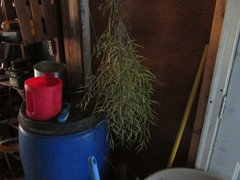
I harvested a sheaf of purple kale seed stalks yesterday. They were starting to show some brown on the pods. So I cut them and hung them inside my tool shed.
- 10 years ago
Do you hang them in a paper bag or something to keep the seeds contained if the pods split open?
- 10 years ago
I tied the stems together and hung them in the shed, in the shade. Last year I set the whole bunch down into a plastic feed sack. But they never shattered. Instead, someone threw the sack out while cleaning the shed! Once they are dry I will put them inside a plastic feed sack and stomp on them a bit, to shatter the seed pods. Then I'll dry them a bit more and bottle them.
leava
Original Author10 years agopods turning brown.the one plant especially is ginormous with a kajillion pods.and then 2 or 3 others.going to pull the plants today.
- 10 years ago
George, That is what happens when I am trying to save feed bags for something. Somebody comes along and spots them and cleans them up and tosses them!
Leava, Yay! I'm glad your seeds are finally turning brown. If all those seeds are viable, you're all set for a few years in terms of kale seeds.
Dawn




Macmex