

Is it RMV?
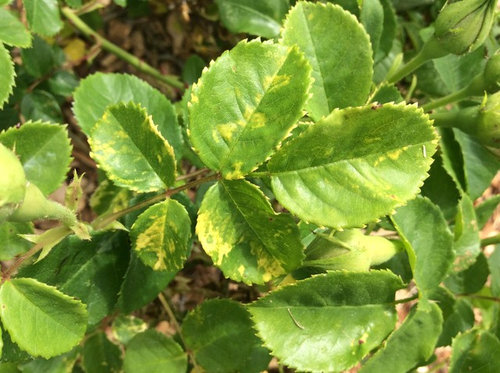
Saw this while squishing saw fly larvae on one of my grafted Princess Annes. Purchased from David Austin spring of last year.
Comments (66)
 10 years agolast modified: 10 years ago
The following was stated:
"jerijen(Zone 10)
You have to remember that we in the U.S. "kindly" shipped virused roses to Europe. And in Europe, it was not regarded as a problem -- even when we in the U.S. started to realize that it WAS a problem."
H.Kuska comment: concerning the "in Europe, it was not regarded as a problem."
No documentation from scientific sources for this statement.
This New Zealand Ph.D. thesis gives a world wide view as of 1983:
http://mro.massey.ac.nz/bitstream/handle/10179/3563/02_whole.pdf?sequence=1&isAllowed=y
---------------------------------------------------------------------
My rose virus information can be found at:
Related Professionals
Albany Landscape Architects & Landscape Designers · Columbia Landscape Architects & Landscape Designers · Greenfield Landscape Architects & Landscape Designers · Huntsville Landscape Contractors · Morgan City Landscape Contractors · Shreveport Landscape Contractors · Clarksburg Landscape Contractors · Hartford Landscape Contractors · Plattsburgh Landscape Contractors · Longview Landscape Contractors · California Home Builders · Sedalia Home Builders · Springfield Home Builders · Twin Falls Home Builders · Cody Home Builders- 10 years agolast modified: 10 years ago
The following was stated: "Oh, Henry, come now . . . a 1983 study . . . REALLY??? Pfffft!!!"
H.Kuska comment: I picked an earlier thesis as I thought that the statement: ("And in Europe, it was not regarded as a problem -- even when we in the U.S. started to realize that it WAS a problem.") was referring to what what happening in that time period and earlier. Normally, thesis (particularly Ph.D. thesis) have very complete historical sections.
I have given the most recent information (that I am aware of) about the known viruses in my link in my earlier post.
 10 years ago
And, once again, Henry quashes any sensible discussion about Rose Mosaic Virus and how to deal with the problem.
 10 years agolast modified: 10 years ago
Rose Mosaic viral disease(s) have been considered a problem for the industry in Europe since the 70s at least. Lots of effort has been put into producing virus free rootstocks, the use of clonaly propagated rootstock material has stopped (as far as I know) but the issue remains as lots of scion material remains virused. I myself have a few roses (mainly HTs) in my garden which I suspect as virused, all of them obtained during the last few years.. Most of those exhibit vein netting or oak leaf pattern chlorosis rather than the random chlorotic patterns usually associated with RMD in the States (as attested in the garden web forums).
I find it extremely puzzling that clonally propagated Dr. Huey rootstock is still used commercially on a wide scale in the States.
chris209 (LI, NY Z7a)
Original Author10 years agoHey guys, I did end up calling DA about this, and they asked that I e-mail them a picture of the plant. I got the below response:
Hi Chris,
I am sorry I did not know about this during our season, as I could have sent you another.
I am happy to send you a replacement spring 2017.
I'm not too sure I want a replacement, since I don't plan on removing the current plant, and don't have room for it elsewhere, but it's nice to know they responded promptly and are willing to replace him it.
-Chris
- 10 years ago
The following was stated: "I'm not too sure I want a replacement, since I don't plan on removing the current plant,......"
H.Kuska comment: since you are in zone 7, please let us know if any of your nearby roses develop virus symptoms in the cool part of fall or next spring.
- 10 years ago
I purchased my first virused plant, Evelyn, directly from David Austin, twelve years ago. Since then I have acquired three more virused plants, two were Evelyn roses, plus a Princess Alexandra of Kent, over the past four years. These roses were purchased from the top nursery in the area and came in five gallon "official" David Austin pots, along with their Austin tags. I'm sure they came to the nursery from DA. My point is-- this virus is everywhere, and it always seems to be DA only (for me, at least). I don't think there is any way to get away from it, replacements or not, as long as it's a patented, grafted Austin, and grown by Austin. They need to own up to their problem. Who do they think they're fooling by replacing a virused rose? The replacement is quite likely to be virused as well. DA needs to stop its replacement song and dance, and try a little honesty with their customers.
Henry, I have never had a rose growing near a virused rose develop virus symptoms, but a new heliopsis, planted near a virused Evelyn promptly began showing virus symptoms this spring, and still does. Weird, huh? Diane
- 10 years ago
No one's ever demonstrated a case of RMV transmitted in a garden setting. What I HAVE seen, though, is roses that I knew had to be virused suddenly showing symptoms for the first time after as long as 20 years. It's usually happened when the plant was stressed to start with, for some unconnected reason.
This happened with my 'Sombreuil, Cl.' and with a 'Reine des Violettes'. And I am not kidding . . . 20 years for the RdV, and 20+ for the 'Sombreuil'.
The virus was there all along. I knew that. I was watching.
But, say I HADN'T known! Then, I guess I might have thought that the plant had just suddenly been infected.
- 10 years agolast modified: 10 years ago
Having said this, one should ponder that there MUST be a way of mosaic virii being transmitted in a natural way (most probably via some vector insects or mites) in some environment, rather than by grafting etc otherwise those virii would not exist in the first place..
- 10 years ago
Diane, Heliopsis and roses are both infected by tomato spotted wilt virus.
http://www.tandfonline.com/doi/abs/10.1080/03235408.2014.884827
https://sites.google.com/site/tomatospottedwiltvirus/
AND of course one or more of the other identified (or yet unidentified) rose viruses may also infect Heliopsis.
- 10 years agolast modified: 10 years ago
Nik, they spread easily in Prunus (peaches, plums, cherries), Malus (apple) and Pyrus (pear) via pollen and occasionally through seed. But they are not "native" in Rosa, and those means of spread have never been demonstrated in that genus. Indeed the only known (and only suspected) means of spread in Rosa is by graftage.
Austin's "virus" is definitely a common strain of Prunus Necrotic Rinspot Virus, and so tomato spotted wilt or other viruses should be of no concern to this conversation.
- 10 years ago
Thanks Malcolm. That's a far better explanation of the problem than I could have presented. 'Preciate it.
chris209 (LI, NY Z7a)
Original Author10 years agoSure thing Henry, however, the closest rose plant to the viruses rose plant photographed above is another Princess Anne, which for all we know may already be viruses. The only other rose near there is about 5 feet away, and I will keep an eye on it.
-Chris
- 10 years agolast modified: 10 years ago
The following was stated relative to spread of PNRSV in roses:
"Nik, they spread easily in Prunus (peaches, plums, cherries), Malus (apple) and Pyrus (pear) via pollen and occasionally through seed....................., and those means of spread have never been demonstrated in that genus. Indeed the only known (and only suspected) means of spread in Rosa is by graftage."
Concerning "those means of spread have never been demonstrated in that genus", please see: "https://sites.google.com/site/rosevirusinformation/home
----------------------------------------------------------------
Concerning "and only suspected" The November 2012 ARS Consulting Rose Manual states: "Some pathologists suspect that mosaic may be pollen transmitted which could prompt removal if other roses in the garden are valuable and not already
infected." see page X-8 and page X-9.http://test.ars.org/wp-content/uploads/2010/03/CR-MANUAL-2012-FINAL1.pdf
-------------------------------------------------------
I would also like to comment on the following statement: "But they are not "native" in Rosa".
It is hard to imagine how one could determine if they are "native" to roses (whatever native means). I suspect that one observation that would support a possible definition of "native" is that PNRSV has infected roses long enough such that roses have developed an immune system reaction against PNRSV.
I am interested in any scientific documentation that is available that PNRSV is not native to roses.
- 10 years ago
As Jeri stated on May 20, "And,
once again, Henry quashes any sensible discussion about Rose Mosaic Virus and
how to deal with the problem."But realize that
never in the history of rose growing, anywhere on the earth, has EVEN ONE rose
garden seen demonstrated contagion of the viruses causing rose mosaic in the USA, from one
plant to another. Not one. Not ever. The ONLY demonstrated spread in the field
has been at very close planting distances in a research project at Davis, where
we know the plants had formed natural root grafts with their neighbors. There
is NO evidence that that EVER happens at garden planting distances, in genus
Rosa. Not here in the hot South (where
all we stupid/ignorant people live) nor in the cold North (where all the
smart/educated people live, and where the virus is far more wily and fiendish). None!
Not once! Not ever!Someone with Austin's was quoted on this forum in July 2012
(when this whole "controversy" was already ancient and had been
beaten like a dead horse): "I can
confirm that our varieties have not
gone through the virus indexing program at UC Davis or the heat treatment
program at Florida Southern College. The major problem is that the Rose
Growing Industry does not have a clear understanding of how the Rose Mosaic
virus is spread. A lot of research has been carried out in this field but no substantive conclusions have been reached. Our decision not to use these two above
treatments is that there is no proof that they eradicate Rose Mosaic Virus.
We see many rose growing fields in the United States throughout the course of a
year. It is true to say that we have seen evidence of Rose Mosaic Virus in all
of these crops.
We
find it most effective to rogue out any virused plants in the field to keep the
virus to a minimum."
How very unfortunate that they have been led to believe that. What they
conveniently failed to notice is that the "controversy" was entirely
made up by one individual person, who is not a plant disease researcher, who has never actually worked with this disease at all, but
who, for years, has continued to try to obfuscate the issue, over and over and
over. On the other hand, nurseries who
have actually dealt with UC Davis, or us, or the former program at Oregon
State, over those 30-plus years, have always (so far as I know without
exception) found that they got healthy plants that then remained completely free of mosaic
for as long as they grew the plant, assuming they didn't graft infected tissue
back onto it. And this certainly includes many people and nurseries in cool or cold climates. It is unfortunate that "problem"
nurseries like Austin can still claim that there is any controversy or
uncertainty, and therefore do not clean up their act, specifically and uniquely
BECAUSE of this one person's arguments, which are completely without merit. But there is no controversy. The fact is that we really do know exactly
how to control rose mosaic. We have no
reason at all to think that it spreads, by any means, in gardens, ever. The cold-vs.-hot climate arguments were made
up by this same person -- they are not true!
No one who knows anything about this disease believes them to be true.Now prepare
yourselves for the onslaught of citations of 30-plus-year-old papers,
non-refereed papers, papers dealing with other viruses, papers dealing with
these viruses in genera other than Rosa, papers that quote hearsay, papers
about RNA silencing, claims that we just don't know how to test for virus, made
up conclusions from misreading a paper, etc., etc., etc. -- the thing that will
tie them all together is that they will not in any way disprove my statements
above, and I would challenge you to find an actual plant virologist or rose
disease researcher who would disagree with that. You won't, because there aren't any.So why beat one's head against a wall again (and
again, and again, and again)? It is in
the hope that disinterested readers will do some serious thinking for
themselves, look at legitimate literature on the subject, and realize that fanatical
nuttiness cannot and must not be allowed to trump scientific truth. This is such a stupidly easy disease to manage and prevent! That there are nurseries who still don't believe that is a travesty. That they've been led to believe that there is any real argument within the scientific research community is evil. I'm appalled, as always. - 10 years ago
Concerning whether my papers are taken seriously in the rose virus world: If one does a Google Scholar search for PNRSV and roses, a 2013 published reviewed scientific paper states:
"PNRSV is known to be transmitted mechanically,
by root grafting and by seed (Abdel-Salam et al. 2008; Golino et al. 2011). The
virus may be transmitted by pollen in rose although this hasn’t been fully
ascertained (Kuska 2003). The high incidence of PNRSV in New Zealand is
unsurprising as it is also vectored by the Western flower thrip (Frankliniella
occidentalis) which is reportedly spread throughout New Zealand (Greber and
Teakle 1992; Teulon and Nielsen 2005) and is known to infest many glasshouse
crops (E. Milleza, unpublished data)."H.Kuska comment: Please note that the words had to be approved by the authors, outside reviewers, and the editor. If there was: "We have no reason at all to think that it spreads, by any means, in gardens, ever" why cite my paper?
-----------------------------------------------------------------------
The following was stated: "On the other hand, nurseries who have actually dealt with UC Davis, or us, or the former program at Oregon State, over those 30-plus years, have always (so far as I know without exception) found that they got healthy plants that then remained completely free of mosaic for as long as they grew the plant, assuming they didn't graft infected tissue back onto it."......................." I would challenge you to find an actual plant virologist or rose disease researcher who would disagree with that. You won't, because there aren't any."H.Kuska comment:
Title: Re-emergence of Rose Mosaic Disease in Florida Nurseries and Landscapes
The article includes the following statement:
"1.Always, start with clean stock plants and ideally, virus-indexed stock. However, be aware that RMD has been reported from healthy virus-indexed material in the past. The reason of why RMD is found in certified virus-free planting stock is not yet known."The rose virus researcher who authored the above has been selected to do research for the government funded rose rosette virus program.
--------------------------------------------------------------------
Now back to one of my earlier points concerning what appears in the 2012 edition of the ARS Consulting Rose Manual. I was not involved in the writing of that. Please note that the statement is: "Some pathologists suspect" not "only Henry Kuska suspects".
---------------------------------------------------------------------------
I am still interested in this from my earlier post in this thread:
"I would also like to comment on the following statement: "But they are not "native" in Rosa".
It is hard to imagine how one could determine if they are "native" to roses (whatever native means). I suspect that one observation that would support a possible definition of "native" is that PNRSV has infected roses long enough such that roses have developed an immune system reaction against PNRSV.
I am interested in any scientific documentation that is available that PNRSV is not native to roses."
- 10 years ago
"has been reported...In the past" -- same old hearsay hooey! "Selected to do research for the government funded rose rosette virus program" -- an unrelated disease, not relevant to this discussion. Note that he has NOT done any research on mosaic. And of course as usual, pointing out what PNRSV does in genera other than Rosa is irrelevant and just added to confuse readers. Also for a nursery to report "return" of the disease does not rule out the concept that the nursery budded certified clean scions onto uncertified rootstocks, or vice versa. Especially in the past, it was rather amazing how nurseries misinterpreted the movement of the disease -- much as we did when first learning about HIV and its spread. Some nurseries bragged that they used certified scions and still had mosaic, yet on checking into it, they were using known infected rootstock, and it had not occurred to them that that was a problem (or at least that's what they led one to believe).
As for the "Some Pathologists Suspect" in the ARS CR manual -- first, note that in the past, HK has demanded nothing but refereed journals as valid publications; something the CR manual certainly is not, and so by his own rules, is not worthy of discussion here. And they are likely quoting hearsay that they got from one of his plethora of articles. Of course the northwest Florida extension publication is also not refereed and expresses the opinion of one person who has never worked with the disease.
Note that the pollen spread article is by HK himself and self-admittedly does not demonstrate spread by pollen in roses.
As for the disease not being native in Rosa -- since the disease was entirely unknown in roses Europe until we sent it to them, yet since PNRSV is very definitely native to Eurasia and was known in fruit tree crops there, and since the disease only showed up in the US after we started using vegetatively propagated rootstocks, it should be obvious that the disease is not native in Rosa. Of course HK will now provide countlessly many articles to disprove all this, but read them carefully, folks! They do NOT disprove! As always, they are- About the wrong virus
2. About the right virus, but in the wrong crop
3. Grossly misinterpreted results (by HK) resulting in invalid conclusions
4. The topic of hearsay or unsubstantiated innuendo
5. Outright lies
- 10 years ago
The following was stated:"As for the disease not being native in Rosa -- since the disease was entirely unknown in roses Europe until we sent it to them, yet since PNRSV is very definitely native to Eurasia and was known in fruit tree crops there, and since the disease only showed up in the US after we started using vegetatively propagated rootstocks, it should be obvious that the disease is not native in Rosa."
H.Kuska comment. This is what I have written about when rose viruses were first observed (of course then they had no way of determining which virus a rose had - when does Malcolm Manners feel that PNRSV was definitely first identified in roses? - reference please, if possible).
https://sites.google.com/site/firstappearanceofroseviruses/home
------------------------------------------------------------------------
A
field that I have not yet written an article about is the determination of
how the rose PNRSV form(s)
differ and also are similar to the PNRSV forms that infect other plants. Hopefully, further studies of this type may shed some light on the evolution of PNRSV .A
Polish reviewed published paper is available in full form on this point.http://link.springer.com/content/pdf/10.1007%2Fs11738-011-0775-z.pdf
Apparently
there are at least 3 strains that have been isolated in roses: PNRSV-R1,
PNRSV-2, and PNRSV-3 with different infection
properties, for example: "The
PNRSV-R1 isolate seemed to be the most pathogenic. It
produced more severe symptoms on Cucurbitaceae plants
than PNRSV-R2 or PNRSV-R3. Abundant systemic chlorotic spots and leaf
deformation were found on Chenopodium
quinoa inoculated
with the PNRSV-R1 isolate (Fig. 4),
whereas PNRSV-R3 caused local symptomless
infection, and PNRSV-R2 did not infect this
plant."Addition
useful information:"The
highest similarity (98%) was found between the PNRSV-R1 isolate and a rose PNRSV
isolate from India (GenBank Acc. No. AJ969095), isolate from Malus sp.(GenBank
Acc. No. Y07568) and isolate from peach (GenBank Acc. No. U57046)."ALSO:
"Comparison
of the PNRSV-R1, PNRSV-R2, and PNRSV-R3 CP genes with the sequences of the PNRSV
isolates collected in GenBank showed a high degree of similarity and allowed to
classify all the isolates studied into the PNRSV-PV32 standard group
(Sanchez-Navarro and Pallas 1997).
Hammond (2003)
reported that the sequence analysis of the RNA3 CP gene of rose PNRSV isolates
RING 13, RING 25 and RING 26 isolated in France allowed to classify them into
the PNRSV-PV32 standard group. Similarly, the sequences of the CP gene of RNA3
of French rose PNRSV isolates MAJHO, MATI and NOIR also represented the
PNRSV-PV32 standard group (Moury et al. 2001).
Similar results were obtained by Yurtmen et al. (2002)
using PNRSV-R0 isolate from Italian rose cv. Mercedes. In the presented work,
classification in the PNRSV-PV96 standard group for sequences of the MP gene of
RNA3 of the PNRSV-R1 isolate was also established."
http://link.springer.com/article/10.1007/s11738-011-0775-z
A
graph (in tree form) that shows the different PNRSV standard groups, is
available at the following 2015 Brazilian
scientific, reviewed published scientific paper:Figure
1 Phylogenetic
tree of PNRSV isolates from rose and some Prunus species,
obtained with the MEGA 6.06 program, maximum parsimony method with 10,000
bootstrap replicates, based on complete nucleotide sequences of the coat (A) and
movement (B) protein genes. GenBank accession codes, host and geographical
origins are informed as well as the classification of PNRSV in three groups."http://www.readcube.com/articles/10.1590/0103-8478cr20141810
From above:
" Molecular analysis of
the MP and CP nucleotide sequences of a Brazilian PNRSV isolate from rose and
others from this same host showed highest identities of 96.7% and 98.6%,
respectively, and Rose-Br isolate was classified in PV32 group"-------------------------------------------------------------------------------------------
If my
interpretation is correct,so far there have been found to be 3 similar (but
differing in infectivity) PNRSV isolates from roses around the world. Also of
possible interest relative to the question of did the same virus "jump" from
other plants some time in history is the following statement which I gave
earlier in this post. " The
highest similarity (98%) was found between the PNRSV-R1 isolate and a rose PNRSV
isolate from India (GenBank Acc. No. AJ969095), isolate from Malus sp.(GenBank
Acc. No. Y07568) and isolate from peach (GenBank Acc. No. U57046)." H.Kuska comment: "malus is apple.The
above quoted statement is from:http://link.springer.com/article/10.1007/s11738-011-0775-z
- 10 years ago
The following was stated: "first, note that in the past, HK has demanded nothing but refereed journals as valid publications"
H.Kuska comment: where does this statement come from? As can be seen from my rose articles, I have used both.
Malcolm Manner had stated: " I would challenge you to find an actual plant virologist or rose disease researcher who would disagree with that. You won't, because there aren't any." My reply of what Dr. Paret stated fits all of these criteria
- 10 years agolast modified: 10 years ago
I think we need a return to reality here. As has been noted countless times, all such conversations get led in multiple, irrelevant directions by one person, apparently to avoid the issue at hand and to confuse the reader. Here's the topic and info on THIS conversation:
1. The original poster has a mosaic-infected rose from Austin.
2. Most (perhaps all?) Austin roses propagated in the USA have a common strain of PNRSV in them.
3. It is not spreading from somewhere weird; it is not a new, previously unknown strain; it is not moving cross-species; etc., etc., etc., -- it is a "normal" infection of RMV. I use the word "normal" to mean it follows classically the pattern of US rose nursery history and tradition.
4. It is being put into those roses in the "normal" way -- Austin is propagating with non-certified rootstock that carries that strain of PNRSV and they are directly infecting their new varieties as they enter that program.
5. This is exactly parallel to the old Roses of Yesterday and Today (RYT) situation of the 1980s and early '90s.
6. The company chooses to be "blind" to the nature of the problem because they have been told there is a great controversy concerning it; that mosaic control programs don't agree and don't know what they're talking about. Where did they get that idea??? It is, of course, not true. All of the existing rose therapy programs agree on all important points, and all have completely happy nursery partners, year after year.
7. What could and should happen is that Austin should clean up their plant material. The reason Vintage, ARE, Heirloom, Roses Unlimited, Rose Petals, etc., now carry many of those varieties, disease-free, that RYT used to sell infected, is that the scion and rootstock material were cleaned up and certified. We started distributing cleaned RYT varieties in the mid-1980s. I've yet to hear of a single case of mosaic "returning" to any of those varieties in the more than 30 years since. That's incontrovertible.
- 10 years ago
The following was stated: " All of the existing rose therapy programs agree on all important points, and all have completely happy nursery partners, year after year."
H.Kuska comment:
Davis has upgraded their rose virus elimination program so their program now may fit the above now and in the future, but the old program had admitted problems.
See the following 2005 link: http://fpms.ucdavis.edu/WebSitePDFs/CustomServiceInfo&Agreements/RoseCustomServicesDescr&Prices.pdf
Please see the section starting "important Note". Particularly the statement:
"Occasionally, disease may not be detected in only one growing season, so nurseries and growers are cautioned to inspect their plants carefully prior to propagation."
- 10 years agolast modified: 10 years ago
Organisation Européenne et Méditerranéenne pour la Protection des Plantes
European and Mediterranean Plant Protection Organization has a procedure for certification of virus free roses.
The following link will not click. However, if you copy and paste into an address bar it will come up.
https://gd.eppo.int/download/standard/100/pm4-021-2-en.pdf
It was written in 2002 so it does not include PCR testing, but I think that you will find it interesting concerning the need for caution regarding PNRSV testing in roses relative to other rose viruses.
Acrobat Reader page 8. Document page 161.
"Vector /Vecteur" "Seeds, pollen/semences, pollen"
Acrobat Reader page 10. Document page 163,
"3.2 Testing requirements
After the first year of growth in the nuclear stock, all plants should be
individually tested for PNRSV. Thereafter, nuclear-stock plants should
be tested every 3 years (or a third of the plants tested every year) for
PNRSV. The probabilities for reinfection by ApMV, ArMV or SLRSV
are rather limited during the life of the nuclear-stock plants but it may
nevertheless be advisable to retest the plants for these viruses at
intervals (e.g. 5 years) to cover the possibility that the viruses may be
introduced by human error."
The bold print was added by me. Please notice that PNRSV must be tested more often than the other viruses.
Acrobat Reader page 12. Document page 165.
"It is advisable to perform random testing for PNRSV at regular intervals
(e.g. every 1 or 2 years)."
Acrobat Reader page 13. Document page 166.
"Each year, the lot of seed mother plants should be
randomly tested for the absence of PNRSV. Every 5 years, the lot
should be randomly tested for the absence of ArMV and SLRSV."
H.Kuska comment: again PNRSV is singled out for more cautious testing.
Acrobat Reader page 17. Document page 170.
"Pollen transmission of PNRSV (which occurs in fruit trees) is suspected in rose."
 10 years agolast modified: 10 years ago
The online nursery I purchased this own root rose from told me there are more viruses than RMV and my rose could have gotten it from previously contaminated soil. I let them know that I had the planter made and filled it with new potting soil. They agreed to look at their mother plant. If the mother shows signs of a virus, they will send me a new plant from a different mother. I will contact them again tomorrow to see what they found. Is there a chance this is something else? Every leaf has a pattern on it and I wanted to be able to show this rose. It is Ingrid Bergman.
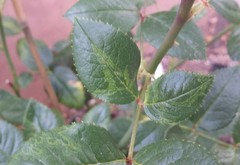
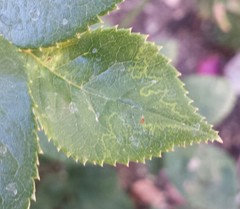
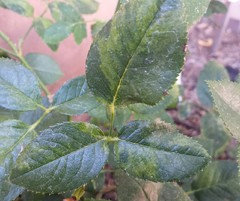
Jeri, they advised me to read this article that you wrote: Virus in roses: what is it? The article is very good in explaining the history and what it is. Thank you.
- 10 years agolast modified: 10 years ago
Jasmine -- looks like "standard" PNRSV rose mosaic. Whether they see symptoms on their mother plant or not, that's what it is.
Henry's most recent article -- published in 2002, of rules passed in 1997. Nineteen years ago. I wonder if they still do that? Since they give no evidence that pollen or seed transmission has been seen in ROSES, and since none has been documented since (and lots of people have looked), and since they are a plant protection organization undoubtedly involved in many different kinds of plants, I strongly suspect they got their information from Prunus and Malus data, and they've simply transferred their rules to Rosa. They're excellent rules for the fruit tree genera.
But to come back to the reality of 2016 in the USA, in ROSES, these remain true:
- No documented spread through seed, ever.
2. No documented spread through pollen, ever.
3. No documented spread in gardens, by any means, ever.
4. No documented spread in commercial nurseries, other than through grafting, ever.
5. The only documented field spread of ANY kind, ever, was in Davis's research program, in closely-spaced plants, known to have made root grafts.
So the problem, as always, lies in nurseries who don't get it (or who won't get it) and continue to use infected plant material. And once a variety is infected, the own-root nurseries are no longer immune -- if they get their cutting material from an infected plant, they, too, will end up with infected plants. One advantage of an own-root system is that they won't be moving the disease from one variety to another. But a nursery that grafts onto clean stock and never regrafts a plant on which the bud failed, also won't spread it from one variety to another. There's really no excuse for the continued introduction of the disease into new varieties (e.g., Austin's). That's just sloppy nursery practices.
 10 years ago
I like buying locally. I tried shipping and I prefer to see the roses, before I bring them home. Lucky to live close enough to Northland Rosarium to go over myself. But I did get some very nice gallicas from Rogue Valley Roses a few years ago! : )
- 10 years agolast modified: 10 years ago
The statement "Since they give no evidence that pollen or seed transmission has been seen in ROSES, and since none has been documented since (and lots of people have looked), ..." is interesting.
They clearly say (and I pointed to it in my post) "Pollen transmission of PNRSV (which occurs in fruit trees) is suspected in rose."
I have discussed pollen transmission.
https://sites.google.com/site/rosevirusinformation/home
I concluded: "I would like to suggest what I consider to be a definitive experiment regarding PNRSV transfer from infected pollen through rose seed to seedlings: hand pollinate a statistically significant number of fertile non-infected roses (that had their own pollen removed) with diseased pollen from an infected local rose (or several infected varieties) that is (are) known to cross with them (one should avoid importing viruses from other areas). The hand pollinated flowers would then be covered to prevent stray pollen from contaminating the chosen flowers (the seedlings raised from the seeds resulting from these crosses would have to be kept in an insect free environment, and sanitary procedures utilized to prevent "after germination" contamination in order for the experiment to be considered truly definitive). The experiment would have to be carried out in a cool climate or in a temperature controlled greenhouse. The seedlings would then have to be tested by one of the sensitive methods such as PCR as visible symptoms alone is not sufficient and even ELISA may not be sensitive enough to detect a natural infection."
My question: of the "(and lots of people have looked)" statement is: which of the many investigations that you know about meet the above criteria?
------------------------------------------------------------------------------------
Concerning seed transmission: in addition to what I have discussed in the above article concerning pollen (Sweet's papers)
"He reported that PNRSV was detected in the pollen of Peace and Queen Elizabeth roses, and in 1 % of two batches of seedling Rosa multiflora rootstocks. As is typical of scientific caution (or at least should be), he points out that finding the virus in the seedlings is not a definitive proof of transmission through the rose seed. However, his statement should not be interpreted that he did not find non grafted seedlings with virus; it means that he cannot be sure that the infected seedlings came from infected seeds (the virus may have infected the seedlings after they were planted (infected shears, infection from thrips, etc.)). What it does show is that there was transmission of PNRSV to non grafted seedlings in 2 different batches. ".
The following is in a recent report: "R. damascena seedlings obtained from a nursery in Isparta showed
no characteristic symptoms related to virus diseases and seemed to be healthy. However, one out of ten R. damascena
plants was also found to be infected with PNRSV."http://pub.jki.bund.de/index.php/JKA/article/viewFile/605/1515
----------------------------------------------------------
As I documented earlier the recent reviewed published New Zealand paper accepted the seed transmission evidence.
-------------------------------------------------------------------
In a damask rose study in commercial fields, PNRSV infections were also reported:
"Among the samples tested,
ArMv, PNRSV, and ApMV were found in 51.8%,
35.7%, and 17.8% of the collection, respectively.http://www.tandfonline.com/doi/pdf/10.1080/01140671.2009.9684247
H.Kuska comment: Since the damask rose is a hybrid that would not come true from seed, it is propagated from cuttings (or possibly recently from tissue culture). I did not find any references that stated that the damask rose plants were budded on an understock. I would be interested in hearing an explanation for the above PNRSV results based on a model that there is no natural PNRSV spread anywhere in the world.
One can ask: but if the roses did not originally have PNRSV, where did it come from? (A chicken and egg type question.)
The following published reviewed paper may answer that question.
http://www.cabdirect.org/abstracts/20153279018.html;jsessionid=81F4AE78D0A79344445174C13A86D718
Abstract: "Prunus necrotic ringspot virus (PNRSV) affects rosaceous plants worldwide. In 2011 and 2012, a total of 50 symptomatic bindweeds (Convolvulus arvensis) were collected from rose gardens in Alburz, Mazandaran and Tehran provinces of Iran. DAS-ELISA and pathogenicity tests revealed the presence of PNRSV, which was further confirmed by RT-PCR assays. In Iran, PNRSV was first detected in rose samples from Tehran province. This is thought to be the first report of PNRSV in C. arvensis in Iran."
-------------------------------------------------------
Infected weeds and roses share the same virus, PNRSV? Is this common. This link gives the results of a Google Scholar search using the search terms PNRSV and weeds:
https://scholar.google.com/scholar?hl=en&q=pnrsv+weeds&btnG=&as_sdt=1%2C36&as_sdtp=
------------------------------------------------------------------
ApMv is another rose infecting virus. I have attempted to paint a picture that the PNRSV virus science is very complex. Fortunately this very recent review of the ApMv has just appeared:
http://www.fupress.net/index.php/pm/article/viewFile/16295/16994
Please note the similarities of the two situations.
"The wide host
range of ApMV constitutes an inconspicuous virus
reservoir for virus spread through plant populations.
However, the mechanism behind virus dissemination
is still not fully understood. This factor should be
taken into consideration when designing and implementing
certification schemes to restrain or eliminate
potential contamination of stocks with this virus to
preserve healthy tree populations worldwide.
Although ApMV was first described more than
80 years ago, much of the information concerning
the virus is lacking or supported by contradictory
evidence. Areas where conclusive evidence of relevant
information is lacking include the mechanisms
by which an extremely wide range of unrelated hosts
(including lichens) are infected, the modes of transmission,
virus distribution within individual plants,
seasonal changes in its concentration and detectability,
resistance or tolerance of hosts, and interactions
with other viruses, bacteria or fungi." - 10 years ago
The following was stated concerning the European and Mediterranean Plant Protection Organization rules for roses:
" I strongly suspect they got their information from Prunus and Malus data, and they've simply transferred their rules to Rosa. They're excellent rules for the fruit tree genera."
H Kuska comment: PNRSV and ApMV are very similar viruses such that early on sometimes the one was diagnosed as the other. Yet this is what they said for ApMv:
"The probabilities for reinfection by ApMV, ArMV or SLRSV
are rather limited during the life of the nuclear-stock plants but it may
nevertheless be advisable to retest the plants for these viruses at
intervals (e.g. 5 years) to cover the possibility that the viruses may be
introduced by human error."
Please explain how your "suspect" is consistent with that statement.
- 10 years agolast modified: 10 years ago
Thank you Malcom and also Chris for starting this thread. Well, according to the nursery I purchased the virused plant from, their mother plants don't show signs of RMV and they checked 300 plants. They said it must be my soil. The planter was filled with new potting soil, but I do have some non-rose companion plants given to me by a neighbor. If it's possible for RMV to be transmitted by infected soil, then I suppose it's possible. But how long do viruses live in soil? I will fully replace the soil and companion plants just in case. The nursery was very generous and offered to send me another plant with only the cost of shipping, which wasn't much.
After reading Jeri's article, I wonder if it's possible for a virused mother plant to not show signs of the virus, but my plant did due to California heat and drought stress. Either way, I appreciate the nursery's willingness to help me. Since they have several mother plants, chances are good that that the replacement rose won't come from the same stock.
- 10 years ago
Jasmine, The nursery definitely sent it to you; it does not dwell in soil.
- 10 years ago
Lots of citations as I predicted. And as I predicted, they do not in any way disprove my statements. I should point out (as one who has worked with roses and other nursery crops in countries around the world), it is common, in non-English-speaking countries (and even those who do, e.g., India), to refer to any nursery plant as a "seedling." Unless they very carefully point out the source (i.e. "seeds") of those "seedlings," as well as the exact method by which they determined the nature of the infection, the statements can (and must) be discounted.
And whatever they meant, notice that we're talking mostly old literature from far-flung corners of the earth. As I've said before, there is no evidence of contagion in the USA. Why keep trying to find out "how" something is happening and how to prevent it, if it is not actually happening?
I'm off to beat my head on a wall now. - 10 years ago
"according to the nursery I purchased the virused plant from, their
mother plants don't show signs of RMV and they checked 300 plants. They
said it must be my soil."
No, that's total BS. The nursery that sold you this plant are lying. As Malcolm stated, the plant was infected with virus long before you received it. That is one nursery that cannot be trusted whatsoever.
And thanks to Henry for continuing to obfuscate the truth with citations and more BS. *sigh* - 10 years agolast modified: 10 years ago
jasminerose4u, C, the only way that I can think of soil passing on a rose virus is if the soil contained rose virus infected nematodes. We do not know which actual virus your plant has. If it is one of the nematode transferred ones, the nursery may be correct. However if your new potting soil (" I let them know that I had the planter made and filled it with new potting soil. " ) was a commercial mix, it should not have nematodes. If it was a potting soil that you prepared from local materials and did not sterilize, nematodes could be possible.
Two examples:
tobacco ringspot virus
http://lib.dr.iastate.edu/cgi/viewcontent.cgi?article=5484&context=rtd
http://apsjournals.apsnet.org/doi/pdf/10.1094/PHYTO.1998.88.9.885
AND
tomato ringspot virus
- 10 years ago
Jasmine, Your rose's symptoms are perfectly typical of PNRSV. Assuming you're in the USA, the probability is perhaps 99%. Add the possibility of Apple mosaic (ApMV) to that, and you're at perhaps 99.99999999999% probability that it's one or the other. So no, nematodes are not spreading virus to your rose. You definitely got it from the nursery, and it is highly probable that
every single plant they have of that variety is infected. They're just
likely not having symptom-promoting weather at the moment. And that
points out the futility of "rogueing" fields, as apparently they and
Austin are doing. It's not a worthwhile exercise.And before it gets demanded, no, I'm not going to cite papers with hard data to support my exact numbers. I will just say that in 30+ years of testing roses for mosaic diseases, I've never seen one that had those symptoms that failed to turn out positive for PNRSV (ApMV tends to be brighter and more speckly).
- 10 years agolast modified: 10 years ago
Thank you all for the information and answering my questions. I'm sorry if in my wanting to understand the source of my RMV infected plant, I gave the wrong impression of this nursery. I have purchased several wonderful rose plants from them, none of which have RMV signs and they have been through drought/heat stress for the past three summers. My call to them probably raised concern. I believe them when they say they haven't seen signs in their mother plants, because as Malcom said, their part of the country hasn't yet experienced symptom promoting weather. I received the Ingrid Bergman rose without markings in late winter/early spring. The signs didn't appear until we had a triple digit heat wave. The owner pointed me to Jeri's article, so they aren't hiding information. However, there is a lot of conflicting information out there (this thread proves that). On the web, I saw many rose societies recommending digging out the infected RMV plant and to replace soil or clear out all roots. Quoting from the American Rose Society, "RM is believed to be non-contagious in the field, except possibly through rare natural root grafts". The nursery owners probably want to believe and hope that my soil contained roots from a previously infected rose. Even if they didn't admit it to me, they have to know there is a likely possibility that one or more of their mother plants could be the culprit(s). I didn't expect a replacement plant. I told them that if they get additional reports from customers to please remember me. The owner said she wanted to help me now. They must have some confidence in their stock, otherwise they wouldn't send me another plant of the same variety. The replacement plant will be exposed to the same drought/heat conditions in my garden.
I had to look up the meaning of roguing fields = refers to the act of identifying and removing plants with undesirable characteristics from agricultural fields. What a daunting task when the mother plants show no signs of infection. A rose nursery has to endure many challenges and many have gone out of business. This nursery is a great source for hard to find roses. I have no problems buying from them in the future, because they have treated me well as a customer.
 10 years ago
Jasmine, There really is no confusion. The wonderful nursery seems to have sold you the plant with RMV. It happens. That is too bad they confuse things talking about the soil etc which is misinformation.
- 10 years ago
Thanks Sheila. I will pot up the replacement plant when I receive it and observe it through a summer or two.
- 10 years ago
The following was stated: "Jasmine, Your rose's symptoms are perfectly typical of PNRSV. Assuming you're in the USA, the probability is perhaps 99%. Add the possibility of Apple mosaic (ApMV) to that, and you're at perhaps 99.99999999999% probability that it's one or the other."
And then in the same post: "I will just say that in 30+ years of testing roses for mosaic diseases, I've never seen one that had those symptoms that failed to turn out positive for PNRSV (ApMV tends to be brighter and more speckly).
H.Kuska comment:
In the tobacco ringspot virus (a nematode transmitted virus) Ph.D. thesis that I linked to earlier, the author compared the visible symptoms to PNRSV rose infections" Most rose cultivars bud-inoculated with LPMV did not show
symptoms obviously different from roses infected with RMV, NRSV,
or TomRSV (97)."
(LPMV was the temporary name give to what was then called tobacco ringspot virus.)
-------------------------------------------------------------------
A still unanswered question is how common are these "new" viruses in the U.S.?
Hopefully, this question may be answered soon as at the end of this month the following topic is scheduled to be addressed. Title: "Rose viruses: Which ones are important?"
----------------------------------------------------------
After thinking about possible soil infection further, I remembered that ApMv has been found infecting lichen fungi. (https://en.wikipedia.org/wiki/Lichen)
See: http://botanika.bf.jcu.cz/lichenology/honza/publications/Petrzik_2013.pdf
----------------------------------------------------------------------
Cauliflower mosaic virus has also been reported in lichen so one may wonder what others?.
http://journals.plos.org/plosone/article?id=10.1371/journal.pone.0120768
- 10 years ago
I worry constantly about catching kuru from my garden soil. Or at least lassa fever.
- 10 years ago
"I worry constantly about catching kuru from my garden soil."
Gosh Malcolm, now I'm worried too!
- 10 years ago
And I!
Heavens to Betsy! Now you have ME worried about Kuru!
Is Lassa Fever less serious? Or should I Roundup the entire garden and plant Cacti? chris209 (LI, NY Z7a)
Original Author9 years agoI realized I never updated you guys on this. Austin roses did agree to give me a replacement for the infected plant. After explaining that I did not want another grafted plant, for fear of receiving another virused plant, they agreed to send me an own-root specimen, (not that we can say the odds are any better). Since they did not have any own-root Princess Anne roses available, they offered to send me an own-root plant of my choosing, so I selected Munstead Wood, which was on my list. It was the largest, bushiest own root plant I've ever received, I must say. I would encourage anyone who receives a virused plant from this company to be vigilant. Don't let them get away with it. Who knows, maybe in the long run they'll come around and change their practices. It is a shame because there are many Austin roses that are not available elsewhere.
-Chris
- 9 years agolast modified: 9 years ago
Very interesting thread and thanks for the update Chris. If all customers go and ask the nursery or Austin for a replacement then I'm sure those businesses will go bankrupt. There are lots of factors that can kill a rose fast and RMV is not just one of them ( ie canker, putting too much fertilizers, over or lack of watering, etc.) Back in 2012 I panicked when found out most of my roses particular the Austins were showing signs of RMV. And this forum did not help much at all apart from making me become more fearful and worried. So I got rid of them and replaced them from different nurseries. I literally spent heaps of money on replacing the roses that showed temporary signs of strange patterns on the leaves - but they still have RMV. If I was to go back in time I would just leave it as it is - this does not mean that I'm supporting some rose specialists bad practises - its because I don't want to go through the panic mode again. I also noticed a lot of nurseries pulled out older varieties of roses. I would hate to see a rose that I want to get in the future disappeared just because it has RMV. I also noticed these patterns showed up when insects like white flies surrounded them. Maybe insects could contribute to it I don't know. Also a bare rooted rose cost about 14 to 19 dollars - it not a lot of profit at all. And I had roses that died earlier than the ones that have RMV.
- 9 years agolast modified: 9 years ago
Tangles Long , your RMV experience would have more meaning to me if you told where you are located (some of the viruses that give mosaic symptoms on roses have a temperature dependent immune system),
https://sites.google.com/site/temperatureandrosemosaicvirus/home
Thank you.
.



nikthegreek