Software
Houzz Logo Print
salevene

Staking Correctly?

10 years ago
last modified: 10 years ago
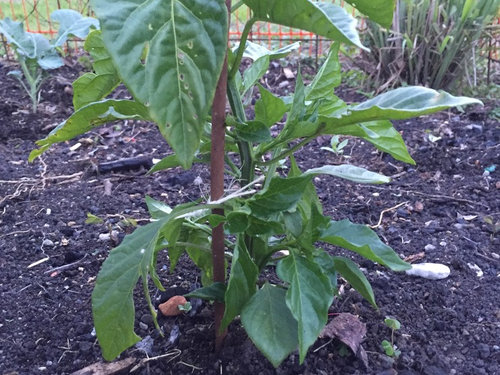
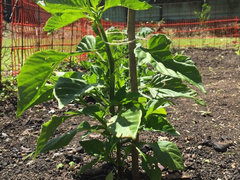
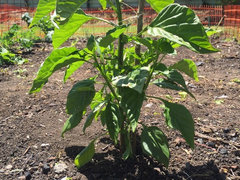
This is a peruvian yellow pepper and they can be lanky. So, unfortunately the way the garden is positioned, it can pull the plants. In this case it was leaning a lot just from wind (almost as if it was weak at the bottom where the stem connects to the roots, which I thought was weird). In any event, eventually I am going to put a tomatoe cage around it, but in the meantime:

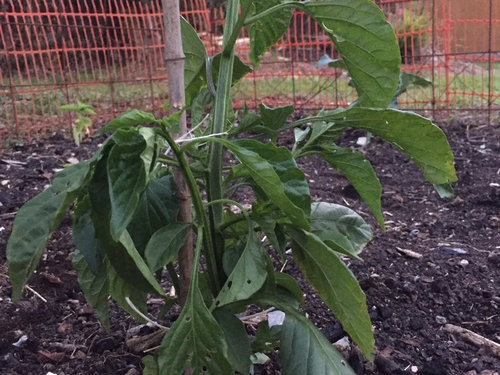
1. Does it appear I staked these plants correctly?

2. Does staking inhibit growth or what happens as these start to grow (peruvian yellow peppers grow quite large)? Do you have to continually move the string connecting the stake to the plant or will it grow strong on its own and eventually you can remove it?

thanks in advance!


Comments (31)

  • 10 years ago

    Looks good, but I would also tie them up higher as well.

    salevene thanked esox07 (4b) Wisconsin
  • 10 years ago

    From what I can see you have done a good job but you will likely need to tie additional strings further up the plant and if the plant grows as you expect the stake may be borderline in length for a tall plant. There are different ways to stake and secure the plant so there is no best way. You would normally leave the strings for the entire season and just tie more at intervals ( 10-12") up the plant as it grows. Avoid tying a knot around the plant which would restrict growth(seems you are good ) and if possible locate strings in a way to avoid restricting the developing fruit, thereby causing deformed fruit shapes.

    I will mention what I'm doing in a high tunnel with rows of peppers. I use a stake every 3 plants and then just wrap a string around stakes on opposite sides of plants, never tying string onto plants but providing support on 2 sides of the plants along the row. So far I only have stakes installed. With my method I use less stakes but I find that I cannot step between rows after I've put more than 2 lines of strings on a row and navigation gets tricky if strings get a few feet high. This Florida weave is used commonly for tomatoes and other crops.

    Don't count on your plants ever being strong enough to remove support. As they grow taller and add fruit they just get more top heavy and need more added support. You may be ok with the support stake if you tie again at the top of the stake you have and stop there, even though the plant may grow twice as high. I provide no support for my field grown pepper plants. Some is good even if it doesn't go to the top.

  • 10 years ago

    That is one thing I have found with staking plants. Once you stake them, they come to rely on that extra support and don't build as much strength in their stems and branches as they otherwise would. So, if you try to remove the stakes later on, they likely won't fare too well. Some pepper plants do just fine without staking, but others will have problems without it. In the wild, they just lose a branch here and there and carry on, but with our help, they can max produce.

    salevene thanked esox07 (4b) Wisconsin
  • 10 years ago

    Thanks so much for the advice! I think I'll have to find a bigger stake tomorrow and re-do it just to be safe (these things can grow 4-5 ft. easy into the second harvest!).

    The issue with not being able to support itself overtime is one of the reasons I prefer tomato cages, but its just too small to set one up at this point unfortunately (they don't sell them here in Colombia so I had to make a makeshift one and its for when the plant is bigger). The way they do it here is basically stick two stakes in the ground with a string across and then tie a string to a branch and then up to the string hanging across. They do it that way big tomato growers here and most commonly you'll see it with beans. That way never appealed to me, anyone here ever tried that?


    Barrie - the only thing I didn't quite follow was: "avoid tieing a knot around the plant"?

  • 10 years ago

    Barrie just means that you want to refrain from tying the string tight around the plant stem or branch as the plant will continue to grow and it will eventually constrict on the plant.

    And you are right, eventually, you will have to start supporting the branches on some plants. I have wound up with 4 or 5 stakes just to support one plant.

    Good luck and post some photos when the plants get bigger and start bearing fruit.

  • 10 years ago

    Thanks Bruce, for clarifying. I was going to put in a bigger stake, but instead I'll just leave the ones in those two plants and then just go straight to the tomato cage. At the rate they are growing, in 1-2 weeks I should be able to tie it up to the tomato cage.


    I'll post pictures down the road for sure! This is a great pepper, not too spicy, but packed with flavor!


    Thanks for all your help/suggestions!

  • 10 years ago

    Just by chance, I happened to find nice stakes from a flower bush so I re-did it (will still switch over to cage eventually). Now I just need to switch over fast enough so that the stakes don't have time to sprout roots and steal the nutrients from all my peppers! :)


  • 10 years ago

    Looks good. I have just used stakes (sometimes 4-5) in the past, but I have a bunch of tomato cages laying around and I may put them to use this year instead of the stakes.

  • 10 years ago

    Barrie, the thing is that those peppers never see 40mph winds. I am not saying peppers need tomato cages. Never used one before. But in years past, I have started with one stake, then needed another for branches, then another for another branch, then another. I have the cages sitting around getting in my way, so I think I will give them a shot this year.

    This poor Pablano branch could have used a little more support from a wind storm.

  • 10 years ago

    My main concern with something like cages is the difficulty that it adds to picking. I always am in a hurry when picking peppers and any obstruction is time lost. For my field peppers, usually 1600- 1800 plants I have never stakes and losses from weather related breakage are minimal. I am my own pepper plants worst nightmare since I snap branches of certain varieties and with serranos I just strip up the plant with both hands taking leaves, branches and whatever else comes off of the stem. I sort out the peppers on my truck tailgate after dark. That saves a lot of time for me.

  • 10 years ago

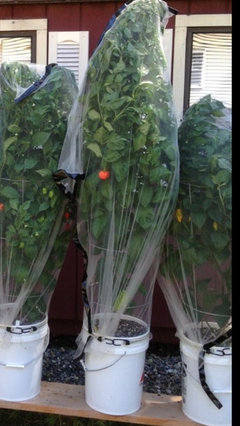
    I'm glad I used cages last year ;) (probably could've used a bigger tulle net too)

  • 10 years ago

    hahahahahahahahah, that is just too freeking funny Mike. Did you bag them for massive seed collection or what?

  • 10 years ago

    Barrie: I totally understand your dilema with that many plants. Plus the cost of that many cages would be prohibitive.

  • 10 years ago
    last modified: 10 years ago
    Bruce- yup. Easy way to isolate seeds without having enough real estate to keep them far enough away from each other so they don't cross pollinate. Plus, you can pick and choose which pods you want to save seeds from (size, phenotype, etc.) without gambling on bagging a single bloom or branch. Worked out well, but I'm sure the neighbors thought it was hideous :) Sorry, not trying to hijack, but the cages worked out great for me. Then again, I only had about 15 plants last year- I'd never do that with 1600-1800 of them, hahaha

  • 10 years ago

    Yah, I bagged, but I only did branches. hahaha, I bet they made good halloween (Ghost) decorations in October.

  • 10 years ago
    last modified: 10 years ago

    I use tomato cages for my peppers, both in ground and in containers. I DO see significant wind, "breezy" here means anywhere from 20-30mph, "windy" means 30+, and gusts have gotten up to 50mph, especially during T-storms. Nice for cooling off, not so much for growing annual veggies. I'm not by any means a large scale grower; on a good year I might have 10 or so plants, so the cost is worth it to me since I can reuse the plants for many years. As far as harvest, it isn't difficult at all to reach fruit. The cages are mostly open space.

  • 10 years ago

    We have had a "breezy" spring here as well. Lots of 20-25mph weather and several times we have gusts in the 40+ range already this year. The mature but young plants without peppers and a ton of foiliage seem to do well in that kind of weather, but once the plants begin to spread out and get heavy with pods, the wind can really tear them up. I will probably get some cages out in the next week or so.

  • 10 years ago

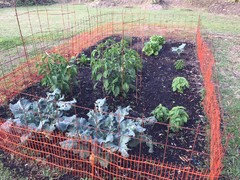
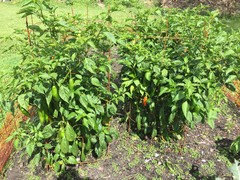
    Hey all, as an update, peppers are doing great! I've caged them and re-tied them a few times, but at this point, I'll leave them tied as is and let the harvest begin! I'll post an update down the road when I have some nice peppers to show.


  • 10 years ago

    That is a nice looking garden. I would have been a bad boy and crammed too many plants into that space...I always over crowd my plants.

  • 10 years ago

    Thanks Bruce! Its actually got a few more non-pepper plants in there, but I'm working on creating a "rotating" garden, so the new stuff is small and hard to see.

    I wouldn't recommend over-crowding for several reasons, mainly the risk of funguses. I learned this the hard way last year :). The other benefit of less plants/more spacing is higher productivity since the plants won't be fighting each other for nutrients.

    I had all peppers last year, and found that mixing in other crops so far has been beneficial as well.

    I work in coffee and have learned a lot visiting coffee farms, etc., and have been able to apply that knowledge to my own little garden. :)

  • 10 years ago

    Well, it is a very nice looking garden. It looks like the plants are pretty happy there.

  • 10 years ago

    Thanks Bruce, but couldn't have grown the peppers without the help of this forum! You guys are amazing.

  • 10 years ago

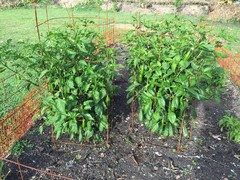
    I'll post some more when the fruits start to mature, but here is an update... they just grow and grow and grow, I've already had to prune them back several times! Expecting one of my biggest harvests ever! By mixing in other crops into the garden (less than 50% peppers) and giving everybody more space, everything we have growing seems to be much happier.


  • 10 years ago

    Cages are perfect for peppers and are pretty worthless for tomatoes. I can see them even useful on a large scale since they only cost a couple bucks and I have some that I've been using for well over 10 years.... wooden stakes rot after a couple years max.


    Salavene: Insert cage right after planting seedling. Otherwise you risk damage to roots and/or damage to branches trying to get them through the hoops.


    Kevin

  • 10 years ago

    Many of my field grown bell and banana pepper varieties set numerous fruit which are so cramped that they become misshapen. To pick those peppers usually requires twisting and manipulating fruits at different angles. I just can't imagine having the obstruction of a cage added to that mess.

  • 10 years ago

    barrie: I've had that problem with bells before where the 1st one gets cramped between the yoke of the 1st two branches. I've actually thought of snipping the 1st flower to avoid this. Even with this issue, cages are not an impediment.


    Kevin


  • 10 years ago

    Cages are the best. I think the trick is to be strict and trim the tree/fruits when necessary. Its hard and you feel like you are sacrificing your entire harvest, but its really just a few fruits or branches and it saves you big in the long run. I've had to trim back those plants several times so that there is plenty of air flow between those two cages.... so far, its rewarded me with what you've seen in those pictures. ;)

  • 10 years ago

    So you guys are telling me that you all reach inside each cage and trim out center peppers to thin?

    I can imagine doing that for over 1600 field pepper plants and 474 high tunnel pepper plants I'm growing.I'd much prefer to thin as I pick to harvest and a cage for my tunnel habanero pepper plants would just be a point where branches would grow through and then snap off when loaded with fruit.


  • 10 years ago

    I don't thin out the insides, only outsides. But I think with over 2000 plants, anyway you slice and dice it, its a lot of work!

  • 10 years ago
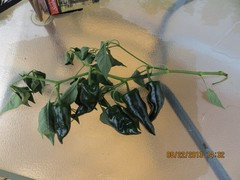
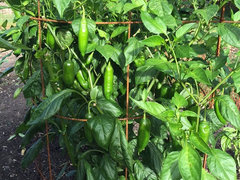
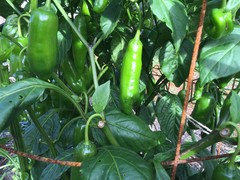
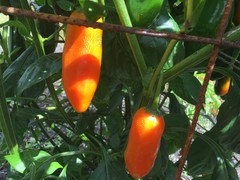
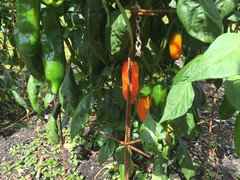
    As promised, now that we are in harvest, wanted to show a few pics! We are harvesting about once a week these days and its looking like its going to be a bountiful one.

    This varietal really loves it down here in the tropics, I haven't added any fertilizer to this plant, from seed to harvest!

    Thanks for all the help in the forum!
Sponsored
Custom Home Works
Average rating: 4.6 out of 5 stars10 Reviews
Franklin County's Award-Winning Design, Build and Remodeling Expert