Software
Houzz Logo Print
hzdeleted_19780821

Chicken Manure

10 years ago
last modified: 10 years ago

The problem with using chicken Manure or horse manure on roses is the high nitrogen, you get a lot of plant growth but no roses. It's a joke.

Comments (10)

  • 10 years ago

    Sam: I have used well rotten chicken manure in my compost pots. I just sprinkle a bit of it, along with river soil. This accelerates the decomposition process.

    User thanked Khalid Waleed (zone 9b Isb)
  • 10 years ago
    last modified: 10 years ago

    Thank you, Khalid .. that reminds me to get chicken manure for my compost. Menards stop selling chicken manure at $7 for a huge bag, so I have to find such elsewhere. NPK of chicken manure is 5-3-2, higher in nitrogen and salt than other animal manures. My roses smell really good on chicken manure due to decent phosphorus at 3, plus high in trace elements of zinc, copper, and boron.

    My concern when it rains all day: will my old-garden roses ball on me, and will my roses lose fragrance? Heavy rain leach out both potassium and phosphorus (needed for scent and oils and fruit flavor). My Duchess de Rohan doesn't ball after the rain, but the fragrance is reduced.

    Found a pdf file, research on the effect of triple superphosphate on tuberose, a very fragrant flower:

    http://www.bdresearchpublications.com/admin/journal/upload/09348/09348.pdf

    Result showed that plant height increased with increasing phosphorus rate up to 155 kg P2O5. Result further revealed that leaf production increased with increasing phosphorus level ... that application of phosphorous fertilizer increased leaf length and leaf breadth of tuberose. Result further showed that side shoot number increased with increasing phosphorus levels."

    *** From straw: the above document also stated that diameter of bloom increase as well as number of blooms with sufficient phosphorus. Phosphorus deficiency is most often manifested as purpling of the leaves, particularly the leaf veins. In severe cases the whole plant may take on a purple hue.

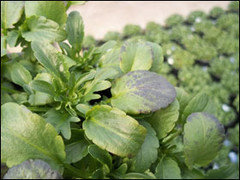
    I have phosphorus deficiency in my alkaline clay, see below purplish tinge in pansy when google for P deficiency:

    From Wikipedia: The stunted growth induced by phosphorus deficiency has been correlated with smaller leaf sizes and a lessened number of leaves.[3] This carbohydrate buildup often can be observed by the darkening of leaves.

    Double-check with flavor of tomatoes in hydroponics website. They also stated that phosphorus is important for tomato flavor, number of flowers and size of fruit. My biggest beefsteak tomato was through FRESH cow manure, without the nasty quick-lime added. Quick lime is different from Garden lime. Quick lime shoots up the pH, and zap out phosphorus and potassium. Quick lime is used in tap water as well.

    I can see why Cantigny park uses super high-phosphorus fertilizer during hot summer, using very alkaline tap water. Their Julia Child rose smells so strong that it reeked, same with Frederic Mistral .. my kid could not handle Fred's scent, she thought it was too strong at the rose park.

    User thanked strawchicago z5
  • 10 years ago

    another wonderful thread thank you Straw Sam and Khalid...


    Straw...how about we get grind white beans and gently work that in around the rose bushes for slow release Potassium along with the living compost on top of that, and add some liquid blood meal-fish emulsion fertilizer to feed the beneficial fungi and micro organisms when the compost is being depleted?


    User thanked jessjennings0 zone 10b
  • 10 years ago

    Jess: That's a wonderful idea, I haven't tested black-eyed peas as potassium, my alkaline soil has plenty of potassium already, it's the phosphorus that I lack.

    But your acidic red clay will be low in calcium and potassium when you get acidic rain water. White beans will neutralize the acidic rain, plus release iron, calcium, potassium, and magnesium.

    It's better than pea-gravel even, since pea-gravel differ from location. Some place might have high-aluminum pea-gravel, some with neutral pH, while my pea-gravel is dolomitic lime, with pH near 9.

  • 10 years ago

    Thank you Straw... :-)


    I was thinking about this all day... I wonder what would happen if I just added these beans whole, underneath leaves etc, and if they spout, I nip it, or pull it out to compost? Would that still be adding the same Potassium-values to the soil that grinded beans would do?


  • 10 years ago
    last modified: 10 years ago

    Jess: Great idea, I check on if beans fix nitrogen. Here's an excerpt from below link:

    http://www.csun.edu/~hcbio027/biotechnology/lec10/lindemann.html

    "Nodules on many perennial legumes such as alfalfa and clover are finger-like in shape. Mature nodules may actually resemble a hand with a center mass (palm) and protruding portions (fingers), although the entire nodule is generally less than 1/2 inch in diameter. Nodules on perennials are long-lived and will fix nitrogen through the entire growing season, as long as conditions are favorable. Most of the nodules (10-50 per large alfalfa plant) will be centered around the tap root.

    Nodules on annual legumes such as beans, peanuts, and soybeans are round and can reach the size of a large pea. Nodules on annuals are short-lived and will be replaced constantly during the growing season. At the time of pod fill, nodules on annual legumes generally lose their ability to fix nitrogen because the plant feeds the developing seed rather than the nodule."

    *** From Straw: too bad that beans don't fix nitrogen that well. I find that soaking soft beans like black-eyes peas overnight make them soft, and can be crushed easily. Once the outer shell is broken, beans decompose faster, so soaking them overnight (rain water), then crush them will help to release the nutrients.

  • 10 years ago
    last modified: 10 years ago


    There was a lot of great answers in the Gardeners Question Time BBC Radio 4. It took place in the Lakes district.

  • 10 years ago

    Sam: thanks for letting me know peonies like clay, how about Clemantis? Dave and Deb (zone 5a) in HMF never tell folks what type of soil they have, they grow lots of clemantis and roses on Dr. Huey.

    User thanked strawchicago z5
  • 10 years ago
    last modified: 10 years ago

    Just found out that Dave and Deb (zone 5a) in HMF has alkaline loamy soil & roses grafted on Dr. Huey, and very healthy roses, see their garden in HMF, their Sheila perfume & Sweet Chariot and white alyssum look fantastic. They grow Clemantis well in their alkaline soil:

    http://helpmefind.com/gardening/l.php?l=99.283&tab=9

    Here's the list of 122 roses that Dave & Deb Boyd grow in zone 5a, alkaline soil, grafted on Dr. Huey, except for mini-roses, which are own-root:

    http://helpmefind.com/gardening/l.php?l=3.4748&tab=2

    User thanked strawchicago z5