

HVX - can it be transmitted by....
When I first got bitten by the hosta bug, and before I knew about HVX I got a plant from a "reputable hosta grower" that was diseased. Not knowing any better, I spread it to other plants when I cut scapes that summer. Ended up destroying about 2 wheelbarrow loads of plants after buying Agdia test strips. Got pretty up close and personal on what HVX looks like. I have been very careful since then ....... This morning I was transplanting a seedling and looked at my 4 year old Fire Island that was right beside where I was planting. This one also from a hosta nursery, looked like it had tissue collapse. Brought in a leaf and tested it and sure enough we have HVX . Earlier this year, and for the 1st time, something was chomping on the leaves. I thought it was a leaf cutter, it doesn't seem like slug or snail damage to me. My question is does anyone know if it can be transmitted in this way ?
Comments (95)
 10 years ago
By the way, the word primarily means mostly, but not exclusively or only.
So in the research they had HVX infected plants growing. They removed them. They planted new plants in the same soil. Some of those plants caught HVX. Why do you disagree with this part of the research that you continue to reference yet then tell me that no research study on the planet backs up what I am saying?
 10 years agolast modified: 10 years ago
"Jon, you liked mybrownthumb's post about how viruses will survive outside the host."
Mr Topher, I do realize your limitations, but this statement is referring to viruses such as Tobacco Mosaic Virus that can be spread by nematodes and thrips for example. They survive outside the host, but not outside 'a' host. As explained to you before; some viruses can spread between humans and swine or humans and birds. HVX is not transferable with any other plant, any known insect with the possible exception of some specific tobacco leaf that you claim (without reference of course).
As this person's blog post further states 'Some obligate intracellular parasite bacteria are also lacking the ability to replicate outside of a host cell. This would be viruses like HVX that cannot be transmitted by insects as other plant viruses can be; such as the TMV that I reference. HVX can only be transfered through sap. Only live hosta have sap. Only live hosta have living tissue. Only live hosta can transmit HVX virus; period.
These facts may be difficult for you to understand. Based on your original assumption that dead leaves and plain soil supported HVX, along with your next saying this would be foolish, and now your return to the position you admitted was foolish ,indicates to me your poor understanding of this, polluted by your desire to refute me and your admitted consternation when your lecture attendees confronted you with the discussions here is fogging your limited understanding and perhaps has you grasping at ways to discredit me without thinking things through.
I readily accept when I make a mistake or am wrong. I just wish everyone did.
Related Professionals
Charlotte Landscape Architects & Landscape Designers · Wenatchee Landscape Architects & Landscape Designers · Flint Landscape Contractors · Laconia Landscape Contractors · Durango Landscape Contractors · Honolulu Landscape Contractors · Portsmouth Home Additions · Lufkin Home Additions · Davenport Home Additions · Portland Home Additions · Keene Home Additions · Hudson Home Additions · Clovis Home Additions · Amherstburg Home Additions · Lagrange Home Additions- 10 years agolast modified: 10 years ago
Soil that at one time contained HVX infected plants can still infect another hosta planted into the same soil. It says that in the research. No wounding is necessary of the newly planted hosta. I does not say that. The research clearly states that HVX is spread only by wounding of the infected plant and another plant.
'No wounding is necessary of the newly planted hosta.' is your words and contradicts what the study says. Please reference where this is said anywhere in the research or anywhere except by you. Once again you say things not referenced anywhere by any reputable source.
- 10 years agolast modified: 10 years ago
'By the way, the word primarily means mostly, but not exclusively or only.'
This does not mean you can invent facts to suit whatever you would like to be true. If your theory is true then if a person has one infected hosta then their entire hosta garden is doomed....if HVX can live outside live tissue and in soil as you suggest. What stops HVX if it can live in soil? It is a preposterous (to put it mildly) suggestion.
- 10 years ago
Well I tried, but sorry Jon, you are really wrong about these things, and people are believing you. I don't understand why you continue to disagree with what is very clearly written in the research. It does not say the things you think it says. It says that the assumptions, which you think are truths, were not correct based on the research.
The research does NOT say that HVX is spread only by wounding... It absolutely does not say that.
- 10 years ago
HVX doesn't replicate in soil. It remains in a dormant state until a living host comes along, and then it infects and replicates within the host plant. That is the information that was shown above to you, and you liked it.
HVX is highly stable outside the host, and that was a big surprise as found in the research. Tobacco mosaic virus, which by the way is not spread by insect vectors either, is a lot more stable and infectious in soil, even though it isn't replicating, however you say that is untrue of any virus.
 10 years ago
Jon, from the link you provided:
The second major
surprise of the research project occurred when it was observed that
virus-free hostas became infected with HVX when planted in the same
location where an HVX-infected plant had previously been growing. Soil
with HVX plant debris and root material was found to remain infective
for at least two years. (Note that two years was simply the duration of
this research project. The actual time of remaining infectivity could be
longer.) Subsequent testing showed that 2 out of 20 hostas planted in
soil from which HVX-infected plants had been removed became infected
with the virus. This method of virus spread had not been previously
reported for Potexviruses and was totally unexpected.So, we're talking here not about soil, but soil with plant debris and root material. Do you have any research that refutes this?
Pieter
- 10 years ago
I hope I never get that virus in my hosta beds but I can tell you from experience that in the biggest crowded bed I have I am having little hostas pop up.
I dug everything out of the bed last fall and overwintered the hostas in pots this winter. I then renewed the fallow bed with miracle grow garden soil tilled in this spring and replanted about half of the hostas that I had pulled out. I am seeing little baby hostas pushing up thru tilled soil--I guess from viable roots because I picked all the seeds in hopes of planting the seeds. Hostas are sure resilient. So I guess if I get the dreaded virus I am going to have to excavate a very large hole and plant something different for a few years.
- 10 years ago
Pieter! Refute this??? This has been exactly my point as to why I am trying to show how killing the hosta with glyphosate before removal so there will be no infected bits left when you dig it out. Mr. Topher's suggestion is that HVX survives in plain soil and dead leaves....at least that is one of his oftentimes shifting opinion on the subject.
The only question is does glyphosate effectively kill hosta to the root as they guarantee it can on any plant. All of the root system is connected and would be killed as an entity. Digging it up and possibly leaving infected bits is far more risky in my opinion.
That is the crux of this entire discussion.
Jon
- 10 years ago
Frank, I don't think propagation from just the root is possible. You have a lot of hosta crowded in an area, so you are probably seeing a lot of cross pollenization with fertile hosta and seed propagation.
Jon
- 10 years ago
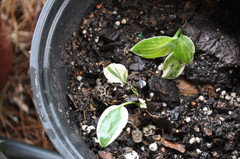
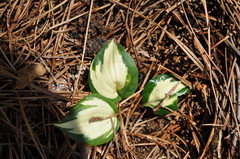
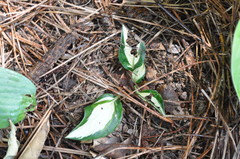
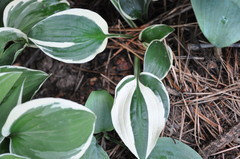
All of them are variegated. I thought seedlings would be mostly green. I dug up the 2 littlest and I think they are seedlings. I don't know about the bigger 3 I don't want to kill them because they have great variegation. Do they look like a known variety of hosta? I definitely have some slugs/snails snacking going on.
- 10 years ago
Well, if they are a division (still pretty sure it is impossible from part of a root) then I would assume it would look like the 'mother' hosta. Do they look like any of the hosta you dug up?
If they don't then I think they are from seed, which is overwhelmingly shades of green and not variegated. Unless it was soo crowded you divided some up without realizing it you have some very unusual super seedlings.
Don't throw them out. Let them grow and see what develops. They do look nice.
Jon
- 10 years ago
How Does Glyphosate Work?
Glyphosate specifically inhibits an enzyme that is essential to plant growth; this enzyme is not found in humans or animals, contributing to the low risk to human and animal health when using glyphosate-based products according to label directions. The presence of this enzyme in plants, but not in humans and animals, provides a basis for a specific selective toxicity to plant species.
When a Roundup® brand herbicide is sprayed on foliage, glyphosate is absorbed by the plant and then moved – or translocated – throughout the plant's tissues. The surfactant assists the delivery of glyphosate into the plant by attaching itself to the leaf’s waxy surface and breaking it down. Once inside the plant, glyphosate inhibits the activity of an enzyme, which in turn prevents the plant from manufacturing certain amino acids essential for plant growth and life.
After the herbicide application, the plant gradually wilts and turns yellow. Then, as the plant tissue deteriorates, it turns brown. At the same time, the plant’s underground roots decompose. Ultimately, the entire plant dies, and is incapable of regrowth. Link
A surfactant is something that breaks the surface tension of a liquid, commonly soap. Someone suggested washing the leaves of the hosta before apply glyphosate. I think that is a very good suggestion as it ensures no dirt is on the leaf (any dirt neutralizes glyphosate) and because the soap will act as surfactant. I am now sorry I didn't do this. Hindsight is 20/20.
Test hosta #2 is already crinkling and discoloring.
Jon
Jon
- 10 years ago
Growing hosta root fragments into plants has never been a question for those of us who have been growing hosta in the ground for years: why you will find a small root fragment growing into mature hosta where the plant has been removed.
It has been done for years by different people using varieties of fragments; study ross-sizing and french cut bean treatments of root fragments.
Before tissue culture how most plant multiplication was (and still can be) done. I have cut root tips, root hairs and woody roots , which when left in the ground will grow out over time ( 1-2 years)
Bruce
- 10 years ago
A couple new discussions are going here now, but I wanted to note that Jon, you continue to take my posts out of context. In a long ago post I said you could test dormant leaves of HVX infected plants and still get a positive test. You jumped all over me about dead leaves and clearly didn't understand what I had said.
However, in Dr. Lockhart's research he did test to see how long HVX would last in plant material in cold storage, simulating dormant/dead leaves, and his results stated that the material remained infectious for 9 weeks. But, since there isn't a link to these results on the internet that I am aware of, and I just have the report in email form, you will likely dispute that this even exists or was tested.
And about digging up plants, the recommendation of the AHS and in the research was that in order to insure you remove HVX when an infected plant is in the garden you should remove the hosta and all of the soil encompassing the root zone to make certain you get rid of it all before replanting another hosta. That's what I suggested, but you twist that around too.
The last thing I would like to say on this thread is that I don't understand why you call me Mr. Topher. My name is Christopher Wilson, and yes, I work at Hallson Gardens, and I am one of the owners and founder of the company.
So you can disparage me all you want, and twist around what I say, but please don't play yourself off as an expert while misinterpreting what you read on the internet.
- 10 years agolast modified: 10 years ago
So you apologized for saying that HVX survived in dead leaves and now claim leaves go dormant? Leaves die off, roots and crowns go dormant. Dormant crowns and roots harbor the HVX virus. Dead leaves, roots and crowns do not.
I realize that the recommendation has always been to dig out infected hosta. My idea is new and has not been tested which is why I am experimenting. You have provided no ideas on why it will not work, only that This is the way we have always done it.
I will continue to test if glyphosate to ensure it kills hostas. If it does there is no doubt any HVX virus that would have existed will die off when all living tissue is dead.
There is zero information to the contrary and volumes supporting this scientific fact. Nothing in Dr. Lockhart's studies refute this science. I understand your nose is out of joint because you have refuted these facts, however, I have no sympathy when you continue to attack my ideas with ideas that are simply not true.
You are telling me not to believe universities, scientific organizations, Dr. Lockhart and every authoritative source I can find and simply take your word that HVX can survive in dead plant material or survive by itself in plain soil when no knowledgeable expert agrees with you? No thank you.
- 10 years agolast modified: 10 years ago
smorz,
1- It is controlled albeit not very large
2- I wonder why you think a diseased hosta is required. The test is to kill a hosta, not the HVX.
3- HVX cannot live without live tissue, that is a scientific fact not my opinion.
4- Glyphosate has been around for 50 and its ability to kill plants to the roots is another fact, not my opinion.
5- I had 3 hosta to begin with. One was sprayed with 2% glyphosate and was dying slowly. I did spray it again with 2% and it has speeded up the process.
6- When I purchased the higher strength glyphosate I learned that the recommended dose for perennials is 10% not the 2% I used. I have a second test going on the second of the three hosta with a painting of 10% glyphosate as recommended by the manufacturer.
smorz, I am dealing with two things only:
1- Can glyphosate kill a hosta. Since in 50 years there has been resistant to glyphosate and that is a grass that has genetically modified for corn, cotton and soybean crops. I think that it is almost a complete certainty that hostas can be killed.
2- If the hosta is killed there is zero chance that the HVX virus will survive. This is backed up with the 5 or 6 links I have given that show this is a scientific fact
Other than you think that I should use a diseased hosta and didn't know I had a control hosta you seem to have only your own bias as an objection.
It is not rocket science. Can you kill a hosta 'to the root' with glyphosate is the only unknown and personally I think that is going to be very easy to prove. Every manufacture of glyphosate for weed and grass control guarantees it.
If I am wrong, I will be the first to admit it. I suggest you try and educate yourself on viruses and read the links I have provided in this and the previous post I had. Educate yourself on Round Up and other glyphosates and see how they work by disrupting plant enzymes.
These are things you should have done before you posted your attack on me.
HVX cannot survive in dirt or in dead plant matter as others have tried to say is possible. If it could it could spread very readily and it doesn't. This is not my biased opinion, this is the conclusion of every single institution that has studied the virus with Dr. Lockhart's study included.
Jon
PS- If you get an HVX infected hosta dig it up, dig up any neighboring hosta and never plant in that area again if you prefer that method.
 10 years ago
I have been following (and even providing) the links and conversations since day 1 Jon... I have (quietly) watched you hijacking threads with your absolute certainty of your "new idea" and endlessly bickering with Chris or anyone who disagrees with you, Nothing I said to you was an attack unless disagreeing with your method and absolutes is an attack now?. You cannot prove without uncertainty that every single cell in every single one of those roots are dead, visually. If they were infected... you would test the matter, and report your results. That is part of a controlled study, from beginning to end, conducted much like the studies you refer to. Yanno... seeins the basis of your study revolves around infected hosta and all. When you advise people of your "new idea" I simply said it was your opinion... and should be indicated as such. Again... hardly an attack.
But now because I dared say my opinion, I need to educate myself? I need to read? Your suggestion tactics are duly noted for what they are...
Now (to clarify the difference) if I were to say.... I find it obnoxious, the stance you take when someone disagrees with you. For example what you just did there with me... first by establishing how you were "attacked", then by suggesting I have no clue on the topic... then kindly offering me the option to do what I want with my own hosta (gee thanks?). Now if I had said that? that would be an attack on your character, without a doubt. So yeah,,, I feel like what I said is even getting twisted... and can relate to what Chris is apparently going through.
P.S. It is even more obnoxious to argue on someone elses post... and for that I apologize.
- 10 years ago
Sorry smorz, but unless you can refute the fact that HVX does not survive without live tissue or that it is immune to being killed by glyphosate there is zero science behind doubting the test.
If you choose to ignore the fact that the research only refers to infection from infected material and choose to accept the edited version that omits infected material and claims beyond reason or every scientific test and opinion available claims that HVX can survive in plain soil and infect any hosta at any time if you plant another in the same spot then you can ignore what I find.
Dr. Lockhart's testing clearly refers to infected material when he discusses the possibility of infection after digging. Omitting this was dishonest on the part of the person that did it. NOT YOU smorz.
If you think digging up an infected hosta and possibly leaving behind infected live material or possibly injuring and infecting nearby hosta without at least trying to kill the singular plant first then you certainly can do this, but I don't follow the logic.
Please provide the logic (links to proof would be nice) of the following
1- Hostas are immune to being killed 'to the root' by glyphosate
2- There is some logic that suggests an HVX infected hosta is required. Why?
3- HVX can survive outside of live tissue.
1 & 3 have to be proven true for my theory not to be true. #1 would be very surprising to the people who have searched for 50 years for immune plants and only found one grass. #3 would refute every known fact about HVX and other viruses.
I trust the established science involved. I have no reason to doubt it. The dig and abandon advice needs no test. It is risky and wasteful.
Jon
- 10 years agolast modified: 10 years ago
But Jon, the research did state that once you dig up a hosta, that same spot will remain contaminated, and the research showed that the garden location remains contaminated for years after the hosta was removed. That's why the report states that you should not replant a hosta in that same location. There is no live plant involved, it is the contaminated location in the garden we are talking about.
The problem with your understanding is that you are confused by what is a "living" and replicating virus versus a virus being infectious.
Here are the issues at hand:
A virus will replicate within the living host. Nobody disputes that part. However, a virus can still be infectious outside of that host. It doesn't have to be a different host either. How else do you think many viruses spread in the world?
...edited out bad example...
A virus can go into a dormant state while outside the host, just waiting for a new host to come along. This information was shared above to you as well, and you dispute it.
Hosta Virus X is extremely stable and long lived outside of the host. So you can have rotting roots out in the garden that once had replicating HVX inside them that are still infectious. The research proved this, buy you completely refute what the research showed.
- 10 years agolast modified: 10 years ago
Please, contaminated by infected material. This is why digging it up is not a good idea as inevitably you run the risk of leaving contaminated bits in the soil.
HVX cannot survive in soil or dead plant matter.
"There is no live plant involved, it is the contaminated location in the garden we are talking about."
"HVX is not known to be spread in soil. HVX is transmitted only by plant division (vegetative propagation) and by contact involving surface wounding. " Dr. Lockhart.
Viruses are spread from person to person, from animals to people sometimes and in the case at hand HVX it is spread through hosta sap
"The second major surprise of the research project occurred when it was observed that virus-free hostas became infected with HVX when planted in the same location where an HVX-infected plant had previously been growing. Soil with HVX plant debris and root material was found to remain infective for at least two years.
Dr. Lockhart""Example: Let's say you have some bean sprouts out in the field and they are contaminated with the E. Coli virus"
E coli is a bacterium. Center for Disease Control.
The only thing I realize is that you are going through great lengths to try and save face and making yourself look pretty foolish by the continual posting of things that a very little bit of searching can be shown to be either gross misunderstandings or purposeful attempts at spreading untruths. After so many of your attempts at deception I have to assume it is the latter.
Jon
- 10 years ago
I edited out the part about e. coli. You are right, it is a bacterium. I'll come up with a better analogy, perhaps the cold virus? Or the flu virus?
 10 years ago
Lockhart's statement does not say anything about the HVX plant debris and root material being dead or alive. I defy anyone to remove a diseased hosta from the ground with or without the prior use of roundup without leaving microscopic pieces of root hairs. The statement that viruses can not remain infective outside a live host is incorrect.. The soil in that spot will remain infective.
- 10 years ago
Thank you, Kathy, though I'm not sure we can get through to him on any of this.
This statement: "HVX is not known to be spread in soil. HVX is transmitted only by plant division (vegetative propagation) and by contact involving surface wounding. " Dr. Lockhart. Was the original thinking on HVX that Dr. Lockhart disproved in his own research, and he acknowledges this. We all dos. This statement was under the things that were ASSUMED BEFORE THE RESEARCH STARTED. This was not the result.
Also, in the field study, you have to understand that the HVX infected plants growing there were removed from the soil. New Honeybells were planted there, since Honeybells will show symptoms within weeks of being infected. Some of the plants were growing in the same spot for years, HVX free, before suddenly showing symptoms. So we are talking about plants that were not touched that somehow contracted HVX from the microscopic bits left in the soil.
I'm not sure it matters at this point, because I think overall people reading this completely understand the matter now. It is those people who might be swayed in the future by Jon's rhetoric in new posts without the rest of us helping to further explain and educate them on the subject.
- 10 years ago
Thank you, Chris for taking the time to share your knowledge. I appreciate your posts and I am sure I'm not alone. Once upon a time, this was a friendly forum. A place to share with other gardeners, who love Hosta.
And thank you, Babka. I am an insomniac, who tends to read the forum in the middle of the night. Wondered if I was imagining things, but I was not. Thanks again.
 10 years agolast modified: 10 years ago
This still is a very friendly forum and online community of gardeners, despite one curmudgeon.
Jon, I believe you have a lot to offer this forum as evidenced by the photos you've posted. It certainly appears as though you are an accomplished gardener. Your river/drift of rocks is very cool. You certainly are passionate about hostas and no one here is upset about that! Unfortunately, when contradicted that passion often gets the better of you and some folks ARE upset about that. It makes this forum not fun. It is not fair to the rest of us to be subjected to such nastiness. Even though it is directed at the few who speak up and disagree with you (and largely, Chris), we all feel it.
In regards to hosta virus x... The most recent information from the American Hosta Society, which was previously posted in this thread by Jon, is from 2013. Clearly, we will each take away our own interpretations, then proceed by doing what we think is best. All we can do is spread the most up-to-date knowledge, then... You can lead a horse to water, but you can't make it drink.
I say do what you want in your own yard, as along as it all stays in your yard. Yet, it is irresponsible to pass along anecdotal advice. As Pieter pointed out, even Dr. Lockhart's tests were done in such small numbers that the margin of error is huge. There is more to learn about HVX, so we must keep an open mind, especially knowing pervious assumptions have already shown to be incorrect. You can't site information from 2007 as evidence that information from 2013 is incorrect. It is on a timeline and what we "know" about the virus changes with more research.
Jon, I do wish you had chosen to test RoundUp on an HVX infected hosta and that you had the means to test the plant tissue in various stages of decay and the soil (a lot). Your test would still be anecdotal, but fascinating indeed! Think of all the wonderful conversations that could be had...
- 10 years agolast modified: 10 years ago
'This statement: "HVX is not known to be spread in soil. HVX is transmitted only by plant division (vegetative propagation) and by contact involving surface wounding. " Dr. Lockhart. Was the original thinking on HVX that Dr. Lockhart disproved in his own research, and he acknowledges this. We all dos. This statement was under the things that were ASSUMED BEFORE THE RESEARCH STARTED. This was not the result."
Please post the written link result that you claim. That would clear up the point of disagreement.
- 10 years ago
"Also, in the field study, you have to understand that the HVX infected plants growing there were removed from the soil. New Honeybells were planted there, since Honeybells will show symptoms within weeks of being infected. Some of the plants were growing in the same spot for years, HVX free, before suddenly showing symptoms. So we are talking about plants that were not touched that somehow contracted HVX from the microscopic bits left in the soil."
The report says differently.
The second major surprise of the research project occurred when it was observed that virus-free hostas became infected with HVX when planted in the same location where an HVX-infected plant had previously been growing. Soil with HVX plant debris and root material was found to remain infective Link to Dr Lockhart's latest research
- 10 years agolast modified: 10 years ago
"In regards to hosta virus x... The most recent information from the American Hosta Society, which was previously posted in this thread by Jon, is from 2013. Clearly, we will each take away our own interpretations, then proceed by doing what we think is best. All we can do is spread the most up-to-date knowledge, then... You can lead a horse to water, but you can't make it drink."
mybrown thuimb, this is the latest research as far as I know, if there is some later published report it has not been disclosed. The report is very clear that infection is from contaminated (infected plant material. In no information shared here as there been anything to suggest HVX lives in plain soil or lives outside a living host. If you can find such a definition or actually think it is possible please post a link to where you obtained this information that would back up Chris' claims.
NOUN
- an infective agent that typically consists of a nucleic acid molecule in a protein coat, is too small to be seen by light microscopy, and is able to multiply only within the living cells of a host: "a virus infection" Link
Virus: A microorganism that is smaller than a bacterium that cannot grow or reproduce apart from a living cell. Link
Viruses are unique microorganisms because they cannot reproduce without a host cell. After contacting a host cell, a virus will insert genetic material into the host and take over that host's functions. The cell, now infected, continues to reproduce, but it reproduces more viral protein and genetic material instead of its usual products. It is this process that earns viruses the classification of "parasite". Link
These are only the first 3 definitions that popped up. Please look yourself and verify it yourself. Deleting 'infected material' from Dr. Lockhart's research does not change hundreds of years of scientific knowledge.
I suppose I should have not been so easily baited into being so blunt, but when someone personally attacks me on more than one occasion saying I have a problem in comprehension, when I am well aware that they are being disingenuous, it makes the back of my neck go up.
I readily accept your description of me as a curmudgeon. I agree with that description I have worked for over 20 years in engineering and an additional 13 years as a product manager most of the time on equipment that much of the time processed material that was toxic and contained acids and deadly components. In my entire career there was not one incident of anyone being injured by any machinery that I was responsible for. It is one thing to make statements on hostas where the worst that can happen is a dead hosta or hostas; it is quite different when you have a responsibility for the lives and well being of people. I always try to be 100% sure of what I say and if I make a mistake I readily admit it as many here will readily attest. In fact I have recently admitted that I used a weaker than recommended dose on the first hosta I treated with glyphosate in my first test.
I am very certain of the facts here.
1- Viruses do not exist outside of a living host
2- Glyphosate affects plant enzymes in an entire plant. If the dose is not strong enough then a plant can survive. There was only one plant found in the entire world that was resistant and the genetics of that grass have been introduced into corn, cotton and soybean plants. These crops have almost entirely displaced none GMO modified crops.
3- Once any plant is dead no virus in existence can survive on the plant's dead leaves, crown or root.
These are irrefutable facts. Anyone who claims otherwise has never provided anything to back up what they are saying, and what they are saying is scientifically impossible. Saying you are quoting some further research without sharing the research proves nothing. If this information, which is at odds with the entire scientific community exists then this would indeed be spectacular news that revolutionizes the history of viruses. Since no reference is provided it is extremely difficult to believe. Every reference I find says it is impossible.
Period.
Jon
Thank you for being civil and I am quite certain that you are not one of the people who has tried get me thrown off the forum. I don't have any HVX infected hostas, however, if an HVX infected hosta dies the HVX can no longer survive. If someone has an HVX infected plant and they want to send it to me I will start a new test to assuage this concern. As Jo suggested the root remains could be ground up or snipped and tested for HVX Or someone could do this on their own.
Since certain people have tried their best to 'poo poo' (technical term) my test perhaps it would be better if someone impartial, such as yourself, should conduct the test to confirm its validity.
Jon
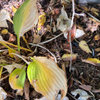
- 10 years agoOriginal hosta, sprayed twice with 2% glyphosate
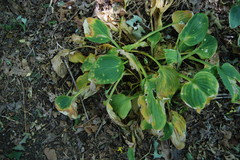
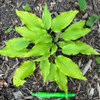
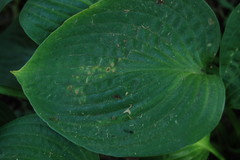 Top photo, typical leaf from the hosta treated recently with 10% glyphosate as recommended for perennials. Obviously the 10% will work better / faster although it seems apparent that the 2% double dose is working well.
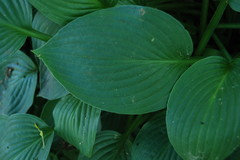
The 10% test hosta has some very small holes showing. Other leaves show more and larger holes. I expect that critics would attribute the holes to insects even though the non-treated hosta has none.
Note the crinkling of the treated leave. This type of hosta has not shown this in the 3 plants involved in the test previous to the test or the 7 other exiting locations that currently exist.
Jon
PS- the very small black dots are not holes. These are Winter Moth Caterpillar poo. They are are absolutely devastating this year. They are even attacking the pine trees here. Most oaks are stripped completely of leaves and the ground is covered with chomped leaves and pine needles. UGH !!!
- 10 years agolast modified: 10 years ago
The information released in 2013 by the AHS does repeatedly mention root debris and infected plant material as the source contamination, but it also says that contaminated tools can remain infectious for at least 2 years. Now, is it possible that plant debris can live for 2 years or more on a tool? That sounds far from probable. So, if living plant debris isn't harboring the virus, what is? How is this explained if the virus can only be harbored in and spread by living tissue?
Remember that viruses need living hosts to replicate, etc., but not to simply exist. They definetly exist outside of a living host. Several of us have already posted links in rebuttal to your assertion that this is not true. In fact, kathy and I posted the same one. Here are some more that not only refute the "fact" that viruses can't exist outside a living host, but that they can exist in plain soil. This is not new information:
Here is another - "Viruses are found on or in just about every material and environment on Earth from soil to water to air."
And another - This brief abstract directly refers to widespread virus contamination (including potexvirus) of soil.
And yet another:
And what about sap? Sap isn't living, but it is commonly accepted as a HVX carrier. The information provided by the AHS leaves the subject open to conflicting reviews.
Jon, in regards to taking up my own experiments, I saw some infected plants while strolling through Walmart yesterday, but there is no way I would purposefully bring that on my turf! I don't want none of that.
- 10 years agolast modified: 10 years ago
"Now, is it possible that plant debris can live for 2 years or more on a tool?"
Yes, a virus is microscopic. Even if just dipped in bleach or Dawn there is no guarantee that any residual virus will be reached. That is why scrubbing is needed. I don't see that tools were tested for 2 years, only plant material infected soil. If you kept them buried they might be infective two years or more.
'Vectors for spread of these viruses are fungal‐like organisms or plant‐parasitic nematodes, but some viruses can also be exuded from infected roots and transmitted abiotically, without the aid of a vector.'
Parasitic nematodes can transmit some plant viruses. No known insect or living thing other than hostas can transmit HVX. Other viruses can live and be spread by insects and human viruses can exist and be spread by birds, swine and rats as in the Bubonic Plaque. Abiotically refers to spreading with the aid of an insect or animal that can harbor a virus. HVX has no known biotic carrier.
"And what about sap? Sap isn't living, but it is commonly accepted as a HVX carrier."
Please read Dr. Lockhart's definition of how HVX is transmitted by sap. Link 'dishwashing detergent, 70% alcohol, or a 10% solution of household bleach (1 part bleach and 9 parts water) were all effective in preventing HVX spread by eliminating HVX in sap or plant debris contamination.' Sap from wounds in hosta is listed as the major way HVX is transmitted. Infected material or sap left on tools or in the soil does infect other hosta.
From your link
'Soil‐borne viruses belong to fifteen named and two currently unnamed genera that fall within the Secoviridae, Potyviridae, Ophioviridae, Tombusviridae or Virgaviridae families, or have not yet been assigned to a virus family.'
HVX is a Potexvirus, Link. Soil borne viruses can live up to 30 years. They exist on slime mold which once was considered a fungi, but has been reclassified as kingdom Protista. Link
This is all very interesting and deep into the weeds. Thank you for the information and prodding me to be become more educated. However none of what you provided changes the facts.
HVX can be and has been tested to be transferred with sap. Bare soil does not harbor HVX. Yes there are so-called 'soil borne' viruses but no Potexvirus is and they do have a host which is a Protista which closely resembles a fungus. HVX I snot a soil borne virus and a 'soil borne virus' still requires a host, 'slime mold' as it is commonly called.
Soil-borne doesn't mean it lives on soil as its host, it means soil borne or harbored in soil. It is very interesting and I have learned something from this. Time learning something is never wasted.
Jon
- 10 years ago
Your entire position seems to be based on your assumption that the virus must have live plant material to exist, but we know it does not. Now, if we could find out that roundup can kill the virus, that would be useful.
- 10 years ago
And one of my links does specifically list potexvirus as being found in soil.
- 10 years ago
And, yes, the most current information says those solutions do render HVX un-infective, but the fact remains that the virus can exist and remain infective in nonliving material. Your argument has always been that if you kill the hosta, you kill the virus and that has yet to be proven.
- 10 years ago
Your entire position seems to be based on your assumption that the virus must have live plant material to exist, but we know it does not.
Based on what source?
I found some interested information for you to chew on. It is from a Hallson Gardens Forum with Dr. Lockhart.
"I asked afterward directly - a question that had been raised on the Hosta Forums - If a plant became infected and root zones might be in common with other hosta and since he stated that transmission of HVX is less likely late in season is it better to delay removal till late fall or possibly using Roundup and leaving in place. His feeling was that immediate removal of plant and soil was best, and that he would not use roundup for fear of killing adjacent plant."
"A more detailed investigation of HVX spread in soil including:
-How long does HVX remain infective in plant debris in soil?
-How much HVX infected residue is needed for soil contamination?"
It seems Mr. Lockhart feels Round Up[ will kill hosta and he didn't mention any other reason not to use it except a neighboring hosta might be damaged. It also seems there is a surprising notation by Chris Wilson in another post at the same link"Other than the surprising results that some HVX residue remains in the soil, the rest is about what we've been saying."
It seems at this point he realized HVX infection was from residue.
Another exchange....
by Noreaster » Jul 05, 2010 7:46 am
Yes, thanks for sharing, Paul.
I still am not sure how I understand how remaining bits of plant debris can infect a new hosta planted in that spot. I thought it had to be sap to sap contact. So the old roots would have to have open wounds pumping sap which then must come into contact with an open wound on the root of the new hosta. It just seems so unlikely.
Noreaster Posts: 389Joined: Sep 20, 2007 7:15 pmLocation: MaineRe: HVX - Highlights from Keynote address by Dr Ben Lockhart
by Chris_W » Jul 05, 2010 10:11 am
Hi,
I agree, the transmission this way is unlikely since basically his study showed it moved 4% of the time. But it is still a risk since the virus remains active for so long and the percentage might go up over time. When new roots are growing I've seen them get stuck to the sides of pots or get stuck to potting soil, plus I've seen roots fuse together.
This was in 2010. Wilson claims there is new data, however this 'new information' is impossible to find if it exists at all. Wilson in this forum discussion agues against any further research by Dr. Lockhart rather he suggests a public information campaign would be money better spent.For whatever reason Wilson's opinions have changed since the 2010 research and the forum at Hallson Gardens. I would like to see the reason, if there is any.
Jon
- 10 years agolast modified: 10 years ago
Yes! The virus is soilborne! It exists in the soil and to my understanding, unless the virus is destroyed it can infect another host once it finds one. I think everyone's concern is that you are encouraging others to try the RoundUp and replant in the same spot relatively soon after the hosta is killed and we just don't know if the RoundUp kills the virus and/or if the soil is rendered uninfectious after it's use.
- 10 years ago
'Soil borne' as in held in the soil. Go ahead, disagree with your own reference if you want to. Of course it is a diversion from the fact that HVX only survives in living hosta tissue and is transmitted by sap.
Any disagreement is with Dr. Lockhart, not me. Swine flu lives in pigs and people, it doesn't mean HVX does.
Once the only host that is known to harbor HVX (with the possible exception of maybe some tobacco leaf (no source available) and HVX does not exist outside of living hosta tissue.
The only suggestion it does is from deleting 'infected material' from the University of Michigan study headed up by Dr. Lockhart. This does not change the science.
If I say 'I could bench press 325 pounds if I were Arnold Schwarzenegger' and leave of 'if I were Arnold Schwarzenegger' it completely changes the meaning. You cannot leave of the most important part of a research report and then try to defend this as a fact just as you cannot leave of the fact that soil borne virus live in a fungus like Protista and pretend they don't live in a host. Soil borne doesn't mean it gets its subsistence from dirt, it means these virus are present in the soil as is the HVX infected live plant material that can cause infection over 2 years after being left in the soil.
Nowhere is there any suggestion that HVX can survive except in living tissue.
Jon
- 10 years ago
Those were good reads! And I doubt Chris's opinion has changed regarding either the likelihood of transmission or his stance on removal. The study shows that trasmission by replanting in a spot that previously housed an infected hosta is not as likely to transmit the virus, but it apparently still poses a small threat. Considering the lack of difinitive information i'm not surprised that there isn't a concensus regarding best practices in dealing with HVX in the garden. I am not surprised that Chris would not want to take any risks since he has a business to protect. I presume his methods have worked for him on a realtively large scale?
- 10 years agolast modified: 10 years ago
Digging out an infected hosta and all the surrounding hostas seems draconian to me. This is why I thought why not just kill the hosta in place. Dr. Lockhart's objection was only he thought neighboring hosta would be damaged. If the foliage is protected there is really little danger of damage as glyphosate chemically bonds with soil and is neutralized as soon as it hits dirt, even dust.
I have a lot of area that is natural and I do a lot of glyphosate spraying to keep weeds and even seedling trees from growing. A piece of cardboard is all you need to protect from overspray if there are hostas in close proximity to one another.
The 4% figure reinforces my thought that spraying a diseased hosta is a better option rather than declaring an area "radioactive'" and banning any hosta planting forever.
Imagine if you had a big display with hostas grouped together and had one HVX infected hosta. Digging it out a all the nearby hostas would leave a huge hole in your display. For a 4% chance of infecting a replacement or a zero percent chance if you kill the infected hosta rather than such a drastic measure.
If you are correct and HVX lives in soil without live tissue isn't any such display completely doomed as nothing could stop a virus that survives in soil. It rains in your garden and it would surely keep spreading.
I hope you are beginning to see how ridiculous the whole idea of viruses living in soil alone is.
Jon
I have to warn you brown thumb, they will try to get you thrown off the forum if you start agreeing with me.
- 10 years agolast modified: 10 years ago
Jon- I didn't ask anyone to throw you off the forum. I brought your BEHAVIOR (the tenor of your posts) to the attention of the Houzz folks, and asked if it were possible to have them convince you modify it. I am just another forum member and don't have that clout. Please try to stop being so defensive and understand that people have differing opinions to yours...accept it and move on.
-Babka
- 10 years ago
It's not about agreeing or disagreeing. I am here to learn and have an open conversation.
It is important to note that Chris is a business owner with the health of many, many plants, his business, and his reputation at stake. Is it fair to fault him for being cautious? No. No, no, no. Furthermore, according to the information that has been presented, he isn't wrong. For whatever reason, soil can remain infective for at least two years and can infect healthy hosta. The 4% chance of spreading infection this way might seem like small potatoes ;) to a home gardener such as yourself, but when one considers the number of plants that could be affected in a hosta nursery where hostas are grown for sale AND the sheer number of opportunities it could be spread in an operation like that... Like I said, I understand why he uses the utmost caution.
That's what is right for him and his business. That route might not be what you feel is best for you, Jon, but we cannot fault him for his practices. Hallson's has an excellent reputation, and sell healthy plants, so they must be doing something right, no?
- 10 years ago
I understand you feel that digging and the extra cautious route seems very Chicken Little to you and that's fine. I very much appreciate that you are thinking of other ways to combat the virus. I really find it very interesting. While I would generally avoid using glyphosate, if it were effective in stopping the spread of the virus in my garden, I would go for it. Drastic times call for drastic measures on occation. Again, we just don't know the intricacies involved with HVX pathology.
If Dr. Lockhart believed that RoundUp was the best option for removal, wouldn't he have said so? He never suggests it. The only reason he even mentions RoundUp is because he was asked a poined question by Paul. Dr. Lockhart merely says that he wouldn't use it for fear of harming a nearby plant. Direct quote from the link you provided to Hallson's forum: "I asked afterward directly - a question that had been raised on the Hosta Forums - If a plant became infected and root zones might be in common with other hosta and since he stated that transmission of HVX is less likely late in season is it better to delay removal till late fall or possibly using Roundup and leaving in place. His feeling was that immediate removal of plant and soil was best, and that he would not use roundup for fear of killing adjacent plant."
I understand that this has not been tested. Your RoundUp hypothesis could hold some water, Jon! But, we'll never know until virused hostas, sap, soil, etc. are tested large scale. Even antecdotal information would be very interesting. The forum post was a great read, though.I really am fascinated by some of the questions raised in the forum posts you provided, like this one:
- 10 years ago
I'll be the first to admit that I am out of my league here. Coincidentally, I know a microbiologist with over 40 years experience and will be seeing some of her collegues soon. I will definitely be asking questions. One of them is even a hosta enthusiast. I'm getting excited just thinking about it...I hope that one isn't overseas do-gooding... If I find out any intresting tidbits, I will certainly pass them along. Knowledge is power! After being involved in this idiotic thread, I understand why Chris thinks money would be better spent on a public campaign rather than even more research.
Things we can all agree on:
Know what to look for/what HVX symptoms look like
Don't plant a diseased hosta in your garden
Decontaminate tools with proper decontaminating cleansers and scrub thouroughly.
Afterall, an ounce of prevention is worth a pound of cure. - 10 years ago
Babka, someone did and you said you were going to try so I took you at your word.
- 10 years agolast modified: 10 years ago
Brownthumb, if I owned a hosta business I would be quick to throw out any hosta that had HVX. Even a 4% chance is unacceptable in that situation. I also would never engage in publicly attacking anyone's comprehension and certainly would be very careful to make sure that what I said in a public forum had been triple checked for accuracy and I would make sure that I provided much more than 'Trust me, I'm the expert' for anything I said.
- 10 years ago
I would be very interested in any information your friends might offer. I have one question that you might ask on my behalf, "Does any virus live without a living host?" That is the crux of our discussion and it would be good to get an expert's insight. However I think it far more important that you enjoy your friends company as a first priority.
Jon
We can agree to disagree without being disagreeable.
 10 years ago
Mybrownthumb, that is exciting and my never-ending curiosity wishes I could be there, a fly on the wall amongst you during that visit. It is all fascinating, HVX, viruses in general and not so general. Working in microbiology must be an exciting field and make for great conversation sometimes ... and with a hosta enthusiast besides yourself in the midst... well, I do hope you get home...sometime! LOL. (I like to tell myself everyone is as crazy and obsessed with hosta as I am ;-). We'll be waiting for you! Looking forward to your post. :D








smorz