Software
Houzz Logo Print
hzdeleted_19693228

Cold Death

10 years ago
I lost a few yearlings this spring. They survived the winter in good shape but we kept getting dramatic and unexpected temperature plunges at night. I just ditched the obvious casualties but then, two of my three-year old projects started looking none too pleased. They were growing back full heads of leaves but their trunks began to feel springy. Argh. Oedema.

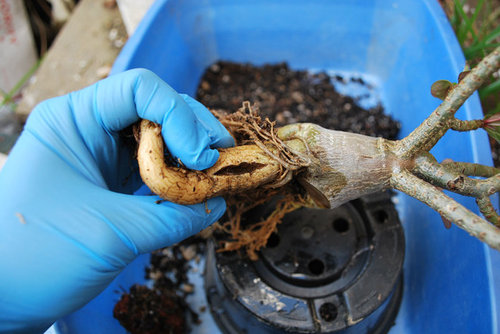
You know me, my first reaction is to always dig them out if there is nothing obvious above the soil. One of them had ruptured roots.

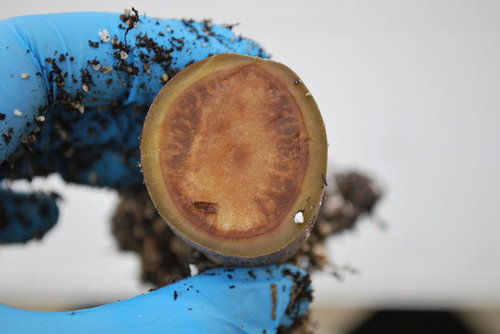
All that bendy root stuff is basically dead/dying tissue. There is no rot, as you can see below. That comes later. This is how you know that fungal or bacterial rot did not cause this; but the combined effects of rain and the cold snap caused cellular collapse, as you can see:

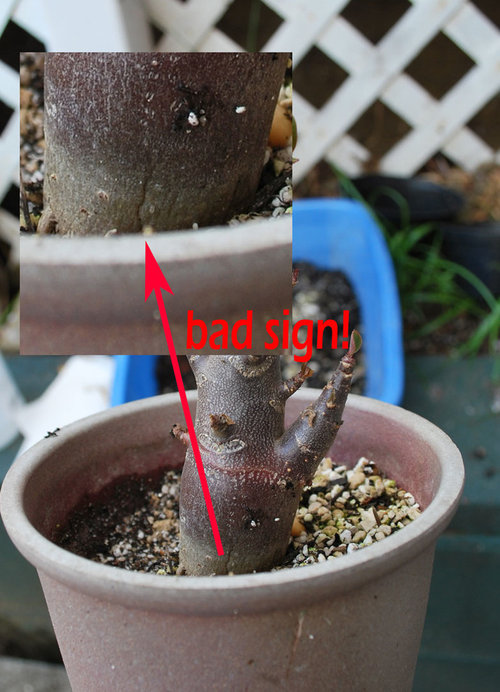
Had it not dropped below 9C two nights in a row, this plant would have had no issues dealing with three days of rain. Here's how to detect the problem early:

So, how come these particular plants were struck and not others? No clue. All my adeniums have everything in common except some spent winter in the house and others wintered in the basement. All of these wintered in the basement and should have been more accustomed to the cold. Sometimes they just do what they do.

Pagan

Comments (22)

  • 10 years ago

    sorry to see Pagan hope you can save them Im haveing the same problems with the weather night temps down to 3c daytimes 26c plants still wont to grow but had to move them inside last week as we received 300mm of rain last Saturday night hopeing to force them into dormancy I will been keeping a close eye on them and looking closely for any cracks thanks for the tipoff Pete

    User thanked pengus_7
  • 10 years ago
    last modified: 10 years ago

    so sorry for your loss.. seriously

    User thanked spacecoast_fl_zone_9
  • 10 years ago
    last modified: 10 years ago

    Thanks, you guys. I'm used to losing a certain number of these young ones every winter, though. I just never lost them this late in spring.

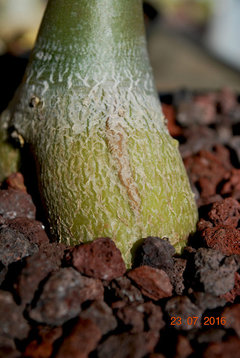
    Pete, you'll want to be able to detect this kind of damage early. The cracking typically happens under the soil. Above the soil, what you will see is some wrinkling on the trunk, right above the soil line. That wrinkling is visible even before the trunk starts feeling soft and mushy.

    Cold kills fast especially when the substrate is wet. But even a dry pot will kill an adenium if it doesn't warm enough during the day.

    SO keep an eye on those plantlings, martin!

    Pagan

  • 10 years ago

    Pagan, I am so sorry....I hate it very much....I know the feeling too well.

    Marie

    User thanked Marie Tran
  • 10 years ago

    Thanks, Marie.

    I put the healthiest-looking one back in the pot. I think I'm actually going to babysit this one. The shock of all that TLC will definitely kill it this time lolAnd I had to raise it to keep the cracked part above the soil.


    Pagan

  • 10 years ago

    I am freaking out now. It is suppose to be 44 for the next few nights. I am doing the should I or shouldn't I bring them in thing. Maybe if I cover them at night.?

  • 10 years ago
    last modified: 10 years ago

    Marica, bring them in. If kept dry, arabicums can handle the low temperatures, but obesums are more cold sensitive.

  • 10 years ago
    last modified: 10 years ago

    I agree. For your peace of mind, shelter them.

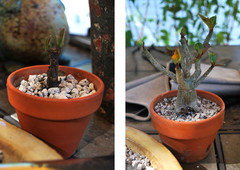
    Here are the other two still drying out. The trunks are no longer soft, but I'll keep these out of the pot for a couple of weeks more.

  • 10 years ago

    Pagan, I feel sorry for your lost, just happens the same to one of my plants, here is almost winter and usually we have 18C winters, but this year drop to 3C, I have mines inside in my kitchen, nevertheless the plant got cold, the soil was moist nearly dry, I cut all rot and now is drying, my question is, what is the next step? How I repot this plant? Thanks!

  • 10 years ago
    last modified: 10 years ago

    Ugh. that sucks, Cynthia. Just leave it that way to dry for at least a week. Keep checking.

    When the cut is completely dry and calloused over, pot it in the fastest-draining dry substrate you can build. Then treat it like you're rooting a succulent plant cutting. In this case, watering only the sides of the pot, as little as you can while still allowing some moisture in. If you have pumice, use that and nothing else. Keep it indoors, in a warm and brightly-lit location.

    I hope you save it.

    Pagan

  • 10 years ago

    Good luck on yours.

    I brought mine in. It got to 42 last night. Thought say that will be over next week and we won't see below 60

  • 10 years ago

    Oh and just to add, if you have experience rooting succulent plant cuttings, remember that this is slightly different. Cold-damaged plants have already been under some stress, on top of being chopped up. They're going to be a little more sensitive to watering. Don't use a watering can. Use a serving spoon so you won't accidentally drench it if you get startled or something. And it will take a little longer than usual.

    Pagan


  • 10 years ago

    Potted them up in the smallest pots I could find. I drilled bigger holes at the bottom too, since I want to be able to carefully water these AND dry them out quickly at the same time while they grow new feeder roots.

    Pagan

  • 10 years ago

    Pagan so you are saying that the wounded ones will need less water? or small amounts more often. Is this after I have hung it? I have left it hanging this week and it is somewhat firm. Don't think I will plant it yet. Too cold here.

    It looks like all of us have tree's that need babied.

  • 10 years ago

    I don't really baby any of my plants, with the exception of my Euphorbia globosa which I actively protect from rain (I put it in a drawer).

    Two of these cold-damaged adeniums have no roots at all so they wont be able to absorb water anyway. I did not hang them, I just put them on a shelf, away from the cats. After a week, I'm convinced they aren't going to start looking any better or worse so I potted them up. In this condition, I am treating them as cuttings. This means the following:

    1. They are in pure, sifted pumice with only large particles in the pot.

    2. I will water them by the spoonfuls and only around the very edge of the pots. This way, the cuttings themselves will hopefully not get too wet or soak therein. If it is hot all week, I will water it (I've had to set an alarm on my phone for this purpose).

    3. They will be in the hot, bright shade until something happens.

    4. Even if they start growing back, they will continue to be watered in this manner, not fed and in the shade.

    The least damaged one is already in a pot and out in direct sun and basically being treated the way my other plants are treated---water very rarely and fertilized when I remember.

    What I believe will happen is this: that small dark arabicum will die first. The other one will take longer.

    Pagan


  • 10 years ago

    Pagan, I'm hoping that last paragraph does not come true and that they all survive. Please do keep us posted.

    User thanked Maria Elena (Caribbean - USDA Zone 13a)
  • 10 years ago
    last modified: 10 years ago

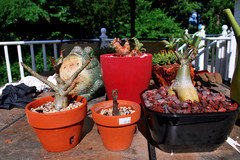
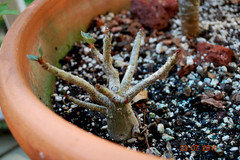
    All three that were rescued appear to be still alive. I'm surprised at the resilience of the one on the right (A. obesum x crispum). It's now rock-hard and growing new leaves.

    The one in the middle (A. arabicum x crispum) lost all its old leaves but are also growing new ones. I knocked it out of that pot once and it really has not rooted so I am assuming it is just using up its reserves to stay alive.

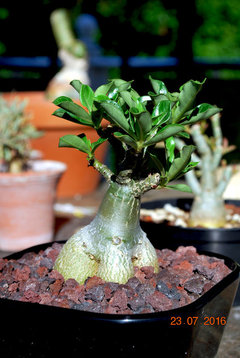
    Finally, the left one is back in full swing. It was the one I caught early enough that it only needed to be raised to keep the crack on the taproot out of the soil and prevent rot. It has healed and scarred over.

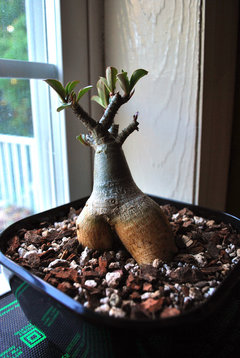
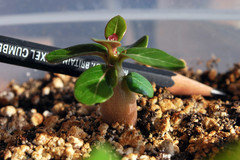
    I'm glad that one survived, it's my favorite seed-grown adenium, now going 4 years old. Here's its baby pic, I've been tagging it from the start. I checked my order history and it turned out it is a cultivar called "Star of Black Night".

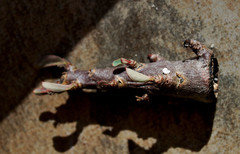
    I lost this one below, though. And several others.


    Pagan

    P.S. Go Murray!

  • 10 years ago

    Happy to hear they are alive! Mine died, but it was a fragil plant, for very long shipping from Thailand, never acclimated well...

    User thanked Cynthia Martinez. Asuncion, Paraguay Z10a
  • 10 years ago

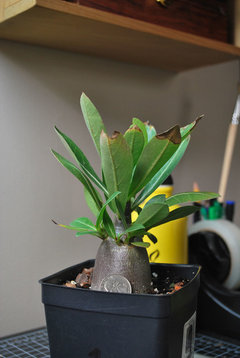
    So my favorite seed-grown adenium has completely bounced back: Mr. Ko's Star of Black Night, now 4 years old.

    The crack on the caudex has healed. Too bad I can't plant it back to its original depth. I did not want to raise this one at all.


    This one below was hanging in there but not growing roots. So I removed it from the pumice pot put it in a large pot with the dahlia whose soil is more water-retentive.

    This one, well. Despite the new growth, it's absolutely not rooting. Normally I'd toss it but there is space in the dahlia pot so I might as well shove it in.


    To be furthered.

    Pagan

  • 10 years ago

    Whats happening with your plants Pagan? How are they growing now?

    bye Dianne

  • 10 years ago

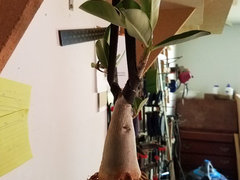
    Hi Dianne! The one with one cracked taproot has fully recovered. The one with mushy caudex has finally started to root in the dahlia pot. The black a arabicum still struggles. I found another yearling with cold damage and I have it dangling in my shop.

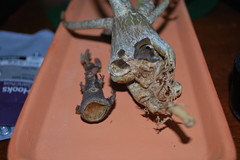
    By the time I noticed it, the entire caudex has melted under the soil and it has started to root on its own! So I dug it up to excise the rotting parts.

    In fact if you hadn't bumped this thread I would've forgotten about it. I'll pot it back today. Thanks for reminding me!

    Pagan