Software
Houzz Logo Print
kshaklee

Ok, tomato gurus...

10 years ago
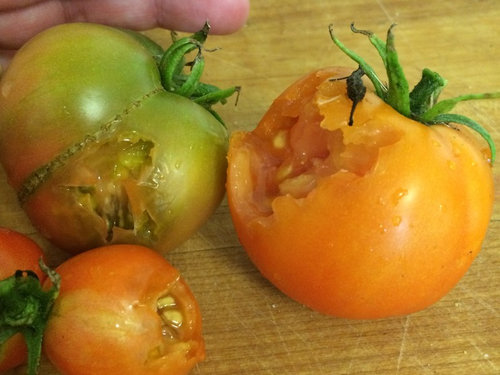
I've had this problem in years past but it's usually just a tomato or two. This year, more and more of them have hunks bitten out! Sometimes the break in the skin looks suspiciously like someone's two front teeth! Birds? Cats? I only have about 10 plants so each tomato is precious. Do I need netting or something??

Comments (14)

  • 10 years ago

    Tomato hornworm

  • 10 years ago

    Kate, I'm not sure about yours, but I found one in my garden this morning. It had started blushing and I missed it, so a squirrel found it.

  • 10 years ago

    Squirrel or rat.... Last year for some reason my Ananas Noir tomato plant was targeted by critters and the tomatoes looked like yours do in the photo. Someone I know who usually gives good advice told me if you can see teeth marks it is probably a squirrel. Cover the tomatoes with a micro mesh bag with draw string closing. The Ananas Noir tomato is unusually sweet so I think they were drawn to it for that reason.

  • 10 years ago

    Mice, rats, birds. Once my dad killed a turtle that was eating his tomatoes.

  • 10 years ago

    I wish cameras were easier to set up so we could see all the critters that come into our gardens!

  • 10 years ago

    Tomato hornworms don't leave that kind of damage, and it's a bit early for them in my garden anyway.

    Those holes look like bird pecks.


  • 10 years ago

    I'm thinking birds too. I'd sure hate to run across that tomato worm!

  • 10 years ago


    I think it looks more like bird pecks than anything else, but turtles have done similar damage to mine. We have oodles of squirrels and yet I've never had them touch a tomato (maybe because they are too busy stealing and eating peaches), so I have no first-hand knowledge of what squirrel damage looks like, but I'd expect it would show some toothmarks.

    Damage from hornworms usually looks smoother and less jagged than the damage in your photos.

    To keep pests off your fruit, you need to cover the plants with the row cover or netting of your choice. You might have luck with the bird or deer netting that has the smaller openings, but not the deer netting that has the larger one. The netting needs to be suspended over the plants high enough that a bird cannot sit on the netting and peck at fruit beneath it. Most bird netting is thin and flimsy and has smaller openings (maybe 5/8") and most, but not all, deer netting is somewhat heavy and higher quality, but may have larger openings (maybe 1").

    For types of netting that have larger openings:

    You can use tulle netting that is sold at craft and fabric stores.

    You can use mosquito netting, which is sold online.

    You can use garden netting like the Biothrips Proteknet netting or Micromesh netting. I got my Biothrips Proteknet netting at Purple Tools dot com and my Micromesh neeting at Territorial Seed when I was ordering seeds. You can find Micromesh netting at many online retailers.

    The lightweight summer-weight floating row cover would work, and one of the common ones is Agr-Bon AG-15.

    If it is birds, sometimes all they really want is water (look how hot it has been this week!), and a birdbath or dripper can satisfy that need.

    If it is turtles, all that has worked for me is to catch them and relocate them outside the fenced garden.

    In your garden is not fenced and other animals have access to it, there are other types of wildlife that like tomatoes, probably more for the water than the fruit itself. I have a baby bunny who has been living in our garden, apparently alone, for about a month and he hasn't touched anything as far as I can tell except for nibbling one cucumber, and we have lots of low-hanging tomatoes he could eat if he wanted, so I am not sure how much rabbits nibble fruit. I do keep a small plastic bowl filled with water for the bunny, and if it starts damaging plants, I'll catch it and remove it from the fenced garden. I just hate to put it outside the fence if it isn't doing any real harm because the predators will catch that motherless bunny in no time at all.

    I am already seeing all kinds of hornworm moths, not just the tobacco ones whose larva are what I will see on tomatoes occasionally, but other kinds of hornworms that plague other plants like cherry trees, for example, or Virginia creeper. I haven't seen any hornworms themselves yet, but if the moths are around, the hornworms are not far behind. I normally only see tobacco hormworms (Manduca sexta) if I see hornworms in my garden at all, which is rare, and almost never see actual tomato hornworms (Manduca quinquemaculata). The tobacco hornworms are far more common in southern parts of the USA and the tomato hornworms are more common further north.

    You can see damage from a tobacco hornworm on figure 12 at this link. See how smooth the damaged edges are in comparison to your tomatoes?


    Hornworm Information

  • 10 years ago

    Thanks for the input, everyone!! It's unlikely to be turtles (some of these plants are up in large pots, high up, etc.) and no birds lack water in my yard (multiple birdbaths!) I also thought the damage doesn't look like hornworm damage - these "nibbles" on my produce are always very sharp/jagged and teethy looking. I'm in and out of the space all day so I'm pretty positive it's a nighttime critter. We have a TON of trees and squirrels in my corner of the world, so maybe that's it, but probably birds make the most sense when I look at the kind of access a critter would have to have. I am mostly very disappointed to lose the 'maters. I'll plan various covers, screens, mesh-contraptions, etc. and see what works I guess. Hope you all are busy harvesting un-damaged tomatoes! :)

  • 10 years ago

    The birds are doing the same thing to mine. Worst tomato harvest in years thanks to the birds.

  • 10 years ago

    Same thing happen to us. First tomato and we were waiting for it to ripen a little more. Darned bird got it!!! We're going to cover ours with netting!!

  • 10 years ago

    I hate to hear about all the bird damage. That's awful. I have had plenty of it in the past, but I think they are more interested in the berries, which are right next to the garden. My shed is stock full of mylar bird repellent tape, bird netting, etc. I didn't use any this year. It's not that the birds aren't in the garden, but they seem to find worms and I've been leaving a portion of the berries uncovered so they can have them. Now that I've typed this, the next thing I find will be bird-ruined tomatoes!


    Mary

  • 10 years ago

    I'm surprised by how much bird damage folks are seeing this year. I have around 100 tomato plants and ,like Mary, I haven't had any bird damage yet this year. Of course, now that I said that, it will happen. I think all the damage probably is related to the big heat wave and the extraordinary heat index values we had last week. We have had a couple of peaches pecked, but not tomatoes, and the garden is full of birds, mostly eating grasshoppers and caterpillars. I do have native blackberries at the west end of the garden and did leave most of the berries for the birds this year, so that might have helped.

    There is nothing more frustrating that finding the first tomatoes pecked after you've waited so long for them to ripen.